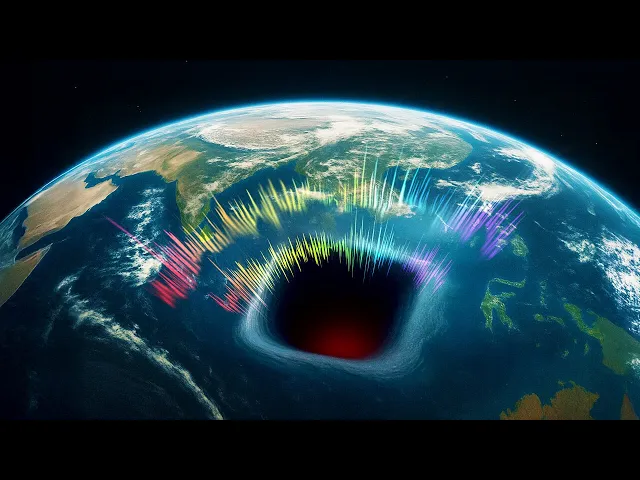
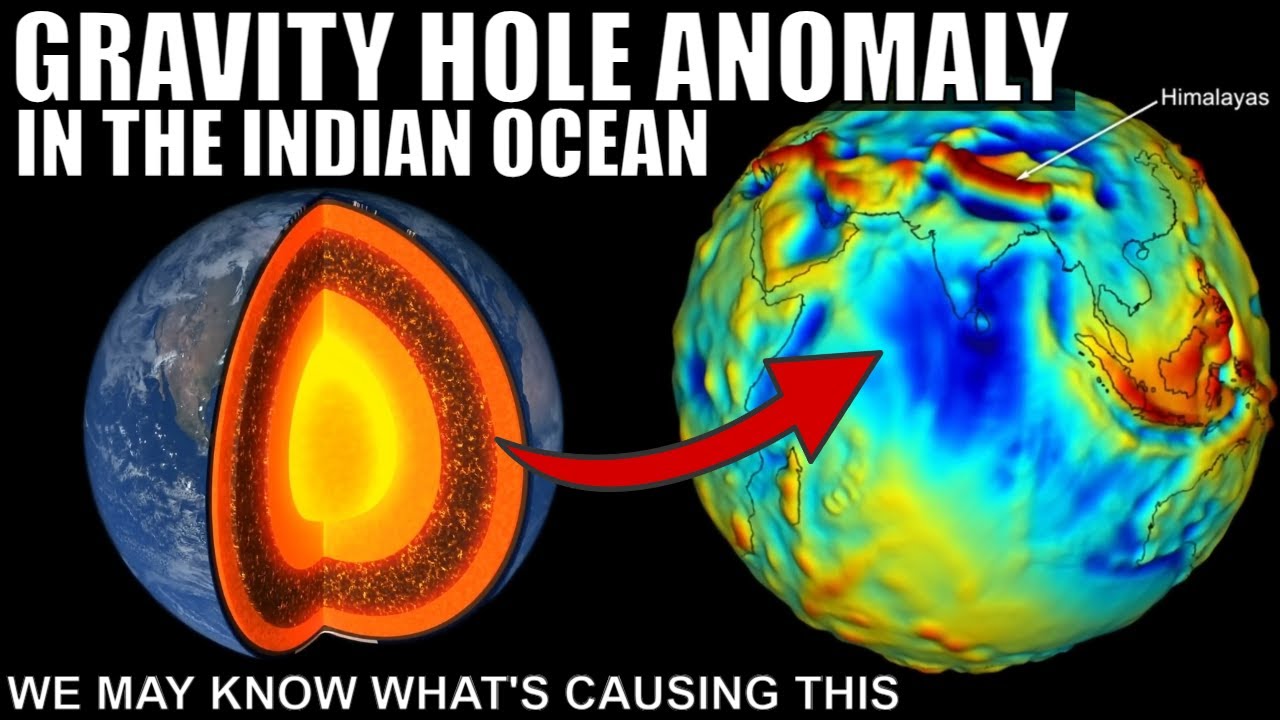
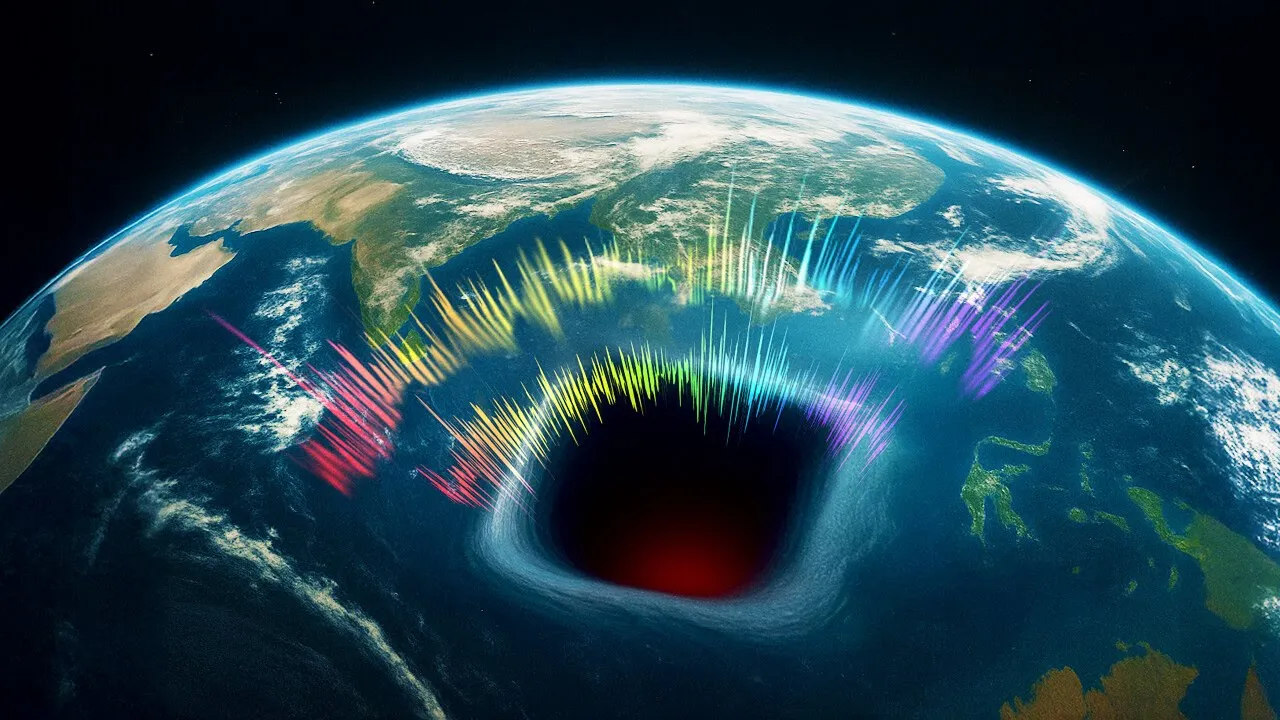
Deep under the Indian Ocean, there's a giant patch where gravity doesn't work like on the rest of the planet. I mean, the gravitational pull works constantly. But Earth is not a regular sphere.
Its surface is not smooth. It's covered with lumps and bumps like a potato. Because our planet is not the same everywhere inside, some parts are denser than others.
Let's say you could pour water across Earth's surface. The shape this water would make is called a geoid. And it's like that because of the differences in materials inside the planet.
That's why gravity isn't the same everywhere. And down there in the dark depths of the Indian Ocean, it's weaker than usual. That spot is something we consider a giant gravity hole that stretches more than a million square miles in size.
It's roughly where the ocean floor sinks down in a giant depression. Scientists used ships and satellites to figure out this mystery. They realized the water level near India was lower because of this weak gravity spot.
They're still not sure what made gravity become so weak in that area. But two Indian researchers realized everyone was trying to understand this considering what that area looked like in the present. So, they decided to go to the past.
They used computers to make models of a virtual Earth and figured out that the answer could lie over 620 m under the surface. That's where a part of an old ocean sank 30 million years ago, causing a hot melted rock to move around. And this mixture might have made gravity weak in that area.
It's a really interesting idea, but it's still not the final answer. In 2018, a team of scientists from India went to the Indian Ocean with special machines to listen to the ground rumbling, similar to when you hear thunder. They found out there were hot streams of melted rock coming up from deep inside Earth.
Could they be part of the reason why the gravity is weak there? We'll need more information to understand the issue better. Maybe even go back further into the past.
For instance, about 140 million years back, the land was all connected as a big piece called Gonduana. But then India started moving away from it. While India was moving, an old ocean floor called the Tethus Sea sank into Earth's insides.
These two scientists from India kept trying to solve the case. using computers to pretend to be going back in time. They checked how the land moved as well as the mantle, which is basically a thick layer of hot solid rock.
The duo found out that a long time ago there were hot, light rocks rising from deep inside Earth. These rocks created a spot where gravity was weak. This spot was like a big dent in the ocean floor.
The more these rocks rose, the deeper the dent became. The first of these rising rocks popped out around 20 million years ago to the south of the weird gravity dent. As these rocks moved and went under the land, the dent got bigger and stronger.
The two scientists think these rocks were pushed up by the sinking old ocean floor like bubbles. This process disturbs something called the African blob. You got to see this.
Deep inside our planet, there are two very big blobs like giant pieces of rock as large as continents. One is under Africa and the other is under the Pacific Ocean. These blobs have roots that start almost halfway, 1,800 m toward the center of Earth.
and they're probably the place where columns of hot rock rise up from way down below. When these hot rock columns reach the surface, big volcanic eruptions happen. And we're talking about some really massive ones that might have even played a role in erasing dinosaurs from the face of the earth a long time ago.
So, we don't want these giant blobs to be disturbed. Anyway, not all scientists agree with the theory about why gravity doesn't do its job in this particular spot in the Indian Ocean, saying they need more proof to be sure about these rising rocks. The real answer might come from listening to Earth's rumbling.
Plus, who knows if this gravity hole will stay there forever or move away. It depends on how Earth's mass will shift around. to see some changes might take a very very long time, maybe even hundreds of millions of years.
That's not the only region where gravity works in mysterious ways. Or at least that's what it feels like when you see certain things around the world. Like what if you saw rocks that don't sink, but can float on water for a very long time?
They can even travel around for thousands of miles until they finally find a spot where they sink. Scientists figured out how this worked by using special X-rays to check the insides of these rocks. And these unusual rocks turned out to be very light and full of tiny holes.
Researchers used wax to cover pieces of these rocks and went with a special X-ray method to look inside the rocks to see how much water and gas was there. The reason these rocks can float is because of something called surface tension which is like a very thin the size of a human hair layer of air on the water's surface. This helps some animals like lizards and insects to really walk on water.
And these floating rocks are not just cool because they travel, but also because they can actually help scientists find underwater volcano eruptions. They can also carry living things across oceans since they tend to collect some plants and other things rich in nutrients. So, it's basically like a free cruise until you sink down at some random spot.
No iceberg needed. Here you have floating rocks. And in Death Valley in California, there's a strange phenomenon where big rocks move across a dry lake bed and leave trails behind them.
People wondered how this was possible for 60 years until the case was solved. Some thought there must be strong winds moving these rocks or maybe even ice. But scientists found these winds aren't really strong enough to move such big boulders.
They placed cameras on cliffs near the rocks, even though they were hard to reach. They did this for three winters in a row to study the temperature, rain, and wind in the area. Their idea was that ice might lift the rocks and let the wind push them.
To test this properly, they put a rock in a container with water and sand and froze it. When they later pushed the container, the rock moved like it was on ice. This experiment helped prove their theory.
And what's interesting is that the rocky area in Death Valley is similar to one of Saturn's moons, Titan. So, these weird things on our planet may help us understand other phenomena, even in space. The reverse waterfall in England is an example of a spot with weird gravity, too.
You can find it not far from Hayfield. It has water that looks more like a fountain than a waterfall, considering it goes up toward the sky. But it turns out gravity doesn't have anything to do here.
It's just the wind. It's so strong that when the water falls down, it catches it and pushes it back up. But where does this constantly strong wind come from?
You can see a similar thing at Hoover Dam in Nevada, US. Try to climb up the dam. 726.
4 ft and pour some water out of a bottle. Not working? Yep.
The water won't flow down as it normally would. It will fly up. You'll have the same result if you throw some light object from the same height.
You will get it back. And this happens because of the strong air flow, too. So, these things seem like gravity is messing up with us.
But there's always a logical answer behind that. Hopefully, we'll get one for the gravity hole in the Indian Ocean, too. That's it for today.
So, hey, if you pacified your curiosity, then give the video a like and share it with your friends.