have you ever wondered why a bird can sit on a power line without getting a shock you may even wonder why the sign warns of danger you too could sit on power lines if you could find a safe way of landing on them and getting off safely if per chance you decided to climb down the supporting Tower the instant you touch the tower You'll wish you had you have probably experienced some of the scien ific principles involved in the fate of our unfortunate parachutist but in a less dramatic way if while standing on a carpet
on a cold winter day you were to remove your sweater you wouldn't feel a thing but your hair would indicate that you were carrying an electrostatic charge we can explain electrostatic Effects by assuming the charge is either positive or negative if you now touch a water tap you may get a shock as the charge suddenly flows out of your body and in so doing discharges or neutralizes your body since Metals allow charge to flow through them easily they are called conductors however charge cannot leave your body by flowing through the carpet materials like carpets are
called insulators since they do not permit charge to flow easily why do materials differ in this way we believe that all substances consist of tiny particles called atoms our current model of the atom assumes that it is mostly empty space and in a tiny volume called the nucleus over 99% of the mass of the atom is concentrated further evidence suggests that the nucleus is made up of particles called protons which are positively charged and neutrons which are neutral in charge neutrons and protons are almost identical in mass in the space surrounding the nucleus are tiny
negatively charged particles called electrons the attraction between the negatively charged electrons and the positively charged nucleus keeps the electrons in the vicinity of the nucleus as they Circle it it takes 1,837 electrons to equal a mass of one proton but the charge on a single electron exactly balances the positive charge on a proton electrons which are farther away from the nucleus experience a smaller force of attraction than those which are closer to it these outer electrons can be removed with relative ease the nucleus on the other hand is like a wellb built Fortress and inside
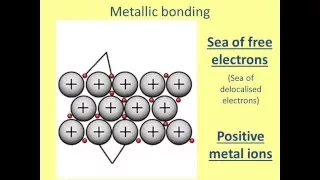
the protons and neutrons are the prisoners even disruptions like explosions and high temperatures leave the nucleus intact this fortress-like character makes it impossible for charges to enter and leave at will with this background let's have another look at insulators and conductors remember our atomic model a metal conductor is largely empty space the nucleus of each copper atom contains 29 protons and 34 neutrons and is surrounded by enough electrons to balance its positive charge the outermost electron is very loosely held it can therefore drift away until it comes under the influence of another nucleus the atom
now has one less electron than it has protons consequently it is no longer neutral but it has a positive charge atoms become ions when they become charged by gaining or losing electrons since all copper atoms have a loosely held outer electron we can visualize a metal conductor like this the nucleus and electrons near it are positive ions spread throughout the network of ions are loosely held electrons suppose we watch one of the electrons over a period of time it appears to move throughout the volume of the metal if we place a positive charge at one
end of the metal object and a negative charge at the other end the electron will be attracted to the positive charge and repelled by the negative charge accordingly as the electron follows its random path it gradually drifts towards the positive charge the charges on either end also affect the nuclei in the metal remember the protons making up the nucleus are not able to escape from it in solids the nucleus and the ion of which it is a part will only vibrate the reason for this immobility is because the ions are joined together in a network
although each nucleus will be attracted to the negative charge and repelled by the positive charge individual nuclei and ions cannot move in resp response to the electrostatic attraction and repulsion that they experience in solids a transfer of charge can only be accomplished by electrons moving from one point to another why then do insulators not allow for the same transfer of charge materials like carpets are complex substances composed of many different types of atoms we will show these atoms as different colors in this case the outer electrons of most atoms are involved in chemical bonds with
other atoms as a result these electrons do not have the freedom of movement found in metals when opposite charges are placed at the ends of the carpet little if any movement of electrons occurs not all insulators are as complex as carpets sulfur atoms for example will form bonds with adjacent sulfur atoms again we have a substance within which electrons are not free to move opposite charges placed at the ends of a chunk of sulfur do not result in a flow of charge if you become charged by taking off a sweater we now know that you
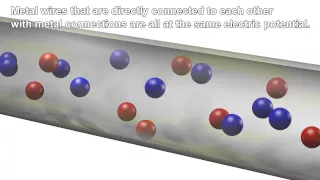
can discharge by touching a conductor because a conductor allows excess electrons to flow from your body it would seem that our Intrepid parachutist touched a conductor when he reached for the power pole but what about the power line itself we know that electricity is flowing in The Wire so it's probably a conductor why then can a bird or even you or I sit on a wire and not get a shock you may think that the wire is insulated but actually our bold pair could sit on a be wire and not get a shock obviously we
have some answers but not all maybe we should next find out how we get charged in the first place