Okay. Hello everyone and welcome to a new session of infi's online quarter course on professional development. My name is Maria Soraniano. I'm the CEO and co-founder of INFi Foundation and it is my great pleasure to welcome our speaker today Dr. Christine Tamayo. Thank you so much for being with us today in this master class. But before to give the the floor to Dr. Tamayo I want to very briefly tell you what we are doing at INFI for those who join us for the first time. So uh I want to in the next slide I just
want to show you that INFI is a nonprofit organization that for more than 10 years have been collaborating with universities in Spain and Portugal and also with other international organization around the world in order to promote internationalization innovations and career profiles of excellence. How do we do this? In the next slide is What I want to show you that every academic year infi creates a global virtual platform that needs more than 350 members and talents from that includes top students and professors from our partner universities but also includes highly qualified professionals working at top organization
in the world such as Harvard, MIT, Google and many more. You can see here the map and these international professionals became Mentors of the students and collaborators of the professors. The mission of INFI is to promote global education and professional development without borders. And to achieve this goal, I want to show you next that INFI provides to all the members in its platform a series of programs. Erh in the next slide please. >> Yes. H uh programs that include a communication communication platform also h mentoring programs where the Selected students are assigned to an international
mentors. The student also have the opportunity to win fellowships to conduct research at top organizations such as Harvard or MIT. We have three quarter courses like you are in a session today. In all these courses are focused to help you to succeed in your next career steps. Also, we have a full program for professors. We have a an innovation an idea competition where everyone in the Platform can became an entrepreneur and get funding for their ideas. And also we have at the end of the of the year of the academic year we have an international
conference where everyone can present their work and their ideas. So if you want to join this platform and get a more international innovative and an excellent profile uh we join we we the time for for join inf is now. So many of our uh universities partnered universities have the the call have Already are closed but some of them uh will open soon still. So some of you will still have time to be part of this platform. You just uh need to learn about more about the calls and how to be part. you need to go
to our website and then you will have this section of the public calls and you will have there all the information. So next just uh want to encourage you to follow us in social media. We have always good tip about tips about career development that can Be interesting for you. And also this is my email. You can reach me with any questions that you have. And now in next just very briefly a reminder of the requirements to get the diploma. You know that this quarter course is certified with 30 hours. You need to be a
student or professor at one of our partner universities and you need to attend the live master classes. Uh so please at the end of of today of this class h fill out the exit survey. Also, you need to watch the recorded master classes and you have to complete the practical exercises and the deadline to to finish all the requirements is January 11th and you just need to send us an email when you finish requesting the the diploma at qcinfi.org. And now, yes, the time for for the master class. Uh we are so happy to have
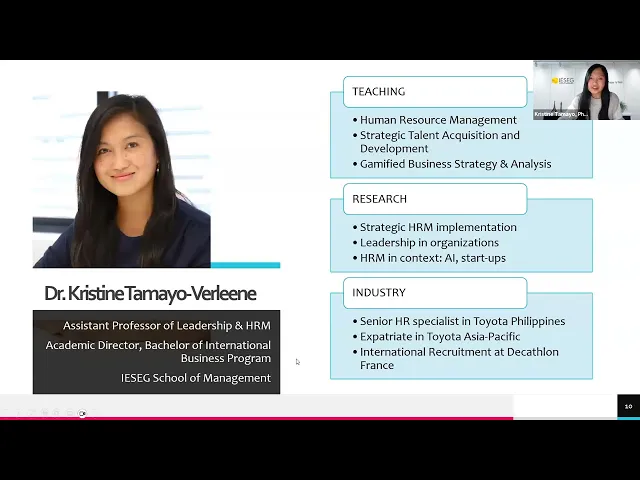
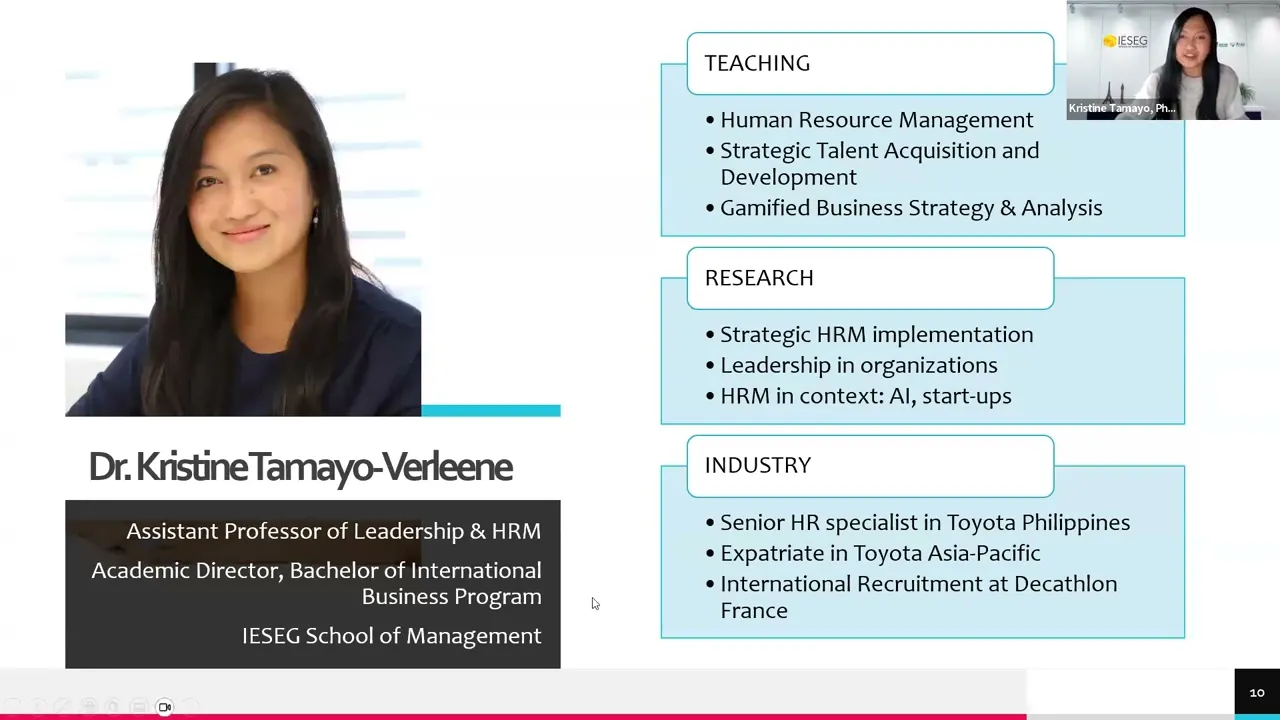
here Christine Tammano. Uh she is the professor of leadership and human resource management In the in the E A sorry [laughter] it's difficult for me. Yeah, >> the let me see if I say properly the EG school of management where she served as the academic director of the bachelor in international business program in the Paris campus and she has published research on strategic human research management topics and AI applications in management in international academic journal. Thank you so much Christine for For being with us today and providing this talk about global recruiting trends and the
impact of AI. Thank you. If you have any questions for Christine, please leave them in the Q&A and she will be more than happy to cover their questions uh at the end. The floor is yours Christine. Thanks. >> Thank you so much uh Maria for that very nice introduction and uh good afternoon to everyone. It's very nice to see uh many of you attending this master class And I see also your messages in the chat. It seems that everyone is enthusiastic. Uh so I'm very happy to be here to talk to you about uh global
recruiting trends and the impact of AI. And my goal today is really to give some tips that would help you improve your job applications and impress recruiters especially in an AIdriven landscape. So, Maria has told you a little bit about myself. Uh, let me tell you a little bit more. Um, so I am originally from the Philippines and I had my PhD in business economics with a specialization in strategic human resource management in KU Luven in Belgium. And now as a professor uh, and we we we pronounce it at ES as ESG school of management.
So at ESG, I do teach courses on human resource management at the bachelor and master levels and I also teach a master level course on strategic talent acquisition and development. Uh and I also teach leadership and also gamified Business strategy courses. As Maria mention mentioned earlier, my research is uh focused on strategic HRM implementation. I also have research on leadership in companies and leadership in different contexts. So for example, AI applications and HR strategies in startups. My goal as a researcher is really to investigate how we can make HR practices and policies more effective for
employees but also for organizations. Now before entering academia, I also uh worked in the industry as a senior HR professional in Toyota Motor Philippines and I was also an expatriate uh at Toyota Asia Pacific in Thailand. And uh when I came to France to do my master studies at first I also had a short uh stint at Dathlon where I did international recruitment. So basically today's master class would be a distillation of my academic experience, my research but also my professional Experience and I'm very happy to always share uh my knowledge and uh experience with
all of you and again so now currently we're at over a 100 participants and perhaps you joined this master class because you're asking yourself how do you stand out in a hiring process that is driven by AI. No, when you are evaluated by machine, how do you deal with it? How do we actually manage in this type of environment? And this is the question That we will aim to answer today with three main topics. First we will be discussing the current context and the future of work because I think it's important to understand that um
environment and how it impacts the second topic which is where we will focus on the recruitment trends and how they are impacted by AI. And then of course I will leave you with some practical tips as candidates and how you can prepare your job Applications in an AIdriven job market. And as as Maria said earlier, we will have time for questions at the end. And if you have any questions, you can leave that in the chat or in the Q&A um box. Okay. So our approach today is really going from understanding those macro trends that
are shaping the world of work, zooming into the intersection between recruitment and AI technologies and then hopefully that leading into being able to craft our personal Strategies for job application success. So let's go. The first topic is uh about the current context and future of work and obviously there are many factors that are currently shaping this uh current work context. I picked uh what I feel are the four trends that are shaping the work context the most especially in relation with what we are talking about today which is about uh recruiting. So let's go through
them one by one. The First is broadening digital access. Now this is not uh anything new. We are aware that digital and digitalization is here and it's here to stay. And before if digital technology was reserved for multinational companies with a lot of resources or for developed countries, now digital connectivity is the norm everywhere. So there is ever more ex inclusive access to work and learning globally. This means that the labor market has really expanded Globally because everyone practically okay not not perhaps not 100% but a lot more people in many parts of the world
now have access to digitalization digital um tools and uh the internet that also gives the bridge to having work opportunities and learning opportunities globally. Now obviously that has also connected to a growth in online talent platforms. These are online platforms that actually facilitate and make it possible for People from different parts of the world to work for companies that are miles and miles away. So you have things like Upwork, Deal, Turing, Freelancer, many many platforms that allow for global um work access. And obviously digital transformation and automation now are imperatives for businesses and organizations. There
are more and more paperless processes. There are more and more automated processes and uh if companies Are not digitalizing a lot of their work processes that affects their competitiveness uh in the industry that they are in. So it is becoming uh an imperative for companies to keep up with digital transformations. The second trend and is very related to the first is borderless and remote work. Now this really shows that talent anywhere work everywhere. You know this this really where we're work we're living in a borderless world where also Remote and hybrid work have redefined organizational
boundaries. Uh how many of us are now working in hybrid uh contexts or remote work? You know I am actually working from home right now um because the world of work allows it at the moment. Um so remote work and and there are also a lot of types of jobs whether knowledge work jobs or service jobs for example call center workers before as a company you had to provide an office and a desk For each individual but now more and more people are working with 100% remote contracts. So this is something that's changing as well
and therefore multinational companies are more and more able to hire across continents. That's the borderless aspect and again a lot of it is facilitated by technology uh and digitalized uh platforms. Now here I just have some examples of work policies around the globe because Uh we know that obviously there's no universal rule about remote working that applies to all employees around the world. But what we know is a commonality [snorts] is that employees working remotely must always be treated as regular employees and must be provided with the same rights and benefits as employees who do
not uh telework. Okay, for example, here I'm not going to go through all of them. You just have a few examples from The UK, France, Spain, and US. And these regulations uh change with the times as well. You know, of course, there were more remote work policies closer to the COVID era. Now, we're a bit uh a few years away from that, and some of these policies may have changed. But all in all, I think we can say that remote work policies and flexible work policies are now in the ethos of employees minds and is
part of what employees now expect their companies to provide. The third trend that I feel is shaping the current context and future of work is what we call the great reshuffle and its impact on candidate experience. I was just talking about COVID earlier and if you remember during the COVID era we heard of this term called the great resignation and this referred to what happened in 2019 2020 2021 where a millions of workers either inspired by or driven by COVID 19 they massively quit their jobs uh for different Personal uh and professional reasons. Um and
so during the lockdown they they realized a lot of things about themselves and it pushed them to quit their jobs. And then this continued on to what was called the great reshuffle around 2022, 2023, even 2024 where these people who quit their jobs immediately postcoid were now trying to find other types of jobs with better work life balance or with more alignment with their personal values or A better match for their personality. So people who used to work in finance had a shift and are now working in the restaurant industry for example or the travel
industry and that was called the great reshuffle again around 2022 to 2023 24 and now we're asking after the great reshuffle what is next and there there are question marks there are some debates about this are we in the big stay era or the great reshuffle 2.0 0 era and it's because uh it seems that Comparatively to the covid era where everyone was on lockdown so there was great resignation everywhere nowadays it's more industry and context dependent because in some industries we observe that worker attrition is slowing down turnover is uh slowing down in some
industries where people stay in their jobs now Maybe this is because they had a better fit. They found what fit their personality the most. But also we have to be honest and there is economic Downturn in a lot of uh areas in a lot of countries and maybe people are staying because they need to earn a living and so they are not taking the risk of job hopping and staying where they currently are. But also we find that in other contexts there are still a lot of workers that are continuing to reshuffle and are continuously
reconfiguring their career paths to better align with their personal interests. And on top of that There are also companies who are economically struggling and are laying off workers. Uh and because they lay off workers those people who lose their jobs they have to reshuffle and find uh new jobs. So maybe it's a reshuffle 2.0. So it seems that yeah again depending on the context we see some variance when it comes to what is happening with uh the workers and their tenure or their retention at work. Now whether it's a big stay or great reshuffle what
this Signals to companies is still the importance of what we call candidate experience which is how future or potential employers treat the candidates during the hiring process. And what we know is that you know it's still there's still war for talent and so there is still this pressure for companies to provide a positive experience to job candidates whether or not they are in a high or low um attrition uh industry. And the fourth um trend that is shaping The current context and future of work is skills-based hiring. probably if if you look for trends in
2025, this is one of the most popular because we see that there is a significant shift from credentialism to skills and micro credentials. What this means is that traditionally when we're looking at a hiring system or a hiring process, there's a lot of emphasis on your diploma and your academic background. I know that here of Course many of us are very highly educated individual and that's still important but this trend is showing that that's not the only important factor and in fact the emphasis shifts from those diploma uh credentials to skills and micro credentials. These
are transferable skills or small achievements or quantifiable achievements that can indicate how well you may perform a particular job. And again, this is facilitated by a lot Of digital platforms that allow companies to analyze big data and really see what factors are most correlated with job success. And perhaps with having these big data, they're able to realize that, oh, actually the diploma is not as correlated with job success as much as an internship experience or an actual exposure to this particular industry. Uh, and in fact, IBM is one of the proponents of what they call
new collar jobs, which are jobs that are Filled with people with very non-traditional backgrounds. They may not have finished university or college, but they have a lot of life skills and a lot of life experience that gives them a lot of core competencies and v valuable and transferable skills that they can apply at work. And uh so those are uh for me oop sorry let me just go back sorry about that. Yeah. So those are the four trends that I feel uh are shaping the current Context and future of work. Again there are many others
but these are uh the ones that I wanted to focus on today. And what it means for us is that it also is redefining what it means to be a talent. You know and talent in this current context and in the future we can expect that if you want to be seen as a talent you have to show that you have valuable skills transferable skills and that you are adaptable uh because of how fast things move and how fast things Change and also that you display digital literacy because a lot of these changes again are
facilitated by technology. ology and digital uh tools and platforms. So again the the future of work is coming but I think skills adaptability and digital literacy will always be important uh in the work context. So with that let's go and zoom in on the recruiting trends and how they are Impacted by AI. First let's uh clarify okay we we know that recruitment is about identifying attracting and securing individuals to undertake particular organizational roles. So usually there would be a job opening and then after this job opening the the role of the HR professionals would be
to find the people the best people that fit this particular job opening. So that's recruitment on one hand and on the other hand we also have Artificial intelligence which would be computer systems being able to perform tasks or produce outputs normally requiring human intelligence using machine learning techniques to large collections of data. Okay. So in a nutshell, AI is when machine learning basically replaces human intelligence in performing what were previously human tasks. Okay. So when we put them together, what do we have? It means that AI tools and AI systems would be Integrated in the
recruitment funnel or in the recruitment process. And again from experience this is usually in these three areas. AI is used in sourcing, in screening and selection and in engagement and on boarding. And so let's see some common AI technologies that are used in hiring. For example, for sourcing, you may be familiar with applicant tracking systems or ATS. These are HR softwares that Manage the application process digitally. So basically an ATS system would be able to store when uh where we found you like if if I'm the company where did I find this applicant? How did
they apply to this position? When did we receive their CV? What was the feedback on the CV? What was the first test that that they did and the feedback on the test? what was the who who did the first interview. So really all of the details of the step-by-step application process Would be tracked by an ATS. There are now also AIdriven job platforms where AI automatically matches the open position to the different CVs and different profiles that it can find anywhere online. And of course, a lot of recruiters, a lot of HR professionals would also
tell you and would admit that they do use generative AI to uh help in their day-to-day tasks. So, for example, some use uh AI to improve their job ads. uh Some would use AI to actually craft, you know, the message, the LinkedIn message or the email that they would send to passive candidates uh to make it a bit more professional, make it a bit more tailored. Um those are some of the AI tools specifically for sourcing applicants. And then there are also AI technologies that are used in the screening and selection phase. I think most
famously we have the autoscreening feature of ATS Systems where uh your CV is screened by um an AI automatically. Now with the advancement of uh generative AI, we also have NLP or neural linguistic programming softwares that actually are able to analyze video interviews by analyzing your emotions, your your eye directions and other aspects. Um there are also autoassessment tools uh for example used in personality tests or psychometric tests that are again automatically um Graded or evaluated by AI tools. And then there are also HR analytics or HR predictive analytics tools that actually gather a lot
of information about the candidate and then analyzes that against specific standards. So then they would be able to predict if a candidate is likely to succeed in the job or not. And then there are also tools that are meant for engagement and on boarding. Of course you are you may be are familiar or have interacted with AI chat bots uh That answer questions about the job or the organization. There's also more and more AI powered on boarding especially for remote jobs where everything is online and everything is generated by AI and so they're able to
specifically tailor the onboarding program for the profile of the employee. And then we also have CRM softwares. Before it was like client relationship management software used in marketing. Now we also have that in HR. uh and it's called candidate relationship management software and CRM systems in HR uh are used to engage uh employee uh sorry engage candidates whether they are active candidates or not and they are able to uh either send short messages or feedback so that the candidates have a better overall experience throughout the application process. So these are of course just some of
the AI technologies that are available and are being used in Hiring nowadays. A lot of them have been developed in the last couple of years and so we can expect more uh AI tools and perhaps more advanced uh more sophisticated AI tools in the near future and more so in the mid to far future as well. Now of course you know I don't want to overwhelm everyone as well uh or or instill fear that oh my god we are being taken over by technology and by AI and I wanted to contextualize you know how Much
is the impact of AI in in recruitment. Uh and here I have a study from LinkedIn and they studied and they surveyed uh people who are using their uh LinkedIn features uh who are HR professionals and they asked whether those companies are adopting specifically generative AI in their hiring process and what they found is that 32% are currently not using AI 31% are in the exploring phase 26% in the experimenting phase and only 11% are actively integrating Gen AI tools into their hiring process. So what do we see here is that number one many companies
are not using AI and there are many reasons for this you know maybe just the general resistance to change you know they are very used to doing the things the old-fashioned way that's been working for them so far. Second would be no resources. You know, they they don't have the tool. They don't have the training to use the tool. Um and so They're not using it. Maybe their top management has also prevented them from using any AI tools. Um and also there is um fear of algorithmic biases because there have been some studies that show
that even though AI can streamline the process, there can still be biases even though it's a machine and not a human doing the process. But what we also see here is that there are more companies that have in one way or another integrated AI tools in their Uh recruitment and selection process and that the trend is going upwards. Okay, so that's uh very important to keep in mind. Another thing that I wanted to highlight especially because uh a lot of us are in the European Union is the institutional framework right and in the EU we
have the EU artificial intelligence act or the EU AI act that was approved in 2024 and what we know uh I'm sorry let me just uh close my team so that we're not Bothered by that anymore sorry about that and what we know about the EU AI act is that oh sorry about that is that some AI use in recruitment is considered high risk and if you're not familiar with the EU AI act basically I it's not just about HR it's about everything uh and all implications of AI use and they have four risk levels
uh level one is the highest level four is the lowest and some use of AI in recruitment is considered level 204 Which is high risk which means that it can cause significant risk to health, safety and fundamental rights and um because it it's high risk for certain utilizations of AI they must comply with strict standards for quality transparency human oversight and safety and uh among the HR let's say processes recruitment ment evaluating applicants and making promotion decisions are particularly identified to be in level two or in a High-risisk category. Practically what does this mean for
companies? It means that if you are a service provider, meaning the companies that create the the AI platforms or the companies that use the AI platforms, they must prove that the AI tools avoid bias and discrimination and they also must comply with some transparency requirements. They even have a compliance checklist in the EU AI act website. Um, so it does not mean That AI will no longer be allowed. It can be allowed, but the people who use it, the the people who create and use it must prove that they avoid bias and discrimination and still
promote fairness, especially in recruitment and selection decisions. And if they do not comply, they would be paying a hefty fine. Uh, the company would be paying a hefty fine in those cases. So yeah again um and EU I would say is a proponent on this. Um there are uh other countries That also have similar um projects like in China where AI is also very advanced in South Korea and in Singapore they also have guidelines but I think in the rest of the world in in the US there are no clear federal standards as well and
of course it changes depending on the administration that's um in power and in many uh other contexts I think it's still not as clear the guidelines in terms of AI use particularly in HR and the guideline That many use is the labor code you know uh if AI use has negative implications for what is in the labor code in that country then you know it's up to the organizations or the companies to apply or not particular um AI tools in their processes and in their systems. But you know in the EU um the the idea
is to implement this fully by 2027 I believe is their is their goal. Um and so we would have clearer stricter guidelines when it comes to AI use in recruitment. Uh so all in all what can we say about the impact of AI on recruitment trends? From an HR perspective, they use AI to automate their proc their processes. It makes their jobs faster and gets rid of repetitive uh tasks on a day-to-day basis. They use generative AI to be more efficient in their roles. They use predictive analytics and it makes their decisions more effective or
helps them uh see better fit between the candidate and the job position. and AI Assisted candidate experiences provide more targeted and allow them to have more personalized approaches to engaging candidates. But also es especially in the EU and again we can expect in other contexts as well uh we see that it may be more regulated in uh in the coming years. Okay. So knowing this landscape, what practical tips can we take away uh in terms of how to succeed in an AIdriven market? I leave you with a few tips. The First one is to of
course develop and demonstrate AI literacy. And we have to I'm pretty sure you are familiar with this. We have to learn to use generative AI tools ethically and transparently. And in fact in contexts where there are not very specific guidelines I think the main rule and the norm is just be transparent with AI use. Of course we can use uh AI tools to make sure that our CV is ATS ready and readable but of course we cannot use it To invent achievements that we did not really have right. So we have to use it ethically
and transparency transparently. I would also suggest once you are familiar and once you are at ease with uh AI, what it means, how it can be used, you can also add AI literacy and prompt engineering as a skill in your profile, maybe in your CV or in your LinkedIn profile. It can help especially for recruiters that are using AI tools to scan the internet searching For profiles with these competencies. And of course as we said the development of AI can vary from context to context. So you have to stay aware aware of AI developments and
norms in your particular context or discipline. Uh if you're going to academia for example, there might be different norms in terms of AI use. If you go to industry, there may be also different norms and standards when it comes to AI use. And uh if we were to choose just where To start and one thing to develop, I would say you know because it is most used in the initial screening process. What would be helpful is to understand how ATS systems work, the applicant tracking systems, because over 75% of recruiters use ATS software and 98%
of Fortune 500 companies use ATS. So, especially those of you who aim to work in multinational companies, uh I think it's again an even more important aspect to learn. And uh if you're not familiar with it, an ATS works very simply. It scores your CV according to a predetermined or preset criteria. The scoring of course can differ from one system to another. Most often it's really about keyword scoring. Sometimes there are knockout or eliminatory questions. Sometimes there are different weights assigned to different questions. So again, it it differs based on how it's configured and what
it's configured To look for, but overall it's really about word matching. Which connects to our second tip, which is, you know, if we know that uh initial screening is where the most AI use is located, then we have to optimize for that initial screening. And the common ATS screening process is simply that you submit your CV to the ATS. The ATS must be able to read your CV and from that reading it extracts the keywords that is looking for and if you have the minimum Required matches then you move on to the next step. If
not you get eliminated. And understanding this process already helps you prepare on how you you know you craft your CV for that. But also we found earlier that not all companies use uh AI right not not all companies have ATS and even companies that do at some point in the process perhaps one manager might even print out your CV. So you also have to prepare for that eventuality right. So I would always Give general tips for my students that are based on fit theories, right? And one of that is person job fit. In your CV,
you have to show that you have the qualifications to fulfill that role. And in your CV, you also have to achieve person organization fit, which shows that your personality matches the overall environment and the culture and the values of the company. And then we can have more practical tips. Of course, you have to use Keywordrich CVs uh and very common keywords. So if you have sections in your CV, you have to use common names like education or work experience or professional experience and not be super individualized especially in the initial screening phase. Highlight your strengths
to through quantifiable achievements. As we said before, on top of your diploma, you also have to highlight your micro credentials and use tools to check compatibility and Readability before you submit your CV. What not to do is of course uh leave any spelling or grammar errors. Really, in this era of technology and AI, there is really no excuse for having errors in your CV. it it signals lack of attention to detail, lack of motivation. Whether or not that's true, you know, it's really something that you need to avoid. In terms of ATS, even though there
are more sophisticated ATS systems now, it's still a good practice to avoid having Lots of tables, columns, graphics, icons that are not machine readable. Uh, and that may confuse uh the ATS. And obviously you want to avoid inconsistencies in the information presented in your CV. It really has to tell uh a story and your story as to why you are uh a good fit for the job and the organization. And I also always tell my students that I'm a big fan and I'm a big supporter of having one CV for one application and not using
the same CV For all applications because each job uh description and each job ad may be looking for something very specific and very different. So you have to be tailoring your applications accordingly as well. Here I have you know just some examples. Of course uh whether you are applying for professional positions or academic positions there are established norms as to the different sections and information that must be included. But again uh I would say you have to refer To the job ad on this one because the job ad would be the main basis for evaluating
the match of your CV for the job. Now we reach tip number three which is building a professional digital footprint because a lot of things happen online. Now uh you have to make sure that you have a professional digital footprint and that starts with reflecting on yourself. What are the companies you're interested in? What are The roles you want to have? And who are the key people that can help you reach your goals? You know who are the key people in your industry? And for me, you know what? You can only improve what you measure.
And so, you always have to take note of your application progress, uh the positions you've applied for, the status. There are also uh websites like hunter.co that automates this for you. So you have to track your digital footprint for example and track your Applications but also keep your LinkedIn and other online profiles updated and consistent with each other. Uh also use a professional headshot. You can even use AI for that. Uh and highlight your skills. And another tip would be to publish or repost relevant thought pieces. Again, it hearkens back to the micro credentials where
if uh I'm a recruiter and I see you're always reposting uh thought pieces about your area of Expertise, then that can signal to me that you're continuously learning and and improving yourself in that area. And lastly, my tip would be to still always keep your humanity and authenticity because again at the end of the day there will be humans involved in the selection process and you will ultimately be hopefully working with humans as well and not robots. So it it entails personal work you know uh ask yourself what makes you unique what is Authentic about
yourself what are your ethics what do you stand for and what do you bring to the table what value would you add to the organizations that you are applying for so all in all you have to find your unique selling point and here I have two academia examples the first one is more Social is more serviceoriented. It describes in a in general terms uh how they connect with students and its in uh in its outcomes. The other one is more Achievementoriented, you know. So just by looking at these two uh profile summaries, I can already
have an idea of the type of person behind the the summary, right? So uh it it tests something unique uh about you and something unique about your personality just by introducing yourself. Uh other tips uh on finding your unique selling point is knowing how others perceive you and getting feedback from your network, from your friends, your Family and applying your personal brand consistently. I would tell you there is nothing more jarring for like a recruiter to be super impressed with your application package that had help from generative AI and then they meet you face to
face and your digital persona is super confident, super expert at uh your field of expertise and then they meet you and you're not confident at all. So matching the digital footprint as well as the face-to-face Persona is even more important. Okay. And also find ways to stand out again even though the ATS kind of standardizes the way they evaluate uh candidates does not stop you from having a personal portfolio. You want to use color theory in your CV, go right ahead, you know, because again, someone would see the the actual CV as well and not
just the words. Uh, you want to have video motivation letters, insert personalized notes and stories, go right ahead Because that's what makes you stand out from the others. Okay. To end in the, you know, in the beginning, we ask how can we stand out and for me it's really simple. We have to be AI smart and be aware of how AI technology is being used in the recruitment process, but always stay human because at the end of the day, um hopefully the goal is to be our authentic selves and find the job and the company
that we would love uh at The end of the day that we would stay in and that we would excel at. and I wish you all the best in finding that. That brings us to the end and I would be happy to answer all of your questions. Thank you very much. >> Thank you so much Christine. Fantastic presentation. I Let's see the the questions that we have here. >> Sorry. H I can read it to you. The first one Joanna is asking how can Europass be ATS friendly? The format I have is not >> and
the format ATS I have is not using the Europas format. >> Yeah, that's a very good question. I am very familiar with the Europass format because in our program uh we frequently encounter uh students using this. I would say that if the institution that you're using it for has specifically Uh required you to use the Euro pass template, then you can use it because then they would probably not use ATS systems to evaluate it on the back end on the other end. Um and that they're used to evaluating uh the Europas template. But if it's
not required, uh I would say you can also take what are the usual contents of the Europas template, create it uh and use a more ATS friendly um format so that you can use it for for more purposes. >> Yeah, exactly. Carmen is asking, "Is it a professional headsh shot to build a professional footprint? Very expensive?" No. Okay. So, this is another good question. And in fact, I had uh uh if if you check I guess it's still on YouTube uh the earlier um master class that I did on a very similar topic. I discussed
there that there are also different rules depending on the country. um not Necessarily rules but more norms that in some countries it's uh in the CV you have to have a picture in some countries you should not have a picture in your CV but if we're talking about LinkedIn and social media um yeah I think you can it just has to be a professional picture so don't have anyone else in the in the picture with you don't have a picture of your dog if it's a LinkedIn profile Um, it just has to be a a
presentable picture, you know, of of yourself. Uh, I Know that there are some uh individuals that prefer to be again to show their authenticity and maybe even if it's a LinkedIn profile, they would uh use a picture that uh shows them doing their passion, their sports or something. I guess that could be a a unique approach as well. But all in all, just know that the picture is one of the first things that they would see, especially if they are very LinkedIn independent. Uh, and it should just represent you the way you Want the recruiters
to see you and to perceive you. So, yeah, my my tip would be to keep it professional. Uh, and then the next best thing is to keep it very authentic and personal. >> Yeah. Uh, another question, Isabella. Since the companies may be using AI for my interview process, do you have any recommendations on how to prepare for an AI interview? Do you believe they are analyzing my answers to see if I fit the Role or do you believe they are analyzing my answer on the questions they they asked? >> So, it depends. Um, I would
expect that if the company requires you to do a video interview and in that video interview there's not even another person at the back end and you get the the questions and then you have to you have like one minute or two minutes to answer that there is a high likelihood that at the back end especially if it's A big company that an AI would also be evaluating your answers and if that's the case my tips would be try to practice uh looking at the camera. So like I'm trying to do now uh instead of
looking at the slides, I'm looking at the camera because a lot of these uh AI tools that are used for assessing video interviews, also look at your eye level and eyesight and where you're looking. So if you're always looking to the right, it might Interpret that you are reading something while you're answering. So I think that's always a good practice if that is the case. uh but if there's someone uh if it's like really just a zoom interview with a person then it really depends because even now you know I cannot tell you that all
companies focus on skills uh because some companies also really really value personality and then sometimes I would come across HR professionals that would say oh I hate Uh CVS that have the hobbies I don't care about your hobbies but that's not uh all companies uh as well. So I think that's also a good use of AI is to get as much information about the specific company before you go into an interview. That way you have an idea uh of how things work, what they value, are they more skills uh focused or are they more personality
and fit focused? So that's part of the application as well is Really knowing the company that you're applying for. Oh, sorry Maria. I think sorry I was mutilio [laughter] is asking how effective is AI recruiting regarding the evaluation of communication skills for GNC. For example, >> there are studies that indicate a trend in limited communication skills in that generation. I I would say that the effectiveness of An AI evaluation tool is only as effective as the way it's configured. Yeah. And that's why it needs to be more sophisticated because uh you may be familiar with
the AI uh I don't want to say scandal but the the case study of Amazon and uh Amazon was one of the early adopters of using uh AI in screening CVS and what ultimately uh they found out is that because the configuration of the ATM S was done in such a way that okay the successful Applicants are similar to our most successful uh the profiles of our most successful past employees. Mhm. >> Subconsciously the AI also took some demographic variables of uh those previously successful employees and traditionally those previously successful employees would be your typical
single uh Caucasian male um and somehow uh the AI also included those elements in its analysis >> and so that that that really brought About the idea of algorithmic bias. Right. So it depends on how the platform and the tool is configured that would determine in a lot of ways how effective it is. And that's why it's we're lucky I guess in Europe that the EU AI act uh is going to strictly implement these things because whenever a company would use uh an evaluation system that's powered by AI that company must prove that they have
done all the checks that they have done the necessary steps to make sure That all of these uh tools are not looking at things that they're not supposed to be looking at. Uh and as you know in the EU there's a very long list of uh protected um profiles uh things that should not be considering in recruiting. As long as uh the systems are able to prove that it's not considering those items then we would have more trust uh I wouldn't say full trust you know uh but uh more trust in in these uh tools
in the use of these AI tools. >> Yeah. Ignatio is is asking using AI like a tool is an ethic practice. Oh, that's a I think a very very big question, right? Indeed, it depends on how you use it. Um, and ethics is not always determined by the law. But I would say yeah of course uh a good guideline would be ultimately if you are respecting the EU AI act that's already uh a good indication that you are using it in an Ethical manner. Um for now again if if you are wondering how you can
make it more ethical I think transparency is is an easy um step to take. Be transparent about AI use. Um and soon I think what's good for job seekers as well uh is that part of the EU AI act may uh require transparency from companies and uh then maybe they may be forced to disclose whether or not they use AI in their uh processes then which would which would allow us to tailor our applications Accordingly. Right. >> Yeah. Sunil is asking can you please elaborate more on the tool such as job scan til and gissy
you mentioned in your presentation where can we access to them? >> Sure. >> Are they free for students >> to that? Uh let me just go sorry let me go to that slide. Oops. Wait, where is it? There we go. Um, So basically the those uh I guess it's in the CV, right? Just a second. Yeah. Yeah. So, job scan, TL, and resi. These are uh tools that check uh your uh CV for it evaluates the readability of your CV for an ATS uh system. So it's kind of similar to you know your turn it
in or your for plagiarism checks. This one checks how readable your CV is um compared to the current uh ATS systems that exist. Basically analyzes how how ATS readable your CV is. >> But I guess they are you can just check it on online and they will pop up and you just can upload your CV and they will check. >> Exactly. >> Yeah. >> Yeah. >> Yeah. >> Excellent. Good. Um how I need to be sure that my CV is Valid and professional. Uh there is any tools help. I think these ones that you just
mentioned and I don't know. >> Yeah, you can you can use those tools and I mean the the good thing about uh the the era that we're living in now is again that that would be another good use of generative AI is you can ask uh for it to give you feedback on your CV and uh you just have to have the critical mind to know when you accept or Not the tips uh from uh the the chat GPT for example. but it can allow you to have a good draft of your CV and then
you can tailor it uh even more depending on what you're applying for. >> And I'm sure that Impah also sometimes they they may have master classes that are specifically tailored to uh helping you improve uh your CV. >> Yeah, exactly. We have a in in this quarter course some of of the classes are for this. So we encourage you to Check the syllabus and find the the classes. We are over time. Christine, we have three more questions. I don't know if you are you happy to take them. >> Sure. Sure. >> Perfect. No worries. >>
And I also have one question. I think it's interesting now. So if you have time, is it acceptable to adjust AI recommendations in the hiring process? >> Yes. And in fact that is one of the uh recommendations of the EU AI act for Things that are in level two because level one would be things that are unacceptable that the EU would never say yes to like for example the social score AI social score that they have in China nowadays in the EU AI act that's level one that will that will for now would not be
applied in the EU but for level two uh high-risk um AI uses. Uh what they want is uh some some guidelines and one of the recommendations is you can use it but you have to be able to prove That there are no biases and that there is still selection fairness. And an important aspect is the human um the human factor that they also have to prove that it's not 100% decided by AI but that there is human decision making involved in the final decision of uh selecting which candidate is to be hired. So yes absolutely
um it it if even if an AI for example selected candidate A over candidate B if the manager says no we select candidate B That is totally uh acceptable and in fact it's the human decision making that uh would be favored compared to the AI decision making this case I think >> Sarah is asking excellent master class. I have two questions. Apart from AI literacy and prompt engineering, what other keywords can I use to show knowledge or experience in AI use? >> Ah, so I would say it's really about knowing about different generative AI tools
and this is not just for hiring But uh I know a lot of you are PhD students and master level students. I think knowing the AI tools that are used for writing, for uh editing, for translating, uh for different types of tasks uh would be helpful. Uh so try to know more about different generative AI tools. Um and then prompting I I would say is very very important. I'm sure now there are lots of resources that would allow us to understand uh better prompting um Actually creating your own um uh generative AI um environments kind
of uh your own GPT so to speak. Uh that's very important because the output of generative AI is only as good as the specificness level of specificity of your prompt. >> Excellent. And the second questions of the same person as a student who doesn't have experience in my desired field but would like to start uh posting on linking about the field. How can I start Doing it? Yes, I would say reposting is uh one way to go because it would push you to get to know the the leaders in your field. Um and if you
follow these people and let's say repost uh a thought provoking piece, you can start there, right? Uh we we all start from somewhere of course. Um and uh as we gain experience, you know, we can of course uh as we say uh stand on the shoulders of giants, right? So we Can repost things that you find interesting and over time you would gain your own expertise and maybe at some point you can write your own articles that others would repost as well. >> Great. H and one just last question you were talking about video motivation.
I get that before recruiting process it was the CV of course but then it was the cover letter was or or the motivational letter was very important. I think that with the AI All this is changing. I'm telling you because also for the the fellowship applications that we have at infuse the we evaluated the motivation letter and now we are asking for for these video motivational videos. Some tips about this uh is something that is very extensive uh now in recruiting the the cover letters or the motivation letters have totally disappeared. How is it the
now? >> No, I I I do think that it's the future Because, you know, in in contexts where it's still a person that looks at the the the applications, uh sometimes they would prefer to watch a video than, you know, um spend a lot of time reading the the CVs. Uh I think it still depends on the industry. So let's say in more creative industries uh where you are applying for um advertising type jobs or uh agency jobs. You could be a bit more creative. The beauty about a video motivation Interview is really that the
sky's is the limit, right? You can be alone in your room and just simply talking to the video being your authentic self and that's great. But also depending on what you're applying for, you can record a Zoom meeting with only yourself have some slides. So you can have a visual element. Uh now also with the use of AI, you can integrate video elements or or picture elements in your motivation interview. You can uh very quickly Visualize um for example your portfolio uh using a video uh motivation interview. So it doesn't have to just be yourself.
But again I would say always check the norms for the particular industry in an academic job. If uh you are asked for a motivation uh interview and you talk about your research rather than just talking about it, you may want to flash you know the theoretical framework that helps visualize more easily what you're uh trying to say and Helps you connect better to your audience. Uh so yeah I I I don't have a very straight answer but it really depends on the the context and what you're applying for. Um but as I said you know
uh at the end of the day I really believe that we have to strike a balance between the standardization of the ATS but also the human element and the uniqueness element because at the end of the day someone someone will see your application package and a human Would either be impressed or not with what you have done. >> Excellent. Okay. Thank you so much for the extra time Christine. and for this fantastic master class. It was amazing the presentation and the discussion and yeah it's been a pleasure. Thank you. >> Thank you so much and
thank you everyone for attending. I hope that it has helped you in one way or another uh in your applications and maybe we will see you uh for more master classes in the Future. >> Yes, thank you. Thank you so much and thank you everyone for joining. See you. Have a great day. Bye. Bye.