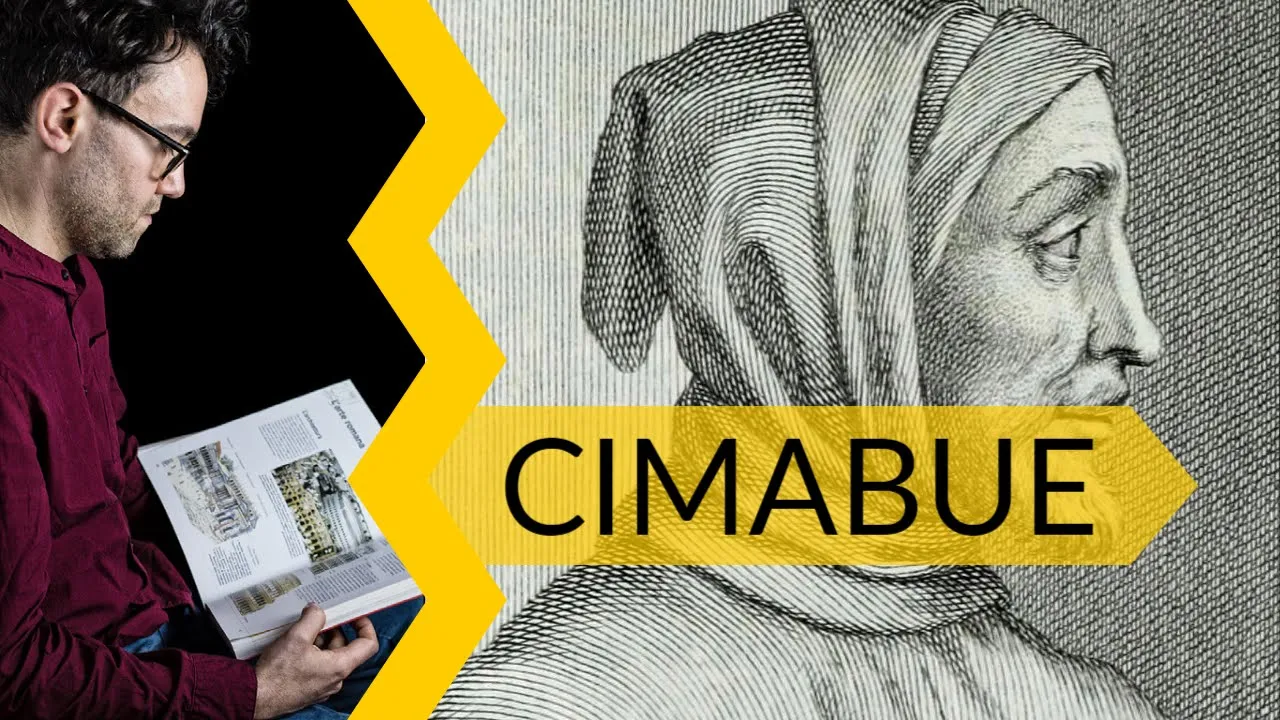
We know relatively little about Cimabue. It was Giorgio Vasari, writing about two hundred years after the artist's death, who provided us with the greatest amount of information about his life. His real name is Cenni di Pepo and the nickname Cimabue is probably due to his rough temperament.
Vasari placed the biography of Cimabue among the earliest of his Lives and wrote: “It was Cimabue almost the first cause of the renewal of painting”. Vasari therefore considers him among the first in the long list of the great Italian painters who pioneered the transition from Byzantine stylization to Renaissance realism. Cimabue's works do not have a precise date and their attribution has often been the subject of controversy; however the great impact they had on the development of Italian art is an indisputable fact.
Cimabue is undoubtedly one of the most important of the Italian primitive artists, even if his discovery is relatively recent. His interest in perspective and in the use of elements of classical culture and dramatic and emotional values allowed him to guide the transition from the ancient Byzantine tradition, in which two-dimensionality dominated, to naturalism, which would have been typical of the time next one. The oldest work attributed to Cimabue is a Crucifix found in the Basilica of San Domenico in Arezzo.
The definition of anatomy and musculature is still quite immature, but the artist's interest in the Romanesque is evident in the effort to render the flat monumental forms in a realistic way. Another Crucifix, damaged by the Florence flood in 1966, is located in the Basilica of Santa Croce in Florence: it shows a strong naturalistic approach to figure painting with a careful reproduction of muscles, veins, bones and tendons. Cimabue took up the subject of the crucifixion in a series of frescoes for the Basilica of San Francesco in Assisi.
Here the use of an illusionistic perspective creates three- dimensional architectural effects, while the draperies, finely painted according to the dictates of classical painting, take up the ancient Roman models. Furthermore, the scenes are imbued with a great dramatic sense. In 1302 Cimabue created the apse mosaic of the Cathedral of Pisa and was commissioned to complete an altarpiece: he died a few months later, without completing it.
His fame was soon overshadowed by that of Giotto, who is traditionally considered his disciple. An anecdote handed down by the Florentine artist Lorenzo Ghiberti tells of how Cimabue, having seen Giotto draw a sheep, was so impressed that he wanted it in his workshop. To date, however, there remains only a fictional tale, suggestive, but without any proof that it really happened.
A curiosity: Dante Alighieri was a contemporary of Cimabue and mentions him in many of his works, including purgatory. According to Dante, Cimabue was so arrogant that he would stop working on a painting if it was criticized. Dante again notes that, although Cimabue was an artist with an established reputation, his fame was overshadowed by that of the one who went down in history as his pupil, Giotto.