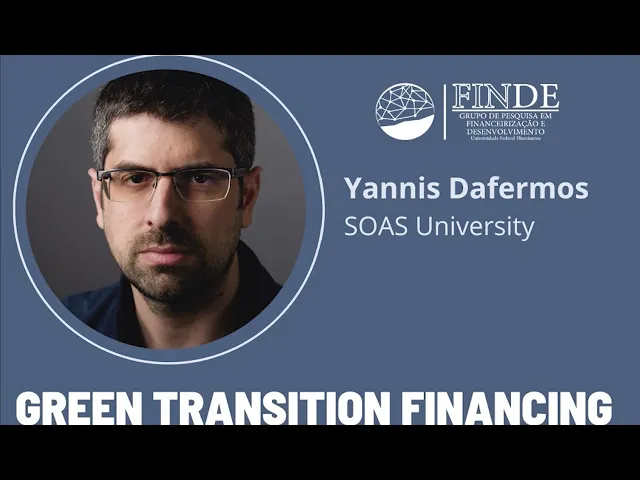
[Music] many thanks for having me it's a great pleasure to to have the chance to talk about this topic and to discuss with you I think uh climate Finance is an area that is is now attracting is is is attracting a lot of attention and uh I have been working on that area for a few years now and I think compared to what the interest was a few years ago there have been a lot of significant changes And uh I'm going to talk about this issue from a Justice perspective and the reason why I'm doing
that is because I think that uh we are now having a kind of a problem in the sense that everyone now is is very much in favor of supporting climate Finance but uh I think in many of the discussions we do not take into account the political economy aspects of climate finance that are now becoming much more important H we also don't take into account in many Of these discussions the the differences that we have uh between the global North and the global South and and this is why I'm going to talk quite a lot
about that in my lecture today and uh we also don't consider when we have this discussion I'm talking about uh all those who are involved in the climate Finance community that the way that Finance is used can be very problematic and uh we have seen all these significant structural changes in The global economy because of financialization and now we are entering a period whereby a lot of the financialization tools that were used in the past are being applied to climate Finance so uh we need to be very careful with the way that climate Finance is
used at the same time climate change uh creat some opportunities in terms of discussing new types of policies that can be used that perhaps were not Possibly to be discussed before climate crisis was such a big topic so I think that on on the one hand we have some risks because of the fact that climate Finance is used in a specific context but at the same time there are opportunities to open up discussion about other ways of thinking about how we can organize our economies so uh let me say a few things about the background
behind this this paper and what I'm going to talk about today so overall When you look what at what happens around the world we see that many financial institutions including central banks have now a very high interest in what is happening with climate change this was not the case 10 years ago I remember discussions about climate Finance used to be like why should we talk about climate if we if we talk about finance and this has changed because now many cal banks have realized that first of all this is a kind of a Risk that
they have to take into account and second uh we have seen significant changes in terms of how we discuss climate Finance in general so now we we have a lot of initiatives by World Bank IMF that talk about the importance of climate Finance they try to use as I will explain later a kind of a drisking approach in order to encourage private investors to invest in climate and and um we can very easily say right now that climate finances is part of all the main Discussions about Finance as I said before we have seen a
lot of initiatives from central banks and financial supervisors in Europe we have seen that the European Cal bank has tried to decarbonize their asset purchases H we have seen that the bank of England has run what is called climate stress testing exercises H we have also in the global South for instance in India some initiatives in order to support the Renewable energy sector uh in Bangladesh for many years we have seen green credit guidance that has been used in order to support uh the the invest ment in green projects so lots of initiatives around the
world and we also have that big financial institutions are now talking quite a lot about ESG environmental social and governance H we have credit rating agencies that now have an interes in climate and as I will explain in a bit The way that they approach the problem can be very U uh problematic because they they try to to find ways to analyze risk in a way that will be perhaps very bad for the global South and we have discussions about the role of public Banks and how public Banks can support the transition and this has
two different aspects one is whether public Banks should continue supporting for instance for fuels and uh we have seen a lot of initiatives that try to stop H Finance from public Banks about fil fuel projects and at the same time we have discussions about how development Banks can support the green economy H now what is very important from my perspective is that in all this discussions we don't have any serious consideration of global climate Justice the concept of global CL climate Justice goes back to to many decades ago uh first of all we had a
lot of uh academic Academics talking about the fact that when we analyze climate it's very clear that the problem comes primarily from the global North why because countries in the global North have generated the vast majority of emissions we know that climate is a problem that has to do with cumulative emissions not emissions right now in a specific year cumulative emissions are the drivers of the increase in atmospheric temperature and we if you look at the data that has been Collected for so many years H it's very clear that most of these emissions have been
generated by the global North and at the same time we have now a lot of information in order to say very clearly that the negative effects of climate change are much more important in countries in the global South compared to the global North and when I'm talking about the effects of climate change I'm I'm referring to hurricanes floods droughts all these types of climate Related events that now are becoming more severe and more frequent so these are much more important in the global South compared to the global North so Global Climate Justice highlights that the
problem comes from the global North but it's more important for the global South what does it mean in practice it means that we have to adjust the way that we globally respond to the problem in order to take into account this Injustice And uh just to highlight that when it comes to climate change we also need to pay specific attention to what has been called a damage and loss there have been a lot of discussions in cops recently about that and uh when we refer to damages and losses we we we basically uh cap try
to capture the fact that in the global South that that we have all these climate related events that create economic damages that at the end of the day have to be covered by the state by Household by firms the and the problem is that in most cases the global Community does doesn't do anything about that so we need to now to focus much more on that problem and find a way through which Finance is going to support the communities that are suffering from from these loss and damages now this is the background and what I
would like to do is first to talk a little bit about how we analyze climate policies from from a more Conceptual perspective so I'm going to compare a little bit the mainstream way of thinking about climate policies compared to a a more heterodox perspective then I will explain some ways through which climate Finance in the way that is developing right now is creating problems from a global Justice perspective after that I will provide some general suggestions about how we can address the Injustice that comes from climate in general but also from Climate Finance initiative so
I will explain some pillars that in my view should be incorporated Into Climate Finance in order to try to reduce the the climate injustices and then I will also describe a little bit some challenges with respect to what I'm going to propose because I think that in practice there are a lot of political economy challenges related to the incorporation of of justice issues Into Climate Finance H and I will explain what this challenges are H and I will also talk a little bit about some some technical issues that are quite important when we are talking
about Green finance and Justice so let me start by saying a few things about u u the the way we can think about the evaluation of climate policies and I think this is very important because sometimes you might uh hear about some ideas uh with respect to addressing climate change that might Come from let's say leftwing parties uh but uh you can find in this ideas some mainstream conceptualizations of the problem so I think it's important from a conceptual point of view to understand uh what is the background ground of these ideas so if you
look at the mainstream approaches about the climate problem in general one very key feature of these approaches is that they put the pricing of nature at their core if you look at the tradition of what we call Environmental economics all the environmental problems according to this approach can be resolved if we find a way to put a price on nature a very common example is what carbon emissions so the the main uh proposal has been to put a price on carbon as long as we do that according to mainstream approaches we internalize this is the
word that is used the problem that was outside the market we put this into the market we Have a price for carbon emissions and the market is going to find the solution to the problem and this is why mainstream approaches focused quite a lot on what is called Market based Solutions and now we have all these discussions about having carbon credits or having a market for carbon ofets and I know that now in Brazil this is becoming very important because there is a lot of demand for for carbon ofets related to uh the avoidance of
Deforestation and uh this is also the approach that now organizations like IMF and World Bank are trying to promote on top of it uh we have seen recently what danela Gabor has called The Wall Street consensus with this idea of the risking so uh when you move beyond the market it's interesting that sometimes you can find mainstream approaches that argue in favor of some interventions from the state but the way that they H suggest that is by asking The state to drisk private investment so the risking in practice means that the state finds ways to
support private investment for instance by providing subsidies we see now a lot of subsidies for instance in the US in the context of the green transition or by having regulations that are very good for the profitability of the private sector or by having some guarantees that if private investors are not very successful in their project the Government is going going to step in and cover some Financial losses so the risking is an approach that require some State intervention but not State intervention in the more traditional way of thinking about the intervention of governments is a
state interation that tries to accommodate private investment so this is a slightly different appro approach compared to the more traditional one but still it has at its core that the private sector is going to Resolve the climate problem now if we look at heterodox approaches uh there is a there is some heterogen in terms of how we can deal with the crisis but in many approaches from heterodox Economist you find uh that it's very important to have a state that is going to intervene it's going to regulate is going to invest H and it's going
to penalize uh for instance posit capital and by having this role the state becomes the driver of the green Transition and not the private sector and in hetero approaches we can also find nowadays a lot of analysis about how we can combine different types of policies not just to have one policy that is going to resolve the problem there are discussions about how you can combine trade policies fiscal policies Financial policies mon policies and so on in the global North there is also a lot of discussion about what sometimes is called the growth how to
reduce Consumption I think this discussion is relevant for the global North and I think there are some um uh some significant perspectives that we get from this discussion because the way that people consume in the global North is not sustainable it creates a lot of environmental problems and now the global South is suffering from these problems uh but we need to be very clear that when we we're having these discussions this do not apply in the Same way to the to the global South so in mainstream approaches is mostly about how to facilitate the market
in hetero approaches is how to change fundamentally the role of the state H and um have very significant interventions that uh can help us achieve the targets of the Paris agreement now when we have assessment of policies uh mainstream approaches focus on what has been called cost benefit analysis cost benefit analysis Complements this idea that we need to put a price on nature why because when you put a price on nature you need to find the way according to this approaches to identify what is the right price and cost benefit analysis is supposed to do
that for example when we have that there's a a price on carbon in principle this cre creates some costs right because the price of carbon means that some firms have to pay more because they produce emissions but there's a Benefit if you put a price on carbon what is the benefit the benefit is that in the coming years we will have a reduction in emissions and therefore there will be less climate damages and what cost benefit analysis is uh does is that puts together the cost of benefits and finds the so-called optimal price so now
that we're are having this discussion about credit markets Economist try to find what is the right price that we should have in These markets in order to get this optimal outcome and the problem with that is that in most cases the way that this analysis is done is arbitrary because it requires a way of monetizing damages from climate and in most cases these damages are underestimated and by doing that we we get that perhaps the price that we should have in the markets is too low but the the other problem of this analysis is that
it does not consider as Is the case in header do approaches the role of power the distributional effects of carbon prices which are very significant as as I I'm sure you're very much aware of H and it doesn't look at the system how how social systems and economic systems systems work so from a heto perspective Ive the we need to have much more fundamental changes to the way that we organize economic systems in order to find the solution and we cannot have a kind of an Analysis that puts a price to everything and uh the
good news is that when you look at what climate scientists do climate scientists look at the climate system and they try to understand how it interacts with economic and social systems and they have this concept of planetary boundaries H which specifies that in terms of economic ecological systems we have some thresholds that we need to respect and our work is not to try to find a price that perhaps would Pass this planetary boundaries but would be optimal according to economies we need to find ways to respect this boundaries and Achieve economic and social stability at
the same time so the the way that we look at policies is very different and the political economy analysis of policies is also fundamental we cannot just look at a policy without understanding who is going to benefit and who is going to lose from a policy cost benefit analysis Is not doing that when it comes to finance the mainstream approaches are very clear they the the if you look at for instance Publications in climate Finance in mainstream journals in most cases the question is how to put the right price on climate risk or how to
reduce to find a way to reduce the exposure of financial institutions to climate risks and in most cases the question is how to protect Finance from climate not how to protect climate Perhaps from Finance right which is a very different question we know that if we look at the data for instance there are many big financial institutions that have provided a lot of fossil Finance so they have contributed actually to The Climate problem Finance doesn't ask this question Finance asks the question I mean the M Finance ask the question how to protect Financial excuses from
climate and this is very problematic hetero approach is when when uh we have An analysis on finance what they try to do is to explain how how the contribution of Finance to the problem will go down and how to transform perhaps Finance whenever this is possible in order to contribute to the transition so it's about having a less negative and a more positive impact it's not about protecting Finance as it is and if the conclusion is that we perhaps need less Finance or different Finance we have to do that it's not about Protecting the status
of quo and finally environmental justice is something that is very different in mainstream approaches compared to heterodox approaches for mainstream approaches right now you can find that many people will say that yes Justice is important this is why now we have that the concept of a just transition has become very mainstream the problem with that is that this is considered to be a kind of a secondary issue so first we have some Solutions that are suggested in general like having some credit markets carbon credit markets and then there might be a discussion about how to
reduce any distributional effects for in in the case of hetero approaches the issue of environmental justice is very fundamental and we should not suggest policies before we look into that so the the priority that head approach is put on environmental justice is is very significant is is very different from What we see in mainstream approaches so I I would just like I wanted to clarify all these issues because it's very important when we look at these debates about climate Finance now let me turn to explain a couple of things about why in my view the
current climate Finance initiatives are creating more problems from a global Justice perspective uh I have here a graph that refers to this so-called climate public debt visous cycle that we we are seeing now in some Countries in the global South and what is the problem with respect to to to this cycle the problem is that we have many countries in the global South that are exposed to climate uh damages they are very vulnerable as a result of this they need to spend more money on CL climate adaptation but also on loss and damages because they
they they they face some Financial losses as a result of climate change and because of the fact that they They have this exposure to climate damages H they end up with high public debt but also they because of high public debt they have to pay higher interest in in the global financial markets and we have a visual cycle because once you you are in a at a stage whereby interest rates are very high you have a high public debt we know that this means that it's more difficult to invest in climate adaptation therefore there is
less investment in climate Adaptation which makes the country more vulnerable so we start from high climate vulnerability this contributes to high public debt and cost of borrowing and as a result of this we have Less ad adaptation investment and less adaptation investment really results in even higher climate vulnerability and what is important is that trading rating agencies are now looking into that and if you if you ask someone in the financial Community they Would say that yes of course credit rating agencies need to to look into climate but the problem is that the way that
they do that is the standard risk perspective that they use and they they they incorporate climate into their credit risk models and and it's not surpris surprising that what they find based on these models is that many countries in the global South in and mostly in Africa and Southeast Asia are going to experience a lot of climate Related events and as a result credit rating agencies are going to downgrade these countries why because from their credit perspective it's very likely that the governments for instance of these countries will not be able to repay all of
their debt so uh in the map you can see that with with r which countries are considered to be more climate vulnerable and therefore more risky if we use this um approach of mood and uh the problem with that is that according to the VIS Cycle that I explained before cred rating agencies are going to contribute to the problem are going to make the cost of borrowing higher for this country count this will also have implications for exchange rates and at the end of the day what we are having is that by trying to analyze
climate Global Finance makes the problem worse and this is related with uh one of the channels that I would like to discuss now with respect to how climate Finance contributes to global Injustice I call it exposing by self-protecting so we have Financial institutions that want to protect themselves from climate therefore they they they they will be and they are already in a position whereby they don't want to invest or buy Financial assets related to countries that are more exposed to climate change and by trying to protect themselves they make these countries more vulnerable because they
don't allow them to invest In climate adaptation so and this is a kind of a broader problem because it it also refers to cases in which the big Financial players at some point decide to stop investing or encouraging investment in areas in any country which are exposed let's say to flood risks or droughts so for instance at some point it will become clear that the financial system will not be willing to invest in coastal areas that perhaps are facing a higher risk Because of the sea level rise and the financial system in general is going
to uh be very much against the idea of investing in those who will be will be suffering from climate change this is the first way through which climate Finance is creating more problems the second one is uh is related to what I call decarbonizing by exploiting so in General there's now a kind of euphoria about climate Finance about the fact that many companies Around the world are having some targets about reducing their emissions and at the same time we have that financial institutions or cederal banks are very happy to support those who who make some
effort in order to contribute to the green transition and the problem is that not many people are asking the question how exactly do companies try to reduce their emissions because there are many different ways through which emissions can be reduced and I have three Different channels of reducing emissions that in my view are very important and we need to look carefully into that the first one is when we are talking about companies like those that invest in electric vehicles or invest in solar panels or weed Farms many of these companies require some specific materials uh
we have this term transition materials that refers to Copper lithium and so on materials that are important for the green transition And the question is how do companies get access to these materials in many cases they want to get these materials at very low cost and they engage with what has been called green extractivism so they try to find ways to first of all get this at get access to these materials at very low costs that are associated with low wages for those who participate in the extraction of these materials they perhaps try to to
work with governments In countries that have a lot of needs in terms of creating employment and they at the end of the day they try to convince the governments to make the environment for them very friendly which at the end of the day might lead to the exploitation of workers to the exploitation of local ecosystems because for instance extraction can destroy ecosystems and and the many cases we have seen that there has been violation of Human Rights so overall having the Higher need for these materials can lead to a specific form of exploitation and if
we don't look into that the problem is that in some cases people argue that they do something good for the environment but they they don't want to say anything about these green extractivist practices second uh we have seen that in many cases uh we have a problem with the land that is necessary in order to generate green energy and for instance In Europe is not easy for a company to find a lot of land in order to invest massively in weed Farms or solar bnds and what do they do they might go to Africa try
to find a place that is large enough and then H they they they they use land grabbing uh approaches in order to make sure that nobody's going to disrupt their business and this has a lot of negative effects for the local population so we need also to know to what extent companies engage In these types of activities and finally we have carbon ofets which is a kind of a very significant Trend right now why is that important it's important because companies now are evaluated based on their net carbon emissions not based on their gross emissions
so net emissions are your gross emissions minus the carbon ofets and if you have let's say an oil and gas company that doesn't want to reduce their emissions so much in the coming years they have this trick Whereby they say that they have a Target about net emissions so they use some of their money in order to invest in carbon offsets and this can allow them to argue that they will be Net Zero by 2040 or 2050 so we have a very high demand for carbon offsets and we have seen a lot of interest for
instance both for um Indonesia and Brazil because of that private companies try to um to create some carbon ofs products and offer these to companies in order to tell them that You buy this carbon ofs you can reduce your emissions and then the question is how is this money used and to what extent first of all we have a reduction of emissions because of that H but more crucially and this is my main point to to what extent carbon ofets lead to the exploitation of people because you might have that there will be a private
company that will give some money to people who live let's say close to a forest and uh in principle they are Going to make sure that people are not going to destroy the forest or use um the forest in a specific way that they think is bad for the environment and this raises the the fundamental question of why these private companies know better about the management of forests than the people who live there and why do they think that for instance IND indigenous people uh don't know how to engage with the forest so there there
are some broader questions of why who Has the power to to get this money and then to go there and tell people what they have to do with the with nature and uh this is another form of extractivism because at the end of the day people lose the ability of engaging with their uh environment in the way that they used to do in the past and it doesn't take into account that you cannot have a fil fuel company that generates a lot of emissions and they want to to pretend that they do Something for the
environment by exploiting people who uh live close to Forest so I I'll get back to this but this is the main point about how we achieve the carbonization and green Finance perhaps is going to to exacerbate the problem because of the fact that now there's this very high demand for uh having companies that perform well based on their emissions profile final channel is the risking I mentioned that before so right now we Have this argument that many countries in the global South emerging market economies or developing economies they don't have enough fiscal space therefore governments
cannot invest sufficiently in the green economy and the solution that has been provided is for private Finance to engage with the governments of these countries and provide finance that is going to support investment in the green economy and and the idea is that Governments have to find ways to convince the private sector to take the risk and the and governments have have to provide these guarantees change regulations uh provide um supports in terms of subsidies in order to convince private investors to give their money H the problem with that is that in most cases this
is done through ppps so we have these private Public Partnerships and um there are two aspects with respect to this the first Aspect is that when we look at the private sector the private sector always want to engage uh with governments because they see a profitability opportunity and in most cases governments have to spend a lot of time to convince private investors instead of developing a more holistic approach to the way that for instance infrastructure public transport and so on are going to be decarbonized second we have finance that Also wants to get high returns
and low risks and they are willing to finance some ppps but uh the way that they do that sometimes is also associated with things like securitization so they use some techniques that we know that they can be very harmful and in the context of the risking this uh this is very important because it means that there's less risk risk for the financial investors so the Bain purpose of the risking is not to Support the green transition or climate adaptation in the global South is based basically to provide High returns to to climate to to sorry
to to Big financial institutions and big Financial players and this can also contribute to to Injustice so these are the three channels that I wanted to highlight now what could be a potential solution to that and my view is that it's not easy to find the solution but uh there are ways to change how the financial System is is stru ured how climate Finance is promoted in order to make sure that at least some justice considerations uh will be part of the climate Finance Solutions and I think a starting point could be this principle of
differentiated responsibilities with respect to climate change this goes back to the negotiations about climate in the 19 in the early 1990s and this concept that we have common but differentiated Responsibilities has been accepted in these discussions the problem is that this concept this principle has not been applied to policies but also to climate finance and in my view the starting point is that this principle should be applied to to climate Finance as well in practice when we are talking about climate Finance uh I have already made this distinction but I would like to make it
very clear uh we need to talk about climate mitigation tools versus Climate adaptation tools because climate mitigation is about reducing the emissions for instance uh for by supporting specific um uh activities related to Renewables and by reducing the size of f companies but we also need to think very carefully about how we support climate adaptation and climate adaptation Tools in finance are any tools that in principle can support the financing of people a companies countries that have to face losses Because of climate damages and um one of my arguments is that uh when we are
when we take into account the differentiated responsibilities when we are talking about for instance Argentina or Brazil compared to the UK we need to be very clear that UK has contributed a lot to the problem so they now need to reduce their emissions very very quickly uh other countries in the global south of course they have to contribute to the reduction of emissions but they also Need to be supported in terms of climate adaptation and the responsibility with respect to climate as a result of that is very different this applies to Cal Banks and financial
institutions as well and let me now talk a little bit about what can be the tool tools that uh we can use in order to support the financing of of the green transition now I have on the left hand side uh the different types of tools in in um in finance and S banking that can Uh change in order to incorporate climate criteria uh so uh we can have specific targets for public banks in terms of how much they provide to the green economy we can have in countries that use asset purchases and this has
this purchases have been conducted quite a lot in in the UK and Europe that uh some climate criteria are introduced So Cal Banks can buy much more H from from the green economy compared to the fossil economy And interestingly both the bank of England and the European Bank have done that they have introduced climate criteria in their purchases we have credit guidance which is a very significant policy for for many countries in the global South uh I mean BCB in Brazil has also used some form of credit guidance uh in particular in the case of
ruler uh credit uh and they have introduced some deforestation criteria there H we have other countries like Bangladesh or India whereby banks have been instructed to provide a proportion of their loans to the green economy so in India we have the priority sector lending whereby a specific proportion of loans go to Renewables and in Bangladesh Bank we have that 5% of total loans should go to green projects so credit guidance has been used in some countries and I think is is a promising tool collateral Frameworks it's a kind of a complicated tool that has been
used for Instance by People's Bank of China uh whereby commercial Banks can use some green bonds when they want to get access to to Central Bank liquidity H and BCB also has a collateral framework that in principle can be adjusted and there are other tools I don't go I don't want to go into so many details about these tools like how Banks get access to Central Bank liquidity what is the interest rate that they have to pay that have been proposals about reducing Interest rates when Banks provide more Green Loans uh so these tools can
be adjusted in order to incorporate climate criteria but the question is first of all how we avoid the problems that I mentioned before like green extractivism and second how we allocate different responsibilities based on on climate Justice and it's very important to to highlight that one size doesn't fit all when it comes to these tools right now there's a tendency from um institutions In the global North to advise the global South by saying you have to do the same as we do and I think this is very problematic because when it comes to how you
design these tools you need to take into account the local context and the local context also needs to consider that climate adaptation at the end of the day as I said before is more important climate mitigation for for many countries around the world so um for for instance when we are talking About credit guidance it's it's important for many countries in the global South to incorporate the support of climate adaptation not only climate mitigation which is something that in the global North and has not so far being considered so we cannot just take a tool
that is used in the global North and apply it to the global South my second uh point and this is the second pillar that I think is important is to find the way to capture green Extractivism so far the problem has been ignored and in climate Finance I think almost nobody talks about that and uh I have a specific example of the slide when the European Central Bank decided to decarbonize their corporate Q program they they ask they basically evaluate companies by looking at their emissions they didn't want to analyze how the emissions perhaps go
down so my point is that if you have a company that goes to Brazil and engages in any form of green Extractivism we need to know that and we need to have information in order to to say that this company should not be supported by the European c bank so in my view uh it would be a significant Improvement if we start collecting information about all these green extractivist practices that already some databases and some um websites that provide information about that one of these is the global environmental justice Atlas which analyzes how Companies perhaps
have engaged with extractivism in the past and I think we need to work much more on that in order to to to promote the idea that green Finance is not always good and now the third pillar which is the perhaps the most challenging one and it has to do with the way that the global North is supporting a climate Finance in the global South I have here some data that refer to the commitment that the global North has made H for many decades that It would support the financing of climate mitigation and climate adaptation in
the global South and uh there has been some climate Finance over the last couple of decades and I have here the data that refer to to the period between 2016 and 2020 and there are three specific things that we need to highlight in terms of this climate Finance the first one is that if you look at the decomposition from a theme perspective most of climate Finance has been used for climate mitigation projects this comes in contrast to what I said before that adaptation should be a priority for the global South so we don't have enough
Finance for ad ation this is the first problem the second one is that most of this Finance is in the form of loans in the graph you can see that this is about 70% what is the problem with that many countries in the global South have a public Deb problem uh and if you give Them money to protect themselves from climate or to contribute to mitigation and this increases their debt of course it's not going to solve the financial fragility issues third problem is that this climate Finance is very very small it's uh below 100
billions and uh if you look at the climate Finance needs around the world I mean there are much much more than that so uh this is not working and I think everyone now accepts that this is not going well now uh when we Are talking about climate Finance we need to consider a few things that from my perspective are very important they should be at the beginning of any type of debate about uh how climate Finance can contribute to to the solution so first of all we have that uh there is a Global Financial architecture
that uh is uh is is is very much uh designed in in in order to support the US dollar there are many countries that have weak currencies that are exposed to to the Global Financial investors appetite and uh we we need to take into account that CES in the global South have a subordinate position in This Global Financial architecture second we need to be very clear on the fact that there's a big lad about that there is a climate debt that countries in the global North owe to the global South why because of the cumulative
emissions that I mentioned before the fact that these cumulative emissions have generated Climate damages in the global South means that it's not a choice for the global North to support the global South it's a responsibility based on an existing debt we just need to to accept that this debt exists and there is a lot of data analysis about this debt so there are ways to to to capture this also from a quantitative perspective and finally we also have to take into account that unfortunately the problems with climate Loss and damages are going to increase increase
in the coming years even if we manage to to achieve um to restrict the global warming to 1.5 or two degrees we will still live in a world with more climate damages so this means that there's an increasing need for climate Finance uh so we we have to use these three facts as a starting point and then we have a lot of proposals that try to address perhaps some of these points and one proposal is uh is now very Mainstream many people are talking about this some governments have already implemented this idea it is called
debt for climate swaps and the idea is that let's say a country makes a commitment that they're going to invest in a in a climate mitigation or a climate adaptation project and uh by making this commitment they ask investors not to let's say repay part of their debt so they avoid some debt because in principally they use the money that they Would pay to investors in order to invest in the climate project this is one idea we have some other suggestions about uh uh changing the special drawing rights which are provided by IMF and ask
countries to to invest in climate by using this and we also have this idea of climate reparations H which I think now is getting more attention and all what I would would like to highlight is that only climate reparations recognizes the climate Justice problem the de for Climate swaps is considered to be a kind of a favor that perhaps some investors will make to the country as long as the country invests in in green stuff but it's not it doesn't have climate Justice as a starting point it doesn't it doesn't highlight the fact that there's
a responsibility that perhaps these investors most of them are based in the global North have and therefore they need to support climate mitigation and adaptation so uh these are some Proposals now in my view uh climate reparations as I said before is more consistent with with climate Justice and uh the only problem is that it's difficult to generate a lot of revenues in a way that would support climate reparations in the coming years given also the climate damages are going to increase and uh this is why we had all these discussions in comp 208 about
creating something different the problem is that what was created which was a Loss and Damas fund uh will be hosted by the World Bank and we know that the history of world bank is not great in terms of how it supports the global South uh there there when this was announced um some countries already said that they would contribute to the climate to this loss and Damas fund the problem is that no country has the obligation to contribute to this fund H it's not that the the Los and Damas fund has a climate Justice starting
point the Starting point is that there is a fund uh there's um the encouragement for countries in the global North to contribute to this but it's not very possibility and it's very unlikely that this fund is going to collect enough enough money in order to support what I said before the growing losses and damages in in the global South so this is where I at some point I thought that perhaps we need to think at least in theory of something else U and uh this Something else I called it climate Justice Facility and uh it
uses as a starting point the fact that there is a responsibility in the global North uh what we have seen in the past in particular for instance in covid-19 was that those countries that are at the top of the currency hierarchy like the us or some countries in Europe they very easily used their sedal banks in order to support fiscal spending during Covid-19 when you look at the global South you you see that they they didn't have the same capacity they couldn't rely on on a money reading from the Cal Bank in order to support
fiscal spending and this created a lot of inequalities so my proposal is to use the money creation process in the global North in order to support climate adaptation and the coverage of of climate losses and damages in the global South and the idea is to create a facility that is going to Collect money from the global North this money can be created from Cal Banks as it was created for instance during covid-19 and it will be provided in the form of Perpetual loans with zero interest rate which at the end of the day is basically
a grant because perpet loans do not have to be repaid these loans will cover the responsibility of the global North due to climate debt and um the money will be used in order to invest in climate adaptation and cover Losses and D es and and each country will contribute to this facility based on their cumulative emissions in order to take into account the responsibility that they have for the climate crisis this is the the the general idea behind this proposal I also have how this would work in terms of balance sheets but I don't want
to bother you so much with that it's straightforward when you create liabilities you create assets uh central Banks can create liabilities out of thin air so the technical technically this is not difficult but what is important is that if you have something like that you can complement all the other initiatives you can provide a support that will always be there for countries that will face climate related losses this is very important because once you have for instance a hurricane you need to know that there will be an an an automatic way through which you will
get access to Finance and if you know that this support will be there the risks the perceived risk will also go down for countries and I think this is also a way to restrict what I said before about creting rating agencies because if we know that countries will will receive climate Finance once they face a big drought or a big flood or a big hurricane then it's it's less likely that they will be downgraded by creating rating agency so We we we can try to restrict a little bit the problem and let me highlight that
uh there are also other ways to support uh spending in the global South H and let me just refer to one example in Europe we have the the eurosystem collateral framework so the idea is that for the ECB to provide Finance to commercial Banks they ask them to use some Financial assets as collateral why is collateral power ful I will give you an example from the Greek crisis when we Had the Greek crisis uh we had in the summer of 2015 some Bank runs do you know why we had Bank runs in gree because the
ECB didn't accept as collateral the government bonds of the uh Greek government the bonds of the Greek government they said we're not going to accept these bonds we consider these bonds as as very risky so Comm banks in Greece could not get access to to uh liquidity from the European Cal bank and this means that they couldn't Satisfy the demands of depositors now what I'm saying is the following in this collateral frame work we have a lot of government bonds that are issued by Japan by um European governments by the us we could include there
some bonds that for instance are rescued by the Brazilian government and if we do that in the con of climate Justice H then there will be a demand for these bonds because banks in Europe would need to hold these bonds if want if they want to Get access to to Central Bank liquidity and this would reduce the cost of borrowing for Brazil and this I will say that in a bit of course all this politically sounds very difficult but if we going to be serious about climate Justice we need to do something more fundamental so
uh my broader point about the third pillar is that we need to have some new mechanism through which we make sure that climate Justice is reflected in the way that Global North provides Finance to the global South and now let me say a couple of things about the political economy issues and I'm going to finish with that so of course what I said already sounds very difficult from a political economy point of view first of all uh such a system that supports a global South will not be very popular among people in the global North
because it would be considered to be too much for them to support the global South in that way we We need to change the way that we think about Cal banking uh the mandates of Cal Banks should change in order to incorporate for instance a commitment of governments in the global North to support the global South it will be a rot of resistance for from uh big financial institutions like Black Rock or JP Morgan why because they're going to lose their job I mean their job now is to do the risking if you have a
financial uh mechanism that supports Climate mitigation or adaptation in the global South in a way that does not require Banks to go there and provide Finance of course they will not like something like that H but at the same time what I I'm seeing is that the problem is becoming worse many countries in the global South are becoming very angry with the way that they are treated you can look for instance at um the disu with in Barbados H we have that some islands will face very very significant Challenges in the in the coming decades
and they know that this is not their responsibility so I think that perhaps the the the political reality is also going to change because of that uh because the problem is is is very big H there are some technical issues when it comes to what I suggested and some of them are quite important because if you want for instance to have a facility that supports climate adaptation you need to to have a very transparent clear Way of defining what adaptation is who is going to lead this projects uh and um there there is already some
experience that we can draw on in order to to make sure that the money that will be uh Tel to these countries are going to be is going to be used properly but we also need to have taxonomies of what are climate losses what are climate damages uh we need to understand how to allocate responsibilities based on U cumulative carbon emissions I mean there's already Analysis about that we need to think about um um how we can understand uh the local context how to make sure that there will be no Mal adaptation uh how to
make sure that uh local population is involved in the use of this funds so there are a lot of challenges from that perspective as well but I think if we don't have at least the provision of sufficient Finance this discussion cannot start and the discussion will always be about satisfying private Institutions that want to make money this this is uh my main point so I'm going to finish with that and then let me also say that in the context of developing of incorporating clent Justice into Finance I only talked about global North Global south of
course in real in practice we need to talk about class gender and race in many countries uh Rell inequalities are very important so we also need to incorporate this aspects into Into Climate Finance so I Didn't I didn't discuss that uh but it's something that requires much more attention H and let me also say that um uh when we look at the transition to Net Zero economy H I think it's important of course to try to analyze what countries can do at the national level given the global constraints H and for instance what I said
about using some financial and C banking policies domestically I think yeah it's it's it's important to have This discussion but at the same time we need to understand the global constraints and I think it makes sense also to to H spend a lot of time to understand how the global constraints can change because without changing the global constraints it will be very difficult to make significant progress domestically so I think we need to have these discussions at the same time so uh thanks a lot and sorry for talking for a little bit more than I
expected but uh Many thanks for your attention and yeah very much looking forward to to our discussion I think there already uh maybe there are some questions no let's see what questions you have and yeah I think we have plenty of time to to go into some details thank you okay thank you very much is amazing presentation and uh I'm sure you're going to have some questions why people still thinking about organizing ideas I i' would like just to H to raise Something an issue that's in our agenda in Brazil uh and I think that
talks with uh the concerns that you brought that we we the government has launched uh recently uh industrial policy in Brazil and uh and of course aiming to the green transition uh and uh but it's very unclear for us how uh this industrial policies going to be implemented because uh although we have enormous H Environmental diversity that should be something H good for us for our development also we are very financialized economy and uh so the policy space uh is very narrow and I believe that uh and we have been losing ER State capacity of
intervention in the economy so we as I see that's a big obstacle although we have ideas some good ideas some good initiatives but implementation are very difficult in the political Arena uh so but it's very Interesting that the propositions that you raised to us you have to be Bolding our thinking and the positions order to advance the ideas but any question ah Fernand has raised her hands Fernanda I do thank you K thank you y's great presentation and I I I wrote down almost everything you gave us many ideas H I heard I I I
once before I heard you talking about This climate B just a set buying I'm sorry is that is that that's how I I wrote out just a set buy and uh particularly we are very interested in this uh mechanism in this Tool uh because it is one of the Alternatives that Cari and I we've been writing about as a way to finance the green transition our initial idea was the Brazilian Central Bank to to issue such um such a tool such a instrument in Order to exchange Brown assets for green assets at the same time
you would capitalize the central bank that's that's something not allowed by Brazilian laws but now we're thinking about uh this has to be changed but at the same time the central bank would issue bones kind of printing money but issuing bones to capitalize the Brazilian Development Bank in order for it to finance the green transition the green sustainable transition but not in A de risking way I like very much your perspective of the de risking farm and Gabor uh Gabor also it's both of you but it's very interesting uh but it so it is two
forms of the state financing it and this the projects that have have have been financed with this money they have to be aligned with a a greater a transition plan uh not only Brazilian but a global transition plan so how do you think how how is your idea of this just a set Buying how how it work what's the collateral how it's it's going to be exchanged into the financial Market into the banking system and do you have any suggestions uh for the capitalizing of this green fund the losses and damage funding you know to
make it uh more to close the gap to be to put in a different form to close the finance Gap the green Finance Gap but also directing the this Finance towards a proper project a proper green Finance Transition you know not only green washing did I make myself clear I don't know if it just yeah thanks that's that's a great question so thank you let me first say that let me start with your last comment how to avoid green Hing I think there is a problem with that uh because we have seen quite a lot
of green horing and um in principle we want to support let's say a green um project that uh is financed by development Banks but we need to make sure that these are Really green projects and uh there's a lot of debate about that I mean you need to for instance have enough information about how the project will reduce emissions how the project will avoid any side effects on fosil projects or carbon intensive projects because you have companies that might be carbon intensive they want to invest in green but sometimes they receive money and they use
this money not only for the green project so you need to have some very Clear criteria about that on top of it as I said as I described late earlier you need to make sure that U uh social issues are also addressed properly and you don't have extractivism and so on so this is a specific discussion that we need to be very careful about let's say that we managed to get a proper green Bond uh that supports a project that development banks are willing to uh to provide money for and we're going to find ways
to to Support this these bonds uh then uh I think it's important to think about different types of tools so as you said the Cal Bank could do a few things in order to support this one way would be to directly buy this bonds I mean for instance in Europe theb bought some uh bonds of the uh eiib the European Investment Bank uh and uh they did that through the their key program right so you can do that or you can at the same time you can include these bonds into The collateral framework I mention
the collateral framework because BCB uses a collateral framework and when you use a collateral framework in order to support specific bonds there are two things one is to make eligible these bonds which means that if commercial banks in Brazil buy bonds green bonds that have been issued by development Banks they can use this Bonds in order to get access to liquidity the second one is to reduce what is called the haircut the haircut Is a difference between the value of the bond and the money that you get so if the bond has let's say a
price equal to um $100 and you get uh $80 liquidity we have a 20% haircut if you get 90 liquidity we have 10% haircut so the lower the haircut the more you going to to have this Bond because it gives you more access to liquidity so what BCB can do is to say that for these bonds uh first of all they will be eligible Second they will have a very low haircut and this can support the demand for these bonds and my point is that we need to go even beyond that and in the context
of global Justice say that uh others Banks perhaps could try to support these bonds because they have a responsibility to to to to support climate projects in Brazil in the cont of of climate Justice and this is why I talked about the collateral framework of the ECB because they can also say that Some specific bonds that meet some criteria can be eligible in this collateral framework right now they have Japan for instance why because they have only the global north central banks what I'm saying is that this might make sense from a very strict Financial
perspective because these bonds are less risky but from a climate J perspective if we are serious we also need to consider that they they have to do something about that they cannot just avoid the the Discussion and this would make a huge difference because if you know that there is a Development Bank in Brazil that can issue a bond that can be bought by the ACB I mean this would make a big very big difference the only thing that I would like to say that is that still this would not be enough because bonds can
be useful but still they are debt and I think we need a combination of Grants and debt we cannot always rely on the creation of debt because this Creates interest payments and this creates more fragility and this is why what I said about a climate Justice Facility is important because this facility is effectively going to provide grants in the Contex of climate Justice and you and it will not be enough but the combination of Grants with low interest rate bonds I think it's a way to to finance the transition in stand of just relying on
debt and in most cases debt with very high interest rate right Now uh yes so I think three stages first Define properly what is green take into account social criteria second find ways to support these instruments domestically through the Central Bank uh and third to think about uh Global initiatives that can support uh the financing of the green transition right thank you yes thank you I think we have one more hand rais it this follow Paul Please oh y uh I think you under estimate the politic Kar here uh I want to you to talk
about a little about these problems we we have in Europe the farmers especially in France they are on opposition to environmental measures there's the right uh the rise of the stream right in Europe and United States uh Trump could be the next president of the United States the SG is Under treat in us uh and black rock has uh change the its position about this and in Brazil the problem is not so serious but Lula is in his popularity is in the Cline now uh how do you how do you see this these questions these
problems thanks uh so first of all let me clarify that what I I suggest uh is not what I think is going to happen right I'm I'm just saying that if we going to be in principle serious About the problem we need to make some very significant Transformations now I said at the at the end of my lecture that there are very significant political economy barriers not only to what I said but also to the broader discussion about climate and you are very right that in Europe we have these problems because because uh I mean
it's not only farmers that resist to the green transition there are many social groups uh that do not find the Transition very attractive from an economic perspective of course us might now change and again again its approach to climate uh Black Rock initially was um in favor of doing green stuff now they have changed their approach so things are not looking good and I agree with you I'm not saying that we're are going to see any big changes with with respect to to The Climate problems um now the question for me has been how we
need to Think about that differently when it comes to political reality let let's see how we can perhaps try to address this so for instance the case of farmers the problem is that farmers have seen a lot of economic problems over the last couple of decades at least and when you have that you implement policies that do not take into account the distributional issues of course you're going to to to face this this this resistance and this is related to what I said at the Beginning of my lecture about the just transition if you have
as a starting point that you are going to have higher prices for energy fosil energy and you don't invest in public infrastructure so people have to use their cars in order to go to job and they have to pay more of course this is not going to work if you if you have that farmers have a lot of economic challenges they have not been properly supported there has not been in many countries in Europe enough Investment in order to support any kind of transition and then you tell them that now they have to do stuff
in terms of land use that is not are not feasible of course they're going to resist this is why at the beginning I said that we need to see Justice and the combination of different policy tools at the same time we see Justice as a second step we will always have this problem and and uh my main point is that if we going to look at political Feasibility uh what I can only say is what I think can become more feasible from a political economy point of view but of course the way that people vote
nowadays creates a lot of other problems so the problems will be there the question is whether politicians at least try to make sure that those who suffer the poor people are part of the solutions and not considered to be part of of the problem the way that many governments have tried To implement green policies is by basically considering these people as as part of the problem and if this doesn't change I don't I I think the political visibility will become even more difficult now in terms of of global Finance as I said before Global Finance
now wants to engage quite a lot with the risking and uh the problem with that is that it this increases their power even more because if you think about for instance a government in a country in Africa it's very likely that this government will H get presures in order to engage with black rock or other big Financial investors because these are the people who have the money and as long as these people have money in power they are going to to be dominant because they will be the only ones that can Finance some climate projects
and what I said before is that as long as we don't change that we're not going to see progress in terms of the green Transition and any progress that we're going to see perhaps will be bad for for for the majority of people so the problems are many I'm not I'm not saying that they do not exist I'm not optimistic uh what I want to highlight is that um it's important to to think bold because if we just try to find some small solutions to a problem that is very big I think we will always
be behind if we try to create a coalition with those that are uh suffering from Climate change I think we in the future it will be possible to make more significant changes and let me also say that what happened in cop 28 was not great but still it was quite important the fact that a climate loss in Damas fund was created basically within one and a half year is the result of the fact that many countries in the global South said we need to see something more radical we need to see some change we are
not going To accept what has happened so far we going to accept all this responsibility for climate and even though the result was not great still it was quite significant compared to what we have seen in the past so given that people are suffering from climate I think that the power dynamics will also change at some point and in my view it's also important to always work on proposals even though they might not be politically feasible right now because Perhaps in five or 10 years the political reality will be different hopefully but yeah I don't
have any solutions in terms of this political reality I'm just saying that um we need to continue thinking about how to address the problem even though things look quite pessimistic right now but thanks a lot for for for your thoughts on that thank you I think we still how to say processing all the information you Brought to us uh so uh do do you have any more observations or comments or questions uh if not we I do if no one else if no one else have you are shy you are shy well I have lots
to learn oh yes I want to about this just Global clate Justice Global Climate Justice do you considering it just a difference between countries or you Considering also uh just as as part of um equality technological reduction you know closing the gap of technological difference between uh Global North and Global salth or you even in into the global salt we have a different uh inequalities among countries among regions so what do you consider this CL what what's incorporate it because if it's a met only from transfer of money and Technology from the north to the
South it's one thing if you're Considering more aspect of what is Justice another so we going towards some more EOS soety is that what you did you could could you hear all the the question because it was a little for me it was not very the sound was not very good yeah I mean I I understood the question I missed I missed the last part Fernando that's that's the last one if you can repeat that the last sentence it's just an observation Because what climate justice mean uh is going to interfere what kind of tools
and what kind of policy you implementing right so uh what kind of in what way we looking at Africa South America and you know South Asia yes so uh thanks for for this because it's important to be very clear on that and and one of the first pillars that I I described was relat to the to the fact that one size doesn't fit all and we we The problem is that for instance what I see when I talk to sedal Banks um southeast Asia for example or when they engage with sedal banks in Europe they
all way this idea that Europe or the US do the best things and this countries have to to do something similar and sometimes in most cases this comes from the global North but sometimes it also comes from the global south I mean specific people or institution in the global South that they they try to copy What they see in the global North and this is a problem because uh first of all the reality in terms of climate is very different in each Country and this refers both to how you make the transition but also how
you react to to climate related events for it and this reality should be taken into account this is why it's very important to have for instance a taxonomy of what is climate mitigation what is climate adaptation what is loss and damages that Is related to the context of the country we cannot use the same taxonomies around the world we need to use taxonomies that fit the country context and this is a prerequisite for any type of climate Finance initiative what climate Finance can do is to make sure that those that need to make climate mitigation
uh investment although or or those people who need to do things to protect themselves from climate have Financial Resources this is A purpose of climate Finance but then how you use these resources is something that needs to to be properly done taking into account what is the local context and I mean perhaps even the country level context is not enough we need to look at specific regions understand the the power dynamics in different areas and this is why for instance in the Contex of adaptation there has been a lot of discussion about cases of Mal
adaptation whereby adaptation actually Didn't help the local community because those who designed adaptation didn't take into account how things exactly work in this local community and my point with the climate Justice Facility is that I would like I mean again we are talking about something ideal right uh but in principle we would like to have this support financially and then have an agreement of how we create criteria in order in terms of how the finance is used how we Make sure that people who are affected by climate participate in the process we have the concept
of participatory Justice we need to make sure that this is part of of this institution and if we don't do that uh we are going to have a Mal adaptation and the terms of mitigation technological transfers can be important but as you said they need to be adjusted to the local uh needs so we also need to take this into account and the way that The transition is going to happen is very different between countries for instance in Brazil you have a lot of Hydro power in India we have a lot of Reliance on coal
the way that we are talking about the transition is not the same uh yeah and we have very different development needs as well and we cannot uh for instance make a transition that is going to reduce the energy that is is is now available for poor people in some countries we need to take into account That energy should be provided to poor people we're not going to decarbonize the energy system and have as a side effect that people will lose access to energy so all this has to be taken into account including the social applications
uh yeah but uh my my initial point was that what we see is very much this one size fits all and in climate Finance I think is even more clear compared to other initiatives and because people who work on final perhaps Are less aware of this of these realities and for me this is a very big problem that I have seen in the climate Finance Community P you should say that because taxonomy it's um it's a practice that's been widespread now most many countries are creating their own taxonomy including Brazil is supposed to be launching
the official taxonomy in this year's cop so hopefully we have time to do it but uh Brazilian taxonomy is Actually quite how do I say that it's quite daring because it's includes many goals that other taxonomist does do not have I think on taxonomies things are are slightly better than other areas but there's a question of how the taxonomies are actually used yes because in in in practice they haven't been used so much H I think in finance people still use ESG indicators that do not consider taxonomies and uh when the risks are Analyzed in
finance I think nobody's looking at taxonomies they they just analyze exposure to physical risks and they analyze exposure based on emissions H and in in this analysis I haven't seen people taking into account the the the country realities and so on so I think taxonomies is an area which looks more promising because it's true that many countries have tried to develop their own taxonomies and and adjust let's say the EU taxonomy or Other taxonomies to to the country uh realities uh but this is perhaps a kind of an exception with not so many applications so
far but I think it's good that this is happening because it's a way to to have more discussions about how to incorporate all these uh perspectives Into Climate Finance in general but I think we are still at a very early stage in terms of that okay so thank you thank you Fernanda thank you I think we can Finish now we are have lots of your time and uh once again thank you very much for sharing your thoughts with us H we have here lots of students that are uh defining their projects their research projects so
I think I believe that they will benefit a lot from this seminar and uh we hope we can have you in the future ER occasion and uh and behalf of everyone here I have lots of colleagues from our institution and from other institutions as well and we are very I'm Pleased that we record of that because probably you're going to come back to your insightful seminar so thank you very much y so count on us on that whatever you need we are very pleased to have you for the amazing seminar Fern you want to say
something and thanks I don't know Fernand is online fand is here yes he's online just he just doesn't have the camera but he's here Okay no no just just to once again say thank you to yis because it was very very good to hear what you have to say and uh read what you're being WR writing so congratulations yes thank you so much for having me it was a pleasure and thanks for the great comments and questions and yeah I very much look forward to continue this conversation it's definitely one of uh the very big
issues that we are having right now is Going to be there in the coming years in any case and yeah hopefully at some point we will also meet in person and that will be great thanks a lot [Music] m [Music]