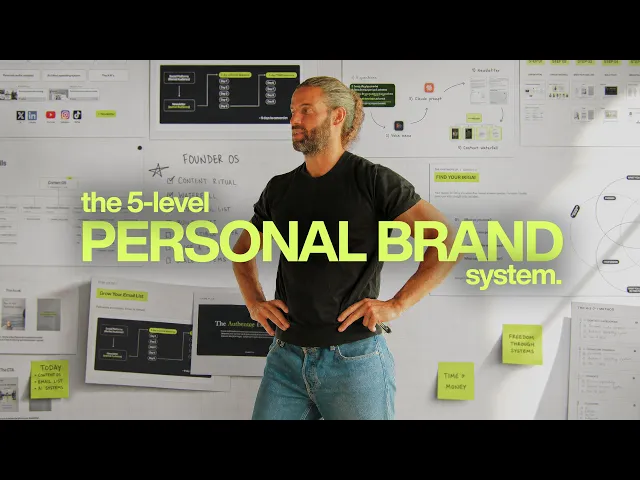
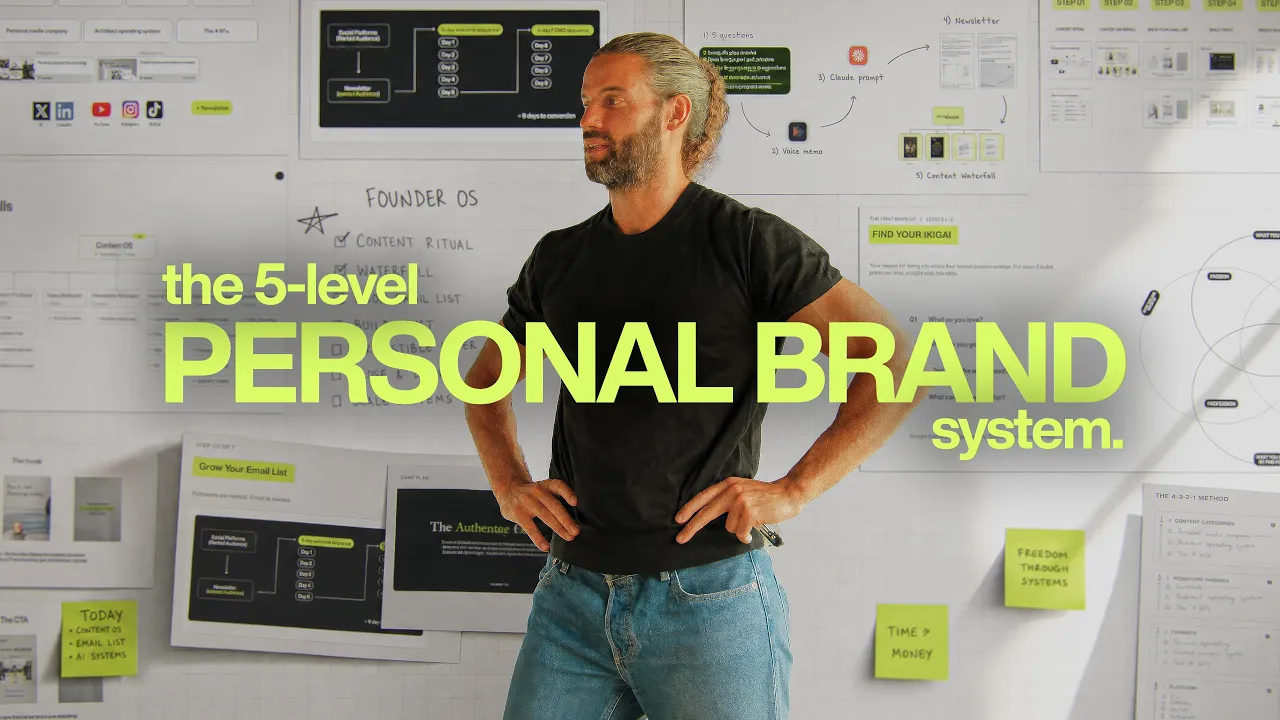
Most people think posting more is the answer. There are five levels to building a profitable personal brand, [music] and most of them get stuck at level three without ever realizing it. You know the feeling.
You open LinkedIn for the fifth time today, hoping the post will [music] finally take off. The brand is growing, revenue's up, and somehow you feel more trapped than when you first [music] started. I've helped over 17,500 founders build their personal brands.
I built mine over 3 and 1/2 million people, and it feeds a portfolio that does over $15 million a year. And I've watched the same pattern play out every [music] single time. The founders who get rich from their brand climb five specific levels.
By the end of this video, you'll know exactly which level you're at, the one shift that moves you up, [music] and then the single question at level five that tells you whether you've actually made it. And this works even if you haven't posted a single [music] thing yet. Let's go.
Level one, the dreamer. Level one is where every single profitable personal brand on the planet started, including mine. And I can describe you perfectly if you're here right now.
This is when you aspire to have a profitable personal brand for years. Now, maybe you have a note in your phone of all of these content ideas that you want to be making. But, week after week, month after month, you keep checking social media, and you see peers, you see competitors of yours going and blowing up because they're staying consistent, and honestly, they're just putting their messy selves out there.
But, meanwhile, you keep stopping yourself. [music] What is that exactly? What is keeping you back?
You've got limiting beliefs at this stage, right? You're worried about what other people will think. You're worried that it's not perfect enough.
You're worried about what your friends or family may say about you, and it's holding you back from reaching your full potential at the end of the day. Oftentimes, at this stage, right, to get over those limiting beliefs, one thing I think that's important to nail is your message. This is not something that needs to be overly fabricated because I believe that the best niche to go and create your own personal brand around is you.
One of the best mechanisms to go and discover what exactly that niche should be is your ikigai. [music] About 6 years ago, before I'd gone and started getting into my own personal brand, I was on Christmas Day driving through Banff National Park in Alberta, Canada. I swerved on a patch of ice, hit a snowbank, and there I was on Christmas Day stuck in the remote National Park with nothing to do.
I was stranded at a random motel in the middle of Jasper. And in my bag I didn't have much with me, but I did have a book called Ikigai. And so there I was cooped up in this motel, and I started journaling around, you know, what I love to do, what I'm great [music] at, what I can be paid for, and what the world needs.
And Ikigai is really this term that stands for your reason for being, right? That thing that really sets your soul on fire. [music] And so sure enough, I went and started then jotting down some notes at the intersection.
What I started to see were things like, you know, helping founders build their [music] brands, building distribution from day one, scaling communities, scaling audiences, building operating systems to remove myself from operations, writing, travel, design. These were the things that hit all four of those quadrants. It's inevitably then what I started building my own personal brand around.
You know, after discovering my own Ikigai, I started just leaning into creating content around the things that [music] I just genuinely love. And from all of that sharing around the stuff that I'm just naturally gifted with, that I love to do, my personal brand started to compound. What I want you to go do is go and fill out your own Ikigai, [music] and then start to try and find some common patterns there.
That can form the first epiphany you'll have here in this video in terms of then jumping to this next [music] level. And level two is sneakier because it feels like progress. Level two, the tinkerer.
The tinkerer now is getting going and sharing more of their reason for being and the stuff that really fires them up with their audience online. What they start to run into is starting to feel like they're just making everything for everyone. You know, you're being consistent with your content, but it feels like you're going an inch deep and a mile wide versus providing a lot of depth in your content that helps you create more of a die-hard kind of cult following around what you're doing.
The key unlock here is the 4321 method. We're going to go and come up with four content categories, three signature phrases, two formats, and then one core platform to focus on. Your four content categories are essentially the drumbeat of your profitable founder-led brand.
And so, the kinds of categories I talk about online are things like, you know, scaling a personal brand, removing yourself from operations, using organic content, and then time-saving systems. The next piece here is your three signature phrases. You can think of this almost like your content intellectual property.
So, for me as an example, I have phrases like building a personal media company. I talk about the importance of an architect operating system, not just being the engine of your brand, but an architect. Those few examples, right, are signature phrases.
Go and take a second and think about what could your three signature phrases be. When we come down to two formats, okay, the key thing here is that we want to go way more deep versus trying to create tons of different kinds of content. Say you're getting going on YouTube as an example.
It's helpful to think of a couple formats to start. When I went and got going on YouTube, I had my talking head how-to format, and then I also have a whiteboard format where I help different founders like Ali Abdaal, Blake Rocha, and others go and scale their businesses by helping them with a specific problem they're currently encountering. Pick the sort of format that works for you that fits your strength.
Now, when it comes down to one platform, here's the deal. Too many founders spread themselves way too thin trying to be everywhere to everyone. When I think about choosing a platform, I think it becomes pretty obvious whether you should be more pen-first or camera-first.
You'll know if you're pen-first if by nature you love to journal, you love to write. In that case, you may go and determine you're a pen-first creator, and then get going on platforms like X and LinkedIn with a newsletter. On the other side of things, maybe when you think about building your profitable personal brand, you really gravitate towards creating videos.
You're a video-first founder, right? And what you probably want to go and do is then focus on platforms like YouTube, Instagram, or maybe even Tik Tok. Again, with a newsletter because doesn't matter which route we go here, we want to make sure we're actually growing our email list.
So, no matter what level you're stuck at here, this is exactly what I helped founders with inside of Founder OS. >> We just crossed over 100k in revenue for January. We've never done anything like that in any company we run that high.
>> We installed the exact personal brand operating system that's helped me build a $15 million a year business and scale my own personal brand over 3 million and help thousands of founders do the same. >> What Matt put together with all the Claude stuff is nuts. This is insane value.
I showed my head of ops and he was laughing crying as he was looking at this. >> Helping you nail your message, your content waterfall system, helping you with your content ritual, scale up your team, and all the processes required so that everything doesn't fall on your shoulders. >> See, this is the kind of stuff that lights me up.
>> That's interesting. You want my help and my team's help scaling up your profile personal brand. Be sure to go and apply to Founder OS via the link in the description.
Now, here's where it gets interesting. Level three is the level I call the beautiful prison because from outside everything looks incredible and on the inside you already know something's wrong. When you're in this level, you've content going out, you've nailed your content categories, you've nailed your formats, your signature phrases, and you're starting to show up regularly.
But, what you're starting to run into here is founder chaos. It feels like the whole content strategy all comes down to you. You're there to make sure every post goes live.
You have content guilt at night sometimes thinking about what's that thing I'm going to write tomorrow or how am I going to go and get this newsletter out on Saturday. When am I going to go and film this next video. You don't have the right team in place yet.
You don't have the right systems to make sure it's able to scale without your time and effort. And the big way to solve this right out the gate is to get your identity right. One question that I think is a bit of a razor through this thing is, if you walked away from writing or from filming for 30 days, could everything run without you?
Most people answer that question and are like, "Hell no, it would all fall apart. " And you want to be able to go and pass the freedom test. You want to walk away from everything around your personal brand and be able to come back 30 days later to a brand that's still growing and stronger than when you left.
You know, I know I experienced this just 4 months ago when snowboarding with a few friends in Japan for 3 weeks. You know, I was enjoying the Japanese powder, relaxed, off my phone, and came [music] back, all the content was going out smoothly. We had a bank that was already, you know, off and to the races.
My designer was making sure that carousels were going out on Instagram. My video team had all of our content going out on YouTube. And my overall audience growth had been 25,000 across all platforms without me having to touch a button.
And the way out of level three isn't more content, and it isn't better content. It isn't even a bigger team. It's one identity decision.
And when I made it, my working hours got cut in half while revenue went up. Here's exactly what it looks like. Level four, the media company CEO.
Here's the identity decision. You stop being the creator of your personal brand, and you start to be the CEO of a personal media company. Same person, but a completely different kind of business.
A big piece here, right, is obviously the people you're putting in place, but the right people don't matter if your systems are not sturdy. And so, there are really four core systems that we need to have in place to get this right. First system is your content waterfall system.
The second is your content GPS. The third is your killer capture email flow. And the fourth is the $5,000 per hour rule.
The content waterfall system's going to allow you to take one core idea and turn that into 30 other pieces of content across each of the platforms. So, as an example, one pillar piece of YouTube content could become six short-form videos on Instagram Reels, YouTube Shorts, TikTok, [music] right? It can also become three different newsletters, and it could become 10 LinkedIn posts and 10 X posts.
The second system is your content GPS. This is the core infrastructure that's going to allow you to go and take a piece of content and make sure it actually is converting for you. So, the key thing here is that we want to go and move people from a rented audience across platforms like YouTube, X, and LinkedIn and actually go and make sure that we're owning those people >> [music] >> in our email list and then driving those people through to purchase.
We want to see it basically like an organic content funnel, right? Where we have contextual lead magnets across social that are then driving people to our email list and then really go and put great CTAs inside of our emails that then drive people to customers. This next system then is a magical system that allows us to go and make and print money while we sleep, the killer capture email flow.
Basically, what you want to have happen is that when people go and join your email list, over the first 5 days they're getting a welcome email sequence that's getting them, you know, a bit of an understanding of your vision, [music] your mission, your values, the kind of people that you serve, and how your product or service works. Then you have a four-email FOMO series or fear of missing out that's essentially going to go and more [music] hardcore sell people into what you do. So, at that point you're now maybe providing more detailed testimonials, you're giving people a picture of the impact you've had on others, you maybe sharing just specific case studies, and letting people know the next step they should be taking, which for some of you is a sales call, for others you maybe selling directly from an offer doc, which is what we're doing these days, or you maybe just converting people via landing page, right?
Any three of these will work, but you can imagine that over those 9 days now someone's joined your universe and you're almost immediately being able to convert those people to profits. Now, the fourth piece here is the $5,000 per hour rule, okay? This is where you really want to get intentional about where you're spending your time.
You are not going to be able to scale a profitable personal brand if you're just spending all your time on $50 an hour task. You should not be posting content, you should not be scheduling content, you shouldn't be replying to comments, hell, over time you don't even want to be the one interviewing all the people. You should be going and working on tasks that are $5,000 an hour type [music] task.
I'm talking about going and drafting new offers, coming up with more high-level content strategies, maybe going and building your leadership team, or going and figuring out some of your pricing architecture. These are the kind of things that are going to be high impact and you're able to then delegate, eliminate, or automate the rest of the things on your plate. And so, it's these four systems that allow you to go and start becoming that media company CEO.
Now, most founders think that level four is the summit, but it's not. There's a level above it and the founders there have something that can't be copied. It can't be competed with and it can't be [music] replaced.
And that question I promised you at the start, well, we're almost there. And by the way, everything I just showed you inside of level four, the waterfall, the GPS, the capture flow, is exactly what my team installs for founders inside of FounderOS. If you want us to build it with you, the link is in the description.
Level five, the iconic founder-led [music] brand. An iconic founder-led brand is one where a video from two years ago is bringing you clients on repeat. I think one of the biggest markers of it is when you don't have to sell people anymore.
People already come to you pre-sold and pre-swayed with their wallets open, ready to go and buy from you because your content and your brand has already done all of the selling. So, when I say pre-sold, I mean like you're literally selling people without having to get on sales calls. You know, in that case, you're running a pre-sold system essentially with an offer doc that people are able to just to go to your content, read your offer, and purchase your $5,000 or $50,000 thing without having to talk to anyone because your content is built up so much trust, they are [music] ready to buy.
So, when you have an iconic founder-led brand, right, you are really known for some core phrases, right? You are really that category champion. [music] And you see this with, you know, Mel Robbins and the five-second rule, James Clear and Habits, Ryan Holiday and Stoicism, right?
You see it with me and profitable personal brands. There's a core sort of phrase or category that you own in the mind of your dream customer. And the beautiful thing is that when you own it, it's going to travel through conversations because about 50% of marketing, right, is going to happen through word of mouth.
This is where, you know, you're putting out content and people are actively going and sharing it with 20 co-workers in their Slack. It's when you have people lining up to go and purchase from a launch from you. You have people quoting you on the streets without you ever being in those rooms.
At this [music] point, it's essentially like a snowball going and traveling downhill, right? It's becoming more of an avalanche and the word is spreading without you having to do anything. The key thing here is making sure that [music] you're keeping things fun and you're keeping a good point of view and revisiting your overall systems over and over because like any great thing, it's not something that you just set it and forget it, right?
You need [music] to stay with the times, keep your taste there, keep your formats fresh. And so, what you're going to want to do is make sure that so every 90 days right, you're auditing your content. What's performing best, right, doubling down on those content topics.
What's performing worst, removing those patterns. It's your kind of always keeping that obsession there. An iconic founder-led brand is doing the same thing.
Constantly experimenting with new formats, experimenting with new approaches, releasing new products and staying at the forefront of their given category. And so, it's that relentlessness, that delusional self-belief, that consistency, and that always pushing the boundaries that's going to keep you ahead of the rest of your competitors. So, the question, the one I promised you at the very start of this video, the one that tells you whether you've actually made it, here it is.
If you disappeared for 30 days, would your business be stronger when you came back? Whatever level you're at right now, I built something for you. The FounderUs Blueprint walks you through the exact systems that take founders from level three to level five and it's completely free.
The link is in the description. And if you want to climb that ladder with me, be sure to subscribe below because next week I'm opening up level five from the inside, the complete personal brand operating system that runs my $15 million a year company. All seven steps, [music] nothing held back.
I'll see you there.