hello and welcome to this edition of joint action [Music] this podcast is dedicated to all those out there who have osteoarthritis on the show we unpack the truths and demystify the myths about the disease and its management if you have joint pain and want to know more about how to manage it from the world's best experts you've come to the right place without further ado it is time to welcome your host david hunter hello and welcome to this week's edition of the joint action podcast where we have the opportunity to talk about something that i'm
sure is very near and dear to many of your hearts what does osteoarthritis pain feel like now obviously everybody is different and as it relates to today's topic osteoarthritis symptoms vary incredibly from person to person for example some people experience intermittent pain during physical activity whereas others experience constant pain and others a mix the pain that i tend to get in my right knee from my osteoarthritis is usually episodic and for the most part i've been fortunate that i've identified triggers that might lead to exacerbations of pain or that intermittent pain that we've described and
so hence i can avoid much of that from occurring now in addition to episodic versus constant there are lots of other descriptors used for osteoarthritis pain such as the character of the pain its distribution or location its severity and obviously as we'll focus on a little bit today its frequency in particular whether that is intermittent or constant and its new research into these patterns of pain that shown that different pain patterns experienced by people with osteoarthritis can lead to different clinical outcomes now if we could identify why some people have more constant or more severe
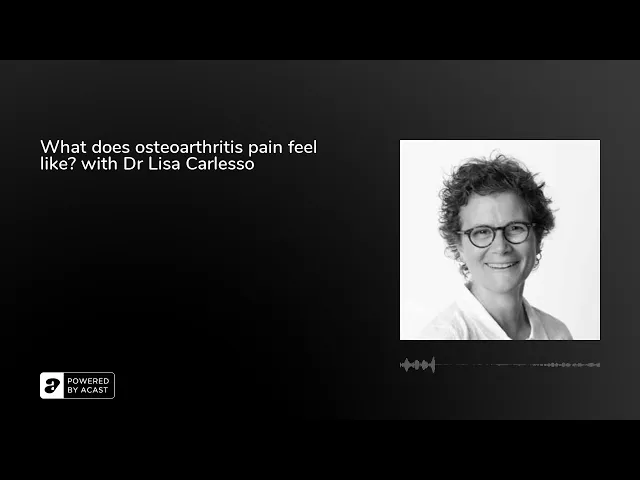
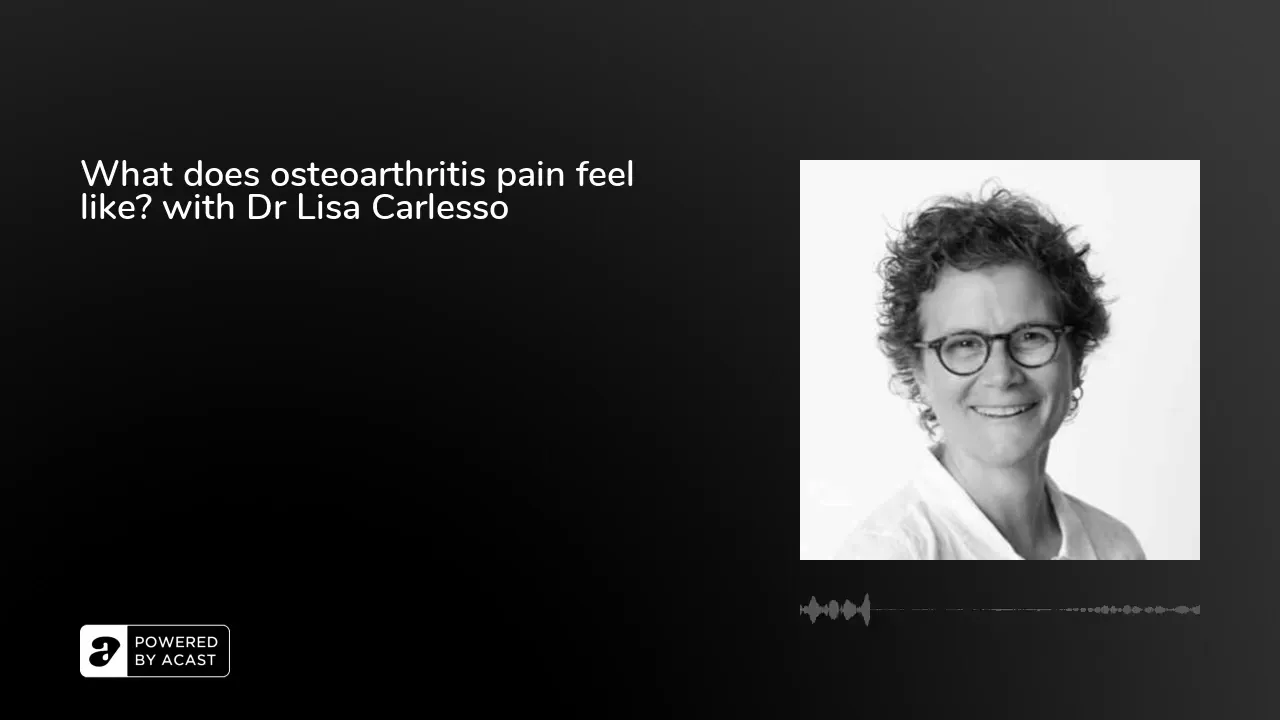
pain or identify the triggers for episodic pain it might provide insights on how we can better intervene and this promising area of research can help to enhance not only a person's prognosis and trajectory of their disease but also hopefully provide more targeted treatment even if that's just changing behavior or changing activity that might be triggering symptoms and in today's episode of the join action podcast we're joined by lisa calesso now lisa is a licensed physiotherapist and an assistant professor in the school of rehabilitation science at mcmaster university in ontario canada her extensive academic background in
physical therapy and clinical epidemiology have shaped her research interests in common age-related musculoskeletal problems such as osteoarthritis her most recent studies focus on improving treatment and outcomes for people with musculoskeletal disorders such as osteoarthritis and chronic low back pain lisa is interested in understanding the mechanisms and consequences of pain as they relate to disability mobility participation and healthy aging hello lisa and welcome to the show hello david thank you for having me oh it's a great pleasure i've been a huge fan of your work for a long while and it's great to have a chance
to to catch up with you and to talk a little bit more about what you do i guess in the first instance just to allow both myself and the listeners to get to know you a little bit better just wondering if you can tell us a little bit about your background and what a typical day looks like sure i like to think that i had kind of a bit of an atypical road to where i am now in that i i was a physiotherapist practicing for many years and i didn't start my graduate work till
about i think it was about 13 years after i had been working clinically and then it took me a while to do my phd because i didn't think that was the route that i wanted to go but eventually got there so yeah i worked actually about 25 years clinically in total before i became a full-time researcher and academic so now i spend most of my days doing research i used to teach a little bit more but thanks to a career award i'm doing that a little bit less right now and for the next few years
and i get to focus on research more which is great but i do still spend a bit of my time teaching entry-level physiotherapy students but the majority is on research and supervising graduate students and then i also have some administrative duties which i'm really actually quite involved in making sure that the curriculum that we offer in our program meets national standards and and stays at a high level so that takes up a bit of my time as well sounds like you have an incredibly full plate um and i'm very much of the adage that all
good things take time so i'm sure all those years working as a clinician hopefully you've flavored a little bit of what you do do you think it has changed your perspectives in any way does it color what you do i think it's been just incredibly informative because you know i often think back to my days as a clinician right and those those interactions those conversations i would have with patients and i think it really helps keep my research i hope clinically relevant and at the end of the day that's always my goal is that even
though i know some of my studies aren't immediately translatable for clinicians i'm always working towards that goal that if it takes me five or six studies on a certain line of inquiry to get to that point then that's what i want to do but i think that's really kind of the most important thing when we're doing clinical research is that it benefit those healthcare workers that are on the ground yeah yeah wonderful and for the patient population that you previously looked after as as a practicing physiotherapist why did you choose osteoarthritis in terms of your
career research goal was there something that you saw something you did what was it it was actually a bit of a fluke i'd say so i became increasingly interested in pain during my phd because my phd was not at all to do with pain and then i decided that i really wanted to focus my postdoctoral studies uh in that area but instead i was going to focus on low back pain and that's where i started out but i was post-talking with you may know elaine aileen davis yeah and so she's obviously a big knee osteoarthritis
person and so she was slowly like hey look at this you know and teaching me about all the interesting things about neo-a and and then she uh put me in touch with tahina and the ogi and said hey if you're interested in pain you've got to collaborate with tina and so that was born and then off we went and i just really became fascinated with how complex the pain in this population is and and we know you know it's not well managed and there's no cure for it so that really drives me in trying to
move things along oh well it sounds like a very tremendous journey that you've been through and it sounds like eileen's been a fantastic influence as well so applause to her for uh for driving you in this direction and to tahina as well yeah i'm very grateful now when you're not doing your day job what do you like to do i love to hike and i love to be outdoors i'm fortunate that really just very close to me like a couple of blocks we have access to trails in the forest so i like to to get
out there as much as possible or take weekend trips to just set out and hike for the whole weekend kind of thing i find it very very good for the soul tremendously good and cannot agree with you more i wish i could do the same and walk out of my back door onto a trail somewhere but living in the city it's not quite the same but i i am a little bit spoiled where we live we do tend to walk most days but i don't think it's necessarily in the wonderful forest that you're probably walking
through no but you you have beach i'm sure very close at hand yeah i'm spoiled i'm not complaining now lisa if you had to describe yourself in five words what would they be i would say i'm very passionate about my work and that i think i'm a caring and pretty honest person and then i would say that i am well as i just said i love being outdoors and i love good food [Laughter] sounds tremendous sounds tremendous all wonderful qualities now obviously the main content of today is talking about osteoarthritis pain and what patients and
people who have osteoarthritis experienced from their disease but i just want to start by i guess framing the content a little bit and ask you to tell us what a phenotype is and what particularly is a pain phenotype yeah so you know phenotyping has become a really hot topic in osteoarthritis in the last few years as you know and and i would say even generally more broadly in musculoskeletal pain conditions and i think the easiest way for people to think about it is that it's kind of the interaction of our genes with our environment and
that ends up including a bunch of different areas like our physical form our physiology our biochemistry our behavior all these kinds of things so there's kind of all these little subheadings underneath that but broadly if you think of it i think as as that interaction then that's kind of a simple way for people to imagine it pain phenotype i would say a little bit different and that there's only been kind of one group that i know of that has kind of tried to define that so that's a it's a research group called impact and they
kind of took you know the kind of basic definition of a phenotype and extended it to say that it includes patient self-reported characteristics patient reported symptoms and a patient's verbal or behavioral responses to standardized provocation when they're referring to particular tests that we do to to test a person's sensitivity to pain so that's kind of how i would define a pain phenotype oh it's very useful framework particularly for the remainder of the conversation now everybody's different who has an experience as osteoarthritis but there are lots of different descriptors that are used for that pain in
the work that you and others have done what are the different types of pain that are experienced by people with knee osteoarthritis yes so a few years ago it was actually dr dr jillian hawker out of the university of toronto here conducted many focus groups with people with knee osteoarthritis and asked them to describe their experiences and from that study they were able to say that people prescribed intermittent pain constant pain or a mix of the two and they further related those descriptors to where they were in the disease process so people who had intermittent
pain tended to be more early on and they described it as being sharp and it kind of came and went and was often related to activities that put some type of stress on their knees so maybe somebody goes out for a jog or maybe they've spent the afternoon gardening and pushing on a shovel you know loading the knee and that might bring that on and then they described that as they kind of moved along and the disease got a little bit worse the pain would become more constant and that they described as being more achy
and dull in nature and wasn't necessarily related to any particular activities it was just more there all the time and then as a further progression that intermittent pain would come back and kind of overlay on top of the constant pain but now it would be a little bit different in that it would still be sharp but it would be quite intense and it would be very unpredictable so it wouldn't be related to loading the knee it could just show up randomly and people described that as being a bit distressing because they couldn't necessarily relate it
to their activities or what they had done those were kind of the three groupings and according to disease progression that that came of that and they were able to create a questionnaire to quantify that those experiences and so we did some studies that have used that questionnaire and assessed these different pain patterns in different ways that's tremendous just to dig into that a little bit further from memory some of jillian's earlier work there focused on what was more distressing for the people who were experiencing pain and again i think the intermittent experience was the one
that was more distressing than the constant background pain is my recollection right i think so and i think even in the earlier stages my interpretation of that would be that when you have intermittent pain and even if you can kind of predict when you're going to feel it because you don't have it all the time i feel like when you feel it you feel it more intensely versus when you have pain that's there all the time particularly if it becomes kind of like a background pain i think you habituate to it and so it doesn't
feel as intense necessarily and maybe it goes up a little bit and goes down a little bit but it's kind of there all the time and so you're used to it but it i think it's more alarming to us like i said even if we can predict it to suddenly have pain just arrive and be sharp and even if it goes away quickly it's still a bit of a shock to our nervous systems that way yeah and for those listeners who want to learn a little bit more about episodic pain or pain flares and the
type of pain that lisa is describing there just listen to martin thomas talk about some of those flares that he's described in in his particular podcast now i guess just one other qualification too for the comments that you made about what the triggers might be for that episodic pain um this is really about i guess trying not to let people think that activity is a bad thing but it's oftentimes the unusual activity that a person may not necessarily be otherwise accustomed to and load an activity would otherwise typically be a good thing wouldn't it lisa
absolutely absolutely and thank you for raising that point yeah so when i'm talking about activities i'm talking about things that you don't normally do in your normal day-to-day versus again that's another part of the constant pain is that it is aggravated by simple activities such as walking whereas it takes a little bit more from that for the intermittent pain so more more loading more stress on the joint than you would normally do in your regular course but again really important to emphasize that even though there may be some pain associated with some of these things
you're not necessarily damaging your joint and in fact it's healthy to expose the joint to this type of loading it helps with the nutrition of the joint and so i know that's a bit confusing for people to think well why am i getting pain if it's actually healthy for my joint and that's part of what we're trying to understand and figure out but yes that's it's a really important point for people to hear yeah now you've spoken a little bit about disease duration as it relates to episodic versus more constant pain but what are the
proposed mechanisms that underlie these different pain patterns other than disease severity yeah so we have looked at what we call you just referred correctly to pain mechanisms and that kind of refers to people's nervous systems and how sensitive they are to pain and painful stimuli as well as their ability to modulate pain and so we have a number of tests that we do in the lab that test the sensitivity of the nervous system and that gives us an idea of you know we are able to compare people how sensitive their nervous system is and so
we see that people who have a greater sensitivity to pain tend to have higher pain intensity and in terms of the pain patterns they're more likely to have that mix of constant and intermittent pain compared to having only intermittent pain or no pain so the more sensitive you are not only the more kind of in intense pain you'll have but you'll have it more consistently as well and that's makes sense to us because the sensitivity in our nervous system it actually makes it it's like our thresholds our tolerance for these different stimuli that might not
normally cause us pain are actually lower and in in this circumstances end up leading to pain when maybe they shouldn't be and so there's that kind of you know lower threshold or flexibility if you will in the in the system that that can lead to that yeah so it's a wonderful explanation and and i guess just to expand on that a little bit further so you've done tests in the laboratory that look at pain thresholds related to pressure so when you're actually pressing on uh individual parts of the body and that increased sensitivity that you're
describing is not only local to where the pathology and the joint may be but also somewhat distant to that is it is that correct yeah and that's what i was referring to when i think i said a moment ago about the peripheral and the central nervous system but so we have a part of our nervous system is more in our limbs our peripheral joints if you will and then our central nervous system which is more in our spinal cord in our brain and so what we do is say in the case of of the knee
we test locally at the knee to get an idea of how the peripheral nervous system might be responding and then we'll test somewhere farther away typically it's in the forearm or something like that to get an idea of how a part that's remote and is connected via the central nervous system might be responding and so that tells us then that the central nervous system would be involved as opposed to just the peripheral superb now obviously we've spoken about sensitization we've spoken about disease duration are there other factors that might predispose someone to have more constant
pain yes so just coming back to this mechanism piece again the other piece that we looked at was people's ability to modulate pain and this was a really surprising finding because we had kind of thought well if people are modulating their pain well they should have less pain that seems to make sense but in fact we found that people who had more constant and intermittent pain actually were the ones who were modulating the most efficiently and that really kind of confused us at first we thought well that's really opposite to what we were expecting but
you know we were thinking about it we thought well i guess it makes sense if someone is in constant pain all the time this system that we have that's built in to help modulate our pain experience would be and fully engaged because of the fact that we are experiencing pain very consistently so so that's kind of how we interpreted that that the more kind of constantly we are in pain that that would demand our modulating system to be turned on and to be working very hard superb superb now what role if any does disease or
structural severity play in what you were talking about yeah so that was another thing that we looked at and and i know this is always a kind of a controversial point because we always say you know pain is not related to your x-ray finding necessarily and we have lots of studies to support that that they're not very strongly correlated but what's important to i think realize here the difference is that most of those studies have been talking about pain intensity and i'll talk about that as well in a second but and pain intensity is very
different than talking about whether a pain is intermittent or constant so these are more qualities or descriptors of the pain beyond intensity and they give a different you know flavor to it so to speak so what we found again was that very much how the people had described you know that when if i have intermittent pain i've got early disease and and then constant a bit further on and constant and intermittent is is more end stage we saw this when we compared x-ray findings with this reports on this questionnaire that had been developed and we
found that basically people with more severe change on their x-ray were more likely to report having constant and mixed pain compared to people who had intermittent pain and those people had the much lower severity on their x-ray so that was a really neat finding that kind of confirmed what these hundreds of people with neoa had told us in the focus groups so you know then we had data to support that which was great well there are other factors that we should mention in this conversation as well lisa you know whether it be depression socio-economic circumstances
other factors yeah so we haven't looked at those specifically in terms of these pain patterns that we're talking about that would certainly be something to to consider i think it's a really good point and that pain is a very complex construct and it has multiple aspects to it so it's not just about disease severity and pain intensity there's lots of things that shape the pain experience for people as you mentioned things like depression or our mental health our overall physical health you know if we have other chronic conditions that we're dealing with that could impact
it how much social support we have you know there's people that live alone or who are particularly lonely you know might have more pain and stressors in our life like socioeconomic status or trauma things like this they've all been shown to have a direct impact on an individual's experience of pain so what's really important to take those things into context each and every patient that sits in front of you it's not just a number of 0 to 10 on a you know a numeric rating scale and looking at the x-ray and trying to interpret why
that person might be having the amount of pain that they are there's lots lots more to it yeah i think that's really really helpful because i think as clinicians we often have a tendency just to to measure that zero to ten scale but not necessarily to dig into the reasons why um and i think for for people out there who have osteoarthritis there's lots of different reasons why you may be experiencing more or less pain than a person who may have a similar duration of disease and similar x-ray changes and and other factors now a
recent study that you did lisa you were doing this in people presenting to an orthopedic clinic and i think it was a consecutive series of people who are presenting for orthopedic consultation do you want to describe i mean you've already started but you want to describe a little bit more about what the tests were that you did and what you found yeah so as you said we're recruiting people who are having their first consultation with an orthopedic surgeon and we did a number of tests we had several questionnaires that we used and they covered a
number of constructs that are related to the pain experience so things like depression something called pain catastrophizing the presence of neuropathic pain looked at fatigue sleep quality somatization we looked at a person's pain intensity as well as their pain variability over the course of a week and then we did a bunch of laboratory tests like we were just talking about to assess the sensitivity of people's nervous systems and so we had a number of different variables and we ran a statistical model that basically puts people who are similar into different groups and that allows us
to create profiles of people with the goal of providing more personalized treatments right either more personalized prognosis of how this person is going to do down the road or more personalized treatment in the short term you know so someone who has a much lower pain burden will require less intervention than someone obviously who has a much greater pain burden and that's kind of the premise behind it and so we found three groups and those groups were largely defined by the self-report questionnaires that we use in fact all of them with the exception of two categories
which was i believe pain variability and the depressive symptoms were all significantly different across the three groups and then interestingly in terms of the laboratory tests again we know we did a number of them and we only found that one of them was different and that one's called temporal summation and it's an indicator of the sensitivity of the central nervous system i think because of the i'll say the reliance of these groups on the questionnaires in their kind of defining qualities i think that's that's a promising finding in their clinical utility uh down the road
but as i said you know this is this is kind of a line of research and i know you're well familiar with this that it takes multiple steps before we can actually get to a point where we can implement these phenotypes into clinical practice so so we're still a little bit away from that but that's the end goal um and yeah the other things i'll just mention is that we looked at characteristics of the groups and we saw that women and people who were a little bit younger as well as people who had lower levels
of self-efficacy and optimism were more likely to be in the more severe group and then we looked at the relationship of these groups to some outcomes one of them being healthcare visits in the past two years and we found that the most severe group had a 240 increase in health visits compared to the mild group so that was really interesting and we used actual health care data from our provincial data registry to do that analysis so it wasn't using you know self-report by the patient about how many times they saw their doctor or something that
was actually using like billing data so as you say i think reassuring that a lot of the ability to classify those people into the different groups was obtained from questionnaires because i think a lot of the expertise that you talk about whether it be looking at pain sensitization centrally or peripherally or or modulation is i wouldn't say constrained to highly proficient labs but it is a lot more difficult than getting questionnaire data what do you think was different about the findings from this study to the previous findings that you'd had for example in the most
observational study and how might you explain those differences yeah so we did a similar study as you know um but we called those that study we referred to to those people as pain susceptibility phenotypes and what we mean by that is that we initially took a group of people who were essentially pain-free and even though they might have had signs of arthritis on their x-ray they didn't have a lot of pain and then we looked at the relationship of the groups that we came up with to who developed persistent pain two years later so first
of all a big difference is that these people were pain-free and the group that i just studied you know they were coming to see an orthopedic surgeon and therefore had pain probably pretty uh regularly and the groups that we found in the pain susceptibility study i would say we're almost completely opposite to what uh we just found in that they were dominated by the lab tests and we really found almost no differences at all in the questionnaires that we used and one of the groups that kind of was shown to have the most sensitivity in
their nervous system they were twice as likely to develop persistent pain two years down the road so that really showed us that this sensitivity in our nervous system is an important mechanism even before we're experiencing a lot of pain on a day-to-day basis that can lead to the development of persistent pain down the road for us so it's a it's a really good target for us to be working with to help improve pain management for people tremendous explanation now what we'll do is we'll include some of the links to lisa's references in the show notes
for people who want to dig a little bit further into that but are there other resources that you'd like to point people towards lisa or any other comments around the topic that you'd like to make i think just as far as resources are concerned i always think that people's national arthritis associations are really great resources here in canada we have the arthritis society and i know they just have tremendous amount of things for patients i also really like the group at unc in the states and the uh osteoarthritis action alliance and i know that they've
just come out with some new oa i think it's oa care tool i think it's called i'd have to double check but they they're always kind of updating and and their resources and trying to improve on things so i uh i highly recommend them it's fantastic all right now we're going to get into the rapid fire round if that's okay and you're still comfortable and okay i'm scared this is a less formidable audience than most conferences you go to the intent here is i'm just going to throw something at you you just come back to
me with a quick response favorite book that would be a fine balance by rohinton mystery i haven't heard of that one have to look it up favorite movie princess bride hands down okay dog or a cat person dog i have two i'm there with you i don't have two but i'd like to have two favorite quote i don't know that i have one um but generally i would say anything by pema children who is a buddhist nun wow fantastic yeah and she does she has several books that i've read and and really enjoy her so
what's your favorite food that would be my mom's lasagna design is a great one isn't it now do you have a bad habit i would say this this goes back to the dogs i watch a lot of funny videos about french bulldogs because i have to and i find them extremely funny so i probably spend too much time watching when i should be working where would you next like to go on holiday covered and other disasters aside i would say maybe costa rica or spain i haven't been to either of those places sounds superb now
what superpower would you have if you could have any oh that's easy i i would like to fly and that's related to the fact that if i had to come back as an animal i would want to be a bird i hate heights so you're much braver than i am if you could meet anyone dead or alive who would it be i think probably someone like martin luther king or gandhi people who really were you know change makers in their time yeah and if you could have all the money in the world and it was
not an issue what would you do i would travel and i would travel probably just around the world spending different time with different non-profits trying to do good you're an inspirational person lisa so because i haven't managed time particularly well i'm going to skip through some of the remaining questions and just focus on a couple but why do you do what you do what motivates you well i i think as i said earlier you know we don't have a cure for pain in me in a way well i mean oa in general and i actually
i live with an arthritic knee so i i know the impact that it has but i see the impact that it has on people's lives and when we have pain in our our knees in particular we don't want to move and when we don't move that leads to other health problems and and it can um really complicate things as we're getting older and so i think you know if we can focus on trying to find a cure for the pain and improving pain management for people then downstream that's going to help them in so many
other ways to remain active and healthy as they age and enjoy life it's uh much needed and a tremendous motivation i hope you continue to do what you're doing and if there's one piece of advice knowledge or wisdom that you'd like to give for people who have osteoarthritis what would it be i would say you know to remember like as we were talking that pain is very complex complex thing and that it has you know emotional and cognitive and physical parts to it social parts to it we know we're all preaching about the importance of
exercise and staying active keeping your joints strong but it's not i'd say it's not so simple as just that if you think of it in the turn in terms of pain the reason that all of that is so important is because exercise helps provide so many of those things it helps improve our mental our physical health it it gives us social connection you know it gives us so many things and all of those things can help improve our pain that's the thing i guess i want people to understand is stay active no matter what stage
of the disease you're in and realize that doing so kind of ticks all the boxes on trying to figure out that complex pain piece yeah a wonderful wonderful proactive way to end and hopefully a really good message for everybody who's listening out there and getting proactive about your health particularly as it relates to exercise but you know lots of other things that people can do as well now lisa thank you so much for spending a little bit of time with us sharing those really important insights and for the wonderful work that you do it's been
a privilege to have a chat to you it's been my pleasure david thanks so much for the invitation now i'm hoping you found the content of today's show helpful and in particular provided you with a better understanding of the different types of pain characteristically experienced by people with knee osteoarthritis now again just to reinforce everybody is different and your experience of pain may be very different from the majority but in typical circumstances early in disease the pain is characteristically intermittent so self-limited usually lasting for a few days often exacerbated by an activity or unusual behavior
that a person oftentimes is unaccustomed to doing in the latter stages of disease pain may become more constant with fluctuations on that background now as lisa's expanded on today there are lots of different reasons why that pain may become more constant including factors around the duration of which you've experienced these symptoms for the severity of the disease in addition to features that oftentimes are measured in the laboratory including aspects related to your sensitivity both peripherally and centrally and how you modulate that experience of pain or play a role in whether your pain experience is more
constant or intermittent or episodic now as mentioned everybody's experience is a little bit different but hopefully as also lisa expanded on today insights gained from this research may provide information that we can better intervene on and prevent people from having a trajectory that leads to constant background pain there's lots of factors that are probably within your control in influencing your pain experience including your moods your weights and other factors that i would encourage you to learn more about and hopefully intervene on as well again hopefully you found the content helpful and informative i appreciate the
time that you've spent listening and supporting the show thank you very much for the privilege and opportunity to speak with you and between now and when next you hear from me please do take care of yourself and if you have the opportunity someone else as well thanks and goodbye [Music] thanks for listening to joint action with david hunter if you like our show and want to know more visit www.jointaction.info if you have any questions you can email us at hello at jointaction.info and follow us on twitter at jointactionorg this podcast was hosted by david hunter
edited by vicky dwong music produced by jordan hunter the information posted on this podcast is not intended to diagnose treat cure or prevent disease anyone seeking medical advice should consult the health professional [Music] you