This question comes from Shawn, who asks, "What would happen if you were to gather a mole, the unit of measurement of moles, the small furry critter, in one place? " There's no way to sugarcoat it. Things get gruesome, unless you have a really long time to wait.
First, some definitions. A mole is a unit. It's not a typical unit, though.
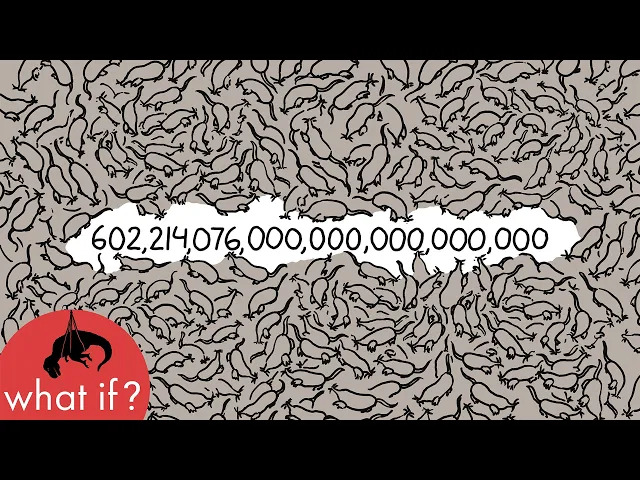
It's really just a number like dozen or billion. If you have a mole of something, it means that you have 626illion, 214 quintilion, 129 quadrillion of them, which is usually written 6. 022* 022* 10 the 23rd.
Uh, whoops. Nope. Update.
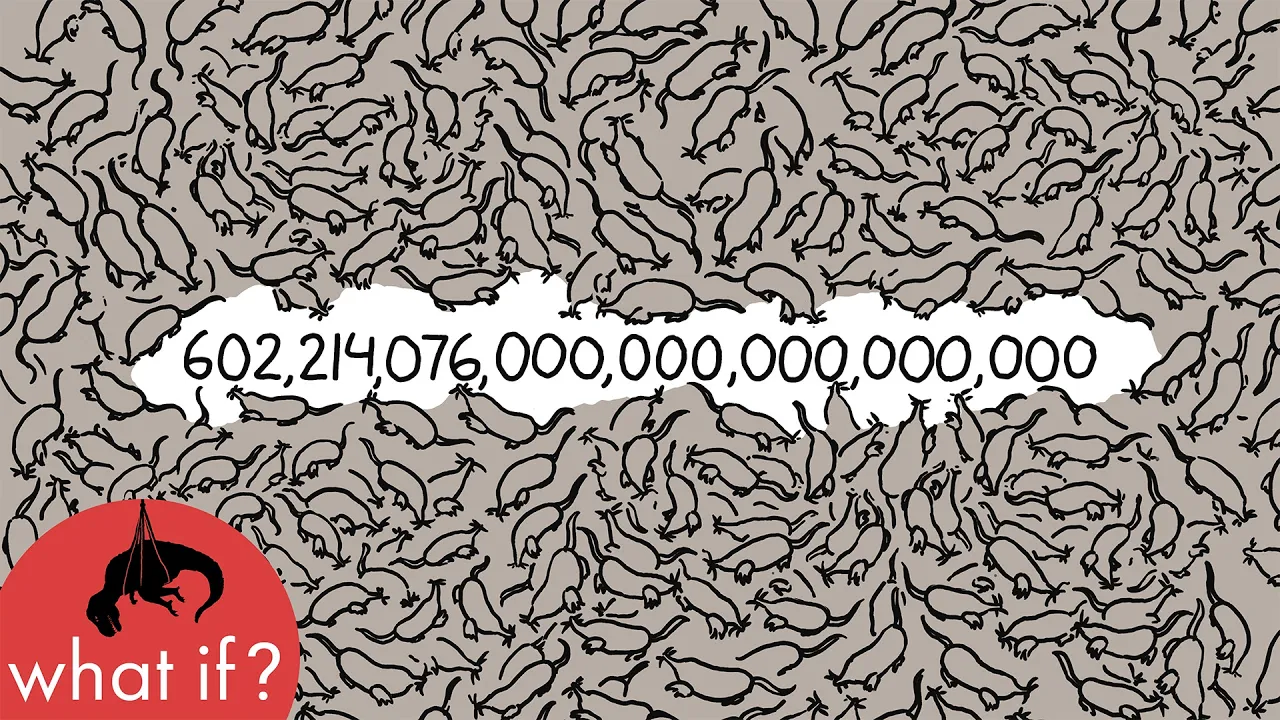
The SI recently redefined the mole based on more accurate measurements. And now it's 626 214 quintilion 76 quadrillion. Put one way, a mole is now 53 quadrillion less than it used to be.
Put another way, a mole is now 0. 00009% smaller than it used to be. Either way, a mole is such a big number because it's used for counting numbers of molecules, which there are a lot of.
One mole is by design close to the number of atoms in a gram of hydrogen. It's also totally by chance a decent ballpark guess for the number of grains of sand on Earth. A mole is also a type of small burrowing mammal.
There are a handful of types of moles and some of them are horrifying. I mean delightful. So what would a mole of moles 6264 quintilian 76 quadrillion furry mammals look like?
First let's start by trying to do a wild approximation. That's the kind of calculation where 10, 1, and 0. 1 are all close enough that we can consider them to be basically the same number.
Let's say I can pick up a mole, the animal, and throw it. I've never tried this, but I assume I can. Let's assume anything I can throw weighs 1 lb.
And 1 lb is basically 1 kg. The number 626214 quintilion 76 quadrillion looks like it's about twice as long as the number 1 trillion, which means that a mole of moles is about a trillion trillion kg. I happen to remember that a trillion trillion kg is about how much a planet weighs.
If anyone asks, I did not tell you it was okay to do math like this. Our estimate could be off by a factor of thousands in either direction. But it's enough to tell us that we are talking about a pile of moles roughly on the scale of planets.
Let's try to get some better numbers. An eastern mole weighs about 75 g, which means a mole of moles weighs 4. 52 * 10 22 kg.
That's a little over half the mass of our moon. Mammals are largely water. A kilogram of water takes up a liter of volume.
So, if the moles weigh 4. 52 * 10 22 kg, they'll initially take up about 4. 52 * 10 22 L of volume.
If these moles were released onto the Earth's surface, they'd fill it up to 80 km deep, just about to the edge of space, or where the edge of space used to be before all the air was displaced by moles. This smothering ocean of meat would wipe out most life on the planet, and it would really mess up my I naturalist wildlife sighting stats. [music] So, doing this on Earth is not a good option.
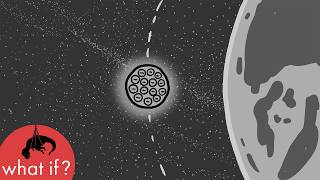
Instead, let's gather the moles in interplanetary space. Gravitational attraction pulls them together into a sphere. Meat being mostly water doesn't compress very well.
So, we end up with a mole planet that's a bit larger than the moon. The mole planet is larger than the moon, even though it weighs around half as much since water is much less dense than rock, which you can demonstrate by throwing a rock into the water or noticing that the ocean stays on top of the Earth's surface. The mole planet has surface gravity about 1/16th as strong as Earth's.
That's similar to that of Pluto. Throughout the majority of the planet's interior, the pressure is over 100 megapascals, which is enough to kill all bacteria, leaving no microorganisms to devour the mole tissues. The mole bodies gradually break down into keragen, a mush of organic matter which would, if the planet were hotter, eventually form oil.
The mole bodies form a literal fur coat, which insulates the interior of the planet and slows the loss of heat to space. Convection in the liquid interior means that plumes of hot meat and bubbles of trapped gases like methane, along with the air from the lungs of the poor deceased moles periodically rise through the mole crust and erupt volcanically from the surface. A geyser of death blasting mole bodies free of the planet.
I told you this would be gruesome. Eventually, after centuries or millennia of turmoil, the planet calms and cools enough that it begins to freeze all the way through. All told, this is a pretty bleak picture.
Let's try an alternate approach. I don't have reliable numbers for the global mole population, but we'll take a shot in the dark and estimate that there are at least a few dozen mice, rats, and other small mammals for every human on Earth. There might be a billion habitable planets in our galaxy.
If we colonize them, we would certainly bring mice and rats with us. If just one in a hundred were populated with small mammals in numbers similar to Earth's, after a few million years, not long in evolutionary time, the total number which had ever lived would surpass 6. 022 * 10 23rd.
So if you want a mole of moles all in one place, and by one place you mean the universe, build a spaceship.