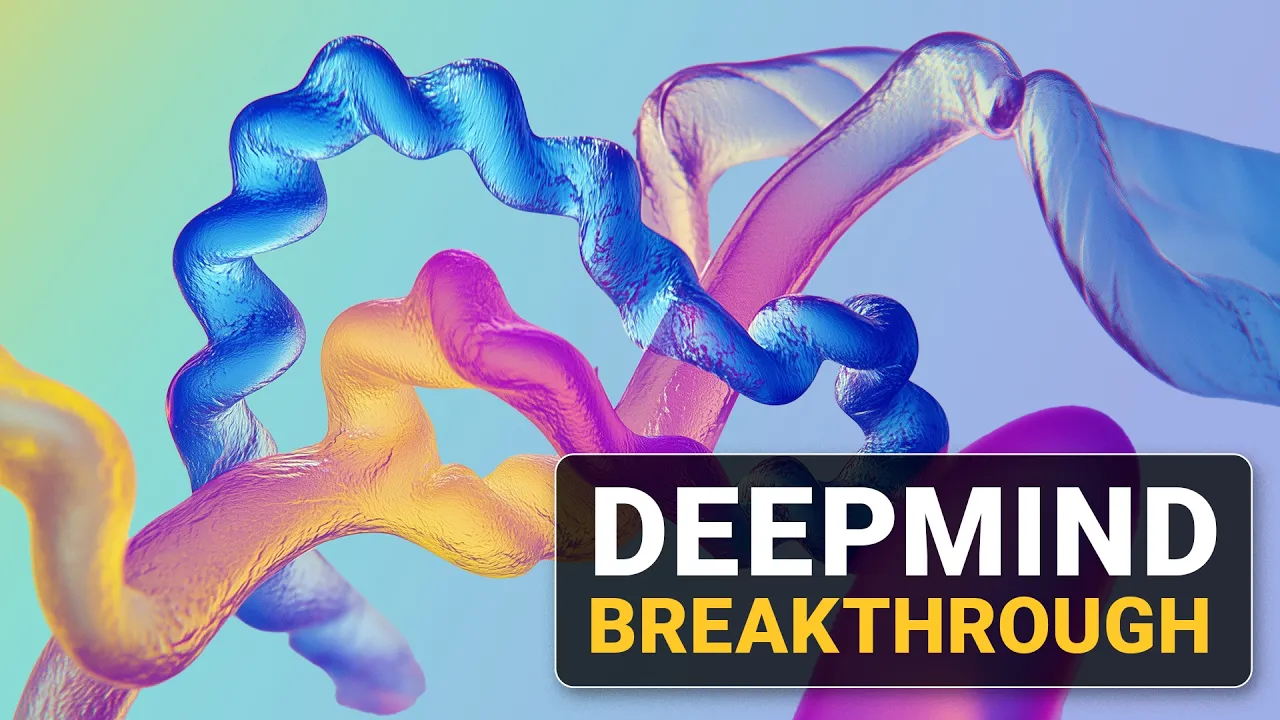
Today an absolutely incredible paper appeared from Google DeepMind, and I had the honor of having an exclusive look at it a little earlier to spend some quality time with it, and I am completely stunned by the results. I think we might have a medical breakthrough on our hands. So what is this?
This can be thought of as a new paper in the AlphaFold family. AlphaFold was about protein folding. A protein is a string of amino acids, these are the building blocks of life.
This is what goes in, which in reality, has a 3D structure. And guessing that structure is protein folding. Letters go in, a 3D structure comes out.
This problem was brutally hard, and their AlphaFold AI did so well at it that we can say that protein folding today is a mostly solved problem. But that is still not the full picture. Something is still missing.
But what? Dear Fellow Scholars, this is Two Minute Papers with Dr Károly Zsolnai-Fehér. So, AlphaFold understands how to predict the structures of proteins, and this new AlphaProteo is their first AI system that "understands how to design" proteins.
The AI designs these little blue things you see here, and this can recognize and bind to a chosen protein. This is extremely important, and if it is any good, it may have relevance to drug development, cell imaging, and even creating more resistant crops. This would be a huge deal.
So, is it any good? Let’s have a look together. Of course, other techniques already exist to do this.
These traditional techniques are super time intensive, they require lots and lots of lab work, and then, finally, they need to be tested in a lab to make sure that the new binder sticks to the protein really tightly. But here, with the new technique, you give it a target molecule and a preferred binding location, and it does its magic. Okay, great!
But is this new one any better, or does this just have a shiny AI badge and that’s it? Well, hold on to your papers Fellow Scholars, because when I saw this I couldn’t believe it. First, its newly designed protein binders are three to three hundred times better than previous techniques.
Whoa! It even works for cases where existing traditional techniques are unreliable, and this particular protein is connected to absolutely terrible diseases. And this is an AI that can hopefully help with those too.
Wow. The other wow is the affinity scores. Lower affinity means that the designed binder protein binds more tightly to the target.
The shorter the bars, the better the technique works. And in this area, it is also spectacular. Way ahead of previous methods.
But I still have a problem. I saw many medical AI papers that work in theory. Okay, in theory, things are always looking great.
But unfortunately in practice, almost nothing works. That is the problem. Nothing really works.
So maybe they also tried…wait a minute. They have established their own lab a couple years ago. Is it possible that they already tried to verify their designs there?
Oh yes, that is exactly the case. Absolutely fantastic. So what is the result?
The result is unbelievable! Goodness, the success rate in practice is verified in the lab and it is between 9 to 88%. That is absolutely incredible.
I really believe this can finally put AI Biology models one step closer to treating terrible diseases that we, with our current knowledge, cannot treat yet. And today, with the help of AI research, breakthroughs like this happen not every decade, and not even every year, but almost every few months now. And here is the best part: they give this to all of us for free.
Yes, the research paper that contains tons and tons of details on how to perform this is freely available. A great gift to humanity. Thank you!
What a time to be alive! Also thank you to the scientists working on this paper for double-checking my facts here. This way, we can ensure that you get accurate information.
So, what do you think? What would you Fellow Scholars use this for? Let me know in the comments below.
This might be the very first video on the internet about this paper, and if you don’t want to miss out on what’s coming next, make sure to subscribe and hit the bell icon.


![I Replaced ALL my ADOBE APPS with these [free or cheaper] Alternatives!](https://img.youtube.com/vi/5EfqHg49kMk/maxresdefault.jpg)