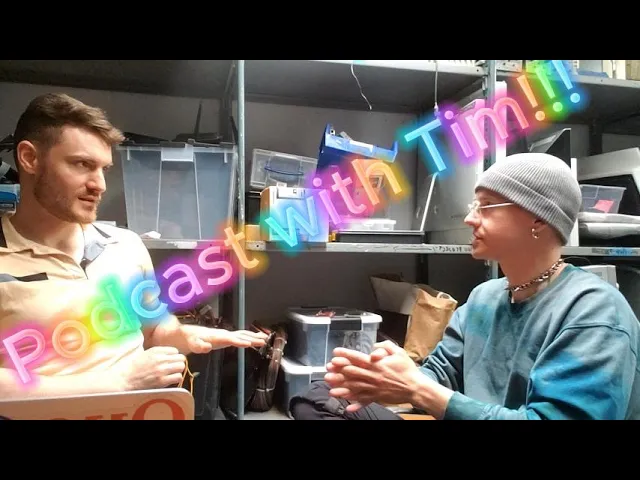
On it. I want to say one more time. So he said if there is I'm going to come sit next to you and I'll put this here and you can try. You don't have to I don't know. I don't know. I don't know how little you were thinking about you. Yeah. Yeah. So the camera's going to be facing us, but if you want to, you could also come In frame. Do you need to plug in at all? [Music] [Music] I'm plugged in. What was the last thing you were saying? So, we were talking about I
guess intuitive exploration like how people discover what is discoverable before they have discovered it. And you were mentioning the periodic table. expos. It's also true in ecology that Whenever you find whenever you can observe a niche um you know that something must inhabit it like if there is an available resource ecosystem something will be benefited from it because available resources are constructed by that ecosystem. We didn't have if there wasn't maintaining that resource it wouldn't remain a resource it would get converted by other organisms in ecology into something else Like order resource structure it's it's
more of an emergent thing than it is okay so forgive me I honestly didn't know what ecology means ecology is just like so you have like anatomy which is a study of organisms like the heart biology is a organisms by watching them behave. You have ecology which is a study of organisms interacting basically understand it. I like this description. I feel like an academic would not use these scriptures. I like That. That's like esoteric knowledge becomes less and less true. Like as it becomes more and more specific, it's less and less real because reality is
like those things which affect each other. And as something becomes more and more specific, it's less and less effective. So it is literally less and less real in like a structural. Whoa. So academics end up pigeon holing their minds actually over specializing and become less and less sensitive to the interactions and interconnections of reality as a whole. Okay, that's really fascinating. I got to think about that. Um that reminds me of an observation I've made many times which is that um I feel like there is definitely like a um a sort of like fundamental I
don't know this This is something that feels real to me which is that like anytime I things feel too complicated I'm go on the wrong path. Yeah. Um, and like I found it like often like the most profound and useful like truths in like realities are often like very simple and they just like affect everything else. Like it's like that like um it's is like it's like a it's like a fundamental sort of like signal that like if you have if you find like Your understanding is too complicated or your theory is too complicated. It
just means that like you aren't low enough in like the or like I guess low enough in the totem pool or like yeah like there's a hierarchy of like everything that exists. You're not low you're just like starting somewhere that isn't actually like the fundamental route and so you should just look elsewhere instead of like sticking with the current theory. Yep. Yeah. It's actually a really big Problem in medicine. Really? Yeah, because as doctors become more and more specialized in one field of study, things start to look like they start they get better at describing
a patient's symptoms within their specialization. Less good at recognizing the like the possibility or probability even that that patient's experiences has some other cause. Oh yeah. And this is also true in like um true in medicine in general, but it's also I think a big Issue culturally now is more and more people are going to therapists because therapy that therapists specialize in this very internalized reality and they tend to push like like they're that like creates a bias their specialization creates a bias for what is information and what is function and what is an interaction.
And so they become more they essentially tend to bias their patients towards describing their experiences in Internal individualistic ways because that's the way that the therapists like psych analyst be more specific. The way that the psycho analyst has been trained and practiced is very anatomical. It's analytical. cut the person apart and label their organs, but not watch how they interact with their environment or watch how they behave or watch how they interact. And watching how patients behave in their environment is social work, not therapy. But do you have do You have like a proposed like
solution or like um do you think that there is like a a way of fixing this like pigeon holeing problem? Yeah. always begin with the greatest need for the most people. So you start at the largest scale and then you work down. It's the same thing as like modeling like just structurally like you try to understand the most Desirable outcome or the norm and the farthest deviation from that norm and address the farthest deviation first rather than trying to understand like like trying to subdivide that norm and be more and more specific about something being
better and better. You start with the thing that is the farthest from where you are. This Okay, that reminds me of So you're doing synthetic modeling rather than analytical Like contextualization. Hold up. Wait, that last sentence when doing who who is wing synthetic modeling? This is like my idea, my Oh, by the way, this is Brandon. Brandon is and Tiger Tiger. I was talking with them at the uh the FS Pope thing. Brandon was also there, but I don't think you talked. No, I was just too, you know. Anybody want noodles? Thanks though. You're tempted.
I mean like I never seen noodles. No, but like it's Here. It's here. Um I didn't find it. Oh, good. All good. All good. No pressure. Um R's a good friend of mine and I I've like recorded conversations with him as well. Um we're we're we're recording a talk so we're both Yeah. Oh [ __ ] No no no you the talk. Yeah. You can join us if you want to. Um what was um so okay this is really cool. So Tim is also a philosopher and also like and we have a Lot of overlapping
like frames of thought and so we got a really good conversation at the office and um what do you want to hear? Um, okay. But this reminds me of like market dynamics, you know, like like if you you sort of leave the market alone because the market will find the best solution to the problem that sort of like uh it's like it's like sort of like two like those political the lazy fair Capitalism Yeah. Yeah. Um have a fun like fun theory on that we can bring up later if you want to talk about it.
Well, may maybe this is relevant because like I I've I've often thought that like whenever you have a spectrum of perspective, um it's it's almost never true. I I I don't I like my my intuition is it probably is never true. I don't actually know, but um I assume that it's never true that you only have one side. Usually you you need both sides in some Proportion in order to be balanced. And and if you actually did only have one side, um you would have something that was like extremely and obviously like super dysfunctional. And
so I I kind of assume that like when you get those sort of like pigeon hole like um over specializations in science and medicine um it often like I don't know. I don't know. It's just like it's like it's working itself out. It'll eventually work itself out. Yeah. Yeah, it is. But um only on a population scale and people like individuals going to their doctor don't get to interact with the medical establishment. They have that one doctor that they have to interact with and their medical outcomes will depend on that individual doctor. And so doctors
try to use consultation as much as possible and they'll residencies in other practices to try to Continue their education and broaden their education. But because of the economic incentives of specialization in our economy, because we have this idea that the survival of the fittest is like the very foundational kernel of that everything else has been built on is this idea of cheapness. There's a really really strong perverse incentive for doctors to take that continued education requirement in order to maintain their license and continue more special in More special specializing over specializing and because they're paid
as individuals not in like a single pay system those consultations are paid. So it costs the doctor some of their profit on that patient to with with other doctors and we don't don't have enough doctors for all the people who have needs and so it's not like you can be an individual and go to a committee of doctors and say Like here's here are the symptoms that I'm having now you all discuss and so you're you're telling your symptoms to an individual doctor who may be better or worse just on a developmental like perspective at
diagnosis Some doctors are incredibly good with treatment but not very good about diagnosticians. Some doctors are really good with research and not very good at treatment. But the incentive structure That we built as an economy culture requires doctors to be incredibly efficient at treatment to treat as many people as possible in as little time as possible and that is not in the best interest of the patients as a whole as a population. Medicine is improving but improving in spite of the weight of the union. Yeah. Yeah. And that's true in academics as well that like
academia is growing its understanding of the universe but each Individual academic is less and less good at understanding. So what we're going to end up with what we kind of already ended up with is the same thing that happens like we see in the the fossil record where like a species will adapt to their environment. They'll over adapt to their environment because they have some some advantage. Usually it's some resource that's available like a different species goes extinct and a New a resource becomes available for them to once that uncontested resource exists or a an
uncontested strategy exists that is no longer incentivized to continue diversifying their energy their resources for their survival strategy. That's where optimization starts. And so they get better and better and better at controlling that resource and as they do they become fitter and fitter but more and more fragile. So like the survival of the fittest is one strategy in Evolution but it's not the winning strategy. What is or what what is extension tolerance is the way I see. So adaptability basically. Yeah. As you get better as you get better and better at controlling a singular resource.
You become increasingly fragile to each anything in your ecology which affects that resource. So climate change happens. We're all still dependent on Oil. We're working ourselves into extinction like every other species that's gone extinct. Almost every species caused their own extinction. Every culture like human culture caused its own extinction. That's interesting. And academia is kind of doing the same thing because of this over specialization. And as long as there's enough paralization of specializ specialties, it's fine. But as those individual academics become more and More optimized like fitter within their specific silo, they become less and
less capable of understanding each other. This is a problem pointed out by people who work in philosophy and science. I mentioned the last time we talked about Thomas Coons and Paul Fire. I just finished the last book I was reading. So I want to start uh that against method probably so trivia. It's like because he's it's like a lot of people who have a Revolutionary idea. You can't really explain what it is. So he spends a lot of time explaining what it isn't. Oh. And so you have to learn how to think not like in
positive structures but think in negative structures. Interesting. Wait, can you explain what it is? revolutionary science. Yeah. like the I actually think that starting from um Coons is a better way to understand Revolutionary science that like Coons has this idea that there's there's this thing called normal science and that what normal science does is essentially once there has been a category that's been discovered continuing that category. So like the periodic table was a great example of that. The periodic table was a revolution in chemistry and like once that revolution Happened there was a large amount
of work that was available like professional work not revolution which is just let's go find those other let's go find let's go find that the rest of the table let's go find the rest of reality but the periodic table doesn't get you to like quantum indeterminacy or relativity. It gets you close. And once you once you understand like this measurement gets This far, we've run out of things to measure, you can try to go deeper into the particles or start to look at their interactions. You can only be so anatomical before you stop being able
to understand that it is an organism. like reality like going all the way back to Aristotle very very very foundationally what makes a thing real is that it's effective that like there is no such thing as reality other than the effect Of things on each other you can't define a thing you can't even observe a thing in isolation we actually observe the interactions of things and interactions that are real. And because those interactions are dynamic, there can't ever be such a thing as truth. Truth is only something that can exist within an analytical model, but
it isn't something that can exist within a Synthetical model. It can't exist in reality. Well, okay. Well, hold on though because like I take strong issue with Okay, this this this an odd sort of absolutism in a lot of people's thinking and talking about this particular topic. Yeah. Uh that I think is very silly because like I don't I think that like everything is relative but not infinitely. I think that like there are relative truths and um and so just because there is no truth which I think is is technically true is almost a useless
thing to say because there are relative truths and they are as concrete as the supposed truths relatively that we like imagine exist. Um, and so, um, it's, yeah, I think a lot of people get tied up in that. And, um, and it's to me it's just like not a useful thing to talk about. Like, like saying that there is no truth. It's kind of like it's kind of like stupid. It's kind of like talking about determinism As if it's a useful thing to talk about. Um, sorry that I said that without context, but like I
also think like I can I'm following like like um like a lot of people talk about determinism like um like the fact that like you have no free will as if it's a useful and interesting thing to talk about. I don't think it is because like um even despite the fact that we might not technically have free will, we definitely have a perception of it and it helps us not at All um in our uh ability to navigate reality knowing that we have no free will or like knowing knowing that we technically have no free
will. It might as well not be a topic of conversation because we absolutely do have the perception of it and we absolutely still need to figure out how to navigate reality and it doesn't help us navigate reality knowing that we technically have no free will. It's just like it's it's a non-start it's a non-con conversation. It's like um Totally disagree actually. Really? Yeah. I think the only way that we can even begin to navigate reality is if we start by accepting how little agency we actually have and grow from there. We have to add to
whatever like to whatever extent we have free will, you have to accept all of the ways you don't. It's sort of like the god of the gaps idea where I don't know that that like for a long time like most of human History god just was the cate like was the description that was used for all of those things we don't understand yet and as we've gained more understanding of those things like the the the the scope of what God is they shrunk and shrunk and shrunk and shrunk and if you the argument for a
long time was how can you how can you navigate reality how can How do you know what's right and wrong? How can you like how can you even know yourself without this idea of God? And The answer is we can't yet. But like thinking that you can is delusional and knowing that you can't is productive because like the longer that you can stay inside that c that curiosity, sit in that confusion and believe that there is something that there is more to like more to discover. That is like that's the perspective the the the psychological
setting the mode that you need to be in in order to be capable of discovering Anything and I think that's true of things like free will too. Can I back you up and can you say the previous part again because like I think I agree with you that like um you need to be in that prospective mode. You have to be looking to the future. You have to be you have to be willing to admit that there's more than you know about. Yeah. Um but but say it again the way you said it because I
don't know if I was following or at least like your initial Description. The way that I structured the argument was a nonse. I was trying to get the structure of the argument because I think that's what's interesting and I don't don't actually care to disagree with you as much as I like care like I think that these ideas are really fun to build with. So it's sort of like um Lego. You have these ideas and they have positive structures and they have Negative structures and you've built this really cool like castle out of these Legos.
I I think that's [ __ ] awesome. And like I want to take that idea and those pieces and build a castle that's equally inspiring to me. That's like my version of awesome. That's what I care about. I don't want to take apart your castle because it's what inspired me. Like I don't the way that people engage in arguments just feels like reenacting trauma to me. Like like your Idea threatens me in some way because I have to agree with you in order to be valid. You're not treating me like that. Yeah. Like if I
was treating you like that, it would definitely be a projection, I think. Yeah. I think it's it's like so that's why like why the jump to like here's this that's a really cool idea. Here's this other structure. Um take a look like that's a cool castle, but also or like to use the Cultural reference. I'm gonna let you finish, but um so Truth versus reality. Truth assumes an unchanging nature. Every single time we have measured nature, we have been measuring change. [Music] What if the changing natures of reality only see their interactions? Yeah, we are
actually only able to Observe change. Well, if there is something that's true, it isn't what we're acting on. If there is something that's unchanging, it can't affect us. Well, what Okay, hold on. What if the nature of truth doesn't have to be something that is static, but it can actually be relative and dynamic? What if what if what if we're not using the word true to refer to something that is like quote absolute, static, and fixed? Um but instead of something that Like you know like uh relative changing in dynamic doesn't have to be like
like uh just because like everything is relative not everything is infinitely relative and um it's like I I don't feel like it's useful to assume that there are absolute truths. I just think it is useful to assume that there are relative truths and You think that it is useful to assume that there aren't absolute truths? So you argue against that. Yeah. Because that limits people's curiosity. Once you believe something, the function of a belief is it's a place to retreat from confusion. Like not knowing something is uncomfortable. I think I agree with that probably. So
we bu we we depend on beliefs because like staying in confusion isn't functional. So like beliefs are a practical thing but they're not Objectively true. They don't exist outside of they're not a part of nature. No belief that any human will ever have is objectively true. Like objective truth is kind of a contradiction in terms and it it comes from like bias from misunderstanding misunderstandings of human psychology that come from applying this analytical mode to humans to try to like dissect the different parts of a person like in an anatomical way and and Think that
that's the same thing as understanding them. The way to actually understand humans is synthetic understanding the ways that we behave and the ways that we interact in our environments and those things those things actually do like very consistently determine people's actions. Yeah. So it's not that like free will Doesn't exist. It's it's not an individual experience. It's not an individual thing. It emerges from culture. I agree with that. Sure. And it does this in this like really like abstract dynamic way. Yeah. And we're like the sort of the the arc of history bins towards more
and more individuation of that agency that we have only ever had as species. Like going from an organism perspective where you're just reacting to aversive experience like Aversive pressures in your environment to now you're pursuing desirable stimulus like attractive attractors in your environment to now you're creating like you're you're insulating yourself from aversive pressures in your environment to now you're creating desirable like like attractive pressures in your environment or attractive experiences in your environment. We're still at this like Evolutionary stage of insulating ourselves from aversion in our environment. Building shelters, medicines like wait what is
the next stage? The next stage would be create like creating attractive things in our environment. So like this comes out through art, through philosophy, through like we're beginning to do that but very few people have that kind of agency eologically. And it's not just it's not just a function of they don't have Access to it in their environment. also that they don't have access to developing it in themselves. Like developmental psychology is something that's fascinating to study in the behaviors of an individual, but it's arguably more insightful to others to study in the development of
cultures like historically and culture from typically a like the most aversive Environment towards some kind of desire. And as those desires come with our existing biases, often there's a lot of supremacism and a lot of like xenophobia. I'm not sure where you're going with it, though. Um because that like that that supremacism comes from an innate concept of self rather than emerging concept of self. Like if you believe that you are something and that Like is unchangeable, your environment will always either confirm or disisconfirm that you still won't have agency like in regards to it.
Well, okay. What is your what is your broader point? The broader point is that like the the very very broadest point is that intelligence is only half of what a mind does. And intelligence where we're like creating systems of knowledge is only Half of what a mind is it is and imagination is the other half. Intelligence will catch you up to the present moment. Understanding past experiences, past data, whatever. But it won't get you any leverage in what you do from there. Yeah. Okay. No, I totally agree with that. That axis, as long as we're
like overly analytical, that's where truth can exist. Truth can exist within our data, but not within our future is maybe a better way to say. It doesn't exist in the present. It doesn't exist in the future. Those are always going to be dynamic. Yeah. But you need both. Yeah. If our systems don't don't like resist that kind of change because we believe we have these beliefs that insulate us from our confusion. It also prevents us from being curious. Okay. So like I've been I have different terminology for talking about this than you do. I would
Love to like and but also like I I don't think my ter I've necess I haven't necessarily ironed out exactly what terminology I want to use myself and so I've been using like a sort of a handful of different terms to describe um like this sort of like future focused past focused dialectic where um and I so I've been using like teology and causal deterministic reasoning as like a broad catchall for Um for referring to these like two ways of thinking about it and I've been thinking about it a lot. I feel like it is
just like so powerful important how like there's um there's latent potential in the unknown and people and people who are like reasoning in a positive deterministic way. They're doing valid reasoning. It's just like it's only half of the coin. is like like often they they they they limit their attention to What they know about or at least like what what they think is possible and then and then they just can't take advantage of things that are in the unknown. And I'm so like I've been trying to think about ways to talk about it, ways to
describe it. Um but but I I do also want to know what what words you've been using to talk about this and um I don't know. This is This is cuz to me like I feel like this might be like the Most profound thing like Yeah, I think so too. Like maybe ever. Um just like so far is the way I think about it. It's the most profound thing so far. Yeah. It's just like it's it's crazy that like um that this has not become uh like that this is this is like a a a
topic that has been as far as I know sort of like relegated to spiritualism. Um and that is like I'm so so excited to see like to get Some phenomenology in your hands. Yeah. Because it's like it's like 130 years of diss tracks about like like spirituality. Yeah. But like if like take like the phenomenology of spirit is like treating Kagard's phenomenology as like so on your own terms that's [ __ ] nuts. Like if you actually believe that all of these things would be true and they that you can't believe them. But here are
all of these things that we can't believe that must be true. Hold On. So I haven't read a career guard. you have to tell me in um well I'm not I'm not a character guard expert like I I studied him in a different okay well give give me give me context I don't know what it is so he he starts phenomenology as a way of trying to essentially create a science of spirituality he wanted to found his natural philosophy on spiritual experiences and so if something was in Contradiction with his spiritual experience. He believed that
he didn't understand the nonspiritual part of it, but he was unshakable in his understand in his belief in his spiritual experiences. And so he compared everything else to that. So it's phenomenology, but it's not dialectical. It's categorical. So like this category is inviable. It can't be shaken. This Belief in God in spiritual experiences disproves everything else and so we must not understand it rather than what was the concept that we brought up character before. Oh, this is this is just like you were talking about this is the most interest like potentially the most profound thing
ever. Yeah. And I was like, I really want to get some phenomenology in your hands because phenomenology is you said that it's been Relegated to the to the realm of spirituality. Yeah. Yeah. Tierard wrote this book trying to like shore up in a really solid way exactly why and how this is all spiritual and it can't be material. And like material reality is um this like focused being in the present and the realm of phenomena is all spiritual. And so if your Material reality or your material beliefs or limit your spiritual experience, that's what's biasing
you. That's what's holding you back from learning more. Okay. No, no. I I had a conversation with this girl the other day and she said that like she said the present is real and the past and future are not. And I was like, dude, I actually think the opposite. I think the present is not real and the past and future are real. Like I agree with you On that. Yeah. Like but reality is something that imaginations do. Um it's like that's that's the way that like when we're talking about like in a like talking about
phenomenology like perceptual reality that's something that our imagination is constructed. I Yeah. And it can be so you use the word imagination to to refer to this sort of like future oriented like what I call teology which is like Uh is like it's prospective like like way of with reasoning in term like this like you can say like faith maybe uh where it's like it's like it's like the our prospect of the future influences the present like the future um And uh like the past influences the present and the future influences the the present and
they do it in sort of like very very different ways And I don't know you're using usually imagination I assume to to refer to like this future orientation right no so the way that I use it is like very materialistic that like on a physiological level you just have a like this is this is my going like from from first principles is that on a physiological level you just have a first experience. You just have environment. You just have pressure and it's not positive pressure. It's not Negative pressure. It's just pressure. And you have to
narratively contextualize that pressure in order to have agency in response to it. So like a cell doesn't know why it's like a baby doesn't know why it's crying. It doesn't know if it's crying because it's not being held or because it's being held too much. It's just pain. You have to like behavior like evolve behaviors to contextualize those Aversive experiences. And that's actually where pleasure comes from. Yeah. So like attraction and aversion on a physiological level are the same impulse. Yeah. how you said that. You said there's no difference between uh like pain and pleasure
in the mind. Your neuron doesn't know the difference. Your neuron just knows it's it's being burned. Yeah. And it spreads that signal to something else. Yeah. So pain and pleasure are interpretation. Yeah. Basically, by the time that you get past that, like by the time we're talking about attraction and aversion, it's already imaginary. Our interaction with reality is already imaginary on a just purely mechanical materialistic like level. What is happening at the mechanics of reality are the mechanics of nature affect our body basically without any input from us. And we have almost no agency in
Response to like to create those those causal pressures or to like to to pursue them, to insulate ourselves from them, all of that is narrative contextualization. And all of that narrative contextualization is imaginary. And so all of the like all of the sounds that we're using are things that our body is doing and we're giving an imaginary context to them. And so like your understanding of the word your is always going to be different than my Understanding of the word your but the word vague enough and weak enough that it is capable of including encompassing
subsuming your idea and my idea of the word your. So when I say your, it functions in your imagination and you have a an like a physiological aversive response to that. And behaviorally, we're kind of adapting beyond just aversion, right? We're adapting beyond just insulating ourselves from Our aversive pressures or pressures in our environment towards constructing things that are desirable. Just like the baby crying, crying is a response to pain. But crying over time can become a like a way of like creating intimacy. Yeah. Okay. I I don't So what we mean by truth is
like or what I what I try to think of as like truth is that's the material reality relative To itself. That's just nature mechanically interacting. That's not what we experience by the time that we have experience. All of what we're experiencing is I see Yeah. And that's reality. And if we attribute truth to our reality, we become less and less adapted or sensitive and adapted to changes. But you need to be able to Perceive. You need to be able to compare. You need perception by it by its nature. Perception is always imaginary. So we shouldn't
be looking at it. We shouldn't be as concerned about it sort of moral value, how true it is. We should be more concerned about its ethical value. What's the effect of it? How do you how do you differentiate moral and ethical? Moral tries to make claims about the way things ought to be. Ethics make claims About the way things turn out, like the way things happen. Yeah. Yeah. I so it's it's like that line and sound again like the past and the future morality always has to or or analytical thinking always have to draw a
line in order to be able to create information something becomes information being distinguished from something else reality doesn't become real by being distinguished reality becomes real By becoming effective interacting. I think I agree with that. If we're I I kind of want I kind of want to clean it up though or at least like I feel like you kind of use a little bit of like circular analogies and I kind of want to get you to like decide on something like a concrete like um single way of saying it so that you can describe it
more clearly. And um but that might be a conversation for another time. There is A concept like there is a word for this concept as far as I know is the it's the non-exclusion. Um did I share the animology dictionary with you? I think this is such a good word. No, wait. Sorry. The enthology of yourself. Well, it's a dictionary that I use. I think you really love it. I just Sent you online. It's an etmology dictionary that goes through like just the the history of the word, how it's changed over time used. So much
more interesting than Words are also like they're part of reality. They don't have an objective truth. They they evolve. They're they're magnetic. Yeah. Yeah. They're me. Absolutely. Yeah. And so like Yeah. Okay. I just I just just finished this book. It's called um The Secret Life of the Brain. And uh I forget what the tagline is, but basically it's about it's about that. It's about how like it's not just words. It's also emotions. The emotions are matic. Like like uh like we literally I think I I I mentioned to you this this to you in
our last conversation that um like uh we like words influence culture and also Um words influence and and then we also like use those words to label our emotions. And so like our emotions are literally a product of our culture. And if you change your culture, you change the emotions that you experience. And um also the same way what is color. Color. Yeah. Like we think that color is a thing that exists, but I think it was the 1500s. Before the 1500s, there wasn't even a word for blue because blue was considered to be a
part of black Because people's only experience of blue in reality was the color of the sky. Not an understanding of the color of the sky. The sky was colored by the reflection of the ocean, but the sky turns from blue, from white to blue to black. And so, like people, at least European people thought that was all the same color. White and blue and black were all the same color. Um, or at least like in in that like as a spectrum or like cuz not Not at the same time. They didn't have a separate word
like like the word for blue is actually really new in western languages like words for blue are really new in western languages. This is crazy because it would be called like I've had the same conversation with someone else I think like three days ago like black. Yeah, this is like Yeah, like um Okay, so I love this word. This is a really Good word. U an organized hole that is perceived as more than the sum of its parts. So it's basically like emerging phenomena but as a shorter word um and um I've been thinking about
this a lot. Okay. It's not like you know that I've been thinking a lot about social theory and something that I have come to realize is that like a lot of the time people are navigating life. Okay, this is this is how I describe the divide which is that like it's like you can Focus on what you want or you can focus on um avoiding what you don't want. And so attraction Yeah. Yeah. And so like there are people who and and these are like totally different ways of reasoning, right? And um I think at
first a lot of people assume that they're like the same, but they're totally not because like but what I what I've come to realize is That like um you have way more agency if you focus on what you want. But also like what people don't realize like most people actually want to focus on what they want. They're just like focusing on what they don't want or like avoiding what they don't want because it's like culturally acceptable. It's like propag. It's like it's me. It's propagated in culture. People are used to other people doing it. They're
used to doing it themselves, but they're taught to do it. It didn't always It didn't always used to be that way. Was it wasn't always that way. It's actually I don't think it is in all cultures either. It's just this culture. Like it's something that has like it's it's always existing in our culture because like our culture goes outism and that like you must avoid hell. It's such an like an essential part of all of the way and it's built into our language. It's like really really core to the way that we relate to The
world, but it's had a massive and and really cynical escalation during our lifetimes in response to 911. Yeah. There's a book called Disaster Capitalism that that lays out that like once you get people to be acting away from their fear, you can you can manufacture their fears. You can't manufacture their desires nearly or as like causally as you can manufacture their fears. So if you want to control people's buying habits and Like to in order to make a profit from them, scare them more. It's easier to scare more people than it is to give the
same number of people the same desire. You can create the same fear a lot more in more different people create the same desire. I think I challenge the fundamental assumption there, but also I see the reasoning because like that is um that that is literally like this type of reasoning. This is like I don't Like to use I don't like to say causal deterministic, but that's what I've been saying. It's just too long and it's like um I want to find like a shorter word to describe like it's like a collection of like overlapping perspectives
that are all like this sort of like it's negativity focused, it's backwards focused, backwards I mean in time like past focus. Um, it's like uh it's um I used to call it recidivism. Okay. I don't dislike that. It's it's it's a it's like it's like orthodoxy with teeth. Sure. Yeah. It's like really gnarly orthodoxy. It's people who really want to go back to the old way of doing things, but their idea of the old way of doing things is very forced and artificial. And all they really care about is what you do next, not actually
knew what was true. It's like it's recidivism. Yeah. So like that's the way I think about it. Okay. Rec. I like that. What what do you what is your word for the opposite when you are focusing on uh the future, your hopes, your aspirations, your dreams. Um on the latent potential and the unknown. Transhumanist. Yeah. So really that's the way that that's that's like the way other people use that word. Oh no, for sure. But I also think that like The way that most people use the word Transhumanist is in react is in the context
of a specifically American political stance against trans people. Oh, but transhumanism predates the trans gender movement. Yeah. It's like it's like cyborg Yeah. trending like like cybernetics predates like cybernetics is like creating systems that can perceive right okay yeah so transhumanism is about like trying to understand the way that I describe like forget Is it like transhumanism's foundational claim or like discovery is that The human brain could only evolve after the invention of that like as long as our as long as our metabolic like as long as our metabolism had to support an immune system.
It was crazy OP. And as long as we as long as we were Depending on um like our our digestion to break down much more complex stuff. There are there are proteins in that are necessary for developing brain tissue that we have now we depend on now that were not a part of our diet until we started cooking. No. And so like cooking as a just as a technology. This is the choice of what transpism grows from like the technology of Cooking has very significantly affected the trajectory of human evolution. And there are lots of
other things that we're doing that are affecting the trajectory of our of our evolution all the time, like vaccines, like international travel, like all kinds of things. And we should be doing those things in a responsible way. Like we should be as long as we're just assuming that human is a set Category and not an evolving organism. Then you get you get like fundamentalist ideas about these kinds of humans and those kinds of humans and you stop being able to address like well there are new problems that we've never faced before and we should address
those problems so there can be more kinds of humans so that we can keep evolving rather than this what I would call a recidivist reflex which is the new thing is bad because we can't control We're not already in control of it. The transhumanist would say like we should be getting to the point where there are more new things and less and less control. That like there's more and more desire and less and less control. We're pursuing the things that we want rather than avoiding the things that we fear. And that on a like on
an ecological scale like do we want to be a monoculture species on the planet? Okay. there to be other species here cuz like What if we were going to if we force ourselves to come up with a word that was like maximum two syllables that that desri that describes this is it the opposite of recidivism. Yeah. Also I think like I think it's important to find um like you find analogies and the analogies turn into your descriptions. Um and so that's the way that I really language. But okay. So Like recidivist I feel like is
descriptive but and I don't know it's just like like the way that I've been talking about it is like it's you might want to say like adaptivist or constructivist as the opposite of this but I don't want to bias it as an inherently positive thing. don't just want a new kind of good and bad. Yeah. Because I think that that that's a false dialogue. I was I was I was using this Terminology or like thinking about using this which is like prospect prospecting or at least like you know like like prospectors like old miners like
people who go out and search for treasure. Um, I feel like this sort of like encapsulates the the difference like um I don't know what the opposite though is. It's like um cuz they it's I don't I don't I feel like I feel Like it's very important though and I feel like once you once you can find like the right analogy to describe it in short terms in in like simple language then you can really build on it and until you can do that or at least like there's there's a very tight relationship between like
the ability to communicate it to other people and also it being like concrete and real Um because uh like reality like exists in imaginations, right? And so we can Like infect or inoculate people's imaginations with an idea. It's they can't live in that reality. They can't build with that Lego. Have I used this analogy with you before? Like there's a tower of knowledge versus a pyramid of knowledge. And like there's a lot of people who know things without knowing how they know it. And often like people have like talent andor like um they're just like
in the right place at the right time. They like absorb information Through osmosis, but they don't have like logical structure or like um or or or the ability like so have really positive habituation without very much nar like like voluitional narrative contextualization. Yeah. Yeah. There's a lot of people who are like this and like so when I was first like looking into like the the philosophy of social stuff and I knew a lot of people who have like extremely high social skill and I asked them like how do you do what you do and They
would give me like the most [ __ ] and stupid answers and I would be like what the [ __ ] Like that's obviously not it. Like you you're doing it but you don't know how you're doing it. And um and so I was like trying to describe it and what I realized is that like um when you when you add when you define it when you give structure to it you can um not only communicate to other people which is cool but it also allows you to Do this thing like with periodic field of
elements where you can suddenly start to predict what will come next you can turn it into a science instead of it just being something where it's just like a hop like a collage collection. It's actually like something that you can build and grow. It's a structure, right? And it becomes something that you can scale instead of it just being like so like people who have like a tower of knowledge often they might they might be Amazing at what they do but they can't get more of it necessarily without like special circumstances often or like if
they do it's usually through sheer intuition and talent instead of like um what I would what I would call like environmental factors. Yeah. Exactly. Yeah. Um and um and so it's just like what I want to do is turn into a science. And so like I I feel like like it's the when you start with being able to describe it In something that like in the most concrete way that you can, you closer to that place where you can also not just uh it's not just about sharing with other people. It's also like it makes
it so that you can build on it. um the ability to describe other people makes it so that you can actually uh turn it into a structure that you can grow on top of. And so I think that's very important. It's very useful. Yeah. But in exploring the idea or constructing the idea, if you limit yourself too early to the utility of the idea, It's that confusion tolerance that I talked about in our last discussion that like the belief is a retreat from confusion, but you need to retreat from confusion in order to apply knowledge.
But knowledge isn't real. Exactly. It's not it's not a part of nature. Knowledge is a label on a Subset of experience. If you if you don't expand the capacity for that experience, you don't gather enough data before you start labeling like like subcategorizing like like subdividing that that data. The data itself can create biases which are totally fine within a system that don't work very well with a model because what systems are trying to do is they're trying to describe the Interactions of things intrinsically and you can do that like it can be logically valid
intrinsically and have no productive value. Um the most obvious like example that comes to mind is of alchemy is like a rationally consistent totally detached from reality system but it works as a system and like really intelligent people understood that system and said well because it's so rationally consistent within itself It's so intrinsically consistent it must therefore be extrinsically consistent as And it's like the departure from like working through that historically culturally like how were so many people so convinced about something so stupid is like how you get modern science which doesn't depend on the
intrinsic consistency of the thing as much as it as much as it depends on the outcome of the thing. The trouble is that we rec the problem Way before we discovered the solution. And so our language and our culture vastly lag behind awareness like that. We just haven't caught up. But the answer isn't system at all. It's synthesis. It's modeling. So a system tries to see the intrinsic consistency of things. A model tries to guess the probabilistic outcome of things. So a model is guessing about the future rather than assuming about the past. Wait, so
a system does what? A system Creates rational and intrinsically consistent assumptions about existing data. A model makes rational guesses about new data. Which one which one is the teological versus rational? I don't know. I think would you would you use those? hearing those labels and the stuff that I was reading. When I started reading things that were post like phenomenology that like once you get to synthesis is the model like like is the goal like modeling is the goal Rather than systematizing is the goal the idea of determinism stops mattering. It's it's a it's a
it's the dichotomy that got us to here. Oh, okay. So I'm struggling to find the context to make these two words stick in my mind. So a system you said a model you guess about future from the past. Yeah. In a system you you guess about the interactions within the past. You're trying to create intrinsic consistency with the data that you have rather than create like to be predictively like right about data you don't yet have a system a system is just interested in intrinsic consistency a model is interested in data you don't yet have
okay so I would say a model is like the teological way of doing it but like that's because that's because like for me is so like maybe teology is not the right word for What I'm referring to I'm not sure but uh But like the way I've been using it is specifically to refer to this way of reasoning about something for its purpose. But specifically only in the future like um like and you it's not that you can look into the future. It's that like you look at something in the past you you you observe
and you like be like oh this is the purpose of that thing and then it Allows you to project into the future and reason about the future. Um whereas like the causal deterministic way of thinking like you see the way things work in the past and then you can really only reason about that thing like into the future like 5 seconds you know or like it's like it's like you know you know chaos theory. Yeah. Okay. Like it's like you can predict how much you can you can predict how far your predictions will last into
the future and usually There's like a a linear drop off in your ability to predict into the future and that's an output of that's an output of model thinking like you get chaos theory from building models from modeling reality but I wait so but I would I would have thought that that was the opposite. I would thought it was system no so like system thinking and teology can't describe change or deviation from the system. Teology the way I'm using teology like I Just looked up theology here and it's study of final causes. So like the
only the only like way that I've heard teology used and and the reason I don't really have a firm it it feels like a very fuzzy vague idea in the way that other use it. I think you have a better way of using it than other people do. Right. I'm not convinced it's the right word to describe what I'm talking about because it starts off as a study in theology. Yeah. About like we Have to understand from like God's intentions and not just from the theology starts out. Well, this the study of yeah study of
final causes from 714 um modern Latin tea um coined in 1728 by German philosopher Baron Christian von Wolf from the Greek telos or entire perfect or complete um genative of telos which is final and completion goal result. If there is a goal to reality, if there is a an end to time, teology makes Sense. If there is an arc of history that's that has a goal, teology makes sense. I do think that that I do think that though that is like the Okay, here's the thing though, because I'm not religious. I don't believe in God.
I don't believe that in spirituality. And I don't think any of that makes sense, but but I do think it makes sense to reason about things as if they have purpose. I think that that totally makes sense. And I think like that is the most That is the best way to make sense of reality. I think that that like um I would agree if you're talking about reality in the way that I talk about reality as being this imaginary thing that's that's disconnected from nature like nature is just an impulse that very feeds into reality
but reality is this thing that our imaginations do I think so like psychological perspective on reality I want to manifest my desires and and I think everyone does and like But but the way that people are going about um quote getting their desires is actually with the the worst kind of reasoning which is this like I call it call itism you're calling it recidivism um I'm not sure it's it's just like it's just like um the that form of reasoning where you not you don't assume that things have purpose does not help you manifest your
desires as well and um I think it's just like get that no I think The only way that you can get to your Desires even existing is if there's nothing if there's no purpose intrinsic to real like to reality that like I think that the only way that you get to manifesting your desire or or like even your desires having like having a source just like in in the I okay I feel like there must be there must be some way we're talking past each other because I don't feel like we mean different things Even
though we we might Be using three different words, it's like like it's this meaning doing distinction where like the words that we're using have different meanings, but the words that we're using have the same doing. Yeah. Yeah. I think that like um and imperial. Yeah. You're talking about using Okay. You're using like this like Okay. You say we should start from nothing. I guess sort of like like um what did you say earlier like you said you don't think we should start Purpose and you don't think you said something earlier about how oh you think
we should start from determinism like you think we should start like believing we have no free free will and then um I think we should start from aversion and increase aversion tolerance and individual level and a and a species level Like it's that evolutionary strategies thing. We shouldn't be prioritizing fitness. We should be prioritizing extinction Tolerance. But isn't that what this is is like extinction to is like it's like um this this this focus on the future, what you want, dreams and desires like like uh focus on what you want rather than avoiding what you
don't want. That that what what it's actually more like focus on what the most vulnerable people want because finding ways to solve their like The most vulnerable people are the vanguard of the like they're they're experiencing they're having the most obvious aversive response to the envir to pressures in our environment drinking like canaries in the coline if the canary dies get more air quickly because like those things tend to spread if it's affecting if it's affecting some people really badly It could affect anybody more. But does It does it make sense though to I don't
know. To me it doesn't really make sense to um to start with that as the focus. I mean I I don't think you're wrong in saying that. I just don't know if that makes sense to start as focus for everyone. I feel like um instead of starting with what other people want and need, you have to start with what you need yourself. I feel like um right that that same principle applies to the Individual as well. Like you start with the thing that's causing you the most harm. Yeah. Are you talking about this on a
societal level or on a personal level? Both. Okay. Okay. Yeah. So you increase your your extinction tolerance. You decrease your fragility and output of that is something like autonomy which isn't yet agency. You have the potential like you start with from a psychology perspective. You start with your subjectivity. What are you Experiencing right now and not moralizing that as desire or fear either one but just like what is the most intense experience you have right now? What is the most present thing in your perception? Let's address that. And so if that for you is a
desire, calling it a desire is just a contextualization, the pressure that you're experiencing, whatever it is, whether it's the absence of the thing, which is a negative pressure, or the presence of The thing, which is positive pressure, you could dislike having something as much as you could dislike not something like uh yeah, but the real finding a way to objectify that subjectivity to enact that in your objective reality in the reality that's shared with other people in in your environment which is still real. It's not nature. It's a construct of our imaginations as well. But
finding ways of objectifying your own Subjectivity is how you reduce that that that dichotomy of your subjectivity and your objectivity and like transcend that dichotomy as an agent agency. And so if we start with the most intense signals in our culture, they're going to be the people that are that are carrying the most. Okay, hold on. I I want you to listen to something I've been thinking about last couple days which is that Um this might be a fundamental perspective like I think I might have to believe this before that I think that there are
there's like a hierarchy of like there are spectrums of perspective but I think that some perspectives are more fundamental than others is a hierarchy and I've been trying to figure out like one of the most fundamental perspectives and I think this might be one of them is like um and I think I also told you a little bit about But I'm Reframing the way I'm talking about it now because I said like it's like hard mode versus easy mode. Like life is good when it's hard versus life is good when it's easy. And um but
now I think that this might be like the right way to frame this might be actually like um like imposing order versus imposing order on chaos versus um seeking order. like like so like when you seek high Order environments usually it's easier for you uh but you have like but also um kind of like you were saying that might be in an analog to what you're saying is that like when in high order environments there's not very many stressors and um and so it's easier for you in the short term and the long term you
seek high chaos environments you get energy from imposing order on chaos. And so you sort of start like a virtuous cycle where you impose order, you get Energy from imposing the order. And then because you're in a high chaos environment, find somewhere else to impose order. And you can just like do that a lot. It's a target reach environment. And um so it's like like people who seek like life is good when it's easy. They seek high order environments because it's easier in the short term, but the long term it's bad. Um and it's the
opposite. like if you're seeking to be in high chaos environments Um and uh it's like I don't know um I made this analogy to like you Yeah. Okay. I don't know if it's actually in industry. It might be one of the other ones. They talk at one point about like there's this warp drive that they use called it like like a matter scoop or like a ram scoop. Uh so it's like the the idea is that like if it it goes really fast and if it hits any Matter in at like high speed, it'll actually
just like grab it and use it as fuel and just like shoot it up behind. Um and it's kind of like that. It's like um you you uh like you turn your attention towards chaos instead of away from it. Um, and in so doing, you provide yourself with the fuel to like you and so like your your intention is to impose order. You have to turn your attention towards Chaos in order to do that. And so you you're in a high chaos environment. You seek it out because you want to impose order on it. And
when you do, it gives you energy. It allows you to more effectively find more chaos and impose order on it. And you just like start to build momentum and um what you're describing is entropy. I don't think finding available energy and reducing like states of relatively low entropy towards relatively higher Entropy. I think it's like like uh delaying entropy. It's the opposite of that. Well, isn't it entropy when everything breaks down, right? And and so so like there's available energy, there's potential energy in a block of wood. And you it will it will decay at
its own pace at a certain temperature and environmental pressure like atmospheric pressure and or there are organisms which steal energy essentially from that Block of wood by accelerating its decay. And that's what we're doing when we make a campfire. We're stealing energy from that block of wood by accelerating it decay. When we eat, we're doing the same thing. We're accelerating like entropy. One of the ways to Life is an ent like life is an entropy condenser. We take lower states of entropy and we condense it. I I always thought that I've always thought that. Yeah.
I think also that's Like um but that is reducing chaos. Just like you said chaos is actually where you have the energy. You're not creating energy through entropy. You're stealing energy to entropy. You're reducing from energy. towards death. I think so. Yeah. Yeah. So, so if Yeah. But it's not it's not I'm not describing entropy. I'm describing a way of like feeding off of it. Yeah. Yeah. Yeah. So, it's like um Yeah. I might you might call it like Chaos fuel. Like I think you just like you're one of the few people who actually understands
what chaos is. Yeah. And what it does, how it works like Well, I don't I don't think that's I'm not describing chaos. I'm describing a way of um navigating. No, you're right. You're not. But like in order to navigate it, the understanding that you have of how to navigate it comes from understanding what it actually is. I'm just highlighting that because it's Cool. Like you deserve some praise for that. I think um this is this is what it this is like this this is this whole thing that we still have yet to find a name
for where like um this prospecting. It's like you turn your attention towards your desires to the future, your hopes and your dreams here. You you prospect. You look forward towards what you want. Not um just trying to get away from what you Don't want. This is what that is. It's like you um you orient yourself towards the chaos in reality um so that you can impose order on it. And when you do, you get energy from it. You start a virtuous cycle where like that energy allows you to find more chaos, imposing order on that
and you take energy from um imposing order on the chaos and um and you just accelerate you when when done effect like effectively. Yeah. But there's lots of imposing order that Doesn't actually result in energy. I think so. Yeah. You I think you have to I I don't necessarily know how to describe how to do it, right? I know that this is like the fundamental mechanism that I've been searching for is that like I think that like you can life doesn't have to be a slow life doesn't have to be um hard from beginning to
end. There are actually ways of like making life work for you and this is like it this is it this is Like um every and there's might be a million different like ways of slicing it ways of doing it but this is like the fundamental mechanism and um so I have a question for you. How How do you separate? How do you like how do you distinguish between something how do you get to seeing a desire that isn't about avoiding the absence of that desire? Like how how do you distinguish between things that you are
attracted To which aren't just because it seems to me that attraction and aversion are purely narrative that on the physiological level you're just experiencing pressure and you're more motivated by the desire than you are motivated by the fear. I think there's something to that psychologically. I used I used to say that like nobody knows what they want. they only know what they don't want and now I think that that is actually wrong. I think that like that you do know what you want sometimes like like so it's like I think you I think that like
by the time you are qualified to act in your own interests you have to know what those interests are. Yeah. And it's not just this isn't in my interest so I'm acting against it. But like I don't know how I don't know how to describe it. It does start there. I don't know how to describe it but like I think that like The push back that I'm I'm giving poorly is it seems like the the way that I'm hearing you talk sounds like you want people to almost reject their fears and pursue their desires instead.
I think that desire begins as fear and that you elevate that like the way that you work with that fear is how you become aware of the desire. Okay. you stay in the fear. If you hold on to the fear, you're reenacting the environmental pressure. Okay. Well, okay. So, like always, whenever there's A spectrum, it's not just one side. I don't think you should always reject all of your fears, but definitely there is an element where like pursuing um the high return eventualities that could exist if your attention are on them represents turning your attention
away from protecting yourself. There are situations where you can't protect yourself and also like have the best um like you can't have your attention on Protecting yourself and also have the best out of the situation. You have to choose one and it's like um and so you can protect yourself and usually what you net in that situation is just like not losing anything versus the best outcome is usually like gaining a whole lot. How do you decide best though? Um, I I know that's a really vague question. It might not even be fair one. No,
but that's exactly the kind of thing I'm trying to make an argument for, which is that like um I don't know, but I think that uh it's just like you need to be open to it. That's that's kind of lame. I don't I don't think that that's like a good way of saying it, but like it's like like most people are just not open to it in the first place. They don't even know about they don't know know if know it exists. No one's talking about there's No language for this. So like um so like
even just talking about it and getting the language like getting it into their minds like like you know that book, The Secret? Yeah. I hate that book. Me too. I hate that book because it's trying to describe this in the shittiest way possible. I don't think it's trying to describe this. I actually think that it's trying to make people and like dissociate from their material conditions into their like into their Subjectivity as a way of making them more fragile to like making them think like depend on magical thinking as a way of making them more
vulnerable to environmental pressures. I think it's a very cynical interpretation but look at what the author has done with that with his money and look at where he's been marketing that book. I have no idea. Africa primarily he's been spreading it on the continent of Africa in order to create more and more like of a kind of Like permanent slave class there. [ __ ] No, he is he is deep. Well, okay. And this like he wrote this book after a paper came out. I don't know if you read the paper. I I can't tell
you, but I know that there was a paper that made like kind of made waves in the early 2000s um that showed like a like a global population scale like the relig like that proved a one to one correlation between the religiosity of a country and The poverty of that country. And then this guy comes out of this prosperity gospel like megaurch cult like fundamentalism like one of those guys writes a book called the secret and almost exclusively markets it in Africa where there's a high degree of religiosity as a way of and but also
a huge amount of Did you watch like a video yesterday about No, I've just been following okay like um because that's like okay that doesn't Surprise me but also the thing about the secret and the I think the reason why I think it blew up and became so popular is at least in part because it's describing this in part there's definitely a partial description of this in there is like um they talk about like like manifesting your desires is a real thing and that's what this is is manifesting it's okay but like it's no it
is a real thing it is a real thing there's definitely there are Eventualities that won't exist unless your attention is on them and that that's true for positive and negative eventualities and So that's what that's what optimism is or like like effective optimism is like when you have a situation where um you can have your attention on a negative which represents protecting yourself and in so doing not lose as much or you can have your your attention on a positive which represents not having your attention on protecting Yourself and potentially gain a lot more. And
so I I don't necessarily have the algorithm for it. But it's definitely like that's that's in part why that book like everyone you can feel it when you read that book is that like there actually is some truth to that. There are eventualities that won't exist unless your attention is on them. And so it's like you can actually manifest things. That's real. That's real. It's just like Uh that book does like a a super shitty job of of like actually describing this in use in a useful way. Not that I've necessarily described it in a
useful way to my standards yet, but I'm doing a better job with it than that. And it's hard to do a worse job other than just objective e like object evil, dehumanizing evil. That book does a really good job of that. Yeah. Uh but so how do you how do you get around the problem of like of magical thinking? I Think that um so I I've been focusing on human interaction and I think that uh something I can say for sure is that like uh you can have relatively more optimistic thinking than the people around
you and you can also refuse to let their pessimism influence your perspective and that itself is a big win. Um how um it's a win in what like what by what Metric just like I mean it's it's it sucks less on an indiv like it sucks less to be anticipating something positive and it sucks to anticipate something negative. Well, okay, but like it's not that I've necessarily gotten around the the problem of magical thinking, but definitely it's like if like the solution is you have to take risks, right? like at least like everyone everyone knows
that like um the best Things in life are on the other side of risk and also like everyone is comfortable with at least a little bit of risk because you can't live without at least a little bit of risk and so um the question is just like like can I tell you an algorithm for when to take big risk no you have to do that yourself but um I can definitely plant it in your head that like this ideology where like you can have a good life and also take only minimum risks that's false you
Actually need to take risks at least some of the time And I think like a minimum algorithm that I can say for sure is that like if you want it and you can live with it not working out, you should do it like um if if you can live with the risk, you should take the risk. That seems obviously true. And um or at least like as a as a like a as a dead minimum like provided you not talking to a sociopath like as long as being able to live with It also includes the
effect on other people. That's a trap. Like even even okay like people people whenever whenever talking about ethics people are always like oh so you're talking about that other thing I talk about um ethics which we haven't gotten to but we should get to it at some point but um people are always like oh well like people with bad intentions are going to misinterpret this. I'm like I don't care. Not because like because people With bad intentions are going to misinterpret everything. They're already doing it and like um and it's just like that's not that's
not a problem that I am here to solve. What I'm here to solve is helping people who don't have bad intentions navigate the world better. And this is why it's important to me to start with people who are the most in need because it prevents those bad intentions from metastasicizing the culture because those emerge from Aversive experiences. People develop psychopathy, sociopathy, narcissism, from child abuse. Essentially there's a certain like physiological predisposition but there also has to be an environmental pressure. If we remove those environmental pressures if we begin by removing those environmental pressures then we
don't have we we the solutions that we're creating don't only work for privileged people. If you start by Saying like I'm not trying to solve I'm only trying to solve the problems of people who aren't in danger who can live with the risk and who are mentally healthy. Those people don't need those solutions. Wait, wait. All right. Are you agreeing or disagreeing? I'm disagreeing. Okay. Well, okay. But but like structurally, I think that like the the system that you're describing is intrinsically consistent And it would work for people that the culture already works for, but
they're going to have a All they have to do is avoid having a bad life. And there's a huge amount of support in our culture already to help privileged people not have a bad life. But how do you get to being privileged? How do you get to being able to live with the Risks? Like like having risks that you can take, being able like having outcomes that you can live with and like being mentally healthy and aware of your desires. I think it's just like the an order of operations kind of thing like the the
problem you're trying to solve is a problem that's appropriate. Like it's your problem where you're in the development of our culture as a whole. It's not the Fundamental problem. It's not a universal a universalizable thing necessarily. So, it like it can be very useful to people who like speak English and can read your book and like have have the can buy your book and have the time to read your book and that's awesome. But I can't unlikely to have a shitty life already. Yeah. But um I think you might be making perfect the enemy better
a Little bit. I I think that like I as I'm understanding it, I think you might be doing that cuz I'm saying like better actually starts somewhere else and by focusing on perfect, you're actually neglecting better. Well, I got to pee so bad. So, and it's like it's I I feel like also like people's behavior often changes when they are being recorded. They're like, "Oh, I'm being recorded. Fuck." And um sometimes they get nervous. Sometimes they just don't say what they would normally say. And so it's weird because like um there are it's like there
are so many moments that I think are really awesome and um I wish I word recorded by default. You can't really do that and I I don't know how to solve that problem. But yeah, it's so I like my my primary creative medium is photography. That's usually the way I play with perception. And it's it's a known thing that like having a camera in the room changes people's perception of themselves and each other. It changes their behaviors. And so like on some level, you kind of just have to normalize it. There are design there are
You can sort of design for this to kind of try to optimize for Normalization. Having a sound treated environment reduces the environmental stress for people just calm to be in an environment that's like like relatively lighting direct lighting, relatively horizontal lighting. So not overhead lighting. Um not a lot of sound echoes so people don't have to raise their voices. each other. Basically, anything that allows people to or like rewards people from being more sensory Sensitive will also help to reduce their anxiety and social to feel less defensive. Um, that's really that's really good. I'm also
looking forward to listening back to this, but um that's a really good point that you just have to normalize it because I need to I need to think about that. I need to think about like how I want to do that because um I feel like it's so important to put Your life on the internet. And the reason is not necessarily is because there is a level of like safety that you can't have if you don't have your life on it. It's like um that's where community exists. We don't have spaces for community. Exactly. Yeah.
Yeah. Sands in person community. We still need community. Yeah. Yeah. Desperately. It's like that that social safety net that you get from A community. We basically have like structurally removed from our society. So like what all we have left is social media. And actually I kind of wonder like how did people do this before the internet? I I have no idea. There must have been pubs. Yeah, I guess so. with public houses. People will tell you that libraries used to serve this role, but I don't think they really did. Um, Universities did like town halls.
It used to just be for politics. And like the town where I grew up in, it wasn't like you could go down to the town hall on any given day and like there would be people that would be just hanging out playing board games and stuff. Usually they older people, a lot of Native American people, but like that's just you could do that. Um, yeah. The way that we treat land specifically in the US makes that really hard. Yeah. And then we've got a bunch of Wait, how do people treat land? It's much more It's
much more like collectively owned. There's much more owners like shared ownership of public and Not just in terms of like who is responsible for it. It's often still a single group or a smaller group of people responsible for it. There is a cultural expectation. Everyone belongs In public regardless of their like economic status and that's just not the case in the US. How is it not? You have to buy something in order to sit in the cafe or you don't belong and then there's a perverse incentive to get people to not stay in the cafe.
So there's more room for people to buy more coffee. So we have what's called averive architecture or adversarial architecture. That's why spaces aren't sensory in the city. That's why everything is so there's no sound treatment like chairs ar people there's no place to actually be. Yeah. Because you don't belong there. I because I was aware that like I feel like suburban architecture in America is isolation architecture. Like I thought this inside this for a while that like I hate suburbia because it's like literally designed to keep people away From each other. And um but I
didn't know it was like also such a fundamental part of like city life as well. Yeah. Um, arguably more so because you don't like parks try are the closest thing we have like left in like in urban environments where you just everyone belongs there. But there's still a bunch of like adversarial architecture in those spaces as well. You can't lay down on a bench Because it's still even in publicly owned spaces you still belong in those spaces. It's actually still only your money that belongs in those spaces. Your economic class determines your access to space.
But in the US, yes. Outside the US, no. Never been overseas. Ever been across the US border? Yeah. Because I' I've read or not read I've had people tell me that Like um like Latin America is so much better or like like any really like collectivist I suppose culture is um is much better like the communities are so much stronger and more welcoming and inclusive and um and I don't think it's hard to design for that. No, it's like such a core part of what it is to be a human. I think it's actually really
hard to design against it. the economic incentives in in US are so heavily in favor of inhumane like behaviors. It's weird that you say it's economic because I don't know if it is. I think that like at least like I told I told you my theory about um ethics influencing social interaction where like the collectivist individualistic thing. Yeah. Yeah. Yeah. Um well so our like in the US the foundation of our economic theory is Calvinism and so like to the extent that You are wealthy you are an elect like being blessed is so important and
the way that you show that you're blessed is you have all this privilege and so like you don't want to be mixing you don't want you to be culturally mixing with the people that aren't blessed. It ends up being a filter. Like we don't we don't begin with prejudices about wealth at all about income. We begin with prejudices about health. That's an interesting observation. I begin with that's a a bad person and I know that I'm a good person and all of the other good people are good people because we all agree on excluding that
those bad people. But that's a recidivist structure. That's a recidivist recidivist status is you always need there to be a bad person in order to identify yourself and community as a good person. And so the kinds of good people end up shrinking and Shrinking and shrinking. There are new kinds of bad people and like more kinds of bad people. And people get terrified out of just being wrong because they don't want to be labeled bad and be excluded because like the foundation of every human fear is the fear of isolation. It's the reason that we
fear death. It's because we don't want to be alone. But I do think that Um yeah I I would definitely actually I think that like it's not it's not not everyone when you isolate people they stop fearing death makes someone suicidal if you isolate someone when someone is actually alone at some point death is always preferable to being alone. Wait, hang on. Uh, I have a couple of things to say there. Um, why solitary confinement is torture. I I Have a I have a theory about this. Okay. I I think that solitary confinement is torture
because um here here's the thing. Here's the thing. I um I know people who have spent extended amounts of time being alone and been relatively okay because it was in nature. And I think that there is a there's there's a strong buffering effect where um like okay but but I think Americans would say You're not alone. Yeah. Everything in nature is your family. Like we're all we're related to all of this. That's interesting because I I have sort of like I think that Okay, here's the thing. I think that like um the reason that you
need other people is because other people speed up your perceptions because when you see other people perceive things or at least like when you aware of other people perceiving what you're Perceiving, it gives you um context. Yeah. Confirmation. Yeah. Yeah. So it like it speeds up your perceptions like if perceiving things by yourself like is inherent in inherently flawed. everyone has deaf perception problems. I have this other theory which is it's about relationships but like basically like I think that like uh accurate communication is a triangulation problem like in order to have accurate communication um
not that You can necessarily communicate accurately ever. I'm not sure that that is necessarily possible, but to the degree Yeah. But to the degree that you want to communicate accurately, the more perspectives you have on the communication, the more accurate it will be. And so it's like asically infinitely approaching accurate. The more perspectives you have, the more likely you will be like approximately accurate accurate. So it's like you have this Weird weird conundrum where like in relationships, especially romantic relationships, the privacy in your relationship makes it special, but also the privacy in your relationship undermines
your communication. And so you have to like you need to balance that. Um because if you are too isolated and alone, um you will start talking past each other and using the same words to describe different things and you'll eventually like lose face faith that you Can communicate despite everything else, even despite effort. But um if you are too public and not and not um like private enough in your relationship, you'll also like under undermine the value of your relationship which is like it's special because it's private. And so like you need to balance that.
That's that's a thing you need to balance. And um I've never heard anyone talk about that before, but I I feel I think that there's another outcome There. There probably are two other outcomes on each side. Um because you don't it's not only or always the case that people's communication diverges the longer they're isolated in like the longer their relationship is isolated. I think it is also the case and like this is this is what I see in relationships that are super super like that last a really long time like among people that are really
insulated like really old people that don't have Community at all they communicate fewer things. Yeah. Yeah. And that's like that's the way insulate their relationship. So they actually end up getting more and more dissociated. Yeah. As a way of preserving their Yeah. Yeah. Exactly. Exactly. Yeah. It's a kind of it's a kind of self-destructive codependency. Yeah. In either case and you have to share the you have to like spread the load of your own perception and experience and desires and aversion Like all you have to spread that through community to some extent. Exactly. Exactly. Yeah.
So like the reason why people literally go insane. Exactly. They can go into the same insanity. But I mean, yeah, that's that's where you end up with like white people that sit on like that sit on their their their front steps with guns all day long because maybe somebody with a little bit of melanin is going to walk down their street or something like it's It's wild. I mean, because they share the fear and they need to share the fear because there's nothing else that they're capable of sharing anymore. And our political discourse is usually
the only thing outside of their relationship those people have access to. And so the fear-mongering is that outside reinforcement. So they they communicate agreement of this shared fear and they need to reenact that shared fear because Of their need for each other for connection with each other. But then their grandson turns out gay or their granddaughter dates a black dude and they have to face that [ __ ] Sometimes they can and sometimes they can't, but it's always their community grows a little bit and they have to face the issues in their relationship. Okay. Okay.
So like uh the reason why solitary confinement is Torture I'm not I'm not 100% sure about this but it's like it's been an observation of mine that like like your your perceptions slow down when you're alone because being around other people speeds up your perception. It's literally like um it's like being in the fast lane and then like when you are alone literally just like everything slows to a crawl. All that validation other people do for you, you have to do it by yourself. And so like necessarily Everything moves at like whatever to whatever degree
you are isolated, that's how slow it things are moving. It's like imagine if you were like the last person alive on Earth and it's just you. like um I I I definitely have not figured out like why nature actually keeps people sane in like extreme isolation scenarios, but I definitely there's definitely a real element to that where it's like um uh and I don't think that nature necessarily Like acts like another person, but like um maybe it's just like soothing. So perception it's like I I definitely think that like it when you are alone you
sort of revert to animalhood like it's like like your your prospect for the future like I think the reason why we need other people is because like other people are complicated and in order to perceive into the future with other people um you like it's like your forebrain is Like like was built for that like we have like a really developed forebrain at like this is what I've heard I don't actually I don't I haven't studied biology But like they said that we have developed forbrain and the reason is because we need to be able
to uh predict the future and that's because like we're surrounded by other people and other people are complicated in in order to figure out what's going on. Yeah. But we were like we were Pac-Man before we had Complex societies. Like complex society emerges after we're we're interdependent as a species. So it doesn't make sense to me that we would have this physiology because of other people because other people happened first if that makes sense. Like it's not we have we have this physiology in order to do society. It's we have this physiology because we've been
doing society just like you go and exercise and your physiology adapts to your behavior. That's actually the way genetics works. genetics affects your behaviors and then your physiology adapts to those behaviors primarily. So like there is a gene which is heavily correlated with smoking or with with lung cancer but it doesn't cause lung cancer. What it causes is oral fixation. That's who I have really strong oral fixation. Yeah. So like but the thing is that like even there the behavior is genetic not chemical. It's not your Chemistry, it's your habituation. And so we're measuring these
genetic markers which are about her heritability in family lines. And the family habituation, the environment that you grow up in is what's correlated with those genetics. Yeah. Definitely like chicken egg. No, it's the egg. It's always the egg. Um like this this is this is a this is a a long answered problem in biology. Yeah, I I know the idea came first, but Um but it's like it's like a there are things that once they start they create the conditions that reinforce them growing stronger. So, what do you call it? It's like positive fe. I
mean, that's why I'm saying like the ant the opposite of recidivism is transhumanism. Let's see what's affecting us. and decide what to do about it rather than this thing is like like we don't want that to affect us wait why is that irresponsible we were Talking about before like why is so recetivism is also transhumanism because it's not just a conceptual difference it's a conceptual difference and a behavior a behavior response the the concept of doesn't have a direct opposite in transhumanism but the beh like the concept and the behavior together are directly oppos are
directly opposed by transhumanism the concept and behavior. So the meaning Doing dialect [Music] what done this guy you want to chime in? I wanted to but I'm I think it's best that I don't. Why? Um, it's I like seeing A and B conversations first and then Okay. when there's like a second like round, I usually pop right in, you know. Cool. We've had like several um and I I typically uh talk Mostly about like um not necessarily like abstract topics, but like um mostly mostly technology um drugs and um and just the meaning of life
which has no like concrete truth to it, right? So yeah. Um yeah, I like talking about those things. Everything else I I let people who are clearly smarter on a topic, I let them talk about those things and try to discern A something from them, you know. I'm looking forward to it. Yeah. Oh [ __ ] No, no, no, bro. No, you you can jump in whenever you want. Um but uh Okay. Okay. You said this. You said this earlier that I wanted to come back to this. So um you said that I said that
um I don't think that we should not propose better solutions because people with bad intentions will use them For with bad intentions and um because I think a lot of people do that. They're like, "Oh, like we shouldn't don't talk about this new better way of doing things or thinking things because um people with bad intentions can misuse it." And uh and my response to that is that like they're already doing bad things. I I can't stop that. All I can do is provide better tools for people who want to do good things and with
you so far. Okay. So, but you said I don't think that that's the way. Like I think that that's an optimization strategy, but I think that optimization isn't the overall winning strategy. What say? I think that that's an optimization strategy, but I don't think that optimization is overall the winning strategy. That's how gain more fitness, but it doesn't reduce extinction. It doesn't increase extinction tolerance. I think that's the bigger that's the foundational problem. What would you recommend that it's just a a priority thing? It's like the way that you think about things, it's internally consistent.
It's externally effective and it's like curious and flexible. You don't have any criticism there. But it answers the problems of people who already have other answers. It's the people who don't Already have other answers that are higher priority in the way that I think because essentially until we meet the needs of people who are the mediest, we're allowing perverse incentives in our in our ecology to create more and more people with bad intentions. I don't want there to be this this like divergence in our specy. I want to maintain the cohesion of our whole Species
and include as many people as possible because I think that those like if you're trying to solve a problem and you address you begin by trying to say like what is the best answer to this problem your perspective on that problem is going to be limited by that triangulation like problem you mentioned earlier all of those people who aren't a part of the conversation can't Their ideas or perspectives, their expertise or whatever to a better solution. Infranchising those people increases the quality of the solution and decreases the effort to achieve that solution while also decreasing
the number of people who develop sustathy, psychopathy, narcissism and stuff like that. So those bad actors are created by this order of operations issue where you're trying to Solve problems for people who aren't in danger instead of beginning with getting people out of danger to the point that they can solve they can be infranchised in solving problems as well. I have to do both. You like the goal is both. Yeah. If you do one instead of the other, like if you're only infranchising people, but not also progressing, that's not that's not infranchising either. That's not
actually Well, I'm not I'm Definitely not trying to withhold the information. Totally. No, but like but how how do I how do I solution? How do I infranchise the people who need it most if I am not withholding the information? Because like it seems like uh okay for example okay like imagine it wasn't this imagine it was like [Music] some it it definitely feels like like sure like this this like if I I release the information and it works and it and It helps people. However, um people who are already interested in this kind of
information are more likely to they infranchise are probably more likely to be interested. So, they're they're more likely to pick it up and use it and do things with it than people who are not infranchised. I don't know if I can change people's they disenfranchise. I'm not sure that I can make them want to be infranchised. Like, um it seems like yes, that's that's what I would have to do in order to make sure that they have equal I don't know if I can do that. I don't know if anyone can do that. Well, it's
like at the very beginning of our conversation when we were talking about like med when I brought up medicine, but like it's a problem that we have this specialization in medicine for the patients. It's not necessarily a structural problem of that medicine has, but it is definitely a Problem that people who need medicine have if we continue trying to advance medicine before we try to spread medicine. All of that like all of we're we're throwing away resources that would also advance medicine. Agreed. So if the goal is to advance medicine to better understand the human
body, we should be like casting our net as far as possible and studying as many Kinds of as many human bodies as we can rather than studying more deeply some humanities. I don't know how I don't know why that pertains though to this situation. That's it. Do you think like like is there anything I should do differently? Like what would I do differently? So you want to have more of these conversations. Like I do too. Like if we share that value and you've identified and this is Something like I recognize too like when you have
a camera in the room, you have a microphone in the room, people act differently and it changes the kind of conversation. So if you want to have more of these conversations more like really good philosophical and just just intellectual conversations I think like you you are interested in more than just philosophy like like you don't limit your like silo your curiosity which is Really cool but like when you put somebody else in front of the microphone they're likely to sil share about this other thing because they don't know about it as well as you or
they're not like eloquent about it yet. Their ideas are still developing. They don't necessarily want to be on the record, feel comfortable being on the record when they're in process. That means that there are a lot of Really good ideas that just never get shared and never get that social confirmation that that people who maybe have been doing it longer don't recognize like so I mentioned earlier lots and lots of people were really intelligent believed very very strongly in Um the the art is another example where there were a lot of scientists who were Very
deeply religious comes out and he writes a paper that that like really puts religious experience at the center of science and because it's the only way that you can integrate them like that you can integrate spiritual experience with science is to prioritize the spiritual experience and and he has kind of interesting arguments for why I don't remember him. It's been it's been decades since I read his stuff and I Kind of he seemed angry to me. So, it was just not something that I enjoyed reading. But one of my best friends in debate love Kart.
It was like his [ __ ] And so whenever we would talk, Kierard would come up and like we got modern science because Kierard was so obviously and so outspokenly and so intrinsically consistently wrong. And everybody else was like, "Oh, well, I've been believing That, but it's idiotic." Like, now I can see how stupid it was. He didn't write it intending it to be sapphire, but it actually really advanced science as a whole, like science doesn't just arguably science even advances farther when people are really clearly wrong than it does when people have a new
discovery. When something gets disproven, You remove that piece of evidence. You remove that belief from your your model of reality and other things connect better. Yeah, they're both important at least. So, the kinds of things that will make reality more functional farther and faster, I think are removing things from like from from our reality or from our belief. beliefs, they're harmful, like magical thinking. Like I'm I'm convinced, this is probably wrong. I But I'm still convinced that um The Wealth of Nations was kind of satirical. Yeah. Because he wasn't writing it as an essay. It
didn't have a goal. It didn't have a purpose. He was writing it as a system. the genre of literature that he was doing this system. He was just trying to say this is what wealthy nations are. This is how wealthy nations Function. And he was writing it as a Scott. Remind me who wrote wealthy nations. Oh gosh. This was like John Lock or something. No, same like similar time period. Um, this is like one of the This is one of those like super influential books that influenced like early John Smith. I'm going to check. Um,
I feel like I might have read this book a long time ago. I read a lot of Books. Okay. And like Markx was also a student of like they would have known each other. Um, Smith, Wealth of Nations, 1776. So England is colonizing Scotland. this Scotsman starts writing a book about here's the system of wealthy nations and he writes into it stuff like in like the invisible hand of the market and like all of this stuff is so irrational and so unscientific but It has to be there for the system to function. He's describing how
dysfunctional the system is and he's like specifically trying to do it as a Scott because the English are taking all of the ideas from the Scots and saying like this is us like they're they're they're doing like this colonial appropriation of Scotch and Irish culture and and academics specifically Scottish academics and Irish culture and saying now this is Britain but it wasn't it wasn't work that the wealthy nations could do because the wealthy nations have to have these magical concepts. They're intrinsically they have these necessary breaks from reality. The sort of necessary psychosis. Yeah. If
you understand that psychosis, you can here's how the system functions. Go [ __ ] it up. Is kind of like the way that I like like Adam I Think is Adam Smith's intention. do better instead of like he wasn't writing as a prescription. He was writing as a description. I think that that that um at least like wait said something like I think he said democracy was it capitalism is like the worst system except for all the others. Yeah. Yeah. And um I've heard that that said a lot. Like I don't know if that Was
about democracy or if it was about capitalism. I feel like it applies to both, you know, like I mean you could say that about anything and be equally wrong cuz like the the we don't we don't have alternative systems that are better. like they might exist but we haven't like I don't think we haven't put in the work to discover what they have better systems that have existed and it's taken huge amounts of work to like to stop them Well oh okay what is better I mean the Soviet system was better than the US system
kind of objectively the majority of the population went from having a lifespan of about 37 years to living longer than the US within two generations interesting about the education system spread like they went for like Yurigard Aaron was born in a mud hut when there wasn't a there wasn't a single school in any of the like the towns near them and he was the first man In space. Okay, hold on. There's something I want to talk with you about like I feel like you have an implicit um belief that we should be okay. Okay. So
there's like a fundamental dialectic like selfish versus selfless and and it's like like the orientation is like I want to help most people versus just help myself like uh like in a human sense like am I am I am I a human or am I an individual? I I Think okay I'd like to hear why but I do think that um there is I I used to be um very much like that. I think I was like sort of trained to be like that um in my religious upbringing and and something something that I have
realized is that like um I don't think that that is right. I think that you want to be fundamentally selfish. And the reason is because um you become more real and more Concrete when you prioritize yourself. And it isn't necessarily that you want to like people when hear people hear the word selfish usually they're thinking like short-term gains like like disadvantaging or taking advantage um of other people so that you can promote yourself. And I don't mean that. What I mean is it's just just that like you should view reality from the perspective of yourself,
not the perspective of collective and um and and then do Whatever it is that you want to do. I think that that is a better um starting point. I think how do you define this off? Um this is like developmentally how I get to the point I think it's best. Okay. Yeah, tell me about that. Tell me about that cuz I don't I I don't know like in whatever classical sense you want to think of like the self like um your physical body, you know, like your Your personal interest like yeah, it's just like um
I think that like it gives you it's it's it gives you a constraint and makes you help sense of reality in a way that starting as a as a me member of a collective does not. And why does like if it's your physical body or even just your mind if you can insulate if you if you if we could function as individuals then solitary confinement would not be Tortured. Even our individual perception depends on the experiences and expressions and responses of other people. Your sense of like nobody's born with a sense of self who it
emerges from the way that other people treat you. like developmental psychology like wait okay children aren't born with a sense of self I agree I agree that um I think that it's like what what it means to be human what it means to self-actualize what it means to Like I don't know like like in a in a profound and like uh like like I I'm not sure it could be more profound like you definitely do not want to just be by yourself and so like like like what you're saying like I agree Like the the
concept of self meaning something without the concept of collective doesn't isn't really that's not a real thing. That's not a real thing. But the way the only way that selfishness makes sense is if you are Also including other people in your sense of self. Oh yeah I agree. Yeah. So like in that regard I don't have a problem with selfishness but it's no longer individual. The thing that's best for you depends on everyone around you as well. Not on like the that it has on the people around you. It can't be good for you in
isolation. Yeah. It can like something can only be better for you if it is also in at Learm to anyone else and the best thing for you will also be the best thing for other people. Yeah. Okay. So this is another observation that I made. I think that like ethics are a a literally just a way of making sure that your long and short-term goals don't contradict each other. Um, and I can I think I see where you're going with that. Uh, and so it's like like um fascinating way to say it. Uh, it's I
think I think most people will be misled by it. Why? because they need to have your perspective. Like in order for in order for that to to work, which it does, and it it's beautiful and fascinating, but like in order for it to to work, they have to share your same idea about their long-term goals. But I think that most people walk around with certain kind of prejuditial ideas about what's good for Them in the long term that are actually not what's good for them in the long term. you have a better understanding of your
long-term goals than I think what your long-term interests than I think most people walking around have of their long-term interests. Sure. True. And so like until you've helped them to have a better awareness of themsel and understanding of their needs. I think that like there's there's a Certain amount of maturity just like with a sense of self. You have to develop a sense of self in order to be selfish, but you have to develop a sense of community in order for your selfishness to not be destructive. Agree. Agree. Well, that's that's what I'm saying though
is that like like what I when I when I say self, literally what I'm just saying is that like you like you need constraints on your perception in order to help you make sense of Reality. And I think that this is a this is like one of the most fundamental constraints that you should start with. It's just that like um I don't mean that you can't exist without other people. I don't mean that like you want I don't I that's not real. But what is real is that like you need a place of starting that
isn't everyone else. And so and that's not it's just like um you want to start with yourself. It's like it's like uh and what I don't ne I don't Necessarily know how to describe what that means, but it's just like um when you take yourself and everyone else into into consideration, you have your short and your long-term goals. You want to promote yourself, but also like you don't want to um uh do anything that will cause harm to you in your interactions with other people because you need other people. So like how do you make
those two things work together? We have ethics but um but you need a Place of starting and it's like that place of starting should probably be yourself because you like that's where your perspective is is is in yourself. So like I don't think that that's true. I think the perspective is a cultural artifact like it never like our our sense of self our ability to individuate but not not totally it's like it's like how and I don't think it ever stops being the way that other people behave. I think that we just start becoming more
Capable of contributing to it that like we can add to our sense of self, but I don't think we can ever remove other people. Definitely. Definitely not. Yeah. And that's what I think like the way that I talk about self is like there are a lot of people who have been removed from our sense of self. Segregation is a real thing and it's not just a thing that happens like geographically or politically. It Happens culturally. It happens and it even happens linguistically. Like you and I don't speak the same language as the people that I
grew up around in Oklahoma. Didn't speak the same language as the people that I grew up around in Florida. harder to include other people's experiences in our sense of self when we have this triangulation like we have before triangulation we don't see ourselves as A part of their community we see that as a part of ours I'm not I'm not saying that I'm not saying that you shouldn't factor in community I just think like you you should have one starting place not many does that make sense like like you should you should try like and
it's like it's just like it's like more than not like maybe like a 604 sort of ratio like I don't um I think it's the other way around. I think yeah I think that has Like a fundamental sort of goal is to add more of yourself to add more self-efficacy more self-awareness and more sensitivity from your individual perspective but that that individual perspective is something that emerges throughout your life. And it's kind of paradoxical that like the more self-aware you become and the more sensitive to yourself you become, the more extreme your empathy is. And
like I think a lot of this individual like Individualism in our culture comes from the fact that there are so many people suffering around us. Like empathy is like constantly overwhelming. Like especially living in an urban environment, I'm walking past people clearly suffering. Like every day I see somebody having the worst day of their life. Like usually it's three or four people that I see having the worst day of their life. And it sucks. The only way that I can functionally Like keep functioning is to insulate myself from my own empathy for that person. It's
a survival strategy. in a tyrannical system, but it's a response to that environmental pressure. Don't think it's in I actually think it's inately in here. And then if we're trying to change the structure so that we can be more sensitive to ourselves, we should start by addressing these things that hurt to see. Okay, hold on. So, how about this? Um this axiom you should maximize gain not minimize loss because I think that the dichotomy is I think that that's also a false dichotomy that maximizing game is only possible in a sustainable way after you've already
minimized loss like the Marine Corps calls it a barbell strategy like well let me let me finish this sentence which is like maximize gain not minimize loss because when you do you naturally turn your attention into opportunities right The potential in the them and there's more yeah there's more learning potential in new opportunities. So whatever you're trying to do you'll do it faster and better in ways you can't quantify until you adopt that perspective and start looking for new opportunities. And my one of my fundamental suppositions is that um there are a bunch of spectrums
of of perspective in life. And um and in I don't know about all of them, But maybe most of them. Uh what it means to maximize gain is that you should prioritize one side of that that spectrum and uh instead of the other. And that doesn't mean that you do it uh exclusively one side. It just means that it's like a little bit more like a tiny prioritization on one side rather than the other. And um and that's what it means to live well is that you prioritize one side on the other. It's like should
you maximize game because You turn your attention to new opportunities. It's like what is one way you do for this? Where do like what is your idea of an opportunity? Like how does somebody become aware of an opportunity? I understand. You're saying that like you should turn your attention towards new opportunities, but like when you're paying attention, but that's like Yeah. Yeah. No, I guess sort of the way that I'm thinking about it like maybe adding more words to what you're saying. Extinction, right? Non recidivistic. Like I think that's what this is, right? Like no,
I don't think so. I think opportunity like the way that you become aware of an opportunity is by being sensitive to other people's experiences. So you are like somebody else does something and it's attractive to you, but you're experiencing that Through your empathy. Somebody experiences something and it's aversive to you. if you're experiencing that through your No, I don't think so. But because you can have like you can have what's called cognitive empathy and usually functionality but it's a stupid word. So I usually call it empathy. Um cognitive empathy is where you've shared something like
that experience and you Back to that in your memory and say like this probably sucks for them because when I was in a situation like that it sucked for me. There's also this like autonomic empathy where you haven't shared that experience but you can tell that they're like that they're going through it or you haven't shared that experience. You can tell that they're having a great time and like that autonomic empathy is becoming less and less common. culture. People are Becoming more dissociated and so they depend more and more on their cognitive empathy. But as
people depend more and more on their cognitive empathy, we become more and more fragile to tribalism. Like when you just haven't shared that experience, it's easier to insulate yourself from feeling that pain. And so people put themselves first as a consequence of this human like Neglecting this like core human mechanism for discovering their desires and like for developing for understanding their interests and learning their interests. I think empathy is how you learn your interests by neglecting their empathy. People who have a lot of privileging your empathy at least like I feel like that's an assumption.
I don't think that I'm not sure that it means that. I'm not sure that means that like I think that like that's a that's a I mean like again the baby only knows that they're in pain. I think it's just a constraint. Like this is literally how it is. Just like it's just that it reduces your uh the number of starting points which allows you to better make sense of of reality. So it doesn't mean that you can't be empathetic afterwards. It just means that like you don't have as many places to start from. But
just like from an information theory Perspective, that's that's like reducing reducing the amount of data that you're including in your model does not does not result in a better understanding. Well, but but it's no, it's about reducing chaos in your perception. That's that's what I mean like like like sometimes you can overwhelm your perception with too much information. That's a better belief, but that's not a better understanding. Oh, I feel because understanding is like this like on the confusion axis, not on the belief axis. This is interesting. I feel like this might be a situation
where my perspective is forward and your perspective is backward like um because uh in retrospect I think it makes more sense to do that. But in prospect or like in like to make sense of the future to make decisions about the future you you need constraints. Making decisions about the future and making like Assumptions about the future are completely opposite things in my thinking. I mean you make a decision. Well, you need assumptions but like Yeah, but you need to be you need to be able to make decisions and you need assumptions. You do need
assumptions. Yeah. Yeah. So like like understanding the future and making decisions happen like you try to understand the future and then when you run out of Understanding about the future you start making decisions. That's kind of the way that I think about it in order of operations. It's like if I was infinitely intelligent, I could include all of the information, all the data, and be like very highly accurate about the future. But all of that re all of that information, like all of that energy that I'm putting into collecting and and synthesizing all Of that
information is energy that I'm not that isn't available to me to act with. And so like you're describing as something more like pragmatism. Yeah. Yeah. Like I want heristics. Yeah. Exactly. I want good huristics. And I think that like but good like having a heristic and calling it good are at odds with each other. Calling it good. Why? A heristic is always going to be compromised. It's always less than good. You don't think we need her? I Think we do. I think we do. But I think that it's a conceit. It's a concession. We don't
understand well enough yet, but we need to do something about it anyway. Oh, okay. I understand. [Music] If you treat your heristics as Oh, I totally agree. Like understanding is way better than her like and and so Okay, your focus is on on trying to understand rather than trying to be able to make very long term. Yeah, I agree. I agree. Like short term heristics suck by comparison understanding. That's definitely true. And there have been like many times when I've like been trying to develop a heristic only later to figure out what actually like the
underlying system and then both of us were raised religious. Yeah. Like but in the meantime you need huristics. No like um it's not until until you have that understanding. I think of it more as like you need the Understanding and you use the huristics, but the tool should never be more valuable than the work. And so if we start valuing our heristics over the actual outcomes, that's that's religion at that point. Like you're you're defending your beliefs against your reality against reality as it happens. And I would say like we should always start by valuing
our the reality for all of its chaotic messages as much as we Possibly can. as much of reality and as much value in it as possible. And because we have to do this like heruristically the like we I I think I have some poorly worded arguments for what I think that we will get the farthest towards our very long goals by answering the most common and most extreme needs that people have. We're like the The more the more that a person is okay already, the less their Needs are going to be useful to us in
like learning more. But like learning from the people that we know the least about is going to be the most beneficial to our understanding. And because we have a limited amount of time and we have a limited amount of intelligence, we should prioritize the data that we understand the least. because it's going to change the understanding we already have the most and that change in our understanding Will result in more effective and more efficient heristics which are better in the short term perhaps perhaps um there's another thing that I've observed which is that often um
I like coin to term this with the help of TPT which is the um cyclical interle progressions. Um so like often like in order to make progress on something you have to divide your attention between like multiple Different things but usually in order to make like there's like a weird sort of like nature to it where like in order to make progress on this thing it depends on the progress of this thing. So you have to like make a little progress here and like often there's like a handful of them. So you go around the
circle and make a little bit of progress and you stop by and eventually like eventually you get them all to completion and then that represents the whole thing. You can Use it like it's structure you can stand on it or like you can build on it but um but be before it's done often you can't just work on one part of it until it until completion. Yeah. You have to work on you have to sort of divide your attention and work on them all together. And that's what Yeah. Yeah. Yeah. I think that like all
of the spectrums, all the dialectics have this in their nature where like in order to advance um usually you there's A rhythm you go back and forth and um and uh so like my assertion earlier is that you should spend you should prioritize one side of the spectrum or like one side of the dialectic is that um comes with I guess I didn't say before but in my mind it comes with this sort of like implicit understanding that like you don't just spend all most of your time on one side you actually like. Yeah. And
um Okay. And so so I think the disagreement that you and I have is like not at all conceptual. It's just we have a different understanding of where we're at in history. Interesting. Like I think we're in a moment where in order to advance, we have to think collectively because we've been overly individualistic. We've gotten as far as we can in that way, but continuing to overoptimize is going to make us like overly fragile. Like I'm not saying that like optimization like that that fitness is bad, but I'm saying that like our species is at
a moment where like becoming more fit will actually make us we are we are evolving towards our own extinction because of this individualism and we need to think we need to start solving problems collectively you're trying to solve like societal problems yes I'm trying to solve individual problems I don't think That you're going to be able to solve individual problems because this is what happens when you have um in the ecology like in among the resources that are available to our species. We've already got a lot of hyper optimized individuals who are soaking up hugely
disproportional amounts of resources. They will continue destroying your ecology and there's nothing you can Do as an individual to stop them. The only way that you can actually deserve having a future is by working together with other people. Okay. You're never going to out compete Bezos as an individual. Sure. Okay. I mean like but also um but you can out compete Bezos in his lifestyle in his like his agency in the world and his ability to affect his environment and his ability to affect culture by working with other People. you can get to the same
point as a group. Like we all live like kings now compared to the 1200s in terms of like we have clean water, we have clean we have really incredibly delicious food, we have extremely sustain like uh durable and comfortable housing. We didn't get there by trying to be kings. We got there by trying to replace them. Hold on. All right. I mean, yeah. Yeah. I think you're right that we we see ourselves in different places in history, but also um I was surprised a little bit because our lives have been so similar. And um Me
too. I think that's why it was so hard to find a difference in perspective. Yeah. Wait, I mean, okay, but here's here's here's one of my fundamental suppositions, which is that u so the reason I'm Working on the philosophy of social interaction is because I surmise that um it is I'm not sure if it's the most powerful um like domain of expertise in life, but if it's not, it's damn near. And um and it was also like extremely personally lacking for me. And so I had like had I think still have a personal need to
um to grow in that area. So that's why I've been working on it. Um but um if if it came to my attention that there was another more powerful domain of life, I think I would turn my attention to that. I'm interested in in um yeah, I don't know. Anyway, that's that's like why that's like I think that is that's why I've been focusing on this axis of I think I think you've got the right problem. I think the it seems Like just from the little bits that you shared about like your habituation becoming yourself.
um people didn't really value you as an individual and like on a personal trajectory. You valued the community and the community didn't value you as an individual. And so like your personal response to that of like valuing yourself as an individual is exactly the right approach for your personal history, for where you're at And the the like the discovery the you're doing there will absolutely be valuable to everybody else to the extent that you have that they also need to be valuing themselves and have not been adequately valued by their communities. My perspective is the
failure was your community and I want to improve the community so it doesn't fail more people in valuing themselves as individuals. That's really cool. That's it. We're tackling opposite sides at the same Time. Yeah. I'm trying to I'm trying to solve for the people who fa like who who failed you and you're trying to recover from their failure. Yeah. So we're comrades. It's the same work. It's not actually it's a false dichotomy. This process of dialectics always results in nonconlict. Yeah. Yeah. Yeah. Yeah. I mean like it's like I think the limit there is actually
IQ The number of factors that you can hold in your head in comparison to the limit for what for understanding for like dialectically anyway how many how many pieces of information can you hold and everybody has a limited amount like amount of information they can hold in comparison which is why conversations are so great because you You can hold information in your head and compartment like comparing that doesn't need to be held in my head and I Can do the same thing. And so you can be holding your personal experiences in your head and and
applying all of that information with all of your intelligence to this problem we're working on. I can be applying like holding in my head these pieces of information about culture like my cultural experiences and applying all of that perspective to the problem we're working on and both of us come out of that with way better understanding and Hopefully some point some [ __ ] yeah good interesting um I really to find better terminology for this. Okay. Cuz like Yeah, me too. This this this dialectic. Okay. So, what are the words? Start writing this out. I
want to ask to help with the terminology. Um, but recidivistic. I don't I don't even know if that's a word. That's just something that I came up with while it was Wait, let me Google 14 or something. It was very effective in communicating like what I was talking about in the community where I was at. Yeah. Uh, okay. So, actually it is a word. A convicted criminal who re reaffends especially repeatedly. Um it might not be like we might need to coin our own word uh for these things but cultural recetivism where we keep reenacting
the same things that cause the problem instead of address instead of Like reparition understanding. Oh, okay. It says understanding and evaluating a person's beliefs, values, and practices based on their own culture rather than judging them against the standards of another culture. Who this is such a nerd, too. Sorely lacking that kind of nerdiness in my life. It's so important I think to because like you can if you describe the idea at Length and you don't have like a you almost need it to be quippy you know like you need like a short descriptor that you
can use your Yeah. And then then you can use it as a verb you know and you can use it and you can um and you can convey a lot more meaning with it. Um and uh it's like yeah it's very it's very important I think to uh if the language doesn't exist you Need to coin the language for it and um and also like make sure it's logically consistent and make sure that it all like makes sense so that you can build it and um at least for the project you're trying to do right
now and the projects you can foresee in the future. Like each new concept is the foundation for like the future work that's built on it. I'd like To do you know where the Yeah, there's a it's a big water filter. I can show you. Are you all dating or just like the way that we sort of talk about it is what's the situation? We're like healing partners. So like we're partners, but like the goal is very we're trying to help to heal like help each other relationship stuff. and family. The water line up until your
your overall mission is securely achieved. Um the mission is just Ouch. Nonouch like all organisms. It's just nonouch is the mission. You said that was the word you used aversion. Yeah. I still think that like attraction and aversion are are already narrative. Okay. Then why do you say a version if it's narrative? Because it's like by that like it's it's real but reality is always narrative. That like natural philosophy and human philosophy aren't really the same product. The intrinsic consistency systems of nature pretty useless to us. That's not actually where we live. Most of our
experience is narrative and even just Most of your pain experience. Measurably, it's 70% of pain is anticipation. You tell somebody that like this is going to hurt a lot, it will hurt a lot. If you tell somebody that it won't hurt a lot, it will hurt less. You will still feel it. If you tell somebody this feels really good, you combine it with something else that feels really good and then you remove social like like Like that will start to give it and then if you remove like you remove social support we'll start depending on
that thing. That's all addiction is. It's the association of a negative stimulus when in the like with a positive experience when in within an environment that's not meeting the social environmental needs of that organism. You can manufacture addiction, you can also turn it off. Okay, this is interesting because I feel Like but you can only do it you can only address addiction culture. I feel like there must be a hidden caveat somewhere because um there's always there always it's like no like what you're saying I think is definitely true on some level at some point.
There's definitely like some like spectrum of human experience where what you're saying is 100% true all the time. But I think there's also like diverging situations where it's really Not like like I I don't think that um like there are extremes of experience where pain and pleasure are not um perception like they are distinct um like also sorry no please do. So I feel like the sort of social model for addiction like how does that connect to situations like so many people their their first point contact with drugs is like prescription medication. Yeah. After surgery
or something like that. Are you Arguing that 100% of those people were in a situation where their social needs were not being met and that's why they became evicted? because I feel like I don't know like it's based on an Air Force study that was done after this after the Vietnam War where like a hugely overwhelming number of the people who came back were like had like were hooked on opioids while they were there. It was just that's how you got through that War. And the VA hospital looked into like like it was it was
a big issue like addiction was a big issue and What they found was in studying the populations that all had the same experience, they were like roughly the same socioeconomically going in. They had they all passed the same psychological screening, all of this stuff, same similar fitness level, and they had basically they had access to basically The same health care. Yeah. that people who returned to like stable families and were able to get back to work like in in jobs that were like that met their their economic needs stopped needing the opioids without any added
treatment. Okay. and the people who came back didn't not necessarily possibility to become addicted. These are people who are currently This drug. The other thing like the other end of the spectrum is there are a whole bunch of people who try recreational drugs in like party settings and the rates of addiction in that like that in that social context are way lower than they are when povertyy's involved or when social isolation is involved. And there have been a series of studies that have also built on this like this like finding from the VA. Yeah. Um
and done redone the rat studies and found that like if you if you have if you have heroin in one of these or they've tried it with a variety of substances now. It's a relatively common like masters like project to do. Um if you the the rats, they'll go to the addictive substance as a way of coping. But if you if you give them like a cozy environment, they've got some legs and wheels to play on, they've got places to Nest, they have other rats, many of them will try it and they won't go back
to it. Interesting. And they'll try it when ostracized. Oh, okay. So, but then if they're if they're included back in the in the in the group, they don't need it anymore. Okay. So, how does that cash out in terms of like what should we be doing so you have seen any Yeah. How do you how would you say that cashes out then in terms of like what What policy choices we should be making as free housing free education swaps. What kind of I mean it's been done I I haven't looked into this as as much
as addiction because addiction was something that was a big issue in my family and I was really scared that it was going to be an issue for me too. Um I wanted to not end up like that. Very but my understanding is it's Holland um that created a program where just anybody who needs a house gets one and they don't have to they don't have to figure out they don't have to have job prospects they don't have to show income status or anything like that just is public housing available um and the rates of unemployment
went way down and the rates of um crime went way As well. Like one of the major drives to antisocial behavior is like sleep depation, sensory like over stimulation and lack of community and like having somewhere that you can invite people is an important part of having like building like positive emotionally and like interependent relationships. I think that's that's a fair argument. There's also Portugal, I think it is, that um just decriminalized everything And spent all the money that they were putting previously into drug prevention into harm reduction. Um, so they have publicly accessible facilities
where you can go and they have nurses that are on staff and you can just bring your drugs, have like have them tested there, make sure that there's that they're like as safe as they can be, have like medical oversight, and like rates of addiction have gone Way down. And importantly, um, the harm of addiction goes way down as well. Sure. Is like realistically is there no level of like access control though? That makes sense. I don't believe so. Okay. Like no level of stigma at all that should be attached. Yeah. Interesting. I I mean
I that's counterintuitive to me. Yeah. Because it seems like if this is going to hurt you, I don't want to give it to you. It's not, but like it's arguably it's the dependency on the thing that's hurting them that is causing the majority of the harm. I feel like that creates a risky situation in terms of like moral hazard like the sort of at least to me like the obvious extension that is why you know not even legal and for sale I really I feel like there's got to Be somewhere along that like sliding scale
where it's like okay there should be some sort of like barrier like activation energy like the cheapest easiest way for you to get, you know, some sort of positive stimulus is to go to the corner store and get the trouble with that. I think that feels like that's so easy. I I agree with you conceptually. It seems that seems more rational. It seems more reasonable. Okay. addiction. I know so much about welcome. Um, you heard of I'm sure you've heard of like the rap park experiment, right? Yeah, I think. Yeah, I think that's so how
like you know you don't have to I guess not really go into it but like how community can actually mitigate for the Yeah. effects overdose and addiction etc. I guess I'm still skeptical that there's Like no side of it who should be like access control. So I think like the trouble with access control is that it fetishizes that commodity. Oh, it's no longer only valuable for like because it's desirable. It's valuable for its consumer value, its consumption value only. There's no there's no room valuable for for research or or any other kind of utility. People
aren't experimenting With these kind of other things of mitigating these other risks because we can't also we we don't have a like a health care system creating drugs. We have a healthare industry and because we have a healthcare industry but that's sole purpose is to All right. Oh, yeah. Um, since we have an industry that's its sole purpose is to make a profit. It's going to do whatever it's going to do to make that profit, even break the rules. In fact, I always tell People, um, laws are put in place by those who have more
power than you. And the first people to break those laws are the ones who make it. And two, um, everything is legal for a price in America. Right. So, like now before Yeah. Right. If you look at the top 10 biggest lawsuits in America, I think two out of three out of 10 of them, I think two out of 10 were like from Genentech alone. Um, and the other Third was from another pharmaceutical company. And these are people who knew that a lot of their uh drugs have major side effects. Um, obviously they cause a
lot of them cause addiction and they say it's just a symptom, but it's really put in there on purpose. um a lot of uh I think I think it's one out of four drugs in in the United States um has been proven that the manufacturer manufacturers knowingly still sell the drugs despite the very harmful effects And that's just the ones that have been caught. So like that's kind of why you have like antivaxers etc etc. People just don't trust the systems that we're in and that's also why we have such an addiction problem here. There's
also the the uh the phenomena It's a psychological phenomena I think that um I forgot who forgot the psychologist that did this but like um he went to there was a psychologist like 30 years ago who went To I think Japan or China and was like hey we have this huge problem in America called um anorexia and it wasn't until we started talking about it that it became a problem in other countries. So sometimes talking about a problem actually makes more aware of that problem which causes the problem. It's like talking about mental illness actually
can somehow inadvertently make people more mentally ill. Um and I think I was just talking to someone about that Regards to like political extremist like manufacturing uh what's the word respectability or like very fringe ideas like there's almost nobody who on their own would be like you know what the Nazis weren't so bad actually but then it's like you read a Pew study that says like, oh, 5% of Americans actually don't know about the Holocaust. They think, you know, and then it's like, huh, you know, and I think there's sort of like a weird Amplification
effect there where it encourages people to to have, you know, maybe consider opinions that they never consider before for better or worse, right? Like for better or worse. So, yeah. I mean, contra points. Oh, yeah. Oh, yeah. She just made a video about conspiracy theory. I'm getting only like an hour into it. So wonderful. What's it called? Yeah, it's a Yeah, it's one of the three hour Point one, too. Philosopher. I haven't watched that in I think five. Oh, yeah. It was just so like so intellectually and emotionally dense. Yeah. Yeah. She's one of the
people who's done like the most like investigation and thinking about like sort of the altit um I met a woman who's like like whatever Fox News says she it's just it's solidified her brain. I love this woman to death but some of the things that mouth. It was scary because I know Her family, her neighbors, people I was surrounding myself with in that small town. I got, it's a long story, but I got stuck in a small town and um the things they believed were just insane. I I think uh it would seemingly be insane,
but but when you're in an area like think of San Francisco, there has to be a collective way people tend to think, you know, and uh eventually that's going to happen. you're going to start pushing out those who don't think the way you Think, right? Um, so she was I'm not even talking about the stuff that she did. But do you think she was going to get pushed out or do you think she was pushing people out? Um, I don't think it actually works that way. No. No. I think that I don't think she was
pushed out though. I mean, I think she she just if you're I mean, she was surrounded by people who were just like uh we live near an airport. She was terrified of Muslims, for example. She Was she's ever met them. It's just the funniest thing. And she's like, "Yeah, they're going to come over here and they're going to mess up the airport." And I'm like, "No, like that's not how that works." And but her neighbors were like, "Yeah." And they and this is what I heard, too. And this is what I heard. But that's kind
of that that area we were in. That's just what they believe in. Yeah. I mean I so I'm half Swedish and this Has been a conversation for like the last decade or so ever since the Syrian civil war basically there's you know migration and a lot of refugees in Europe and but what you're describing there specifically like the places where where they end up mostly urban areas you know near near you know population centers and then you the people though who are the most worried about most upset they've literally never met a person who's not
white in their life Ever that's That's not an exaggeration, right? Um, but they have all these strong opinions about, oh, you know, they're like this and it's like, yeah, you know, like Yeah. And it's so strange how it gets polarized like that. But I think it's specifically like the fact that it is not grounded in any sort of lived experience that is kind of like I think there's a certain freedom is grounded in a lived experience, which is that you have to agree in order to Belong. Okay. Okay. Just like in and out. Yeah. It's
not like this is like the social level. So if they like like this is something like very unintentionally schools do. That if you disagree you're wrong and you're rewarded for agreeing and not disagree and so like we're we're all kind of habituated that like our belonging in the group comes from being Right. Okay, counter point and not from what we from the effect that we have. Counter point in particular I think actually is if anything the opposite. I think you're rewarded for being a contrarian and I recognize the irony of being like actually no contrarian.
Did anyone was anyone educated in Bay Area contrarian? Like I mean it's Oh yeah, go ahead. Well, I I want to touch on your um the fact that you're So I'm actually from the east coast in DC. I came over Here recently and um went to Skyline College for a year and I almost cannot go back to that school. Um because of how much push back I've been getting from my professors and the students um on my opinions when they ask for my opinion. So like for example um I don't have a very liberal view
on things. I also very like far right. I'm kind of centered on a lot of things, but I I just remember a time where colleges used to be a place where you have ideas and Have different backgrounds and everybody's like, "Hey, let's just talk about it." But it's not that anymore. It's more of like um this is a club and you got to be part of this club and if you're not part of this club, you're an outsider. If you're an outsider, you're not getting a job. Um, so I, for example, we're talking about like
um I think uh women's rights or something and um and I think I said some things that you know just really ticked Off people and I was like well let's let's talk about it. But the the the way I guess now people handle that is they just they'll like no I don't want to like you're just you're this you're a misogynist or you're a bigot or whatever words they use and that's that's just how they I've been called all of those and I consider myself to be on the left. Yeah. Kind of like more of
left really but like Yeah. contra points. I do think there are Serious issues in like leftwing spaces with this kind of like purity spiral. the phrase that I've seen for it, right? Like kind of points. Yeah. She was was cancelled, right, for use or for inviting someone to do like a voice acting bit for like 10 seconds or something in a video. Again, they're like three hours long. Buck Angel. Have you Have you heard about this at all? No. Um I've heard about it. Okay. Okay. Yeah. So, um for Yeah. inviting someone To do a
voice acting bit for like a random like, you know, 10 second quote or something. uh who had expressed what what you might say are you know not like yeah uh accepted opinions or like common opinions. Yeah. Book angel. Yeah. Trans man who has a very gender essentialist idea that like gender is definitely a binary. There's nothing in in between. And you are you are born the gender that you are. Even if you're in the wrong body like You you have to have always been that gender. Gender is not a spectrum. Gender is not something that
can change over time. He's very fundamentalist about his ideas about gender, but also like the idea of like medicalizing like the transgender experience like that that gender dysphoria is like a medical condition and then should be treated and like that you should be respected on that basis. It's like a very like drawing the line like okay so okay Gender dysphoria he believes yeah but yeah so it was a really you know I mean there's a conversation out there that's like a million pages you know uh but the point is right that this you know it
was kind of like an aside it was like a just a you know and and this kind of connected to something else that that she said that was interpreted as being like you know exclusive of nonbinary etc. Um, but you know, Contra Points is kind of like One of the pillars or like the like strongest like, you know, proponents and advocates for trans rights and being cut down on that basis for not having the exact right opinions, you know, and fortunately, I think she kind of weathered that storm and came out on the other side
of it. But I think it goes to show that like it's a very self-defeating approach. I think, you know, I' I've seen this with friends of mine, you know, people I don't interact With anymore because it honestly freaked me out, you know, like people getting dogpiled for to score points, social points. But okay, but also so like again it's a complicated issue, right? I think on the other hand, uh the reason why some people do react very intensely to those things is because they have personally experienced consequences of those things in their lives, right? And
like are fearful of what the acceptance or like The the sort of like dominance of ideas might lead to for themselves and for people they know. So I I don't know. I think there's on the one hand like but should we be giving should we be giving our agency to other people's fear or should we be giving safety to their fear? Yeah. For the sake of their own agency. I don't think that's binary. How do you respond? I would say we should be teaching people to be resilient emotionally robust like to to have Self-confidence and
and be confident that even when they disagree with someone, it's okay. And you know, those those are the real thing. That's the real solution I would say that if people feel comfortable engaging in like real arguments and real disagreements, then they won't need to have those walled off from them, right? But also hopefully I mean, the other side of that is being able to really actually listen to people have a different experience and change Your mind, right? Not just be, well, I know I'm right, so eventually But I How do you teach that? How do
you put together curriculum to like I don't know. I have no idea. Actually, when I was in um high school, I was in a debate team thing. And yeah, and uh um I remember just accident I got joined onto the team by accidentally getting into a debate with a student and the teacher not stopping us. He was like, "Keep going." You know, like I'm like, "This Is getting kind of heated." He's like, "No, no, no, keep going." And um that was like where I was, you know, and it's like, "No, you guys are this is
how you solve a problem." You know, I think uh and we didn't have like I'm not knocking on this. I'm just saying we didn't have like safe spaces or anything like that, which personally I think those things kind of limit or inhibit your ability to even have an intellectual conversation in the first place. But um I think I Think putting people in the dog fight or just throwing people in the ocean, which is what you know kids growing up when I was a kid, you know, that's what we did. Like you you were a parent,
your kids would go out on their bikes and you come inside before the lights I guess turned on or whatever and you weren't helicoptering them the entire time, right? I mean it's even that was shown like if you helicopter your kids, they'll grow up to be like Pretty pretty problematic for the most part. Um, but I think we're teaching adults that's okay. And I don't think it's okay. I mean, I don't think that Yeah. having your your environment completely like self-contained and then like, you know, I don't think that's a good idea. I do think
it's important to not throw them into the actual lotion. Oh, yeah. I think it's about like creating an environment where it feels like there's peril, or it feels like There's, you know, stress, but then it's kind of like a ropes course, you know, like you go, you climb up, you're in a harness. Yeah, you might fall but you're not going to die. There should be real risk. Yeah. But there should be adequate medications for and then like what education should be I think become more and more [Music] capable and mating it themselves. Once you've done
that, everything else Is creativity. I know. But that's that's that is the way that people get treated here. It's like rejection from Well, that means having to go through that whole process internally like separate yourself from all your experiences. That feels kind of I don't know very extreme. The way I heard it phrased is you should try to hold your experiences tightly. That was a very helpful framing for me at least. Yeah, holding it lightly or like defying The gravity of the situation when you can. I have another question though. Have you interviewed Zachie? Have
you talked to Zachie at all? I would be very curious how you know I I haven't talked to him a lot about his experiences, but I get this essay. is a person who's very unafraid to define like all of the parameters of his life exactly the way he wants to you know like not neither like rejecting nor accepting the social norms Just going to be this way but not you mean you mean like this kind of curious I talk with him yeah I got but this is anyone else but tiger I'm B oh wait this
is Tim I apologize is. So, I turned the the recording back on after a break because anyway, so like if you said anything you don't want to be in the video, just uh tell me I'll edit it out. Oh, I think you should cut me out. Political reasons. No, I'm good. Yeah. Catch you later. Thanks for Thanks for Chiming in. I did tell you about that time. I lived with a Nazi, right? Okay. I grew up with them. So, did you? Yeah. Where are you from? Orlando. Well, Oklahoma originally. Oh, yeah. Oklahoma. Yeah. I mean,
Oklahoma was actually like very like uh polyultural. Really? Yeah. Because there were so many Native Americans there and they are very politically active especially in like history education. Yeah. No, history like history is not Taught or at least it wasn't taught in Oklahoma the same way it's taught anywhere else I've been in the US really. Like everywhere else in the US that I've been interacted with other people's history education. It's been like these seven or eight stories that you read that you go on like a a cycle on and every time you read them, you
read them in a little bit more depth, but it's very like these are the stories that define you as an American. Yeah. And it's like it's very identitarian. It's very like we're teaching you your history and you need to learn who you are as an American, not and and like the Native American approach to history is much more like people keep getting hurt here. Let's learn what that looks like and how to help. That's what they've called like decolonial like studies, right? I don't know. I mean, the way like really the way that they take
they they don't care about Like they they don't treat history as archaeology. They're that's kind of where I got that idea of archaeology is what you do to study the past. History are the stories you tell about the past. It's a it's a genre of fiction. It's one of the humanities. I I have a big It's not a science. I like a quarrel against a lot of American history specifically. But yeah, me too. I personally don't, for example, I don't like Black History Month. I don't like that at all. Um I think that Black History
is American history and I think um they end up doing is teaching the same six people. Harriet Tubman, MLK, Mark, Malcolm X, like they just repeat these same six or seven people over. You only learn about them as individuals, right? Right. You don't learn their organizations. You don't learn their planning. You don't learn how to do activism. You learn how to be A hero. Yeah. You you learn this like it's just it's just these are some like this it's the same great man concept of history, right? But these ones had some melanin. Like that's it.
And that's not that's not what that's not how culture changes. That's not how history happens. It's it's communities, right? Like I just I think I mean obviously I'm sure you heard like you know history is taught by the winners. You have to kind of just you don't have to accept their History. Who controls the past controls the present? Who controls the present compared that how it goes? I would have thought you would have like who controls the future like present controls future but who controls the p like who controls the present controls I feel like
there's like several layers to that it's like a power struggle who controls the past controls the future who controls the future controls the Past is like or who controls the present now controls the future who controls the future now controls the past and it's like It's about what they want next. It's not about what actually happened. It's about like it's it's it's an action. It's like the meaning doing distinction. The meaning is just a rapper for the effect of the this the speech act. And so like the meaning has to be Palatable, but it's the
effect of the speech as an action that's actually what's motivated by the interests involved in speaking by the speaker. That like people's intentions and their interests are very often in conflict with each other because your intentions are the way that you are are the way that you describe yourself. Yeah, you gain trust initially and acceptance based on your intentions, but Your interests are much more material than than that. Your intentions will shape your actions far more than your interest than your intentions will. Your interests will shape your actions far more than your intentions will. Yeah,
I agree with that. I do think that um unfortunately other people can shape your life and unfortunately your intentions are things a lot of other People can't see. So because other people but you can see your intentions. I don't know if that's actually true. Well, meaning like let's say my intention is uh uh I had a kid and my intention was to make my kid tougher, right? And I I pretty much like put him through fight school and he came home with bruises and etc. etc. My parents me every day to make me tougher. Yeah.
You know what I mean? Like that on the outside that looks it can look like Abuse. It is abuse. Well, I mean meaning like you put him through karate classes saying like now that that's that's different. But I think putting him through like um like jiu-jitsu, you come home with bruises or if you put him through gymnastics, you're going to come home with bruises for sure. Um, when you go to a school though, your teach I've had this happen to me. Your teachers are going to look at you and say, "Your parents must have done
that to you." I I Bite a lot. I had bruises every week, you know? Yeah. My mom would like say, "No, you're you're good. I trust you. Like, go outside, have fun, but I'd come home with like scars everywhere, etc." And I would have child protective services come over my house like three times a year like, "You're abusing this kid. He has like a boo boo here or whatever." I'm like, "No, she's not hitting me. She's not doing [ __ ] Like, I'm just having too much fun, you know? Like, climbing a damn tree. I
shouldn't be up there, right?" But like, um, you absolutely should. But like, Right. Right. But I mean, that's the perception. Yeah. Is reality, you know what I mean? Yeah. I was thinking in your case, there may have been racial profiling. Probably. Maybe. Yeah. I was in actually um so I was raised mostly in Montgomery County, Maryland, which is considered the richest county in America. It's like Beverly Hills times two. But I was a poor person in a rich area, which no one liked that [ __ ] So, um, they I got expel I've never been
to a public high school because I got suspended for betting myself. Um, I have Tit syndrome. So, someone like made fun of me for like blinking and twitching and stuff. Yeah. And I would go to the teachers, ask them for help basically like just ignore, you know, the typical BS, right? Gaslight yourself into being mentally healthy. Gaslight yourself into conformity. And it's like my mom was so busy like my Yeah, it's just so I just lost it. I beat up a kid. I even apologized to him after I did it because I I it's just
not who I am, right? Like, sorry, I didn't mean to like, you know, but you were making fun of me. I'm tired of it. But they suspended me and they're like, "Your kid is a problem. Statistically, he's going to be this, he's going to do that." So, um, I got expelled from all High schools, never stepped foot in high school. So, um, yeah. Well, um, and then I realized later on the statistics against all that, like apparently you're like five times more likely to be expelled if you're a black male than is any other person
or something like I don't know. I was like, yeah, I was never a problematic kid, but I was um, five times. [ __ ] I think five times. Yeah. Doing the same as Person five times as likely to punish for the same that's in like prison systems that's in schools that's in jobs but um this is that that thing that I was talking about earlier like if we're trying to improve the maximal outcome instead of reducing the minimal outcome these kinds of statistics used wrong cuz like I'm a white kid. I got Expelled because my
principal cornered me in a bathroom stall with a syringe for my ADHD. Whoa. [ __ ] [ __ ] I've never been diagnosed with ADHD. There wasn't a nur like the school nurse wasn't around and my mom wasn't around either. What the [ __ ] So, I climbed the bathroom stall, went through the drop ceiling and came out of ventilation for like like on the front of the building and walked home and they expelled me for leaving school early. That's crazy. I was only in that was the only public school I've ever been to and
I was only there for one month. I was not allowed to go to a school like I I went to a private school for two years after that and that is the only schooling I've ever had. Yeah. Like I was not allowed to go to school past third grade because my mom was so scared of child protective services taking me away from her because she was abusive. No. But I'm not represented in any of those statistics. And so like the statistics don't actually represent you either or me. No. Like there's there isn't anybody who's statistical.
Right. Right. But like we're by by trying to like lump people into categories like this and try to improve the maximal outcome for those c like for those people rather than measuring the deviation of like here's here's an acceptable norm and anybody who's Outside of that norm let's help them the most. Let's try to let's try to learn from them. What's their experience? What are how are we failing them? Oh yeah. What did you call that like mechanism? You can call it you said it's not analytical. It's well I that comes like I get that
from the like extension tolerance thing like the strategy of survival ends up removing a lot of people from the concept from from the Humanities from like from human humane behavior. It removes people from humane case. They're subhuman. they're statistically not human. This other way it's like no no these are the people who have the most extreme experiences of the things we're all vulnerable to. Let's learn from that experience because they're the ones that are most qualified to teach us about like what's wrong. Yeah. I don't believe in um trying To give me more help because
of the color of my skin or something. I believe like what you said and I never thought of that but helping those who kind of like is kind of are outside the norm or the norm um and just figuring out like what did this person do right so because I think if you try to swing the pendulum in the other direction the same thing will happen but on the other side you know like Um I'm like no you need to find the solution don't try to like ignore the other meaning um back when I was
talking about the college thing, I was talking about women's rights. Um all I did was mention that like I've never heard anyone uh talk about like this is like talking about like stats and whatever, but never heard anyone talk about the fact that like Yeah. Like male suicide is pretty damn high. Yeah. Especially with 3.5 Times higher than female suicide and especially with Asian males. You almost never Asian men the number one like highest committers of suicide and I've never and this is something I had to find out and you know even though the school
I was in was majority Asian they didn't even hear about it but it's like they didn't care because what we're talking about is women's rights and I'm like no I don't want to just talk about men's or women's rights I want to talk About how we can get men's rights and women's rights you know like like in the same bubble you know I'm not trying to say forget about women's rights or anything but I think what they we're trying to do is saying, "Oh, we're talking about women's rights, so anything that has to do with
male rights is kind of stepping on women's rights." And the real issue, I think, is beginning with the inferiority, like perpetuating inferiority, like women are Weaker, women are marginalized, women aren't heard, women like the wealth like wealth gap like that kind of creates this inferiority complex that says like, "No, I should have more wealth than women. I should have like more representation instead of like actually are my interests being represented or not? Yeah. Like what what is my life like? Yeah. Because feminists took that like like Appro it was a it was a bourgeoa appropriation
of suffrage. The suffragists in New York City, like like in the New York scene, were anarchists who were interested in labor rights and feminists who were stay-at-home moms of the bgeoisi who had servants. And they were angry that their men didn't want to be at home. they would rather be out in like in the men's houses which by the way at the time working man was a professional role and Didn't have anything to do with gender. So the working men's union which is where you get like marks and angles writing communist manifesto for the working
men's union is where the suffragettes met too. The suffragettes were members of the working men's union. They were represented by the working men's union because man and woman weren't gendered terms. They were social roles and women weren't excluded from doing the social role of men like of Being a working man. But these these bgeois women who were who were like culturally entitled and overprivileged were like they didn't like their lives. They were frustrated and they were dissatisfied and they saw other women out there who were active who were collectivizing and they were scared that it
was going to take away their servants that they were going to lose their servants who were taking care of their Children and that their men wouldn't like that their men were in were on the side of these suffragettes in the working men's union who were trying to give better labor rights. Women were worried that they were going to have to take on responsibilities and have to work at home. It wasn't that they were working at home. They had servants that were doing the work at home. And so they appropriated the language of an actually Leftist
organization which was suffrage and they called it feminism which is a supremacist ideology rather than we are all in solidarity because all of us suffer. Yeah. And this hierarchy is [ __ ] and we should all abolish it to no I want to protect my rights to the the rights that I get from the my privileges from this hierarchy. Yeah. and I'm going to start picking fights with men. The femin the early feminists in New York City were the ones Who were burning down bars like going into one particular particularly famous one took hat like
took like would go every single night of the week to a different bar with a hatchet and attack the men in the bars burn them down because they didn't want those men to be activating like to be doing like to be involved in social activism with the suffragettes. They were trying to create conflict in order to pro preserve their privilege. You know what I thought is weird though? This is how we got prohibition because the the sale of alcohol was frozen in New York City because women like because feminists were killing people. Tweet. That was
why. That was why. And then the feminists came up and said like we need to protect our children from out from the from the adverse social effects of alcohol which is taking our men away from the family which is where they belong. Well, they're kind of still Doing that. But it was an anti it was specifically it was an anti-revolutionary action from people who had privilege and were over represented in the community appropriating a leftist organization with violence and the police protecting them. Yeah. And not still doing we're still doing that. Yeah. I mean like
so feminism from its very beginning has been a hate movement. Suffrage already included women. It was Led by women. I just think um this is stuff that I've mentioned and this is what got me kind of not kicked out of college but like canled ostracized. Yeah. Like I I can't I don't sign up for certain classes professors will be that great so but it's like yeah so I think I think all I said was um what did I say that really set her off? Um she I was like yeah I I believe and I actually
want to I want to know From y'all because I could be wrong and I just don't know who to talk to about this. Um, I believe women have more rights than men in this country with fewer responsibilities and more privileges. Meaning like like I think men have the right to vote because they have to actually be responsible to go out and fight for the country like through the draft, right? Um when I think she was talking about my body, my choice, I don't think men have ever had Choices over their body. No. Um through circumcision,
through the draft. Um like so how come we aren't talking about that? Like, but at the same time, I'm not trying to say like we should take anything from women. I'm just saying like this is something we we should probably help each other out, but it's like, no, we're not even going to listen to anything you have to say because you're you're a guy. And um that by itself is already more privileged than Men have. Yeah. I'm like, we are talking. We'll listen to your needs, but you won't listen to ours. It's just kind of
like I don't You know what's crazy? No, I'm not going to use that. No, you fine. Feminists always want to dominate. Like they just they just it's their fallibility. It's their weakness, their fear or whatever and hatred. It's just they just they don't really care. Men are just a scapegoat for the inferiority complex. And I Okay. So, Okay. I was on a a date three or four days ago and um Congratulations. No, it was a bad one. Congratulations for not being on it anymore. Yeah. I I I was like, "Hey, you know, and I I
I was I grew up traditional. So, um in military race, um so I'm very much like like, yeah, I'll pay for the meal, open the door, that kind of thing, and I'll I get it. If you don't like that, just tell me, you know, just communicate. That's all that's all I want." But I Went to a place, a really expensive restaurant. Um paid for the meal, and she got upset because um I didn't give her a discount or something. I didn't get a discount on the meal that I pay for. And she was I was
like, "What's what's the problem?" And um she's like, "Well, you're the man. You need to tell them that you should you deserve a discount and blah blah blah." And I'm like, "Okay, well, you have a voice, too. What is you know, Like you could you feel like I I need a Sorry, I kind of went off a tangent because there's a lot there's a lot of backtory, but anyway, but the point is you're in a space where it's cool to do that." Yeah. I don't know. I mean, it's just The point as though like um
my job was to maintain like a stoic friend because if I were to say anything um I there were people around me who were like yeah she's like yeah like go her because like she's telling him like it Is and like she was ready to throw a drink at me and I p and I didn't do anything but like that would be accepted. Now imagine if I were to do that [ __ ] so like she I think the crowd kind of freaked me out so I kind of walked I just got up and walked
out. She followed me out. I was supposed to tell you about this, too. It was wild. Um, followed me out. It was at Pack one. And um, and I was like, I don't think I don't I'm going to keep the food. This Is my food now. Like, I paid for it. You're not going to eat it. Like, I paid too much money for this [ __ ] So, thank you. Um, I'm going to end the date. You have a great day. Um, the highway is that way. And, um, we start talking about coming over like
mess up my car, my motorcycle, like, "Oh, don't worry. I got cameras. I know who you are. I know. You know, it was pretty crazy, but I'm like, imagine what would happen to me if like Police got involved, which has happened in my life. Um, and yeah, I just so it's but it's like who do I go to? Who do I talk to? Am I allowed to talk about this? Am I you know, and it's just I want to know why it's pretty hard even even in like red states, it's you shouldn't talk about these
things. I just want to That's a thing, you know. Um, no, I think religion Is religion is the primary source of power in politics right now. It's not money. It's not money. It's not money. Religion. Yeah. Really? Religion is the lever that money pushes on to culture and religion are these fundament these these beliefs about reality that are that people take more seriously than their actual lived experiences. So you believe that women are oppressed but you don't actually look Like like look into what oppression is. you don't study who is oppressed like you have this
belief but it's disconnected from reality and that makes people like that that's how money activates vot the voter base I think these le these these bo these these like religious levers no I think it's the reason why I think it's more than religion I think religion starts it for sure like it creates like a kind of a platform to go hey like um like I think Of for example like China I don't I don't see them as like what Buddhist Buddhists I believe a lot of confusion yeah like culturally confusion I think it's it has
a lot to do with uh cultural uh which again stems I do think it stems from religion in the United States but culture and maintaining culture as a foundation uh ripping out foundations from the ground is terrible thing to do but in a lot of areas but we've done that in California however we haven't Done it in all of America for sure um the majority of America you You think that we've ripped like religion out of California? No. No. We've ripped we ripped a lot of the foundation of what it means or a lot of
what it means to not just be American but to be um a man or to be white or to be uh Christian or like you know we we change things and kind of like we're building the foundation while we're sitting on it and that can cause The house to kind of do like this. And that's why I guess I believe that's one big reason why California's in the state it's in. However, it's that's another conversation, but um I don't think that would be a really fun conversation. Yeah, I do think religion plays a huge part
in it. But I do think it's straight up money and power first. I add one thing though. I think the way that Tim is talking about religion is not just Talking about like organized religion. It's it's talking about religious mindset comes from like pulling from like facts or evidence or even lived experiences but just like like some some ideology. I agree with the religious religious belief is any belief that you hold on to against the evidence. Yeah. I work out religiously, you know what I mean? So like and I know it's I If it's no
long Yeah. Exactly. If it's no longer benefiting you and you keep doing it, That's where it becomes Yeah. like like I have this I I gave this monologue just two weeks ago now. Um what I called like the folk religion of privilege. The folk religion of privilege. Yeah. Like people are literally out believing literally that everything will be okay is a fundamental law of nature. Everything's going to be okay. Do you you not agree with that or No. Really? Yeah, things are only okay to the extent that we work together and improve them. Here's my
take on that. I think if you I think if you don't have Now, weirdly enough, it's going to sound like some double think here. That's cool, but um work through it. I I believe that if you have anything other than an optimistic view of the future, then what's the point? I agree with that, you know. But that being said, I do agree that like, yeah, if you See a problem, fix that [ __ ] or your life will be hell. So like for example, we see that I don't think all problems result in your life
being held, but I don't think any problems improve by accident. I think it may not be your labor that causes that problem to improve, but some labor improves that situation. And there is some labor that happens like autonomically. Like most people have scinsesscent cell like scinesscent cells Are normal in our bodies but they don't all become cancerous. The cells die. They're no longer reproducing most of the time. They become scesscent and they don't become cancerous. Um that's happening all the time for most people. But that is still a privilege. What's like uh it's like being
on Titanic knowing that there's an iceberg in our trajectory and going well I'm not going to worry about it now because it's so far off. we can just we Can just we're gonna figure out how to turn the ship later on. But that's like a consequence of it. But like even even on the like the physiological like analogy that I was making with the cells that like if you think that you won't get cancer because everything is going to be okay instead of I won't get cancer cuz my body's working on my behalf. Yeah. That
like you will not understand medicine. pizza. Um, So like what I'm thinking is like if you have um if you have a problem like I consider for example like like AI I consider that a potential end to a lot of um a lot of like human um I wouldn't say interaction but like things that make us human are going to go away really because I believe that I have exactly the opposite like No, I wish. He's just front lever. Lever. What's that? That's where you're like horizontally planking while grip. Oh, yeah. Probably never. Wait. Plank.
Oh god. That's That's He just He just He just did a [ __ ] You gave him a break before this and you hold and you probably start doing nothing else for a week. [Laughter] Do that for a week. You probably front do like I'm like like 15 mm grip 50 mm Grip. No, he's like skinny as [ __ ] He's skinny and has huge forearms. See, I only have two arms. I'm a bad climber. I've never tried. I just don't climb. I have soft hands. Little little baby hands. I do now. I can do
a lot of I just don't know how to do a muscle up. I've seen people like intermission. Okay. Yeah. No, Brandon was literally like talking Like one minute ago. It's the perfect compound exercise. Bicep, belt, lat, and ab. Yeah. One move. I like that. I like working out the abs because I don't ever do it. Yeah. Well, I guess I push up basically. Yeah. impressed. You can do you can talk like that and also do pull-ups at the same time. I'm that was the most impressive thing. I was just like, "Oh, he's just like talking
in a normal voice." But I I do think like, for Example, AI might be seen some as like, yeah, I can do a whole lot, but you know, people are like, oh, well, it's removing jobs, but we've removed jobs in the past. I think it'll be a net negative to the GDP. Actually, it'll take away so many jobs that it'll consolidate wealth with the AI companies, but otherwise just going to That's what I exactly what I believe. And the reason why is because the difference between 100 years ago and now Is that AI is essentially
they're essentially people smarter than you. No, no, no. They're not people, but like they're not robots. They're they're not like machines. Like you need people to like Yeah. You can have people involved, but being that if you have AI, it's it's a it is a person that's smarter than you. faster than you. They are computing and pretty much doing everything you can do. So they're almost like an immigrant. They can like I'm not Saying we shouldn't have that, but anyway anyway I'm just saying like they're kind of like a super immigrant like a Superman immigrant.
They don't pay taxes. They don't pay taxes, right? So like they they but they they're there a billion of them coming at once is what I'm saying versus like you know in in any job. and it's like better to have them for if you're if you're a company. So here's my question. How is that different from Education? Um the fact that education takes time, money, and takes resources. But there was a time when education wasn't available to everybody in the US. Yeah. And providing educa like access to education like mand compulsory education did not cause
a decrease. But you got a whole bunch of people who were not previously educated who now like within one generation were. What kind of jobs are out there? Because like there Weren't that's exactly the point I was going to is that in order for our economy to sustain this like I think that our economy will sustain this the same way that it sustained every other technological revolution is by creating new kinds of jobs. I think well I don't think that's how it's going to do it. The re that so I think it's going to sustain
itself. I think a lot of AI now is just how I view technology now for example is Like there's like a bell curve and I believe when we hit great book by the way book no it's a really shitty book really I believe like for example when like when it comes to peak technology I believe when MySpace came out that's peaked social media and it wasn't until like Facebook and their algorith started ruining that [ __ ] So, it's not social media anymore. It's like how do we get people stuck in platform? Yeah. Yeah. So,
I think once we hit that and like it was fine, but once we tried to perfect that, we started moving way over this side. And I always tell people like I'm sure you heard the analogy too like we've like there I believe in too much success. I mean technology is becoming way too successful to the point where It's not really helping anyone. It can I think medical medically can definitely help people. Um it's self-driven by driving cars. I think it's fantastic. But most I'd say 90% of the AI AI technology out there is not helping
people. Um I see it a lot like people use AI for shortcuts where they use it for to make their to to do their jobs faster. Isn't that what car does? Well, yeah. But so here's the thing. When it comes to self-driving car, it's just a Well, when it comes to when it comes to like an invention versus like a you can kind of tell a good invention versus a bad one based off of like for example, I Think the best inventions in the world are the frying pan, the big lighter, paperclip, bicycle. And the
reason why is because bad inventions fix one problem but cause two bigger ones. good inventions fix a problem and almost you can't you almost never see the two problems it's creating so like um so like for the a car I think the car yeah you can get somewhere faster but it's creating oil issues environmental issues and it's like the car is kind of Going a little bit more to the right in terms of the bell curve but when it came to the bicycle yeah you're going to have to extract some rubber trees you're going to
have to do some like manufacturing the the earth. I think that's kind of where you want to just stay at and you're using it's it's like I'm not saying like it's the best invention, but I'm just saying good inventions are good things don't tend to create bigger problems later on. So like Um mitigating risk is an essential part of something being good. Yeah. Yeah. Whether it's an invention or something else. Yeah. Yeah. Mitigating risk is an essential like a prerequisite for a thing being good. identifying the scarcity where the scarcity is going to be and
then figuring out how you're going to manage that as opposed to like oh great now we have an oil problem now instead of controlling the scarcity we have artificial scarcity now that's all That's all AI is really doing it's like basically artificial scarcity most of it not all of it but most of it say 90% of it is artificial like hey let me uh make uh let me make uh being a lawyer easier with AI or let me fix the stock market with AI I think By the time we have lawyers, it's already scared of
what lawyers do is they defend property. Yeah. And that's literally it.