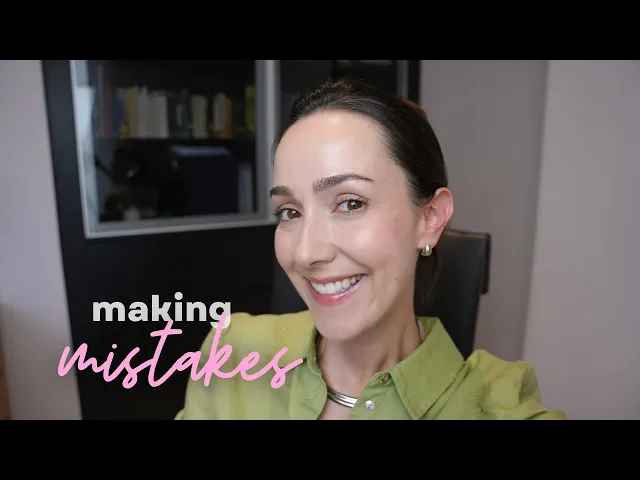
Hello, welcome back. Today I'm here to talk to you guys about something that you all need to hear. Today we're going to talk about making mistakes.
I am not a native speaker of English as you know most of you watching me here. I am from Brazil. So my language is Portuguese and I have been speaking English for more than 20 years.
And what I can tell you for sure is that you're going to make mistakes for the rest of your life simply because I'm going to give you some reasons and I want you to think about this very thoroughly. Thoroughly means in a lot of detail. Give this time.
Think about it. Understand what I'm trying to tell you today and try to selfanalyze and see if this is happening with you too. Number one, if you're watching this video, it's because, well, I think I hope anyway, it's because English is not your first language.
So, you speak another language as well as English. That means you are bilingual. Your bilingual brain functions differently to a monolingual brain.
And there's nothing you can do to change that. Your brain is constantly fighting another language. So here me right now this minute I'm talking to you in English.
I don't feel this anymore because I have been speaking for so many years. But I can tell you that if scientists were to measure my brain activity right now, you and I would be able to see the effort my brain is making when I'm speaking English. Because for a bilingual, speaking another language is always an effort.
That's the number one thing you need to understand. It's always an effort. Even when you've been speaking for a long time and it doesn't feel like an effort anymore.
So that's the number one thing. Now, since you speak another language, when you're speaking English, your brain is fighting this other language to try to keep that language at bay. So to try to inhibit that language, to stop that language from coming out.
So as I'm using English now, all my brain is doing is stopping Portuguese from being uttered, from being spoken. Again, can you imagine the effort that your brain is making when you're speaking another language? It's huge.
It's massive. And that is one of the reasons why we make mistakes. That sometimes we're talking and our brain fails to stop that first language, that other language.
If you speak three languages, four languages, it may be even more challenging for you. I only speak two languages. So your brain is then trying to stop that language from being uttered, from coming out.
And sometimes you can't. So, it's not like, you know, I'm here speaking English with you and all of a sudden I'm going to say a word in Portuguese. Not anymore.
Not after 20 years. In the first few years, if you're not having a lot of contact with English, you will. You will be speaking English and you will say some words in Portuguese or whatever your language is in the middle of what you're saying.
I see this with students all the time. It's very normal for me. Now, this is obviously not happening anymore, but what happens is that your brain is still trying to use that first language that you know, your mother tongue, your native language as the main language.
So, you're speaking in English, you're using a structure in English, and all of a sudden that structure is all wrong and you're wondering what happened there. Well, the reason is that your brain instead of thinking about the structure in English and using the structure grammatically correct in English, it has chosen the other language instead. So the grammar sounds wrong and it sounds like well it is in fact wrong and it sounds like it's messy and there are bits from different things in there and that's an influence a direct influence from your native language.
So you see that's another reason why you make mistakes. So number one is that your brain is making a constant effort. Number two is that there is a direct influence from your native language when you're speaking.
I was talking to one of my students today and she's from Italy and she speaks beautiful English. Really beautiful English. Really, she speaks really, really well and she was extremely frustrated because she sent me a voice message and at the end of the message she said something wrong.
she made a mistake and the moment it came out, she realized she'd done it and she corrected herself. But I know her. I know what she's like.
And so I replied to her message and I asked her, "How did you feel when you made that mistake at the end of your message? " And she went, "How do you think I felt? You know me well enough to know.
" I'm like, "Yeah, you felt awful. You're so mad at yourself. You can't believe you keep making those mistakes.
" She's like, "Yeah. " And I'm so frustrated because I've been speaking for so many years and I felt I thought that by now this shouldn't be happening anymore. This wouldn't be happening anymore.
And that's just not true. So um speaking now let's talk about structure a little bit which was her case. Speaking and changing your mind as you're talking can result in mistakes and that's a very obvious thing.
I don't know if you've noticed but when you're talking and that is in whatever language your native language your foreign language anything you're talking and your brain is going with that particular sentence you know that structure that you're thinking about your brain is you know registering and and speaking about this you're talking about what you're thinking and all of a sudden you decide to change where you're going and we do this all the time so you're talking and you're not you don't want to say that anymore. Like I just did now. I just did it.
Literally, I said, "You're not. " And then I went, "You don't want to say that anymore. You're not.
" And you don't want to say that anymore. This doesn't go together. These two sentences don't go together.
So, you could you could think or say that that was a mistake. That's not a mistake. That's just natural speaking.
So, you're talking, I've changed my mind. I want to say something else. And then you say something else.
That could be one of the reasons why you're making those socalled mistakes because you're changing your mind when you're talking. Which is why it's so important, guys, to be listening to yourself when you're speaking. We are so concerned all the time about people correcting us and hoping that uh our boss is going to tell us when we say something wrong or your boyfriend or your girlfriend who is a native speaker is going to stop you and and tell you that you're doing something wrong.
But they won't. The thing is you have to start listening both to the person you're talking to to understand how they are putting sentences together so that you can learn from that and listen to yourself too. Cuz then when you're talking and you're listening to yourself and you can only do that when you slow down.
That's why talking fast, talking like a crazy person does not help learners. Slow down so you can hear what you're saying. you can listen to yourself, really pay attention, and then correct those mistakes.
And this is something I need to talk to you guys about. If you're speaking and you realize you've made a mistake, just like my student did, correct yourself. I mean, think about it.
If you were talking to me in your native language, so let's say that you are Brazilian just like me and we were speaking Portuguese and you said something completely wrong, would you not correct yourself? Of course you would. And it's exactly the same in English.
I don't know why there is this belief, this idea that correcting yourself makes you look weak because there's this hope that if you don't mention your mistake, no one's going to know you made a mistake. That's insane. People are listening to you.
Native speakers realize you've made a mistake. Not only native speakers, I realize people make mistakes all the time. I notice that.
I hear that. I realize that. So correcting yourself is a sign of knowledge.
It's a sign that you know the language well enough to pick up on those mistakes and to be able to correct what you said. So do not feel bad about correcting yourself. Rather than feeling bad, you should be happy when you pick up on those mistakes and you're able to correct yourself.
Because obviously we've got this other situation as well which happens all the time which is when you're speaking and you say something wrong. You know it's wrong. You know that sentence sounds off.
You know this right? You've had this feeling before many times. I'm sure.
I've had it a billion times. And you don't know what the right one would be. Then you actually don't know how to correct yourself.
If you're talking to someone you trust and it's someone that you feel could actually help you, ask, "Does that make sense? H how how am I supposed to say that? I'm not sure how to say that.
" And hear what they're going to say back to you. That's something else that you can do that I've done a lot and I recommend trying. And one more thing I want to talk to you guys about also regarding the brain and how the brain works for bilingual people is that there are some things that will affect your speaking no matter what you do.
And it's beyond your control. It's not up to you to decide. It's just how your brain is.
When you're tired, when you're stressed, when you're under pressure, you will notice that your speaking changes and it's not as good. So it could be lots of different things. It could be that you make more mistakes so your grammar gets a bit messy.
It could be that you cannot remember the words so your you know your word retrieval which is the act of remembering word is very slow and so the speaking sounds repetitive and a bit boring because the right words are not coming to you. And it could be as well that you stumble upon your words. So your diction which is the quality of your pronunciation is affected.
For me nowadays I could safely say to you that the two things that affect my speaking the most are number one being under pressure. So if I feel that it's a situation I'm really really under pressure like full on then I make weird mistakes. I can't even believe I'm made such mistake.
This happens to me. And what affects my speaking so badly nowadays as well is my migraine. So if I'm having a migraine crisis and I'm speaking English, I know for sure that my speaking is going to be very slow because I'm not going to be able to remember words quickly.
So word retrieval for me is a disaster when I'm in pain, when I have a strong migraine. And you see how important it is guys to analyze yourself and your learning and to really understand what makes a difference for you individually so that you can work on those things and find ways to tackle those feelings and problems and all of those challenges that we have when it comes to speaking because we do as non-native speakers. Anyway, I really hope this video has helped you.
Before we say goodbye, there's just one sentence I want to say to you and I want you to remember that. Really remember that, okay? Because you keep striving for something that is not achievable, which is I want to speak without making any mistakes, that is not achievable, that is not real.
So instead, accept mistakes. Okay, mistakes will happen. How am I going to deal with them?
That's the sentence. and ask yourself these questions and watch this video again so that you can fully understand what I mean by dealing with your mistakes in a more positive way and doing something about them so that you can learn from those mistakes too. Yeah.
All right then. Thanks for being here today. See you all next time.
Bye.