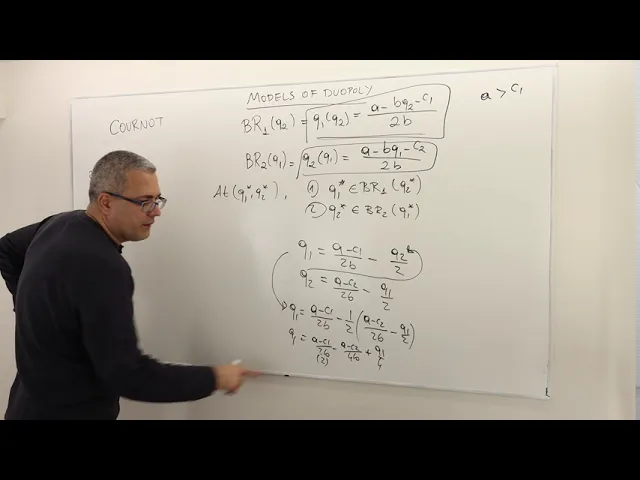
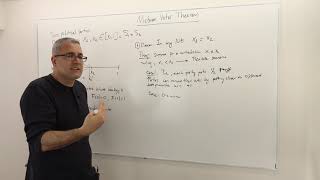
hello everyone in this episode we're going to solve some examples for nash equilibrium and the idea is to understand uh the model's different models of duopoly and we're going to consider two uh models of duopoly the first one is krno and the second one is bertrand okay so let's talk about the kruno uh duopoly well according to qrno there are two firms so this is the strategic environment so these two firms firm one and firm two if you like produces exactly the same good all right and for simplicity and each firm selects how much quantity to produce well they can produce so let's say a firm i where i is either one or two refers to firm one or firm two so qi is in between zero infinite so they can produce firms can produce any quantity they like obviously they can't produce infinite and obviously they can't produce something negative all right so there are again infinitely many set of infinitely many strategies for each uh firm well then the question is what about the price right in real life usually firms not only choose their quantities but also their prices well we assume that in this specific market environment firms only choose how much to produce all right and then uh the the market price will be determined by the market clearing condition or by the demand curve so the demand actually we call it inverse demand is basically given by p equals a minus b times q where p is the market price and and and q is the total output so to be more specific q is equal to quantity of firm one and quantity of firm two because there are only two firms uh operating in this market the total quantity is equal to so the total supply is equal to the supply of firm one and supply of firm two all right and obviously a and b are some positive uh real numbers okay well here uh this uh sort of example makes sense in environments where uh firms for example uh absolutely producing the product requires substantial amount of time and planning in advance for example if it is a automobile all right if it is a car for example that they're producing while the firms need to uh sort of decide how much car to produce probably you know you know five or six months in advance or maybe a year in advance and then after they produce their quantities uh the market conditions whether you know the market is in a boom or in in sort of uh maybe there's a crisis that they well didn't know before producing these quantities so the market price will be determined according to the market clearing condition afterwards all right so therefore uh the firms take the price as given as a function of the quantities they selected all right but once again this is a simultaneous move game where two firms produce uh choose their quantities q1 and q2 simultaneously without observing the other firm's choice and then that's the end of the game the the the price will be realized after their quantity choices and obviously each firm by assumption is aiming to maximize its on profit all right well in order to talk about the profit we need to talk about the cost right because the price and the quantity will give us the revenue but what about the cost well for simplicity let's assume there is no fixed cost but there is a marginal cost of marginal cost of uh ci which is greater than zero for each firm all right for i equals one and two so firm one has cost c1 firm two has cost c2 these are marginal costs and there's no fixed cost what does that mean that means the profit of firm i is equal to revenue minus cost so what is revenue revenue is equal to price times quantity of firm i right i mean as a firm eye you do not care about these other firm's quantity so price times quantity so this is revenue minus cost cost is marginal cost times the quantity you produce all right so what is the price price is given by this inverse demand function so it's basically a minus b times uh q1 plus q2 times q i minus c i q i all right so this is the profit function of firm i what does that mean just to be more specific profit function of firm 1 is equal to a minus i'm going to take c i also in the parentheses of q i so it's a minus b q 1. well let's write is write it as open as possible a minus b q 1 minus b q 2 minus c 1 multiplied everything by q 1 and profit of firm 2 is equal to a minus b q 1 minus bq2 minus cos the marginal cost times q2 all right once again this is a symmetric game because whenever you see q1 write q2 whenever you see q2 write q1 and whenever you see c1 write c2 you're going to get the profit of the second firm by using the profit function of the first firm so it's a symmetric game all right so the question is what is or are the nash equilibrium of this game well solution is simple what we do we find the best response function for each firm all right how do we find this well to find the best response function we basically maximize the payoff function right which is the profit in this case so therefore that means we take the derivative of the profit function with respect to q one and set it equal to zero and solve it this is the first order condition for firm one and symmetrically we take the partial derivative of firm two's profit uh with respect to q2 and set it equal to zero and solve it so as a solution of this we're gonna get the best response function for a firm one and as a result of this maximization or the first order condition we're going to get the best response function of firm 2. so what does that imply well or if and only if when you take the partial derivative of this profit function with respect to q 1 you're going to get a here minus 2 b q 1 because this is going to be b q 1 square so it's going to be 2 b q 1 minus b q 2 minus c 1 which is equal to 0.
and if you take the partial derivative of the second profit function it's gonna be a minus b q one minus two b q two be careful it's gonna be q two square not q one square uh minus c two equals 0. so if you solve this that means you know i would like to write q1 as a function of q2 because q1 is the choice variable for uh firm 1. so that means send this q1 term to the other side leave everything on the left-hand side so what i have is therefore and divide both sides by 2b so leave q1 alone so if you do this you're going to find that q1 equals a minus bq2 minus c1 divided by 2b and once again if you do this you're going to find q2 equal i'm sorry if you solve this for q2 you're going to get q2 equals a minus bq1 minus c2 divided by 2b all right okay very well well what does that mean that means we actually found the best response for these firms let's write the best response function for firm one remember it's a function of the other firm's strategy which is q2 or you can write it q1 which is a function of q2 which is equal to this guy a minus b q2 minus c2 or c1 i'm sorry c1 divided by 2b and the best response function for firm1 firm2 i'm sorry which must be a function of q1 or you know sometimes we write it as q2 which is a function of q1 it's equal to a minus bq1 minus c2 divided by 2b okay well if you drove the best response functions what you will get is actually uh the point of intersection so here is let's let's do this i mean you don't have to draw the best response functions every time uh but it makes sense to do it at least once so let's call this q1 and let's call this q2 so the quantity choice for firm one could be zero could be infinite and same for q2 so i would like to draw this one first so it's a straight line be careful here a is a constant number b is a constant number c one is a constant number so the only variable is q two all right so and so when q two is equal to zero right when q two is equal to zero so this guy is going to be a so the q1 is going to basically i'm finding the q1 intercept is going to be a minus c1 divided by 2b all right so let's call this as a minus c1 divided by 2b well i did not mention it but obviously i assume that this a parameter is greater than c1 so the marginal cost is not terribly huge because otherwise uh probably the the only outcome the rational outcome in this game is going to be producing nothing because the c1 the marginal cost is way too high okay well what about the y-intercept the q2 intercept well this time i set q1 equals zero all right and then solve q2 so if q2 q1 is zero 2b times zero is zero so i send b q2 this side so divide both sides by b so what i'm going to get is this a minus c1 divided by b all right okay so by the way if you see this is a minus c1 divided by b this is a minus c1 divided by 2b so i'm dividing it by a bigger number so therefore that means if if if this is that big well this should be sort of half of it right so let's be more accurate so a minus c1 divided by 2b okay very good so that means my best response function uh is a straight line that connects those dots i'm not going to look at the you know how it behaves in this area or in this region because you know q1 and q2 cannot be negative all right so this is the best response function of player firm one well if you do the same thing for firm two what you're gonna get is once again when q 1 is 0 the q 2 is going to be a minus c 2 divided by 2 b well i don't know exactly where it is going to be but depending obviously on a c 1 and c2 so for example if c1 and c2 are equal so probably a minus c2 divided by b is going to be somewhere here and then the q1 intercept is going to be a minus c1 or c2 divide divided by b all right so therefore oops well this is supposed to be a straight line i'm sorry so the the best response function for firm 2 is going to be this guy all right and so this point is the point of intersection is in nash equilibrium why is that so well because this is q1 star 2 star well at q 1 q 1 star q 2 star what we have is that 1 q 1 star is the best response for firm 1 to q2 star right when firm 1 is producing i'm sorry when firm 2 is producing q2 star amount what is the best response for firm 1 so i'm going to look at this best response function well it's exactly q1 star so q1 star is not element it's exactly equal to well because there's only one best response but q1 star is the best response to q2 star what else however if firm 1 is producing q1 star what is the best response for firm 2 i'm gonna look at firm 2's best response function and q1 starts the best response to q1 star is going to be q2 star so q2 star is element of best response for firm 1 q1 star you see what i mean so that means at this strategy profile each firm each player is best responding his or her opponent so it's regret free because everybody is doing the best he or i mean they can do that's the definition of nash equilibrium right so therefore this point of intersection uh where the two best responses uh uh sort of intersect is the nash equilibrium by the way we always use this idea whenever we have two or more players uh they're they they when the point of intersection of the best response functions is always going to give us the nash equilibrium so how do we find the point of intersection well simple um this is two graphs i agree uh so what we can do is just uh the this is q1 equals to uh this guy let's write it a minus c1 divided by 2b minus b divided by 2b times q2 which is basically q2 divided by 2 right and i can write this i'm just simplifying them q2 is equal to a minus c2 divided by 2b minus bq1 divided by 2b meaning q1 divided by 2.
so if i want to find this point of intersection that means i have to solve these two equalities simultaneously which means whenever you see q2 just plug it here all right and then reduce the number of parameters to 1 and then solve it so what does that mean that means q1 equals this a minus c1 divided by 2b minus 1 over 2 parentheses q2 and instead of q2 i'm going to write this a minus c2 divided by 2b minus q1 over 2. all right so if you do simplification on the right hand side i'm going to have a minus c1 over 2b minus a minus c2 over 4b plus q1 over 4 which is equal to q1 so i'm going to pull this q1 to the left-hand side what i'm going to have 3q1 divided by 4. so let me clean this part so on the left hand side i have 3 q1 divided by 4.
on the right hand side what do i have well i'm going to simplify this but i have 4b here so multiply this ratio by 2 so that i have 4b and 4b so i can subtract the uh you know a minus c1 with a minus c2 but don't forget it's going to be 2 a minus 2 c1 minus a minus minus so it's going to be plus c2 be careful divided by 4b okay and so what do i have i have uh here a minus 2 c 1 plus c 2 divided by 4 b equals 3 q 1 divided by 4. so this 4 and this 4 will cancel out send this 3 to the other side so that means q1 is equal to a minus 2c1 plus c2 divided by 3b all right so i can call this q1 star because this is the nash equilibrium strategy for firm 1.