You don't need a business, a lottery win, or wealthy parents to get rich. All you need is time, consistency, and a little bit of guidance from someone who just a decade ago was exactly where you are today. If you're new here, hi, I'm Nisha.
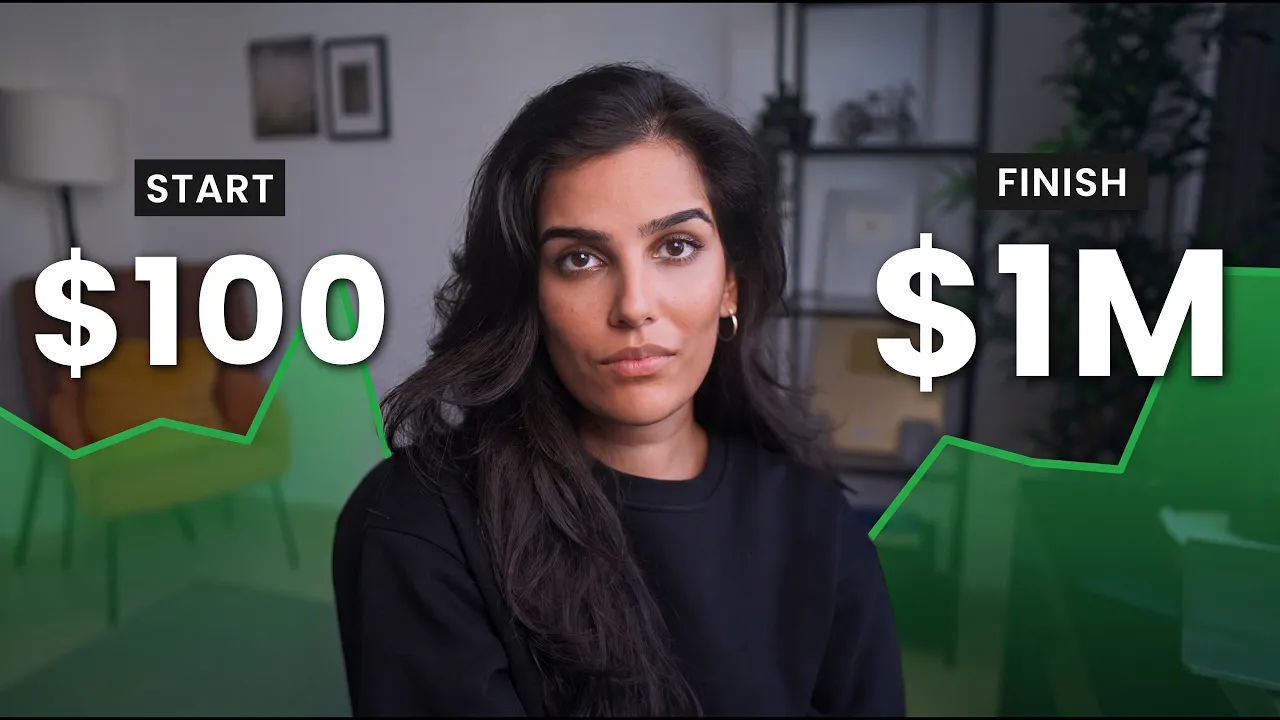
I'm a qualified accountant and a former investment banker who's helped thousands of students shake off the idea that they need a high income or a six-figure savings account to start investing. And today, I'm hopefully going to help you do the same thing by showing you how investing just 100 quid a month can make you a millionaire over time. So, there's no need to come up with some amazing business idea or do anything drastic or life-changing if you don't want to.
Just follow the steps I'm going to introduce you to today, and eventually, you can also become financially free. So, let me take you back about about my story. When I first started working in finance, I was terrible with money.
I wouldn't even know how much I'm spending. I'd drop hundreds on lunches I didn't even enjoy that much. I'd buy clothes I wore maybe twice.
And every single month, I'd tell myself the same thing, that this was the month I'd finally start saving properly. Then, payday would come around again, I'd look at my account, and there'd be almost nothing left. All those hours, all that work, and I had basically nothing to show for it.
But the thing that actually changed everything for me, it wasn't a budgeting video or one single book that I'd read. It was actually watching a colleague get a laid off. One day, she was at the desk next to mine, and the next, she had lost her job.
No sort of warning, nothing. And I remember sitting there afterwards thinking, "That could so easily be me. " I'd been treating my paycheck like it was just always going to be there, like it was guaranteed.
And in that moment, it really hit me that it wasn't. None of it was. Everything I'd built my life around could change overnight.
So, I decided I wanted more control. I wanted a bit of independence because suddenly having everything resting on one job, one income felt a lot riskier than it ever had before. So, I started with the least exciting thing imaginable, and that is an emergency fund.
At first, I just aimed for enough to cover one month's living expenses, nothing overly big. But once I hit that, it felt good, so I kept going. One month became three months of my living expenses, three months became six months.
And honestly, that little safety net changed how I felt about everything. Because here's the thing, I knew I wanted to start investing, but I also knew that if I ever lost my job with no cushion behind me, no financial safety net behind me, I'll be forced to pull money straight back out of my investments just to pay the bills. And that's exactly how people end up undoing years of progress in one bad month.
The emergency fund was what made investing actually safe to do. And then, I started investing. Now, working in finance, it did give me a bit of a head start here.
I already had a decent grasp of how the markets worked, but the part that genuinely surprised me was how little you actually have to do. You don't need to be glued to a screen, you just put a set amount in every single month, leaving it completely alone for 20 years or 30 years, and then you let the maths do the heavy lifting for you. That is it.
It is pure maths. That's the whole secret. So, how does this work?
And you're probably listening to this thinking, it might be maths, but I've probably missed the boat. Maybe you reckon investing is only for people with loads of money or that you should wait until the economy picks up, inflation falls, or the market finally crashes. And look, technically, the best time to invest was 10 or 20 years ago.
But the second best time is today. And you've probably heard this time and time again, but I want to show you exactly why this is. Let's say you invest just 100 at the start of the month into a simple, low-cost index fund earning an average annual return of 10% and compounding monthly.
Of course, returns aren't guaranteed, markets won't grow smoothly in one straight line, and you may have tax and fees to take into account depending on how you're investing. But for the sake of simplicity, let's assume a 10% average return over the long term. After 2 years, you'd have put in 2,400 of your own money, and you'd have around 2,666 in your investment portfolio.
So, that's just 266 of growth. Not exactly thrilling, I know. And the reason why it doesn't feel like much is because when you start out, you're the one doing all the heavy lifting.
Almost everything in that account is your own money. So, it's completely normal to see barely any growth early on and feel like you're just doing all the work. There may even be points, actually, where you have less in there than you put in.
And I'll be honest with you, and this is something I go into more detail in in my free investing workshop. But essentially, seeing your portfolio dip isn't a sign you're doing something wrong. It's just part of it.
So, do not panic, and whatever you do, don't give up or sell whilst you're down, because that's the one move that guarantees you never see the good part. And the good part is worth waiting for. So, let me show you what I mean.
So, let's take that 100 a month again, 100 a month contribution. Now, instead of 2 years, let's stretch it to 10 years. So, you'll have contributed 12,000.
But now, if you take a look at your investment account, you might find that you've got quite a bit more than that in there. So, if we once again assume you get a 10% average annual return, you'll have roughly 20,655 sitting in your investment portfolio. That's over 8,600 of pure growth, money that you didn't earn at work.
And if you continue to stick at it for even longer, after 30 years, that same 100 a month with the same 10% average annual return could reach 227,932. And after 40 years, it could grow to over 637,000. Now, you might be watching this thinking 637,000 doesn't sound rich, especially once you remember what inflation does over 40 years.
Food, rent, petrol, all of that goes up, so your money won't stretch as far then as it does today. And you'd be right, but two things I want to say. First, you'd have contributed just 48,000 of your own money.
The remaining is literally free money that you got from just making one different decision today, and that is choosing to invest. Secondly, as inflation goes up, your income should theoretically go up, too. And when that happens, you'll want to increase your investments with it.
So, how would this work? And what does this mean for your finances and your investment portfolio? So now, let's once again imagine you invest 100 quid a month in your 20s.
Then, once you reach your 30s, hopefully after a few pay rises or promotions, you increase your monthly investments to say 300 a month. If everything goes to plan and you continue getting the same average annual return of 10%, you would be entering your 40s with over 117,000. That's made up of 56,655 of your own contributions, along with a very solid 61,224 of investment growth.
Then, in your 40s, you might be in a position to invest 600 a month, giving you over 443,000, assuming the same conditions as before. And then 800 a month for the final decade, let's say, before retirement gives you over 1. 3 million.
Whilst over the 40 years, you would have only personally invested just over 224,000, your portfolio will be worth over 1. 3 million. And that is thanks to compound growth, which is basically when the interest you earn starts earning interest, too, that you can potentially end up with more than 1.
3 million without having to make huge sudden changes to your lifestyle or even invest thousands every month. And this is something I spent a lot of time helping beginners understand in my free investing workshop. Most people massively overestimate just how much money they need to get started, but it's only when I actually break these numbers down in front of them that they realize how much time has actually slipped by.
And if they started 10 years, or 5 years, or even 2 years sooner, they'd have made progress already. And for many people, this alone is enough to get started. It's like they've had this epiphany moment, and they don't want to waste another second.
someone who joined the workshop literally said, "Best financial decision I've made in a long time was joining your workshop. I originally signed up because I wanted to get serious about retirement planning after turning 45. My portfolio is generating 1,400 a month in dividends, which still feels unreal to me.
Crazy how little practical financial education we get growing up, but I'm glad I decided to pay attention and follow along with your workshop. " Now, moving on to the second part, which is is now a good time to invest. And for many people, there's another roadblock standing between them and their first investment.
And that's the fear that now isn't the right time to invest. And I can see why people think this way. Every time you turn on the news, there seems to be something to worry about, whether it's inflation, interest rates, politics, a possible recession, or fears that the market might crash.
And so, it's perfectly natural when things feel uncertain to think, "I'll just wait. I'll invest when things settle down, or the market falls to rescue right now. The problem is that people have been saying this forever.
Back in 2008, people thought the financial system was collapsing. At the start of COVID, a lot of people panic sold their investments believing it would take markets years to recover. And more recently, people have worried about inflation, about rising interest rates, and whether another crash is just around the corner.
But, despite all of that, the stock market has continued to rise over the long term. Now, obviously, there have been dips along the way, sometimes pretty big ones. And if you invest, there will almost certainly be periods where your portfolio drops, too.
That is part of the game. That part is completely normal. But, if you zoom out and you look at what has happened over 10 years, 20 years, 30 years, historically, the overall direction has been upwards.
And this is why investing is less about what happens over the next few months, and more about what happens over the next decade or more. Because the reality is that nobody really knows what markets are going to do next. If they did, we'd all be billionaires.
Which means trying to wait for the perfect time to invest isn't actually incredibly difficult. In fact, one of the biggest mistakes people make is waiting until things feel safe again. Because by the time the headlines sound positive and people feel confident investing, markets have very often already recovered, meaning the people who waited end up buying at higher prices.
This is why you'll often hear the phrase, "Time in the market beats timing the market. " In other words, getting started and staying consistent is usually much more important than trying to predict the perfect moment to invest. And that leads me to section three.
Investing is too complicated. And this is another thing that often stops people getting rich. It's the assumption that investing is too complicated.
Again, I can completely understand why. If you search how to invest on YouTube, on TikTok, on Google, you'll find thousands of videos and articles promising to help you get rich. But when you actually click on them, how many actually show you what to do step-by-step?
If anything, too much investing content can leave you more overwhelmed than before. One person tells you to buy individual stocks, someone else tells you to go all in on crypto. All this does is leave you doing more Googling and watching more videos trying to understand where on earth to start.
And this is another thing that held so many of my students back for so long. None of them were lazy or bad with money. They just found personal finance content so incredibly overwhelming, especially when they're having to collate information from dozens of different sources.
It's almost like trying to do a jigsaw using all the pieces from 10 different puzzles. And unfortunately, a lot of people in finance make things sound far more complicated than they actually need to be. And that's why it was so important for me that when someone completes my investing workshop, one of the biggest things I make sure that they take away from it is just the confidence to get started.
You don't need to become an expert in economics, you don't need to spend hours looking at stock charts, and you definitely don't need to set refreshing your portfolio every 5 minutes. In fact, for most beginners, a simple long-term investing strategy is usually more than enough. The hard part isn't investing, it's overcoming the obstacles we've discussed today and navigating the questions that everyone wants the answer to, but very few people seem willing to answer.
What account should you open? What should you actually invest in? How much should you be investing each month?
How do you avoid making expensive mistakes when you're just starting out? And this is another hours' worth of content, and it's exactly what I cover in my free investing workshop because there's so much conflicting information online that it can be hard to know what advice to actually trust. For most people, building wealth through investing is actually much simpler than they think.
It's usually just a case of starting with what you can afford, staying consistent, and then giving your money enough time to grow. And if you want help actually getting started, you're very welcome to join my free investing workshop. It is completely 100% free, and I walk you through the investing process step-by-step, giving you a roadmap, showing you how to get from where you are today to financial freedom.
And not only is it completely free, it's actually designed to be fun, so there aren't any deadlines, and you can watch it whenever suits you. If you want to fit it around your job, your studies, I guarantee you'll walk away feeling so much more confident about investing. In fact, one of my favorite comments from someone who took the workshop was, "My biggest win is I feel shifted from the narrative that I needed to be wealthy to understand money and investing.
I feel I'm now in the driver's seat rather than a passive passenger. " I leave a link below if you want to check the workshop out, but whether you join or not, my biggest hope after watching this video is that you stop waiting for the perfect time and just take the first step, because future you will probably be very glad that you did.