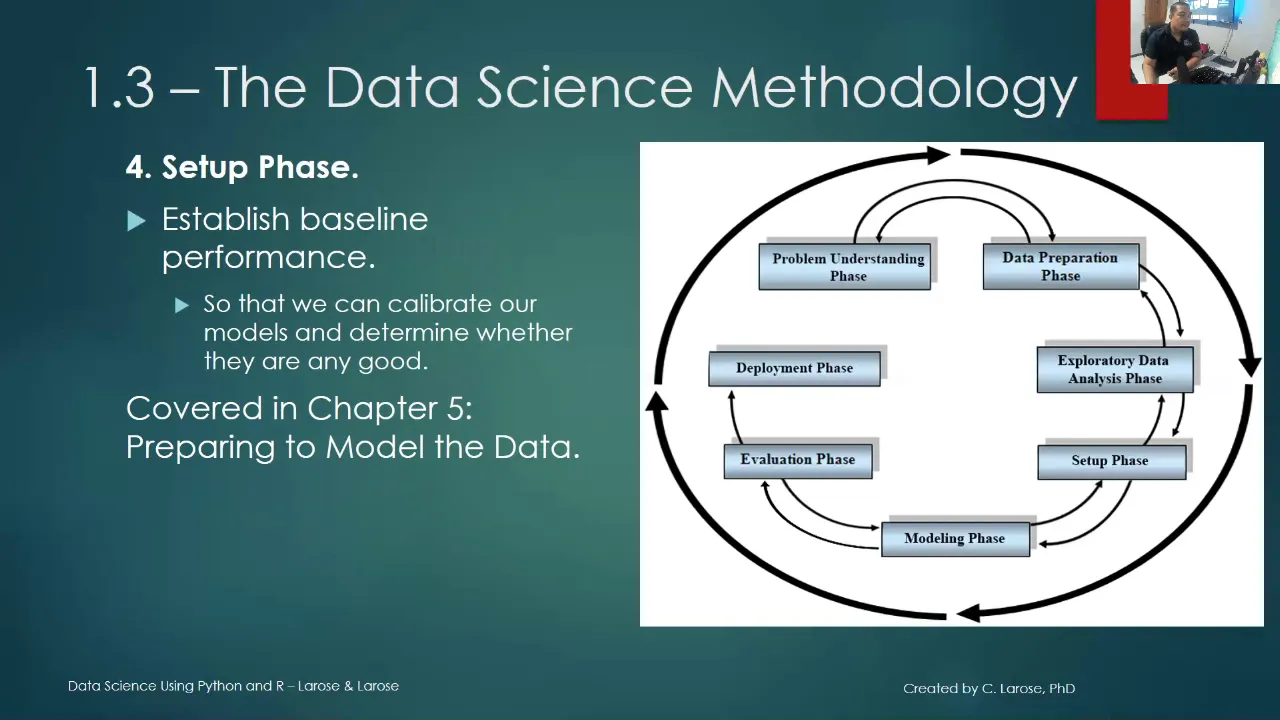
[Music] we follow the data science methodology or dsm which helps the analyst keep track of which phase of the analysis he or she is performing this actually illustrates the adaptive and iterative nature of the dsm using the following phases problem understanding phase the question there is how often have teams work hard to solve a problem only to find out later that they have solved the wrong problem further how often have the marketing team and analytics team not been on the same page this phase attempts to avoid this pitfalls first clearly enunciate the project objectives then
translate these objectives into the formulation of a problem that can be solved using data science for data preparation phase raw data from data repositories is seldom ready for the algorithms straight out of the box instead it needs to be cleaned or prepared for analysis when analysts first examine the data they uncover the inevitable problems with data quality that always seems to occur it is this phase that we fix these problems the data cleaning or preparation is probably the most laborious or intensive phase in the entire data science process the following is a non-exhaustive list of
issues that awaits the data preparer identifying outliers and determining what to do about them transforming and standardizing the data reclassifying categorical variables binding numerical variables and adding index fields for the exploratory data analysis phase now that your data are nice and clean we can begin to explore the data and learn some of the basic information graphical exploration is the focus here now it's not the time for complex algorithms rather we use simple exploratory methods to help us gain the preliminary insights you might find that you can learn quite a bit just by using these simple
methods here are some of the ways that you can do this exploring multivariate relationships among the variables binding based on predictive value to enhance our models deriving new variables based on the combination of existing variables for the setup of phase at this point we are nearly ready to begin modeling the data we just need to take care of a few important chores first such as the following cross validation either twofold or unfold this is necessary to avoid data dredging in addition your data partition needs to be evaluated to ensure that they are indeed random balancing
the data this enhances the ability of certain algorithms to uncover relationships in the data establishing baseline performance suppose we told you that we had a model that could predict correctly whether a credit card transaction was fraudulent or not 99 of the time are you impressed you should not be the non-fraudulent transaction rate is 99.9 32 percent so our model could simply predict that every transaction was non-fraudulent and can be correct 99.932 percent of the time this illustrates the importance of establishing baseline performance for your models so that we can calibrate our models to determine whether
they are good or not the modeling phase is the heart of the data scientific investigation and includes the following selecting and implementing the appropriate modeling algorithms applying inappropriate techniques will lead to inaccurate results that could cost your company big money making sure that our model outperforms the baseline models fine-tuning your model algorithms to optimize the result should our decision tree be wide or deep should our neural network have one hidden layer or two what should be our cut-off point to maximize profits analysts will need to spend some time fine-tuning their models before arriving at the
optimal solution for the evaluation phase your body at work may think that he has a luck on his prediction for the super bowl but is his prediction any good that is the question anyone can make predictions it is how prediction performs against real data that is the real test in the evaluation phase we assess how our models are doing whether they're making any money or whether we need to go back and try to improve the prediction models your model needs to be evaluated against the baseline performance measures from the setup phase are your models actually
achieving the objectives set for it to back the problem understanding phase has some important aspect of the problem not been sufficiently accounted for apply error costs intrinsic to data because data-driven cost evaluation is the best way to model the actual costs involved for instance in a marketing campaign a false positive is not costly as false negative however for mortgage lender a false positive is much more costly you should tabulate a suit of models to determine which model performs the best choice choose either a single best model or small number of models finally your models are
ready for prime time report the management on your best model and work with the management to adapt the models for the real world deployment writing a report of your result may be considered a simple example of deployment in your report concentrate on the results of the interest to the management show that you solve the problem and report on the estimated profit if applicable stay involved with the project participate in meetings and process involved in the modeling deployment so they can stay focused on the problem at hand it should be emphasized that dsm is iterative and
adaptive when we adaptive we mean that sometimes it is necessary to say into a previous phase for further work based on some knowledge gain in current phase this is why there are arrows pointing both ways between most of the faces for example in the evaluation phase we may find that the model we crafted does not actually address the original problem at hand and that we need to return to the modeling phase to develop model that will do so also the dsm is iterative meaning sometimes we must use our experience of building an effective model on
similar problem that is the model we can create serves an input to investigation of related problems this is why the outer rings of arrows shows a constant recycling of older models used as inputs to examining new solutions to new problems you
![I Replaced ALL my ADOBE APPS with these [free or cheaper] Alternatives!](https://img.youtube.com/vi/5EfqHg49kMk/maxresdefault.jpg)