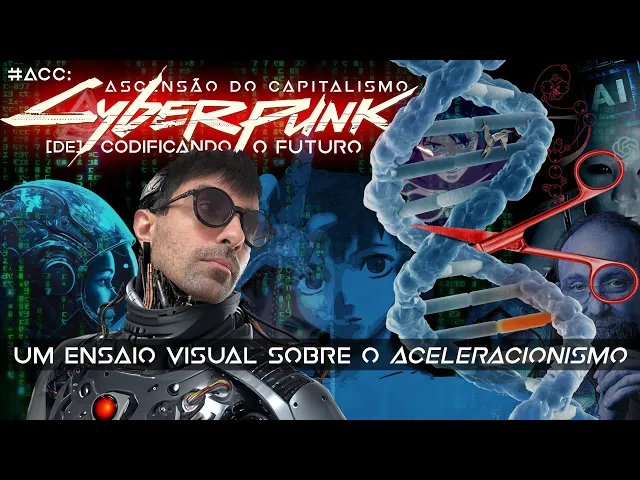
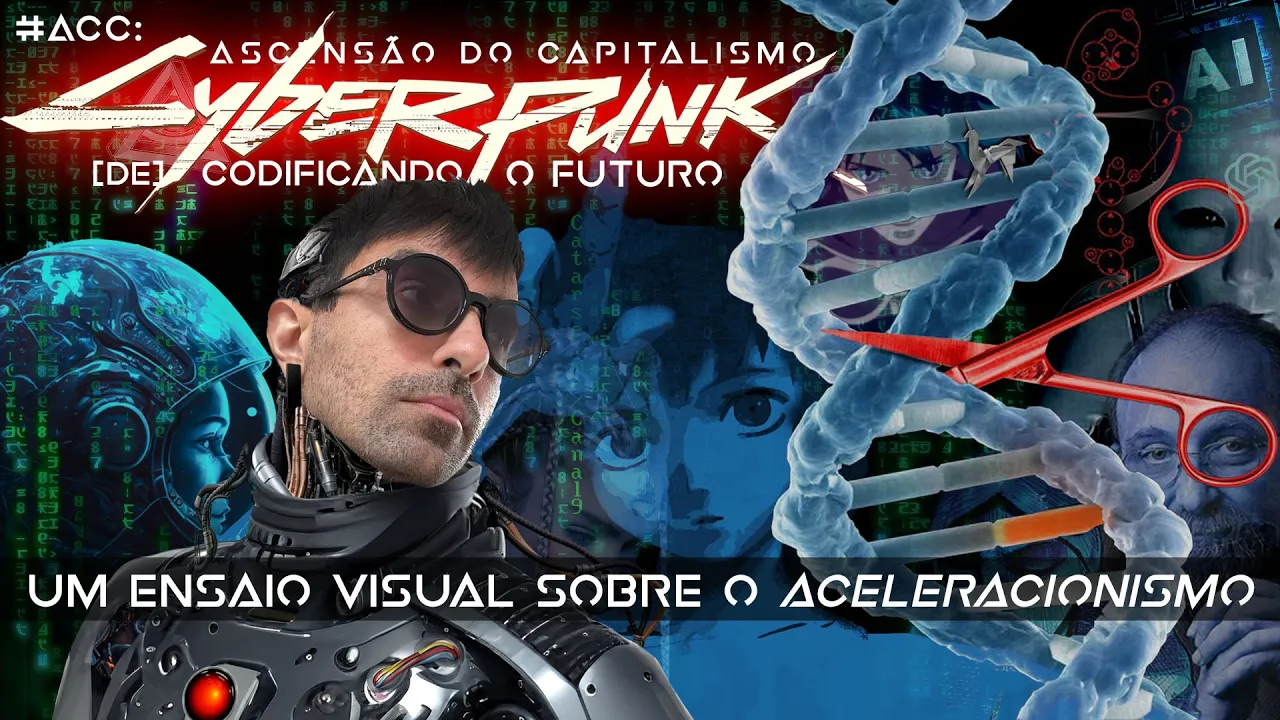
Kaneda's song [AKIRA, 1988] There's a playlist with the soundtrack on my channel Rising of the Cyberpunk Captalism: [De]Coding the Future or A Videoessay on Acceleracionism Is the techno-capitalist future a promise of utopia or a dystopian abyss? While traditional philosophy seeks to understand what things are, there are those who study what things will be. The relationship between body, mind, and machine is no longer fiction.
"We are all cyborgs", without technological extensions, we barely survive. We are at a moment of redefining the idea of what it means to be human, of time, and of existence. The problem is that technology has accelerated much faster than our reflection on it, perhaps because our reflective methods require contemplation in a very slow flow of consciousness.
For this reason, a new philosophy emerging from the ruins of academic thought may be necessary, a philosophy very misunderstood and quite controversial, called accelerationism. At first glance, accelerationism comes from the idea that capitalism, or techno-capitalism, is in constant acceleration and should be accelerated even more until it reaches its collapse, generating a new form of social organization. However, it is much more complex than that and also more exotic, in a mix of philosophy, economics, cybernetics, sci-fi, and occultism, under the use of psych0tr0pics.
The CCRU (Cybernetic Culture Research Unit) emerges in England, a collective of experimental theorists that operated between 1995 and 2003. The collective began its activities at the University of Warwick, but soon distanced itself. An official declaration from the f ormer institutional base stated that the CCRU does not exist, did not exist, and never will exist.
This type of unorthodox combination of various types of thought does not seem to be taken very seriously by universities, and it is with this arrogance of universities that some movements grow in niches outside of them, such as hacktivism, Web 3. 0, and cryptocurrency enthusiasts, artistic movements like vaporwave or philosophies like accelerationism. Much of the thought base is rooted in Marx, which makes it seem that accelerationism was initially inclined towards the left and also draws from Deleuze and Guattari, who are post-Marxists, which can generate—and indeed has generated— various interpretations that spread the ideas across the entire political spectrum.
Nick Land himself, one of the main names in accelerationism, if not the main one, who in the 90s interpreted Marx and Deleuze, "Became something reactionary and completely outdated. " Some people mature over time, while others wither. Despite Nick Land’s recent transformation, his old ideas are crucial.
Mark Fisher, also of the CCRU, who died defending Left Accelerationism said that "Land is the antagonist that the left needs", perhaps because he contributed to the idea that the left is very technophobic and needs to understand the acceleration of capitalism. If you think that Marx would never approve of the acceleration of capitalism, it's good to remember that he was not a thinker who resisted modernity, but rather someone who sought to analyze and interfere within it. However, the old labels of left and right as they were can no longer capture the current complexity.
Protests and criticisms seem like obsolete tools against the excesses of modernity. One of the ideas is that capitalism is the only one capable of destroying itself, and therefore it is necessary to accelerate the process even further for this to happen soon. But as you may already be thinking, the cost could be very high, especially when we are confronted with extremism in the hands of many of those who hold capital.
Does the future exist? The future does not exist! Talking about acceleration is talking about the perception of time that transforms historically The idea of linear time— Past, Present, Future— is a concept, and it's natural for the prevailing system to appropriate this in the culture.
Today, we highly value the most abstract of these times —the future. Everything that is produced in capitalism, even for very quick consumption today, is oriented towards the future. We are always waiting for something, and not always with hope.
It's Mark Fisher’s "slow cancellation of the future". We feel a nostalgia for a future that was promised in the past but never arrives. This constant waiting has always been an ingredient for nihilistic beliefs!
"in the future, Jesus will return; in the future, aliens will arrive; we must prepare for the New Era that will come; in the future, don’t worry! ! , science and medicine will save us!
Of course, we have to prepare, to have plans in our lives, of course, but it is necessary to rethink the idea of the future, knowing that in many cultures it doesn't even exist. In an accelerated world, it’s not hard to understand why so many people suffer from anxiety. Overthinking about the future nullifies the necessary belief that we have something permanent within us today, even if this permanence, this feeling of wholeness, is a belief, because things do pass.
There are sensations more lasting and soothing than others. This prediction of a post-capitalism at the end of acceleration may seem very optimistic to some, but apocalyptic to others. One of these apocalyptic hypotheses is the arrival of the singularity, the idea that one day there will be a super-intelligent-conscious AI much more intelligent than us and with the capacity to self-improve, which would generate irreversible changes, possibly including our extinction, or, in the best scenario, the transformation of humans.
Post/Transhuman [ism] Humanism is a concept. Most people associate being human with something that seems divine. When someone isn't very empathetic, for example, we tend to say something like, "be more human," as if becoming human were a process of moral elevation.
But whose morality? Michel Foucault sees humanism as a historical construct that limits our understanding and prevents the emergence of new ways of thinking and existing. Hence, some thinkers have created the concepts of transhumanism and posthumanism.
Generally speaking, the transhumanist believes that humanity is in transition, perfecting the body and mind. In this case, anthropocentrism —humans at the center —remains. The post-humanist seeks to deconstruct the idea of humanism, anthropocentrism, and any form of cultural dualism and hierarchy of power: "man superior to woman; white European other peoples; "culture / nature, or "human superior to other species".
The post-humanist will be the one who, in a still fictional future still, will advocate for peaceful coexistence between possible conscious AIs with cyborgs and genetically modified humans, all in harmony. And in this relationship of concepts that, in fact, sometimes intertwine, biohackers emerge, also in the underground, conducting genetic experiments in a non-institutional way. As the term suggests, they are scientists and enthusiasts seeking to hack or edit genetic codes, sometimes in their own bodies, through a technique called CRISPR, which popularized genetic editing by making it much easier, faster, and accessible.
Increasingly, the concept of human is trans. . .
forming. Transsexuals who modify their own bodies could, in a way, be considered biohackers. These transformation possibilities are becoming deeper and deeper, and it’s already possible with DNA editing, as demonstrated by Josiah Zayner, who gradually transformed into Josie Zayner.
Josie, still Josiah at the time of the video, went viral on the internet by injecting CRISPR in front of an audience. With a PhD in physics, she worked at NASA as a researcher, and a few years later quit because she found NASA too conservative. .
. not in the flow —this is SO biohacker! After that, she opened her own business called The Odin, offering for a few dollars CRISPR kits to make genetic changes in your kitchen.
I advise? NOPE! or at least not on the human body for now— but there are many biohackers working with plant editing, for example, or small animals.
And Josie has already assured that she doesn't harm her little animals. And that is as post-human! Since all of this is very new and complex, the information reaches us in a very superficial way, which naturally plays on our imagination.
Miguel Nicolelis, a Brazilian neuroscientist and physician, is one of the world's leading scientists in body-machine innovations. Neuralink, which is testing chips in human brains, was created by Nicolelis' students and later bought by Elon Musk. It's quite possible to imagine that brain chips could become normal, even if Master Nicolelis disapproves of the idea and says it's not possible.
But it's already possible with electromagnetic caps. So fiction asks: will it be possible to hack people's minds or live outside the biological body? If you from Gen Z manage to transfer your memories, your brain information, to an artificial brain, will you still be yourself?
All this seems like science fiction, and it is science fiction —but elevated to another level, beyond mere delusion, but where creativity creates! Hell is only a product by morbid human imaginariu The bad news is that everything humans can imagine, they can create. while superstition is merely a belief with no basis in reality and doesn't hold as truth, hyperstition creates reality!
"Hyperstition can be defined as experimental technoscience of self-fulfilling prophecies. " Sh#t, Im not seeing lol At the beginning of the video, I mentioned the influence of occultism on CCRU. But what is the connection between that and cybernetics?
Numerous magical and initiatory traditions, from Pythagoras and Plato— two philosophers and mathematicians —going through Jewish Kabbalah or Masonry, all seek in numbers and geometry explanations for the cosmos. And what would the cybernetic and virtual world be without mathematics? The difference is that scientific culture has left the symbolism of magic in the past to adopt a discourse of neutrality.
Furthermore, the CCRU often spoke of science fiction. Why did they take it so seriously? The hard sci-fi genre, for instance, is a fiction based on scientific theories, and some aim to point out possible paths for the future.
The idea of hyperstition is that culture creates powerful fictions that feed the collective imagination and a new sense of reality —so strong and so widely shared globally— that from this, our desire seeks to create in the world that which was fiction. In this sense, Star Trek wasn’t predicting the birth of the cellphone as many people say. They created the cellphone as Hypertition.
And, of course, with the addition of the modern need for rapid communication, the world rushed to create it in reality, leading to the cellphone sales boom that followed. The biohacking movement itself is a good example of hyperstition. What has existed in fiction for many decades is becoming real.
The potential for something to happen in the future is latent in Hyperion —not the thing itself, but the potential exists today— like a seed that may never become a tree, but has the potential to be one. However, without proper care, we return to the cancellation of the future. Tell me in the comments how many sci-fi movies you've seen where humanity's future is optimistic and utopian.
Dystopias in fiction are really fascinating, but maybe it's time for us to project more optimistic fictions since it is based on facts. the more we project a better future, the closer it gets This manifestation of thought isn't like in *The Secret* "if I think peace, there will be peace. " Unfortunately, it’s not that simple, because Hyperion, despite having all this magical background, must be based on material reality.
As long as we believe in scenarios that haven't happened yet, like super artificial intelligence, there are real problems happening today. For the AI ethics researcher Sasha Lucioni, we need to focus on the current negative impacts, such as excessive carbon emissions from AI supercomputers, violations of image rights that are being used without consent to train AIs, or workers being replaced by robots, among other problems. Critical reflection is essential, and that's the purpose of this channel, but also the development of our creative force to create possibilities for understanding and action.
All of this is very controversial and complex because it requires a networked erudition full of links. In this scenario, abandoning the fantasies of an imminent apocalypse and embracing a hyper-optimistic vision that transmutes fiction into reality where for example, singularity isn't a nightmare but an opportunity to positively redefine our existence, we can somehow transmute we can transmute, in a way, our anxiety into symbolic strength. thank you very much to my supporters!
CHECK OUT my Crowdfunding on CATARSE.