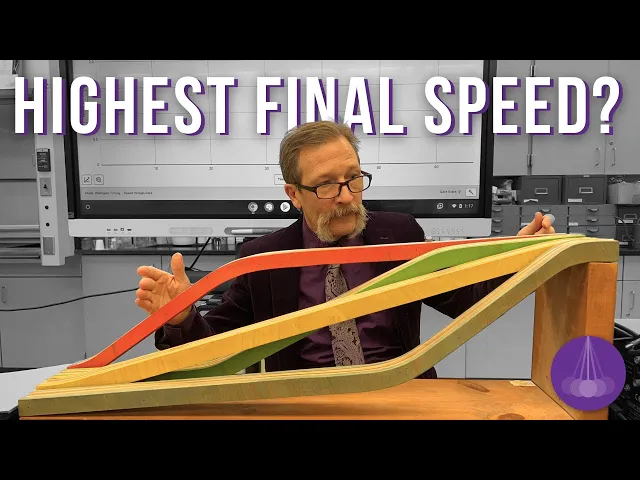
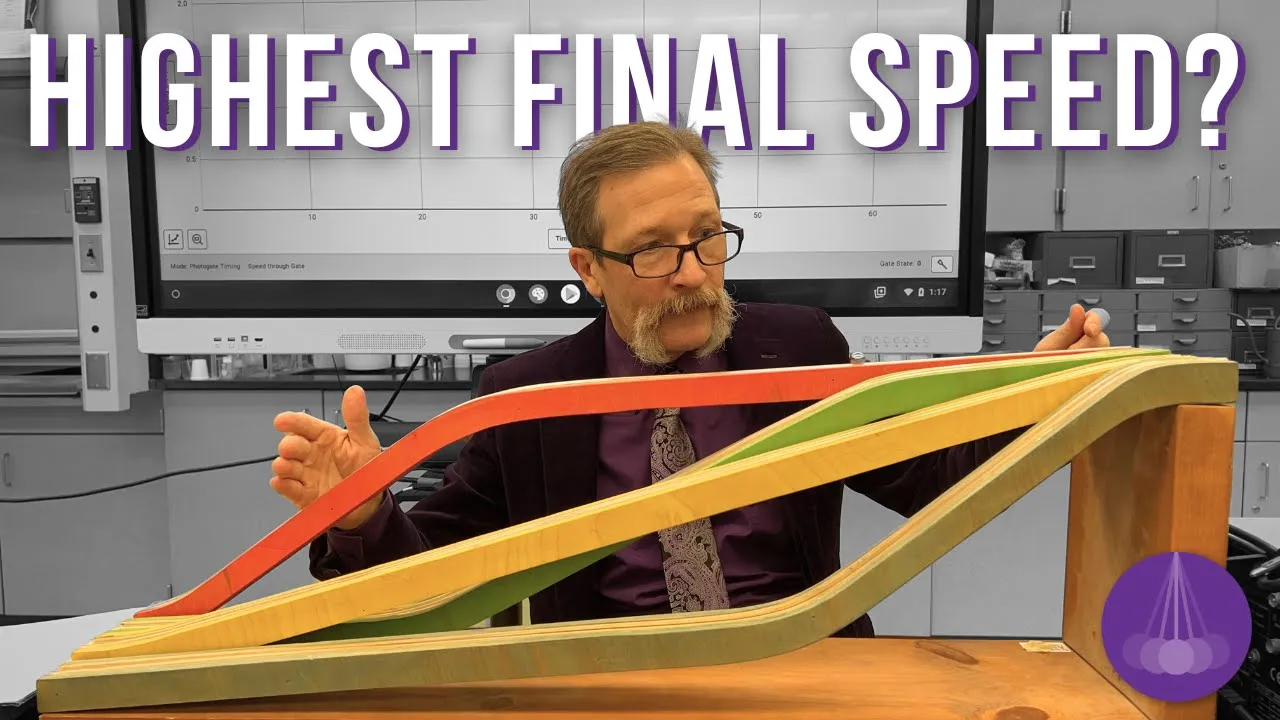
today's quiz involves four ramps they're of different curves but they all start and end at the same place we simply want to know if I were to take one of these metal spheres one of these ball bearings and let it roll down to the bottom when it gets to the bottom which one would have the greatest velocity here's what your quiz looks like I'll hold that up for you now as always Mark your answer as completely as possible and be sure to list your confidence student responses very wildly some will say the red is absolutely
going to be going the fastest because it's got the steepest slope especially at the end where it really matters others will say this yellow has a slow and steady and it's going to have the greatest acceleration and therefore it's going to be going the fastest at the bottom others will say no no no blue gets going fast and stays fast for a very long time it's going to be the fastest others will say green while they all are going to be varied in their ideas they're all going to be incredibly confident in their own ideas
which is so interesting because they're all confident but yet none of them agree all right let's see if we can explain this part of being a physicist or a scientist is not to be Bamboozled and that's really what we're doing here because if you think about the conservation of energy and they're all starting with the same exact amount of energy we would expect them to have the same amount of energy maybe in a different form down at the bottom so they should all be going the same speed let me see if I can set this
up and we'll show you I'm zoomed out so you can see the photo gate now I have a single photo gate which is going to try to uh measure a round object we have a long form lesson that talks about the difficulty of that let's not worry about that right now and let's just assume as long as the ball is going through the gate the same every time it should give us a relative uh measure of the velocities our problem is as each one of these spheres comes off the ramp they tend to bounce and
they can bounce over the beam so we have a little piece of paper and some cardboard underne here to smooth out that transition what I'll do I'll hit collect I'll roll five down the red and then I'll move the photo gate over and then I'll put five spheres down the green and let it go through the photo gate and so on and we will see how the velocities correspond I'll hit collect and we'll get started one two three four five I'll move the photo gate over I'll get five more and we'll try the green 1
2 3 4 5 and you can see right away that they appear to be about the same let's try our yellow five new spars one two 3 4 5 again looking very similar and I'll move this over here and let's try our blow I'm trying to release them at the same point on the ramp despite the color difference and that's why and I think we can clearly see that all of the velocities are about the same as they should be because if you use the conservation of energy we know that potential is going to be
converted into kinetic and if they all start with the same potential energy they should end up with the same kinetic energy and therefore should have the same overall velocity that's why the conservation of energy is such a wonderful tool so simple all right that's your quiz for today thank you for watching Another idealized Science Institute video we are a nonprofit organization if you like what you've seen be sure to like And subscribe and if you want leave a comment below it's helpful to us if you can financially support us go to our website and hit
the Donate button if you can't simply by sharing these videos with other teachers and stud students in your life will be helpful while at our website you'll find that we have our idealized Science Institute book that will help you engage your students in dialogic discourse there you'll also find we have a podcast where we break down educational research we also have long form lessons if you're a teacher you can watch these and go in the very next day and enact these along with this we also have many other resources including more quick whizzes so thank
you for watching and we hope to see you in the next one