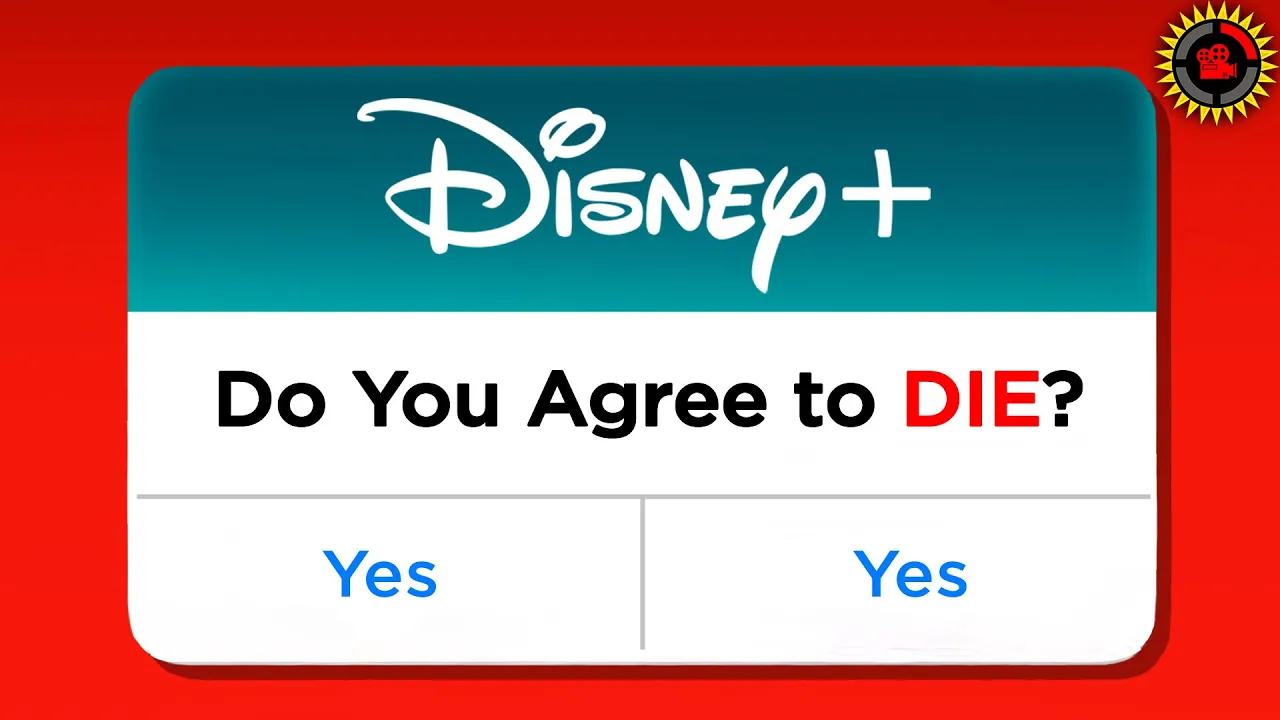
Do you have a Disney Plus account? If so, did you know that because you agreed to this part of their Terms of Service, you can't sue Disney if you get hurt at one of their parks? Like, say, if you break a bone.
Or lose a limb. Or maybe, just maybe, if you die. Yeah, the mouse is actually making the argument that if you sign up for a Disney Plus account, you're literally signing your life away.
Are they right? Well, let's break it down. Hello, Internet!
Welcome to Film Theory, the show that always reads the fine print. I want you to imagine for a moment that you have a loved one that has a severe allergy to peanuts. So, when you go out to eat at a restaurant, you have done everything in your power to make sure that this restaurant has food without peanuts in it.
You checked the restaurant's website, looked over the menu, informed the waiter, checked with the chef, and confirmed that the food that was brought out was good to eat. And yet, a tragic mistake has been made. The food does have peanuts and your loved one dies after eating it.
Heartbroken and seeking justice, you sue the restaurant for negligence, only for the restaurant to try to keep it out of the courts because, years ago, you agreed to the terms of service for a completely different app that happened to be run by the same company. If this sounds like the nightmarish plot of an episode of Black Mirror, it sadly isn't. This actually happened.
A woman named Dr Kanokporn Tangsuan died after suffering an allergic reaction to food served at a restaurant on a property owned by Disney. And now, her husband, Jeffrey Piccolo, is trying to sue Disney for the wrongful death of his wife. But Disney is trying to keep this out of the courts with a legal loophole buried in their terms of service.
But not the terms of service for this restaurant, it's the terms of service for Disney+, all because Piccolo once signed up for a free trial of the service. I don't want to make light of this case. A woman, a real human being, has died.
And Disney is trying to get out of this lawsuit because they watched The Mandalorian. I wanted to highlight this case and really dig into it because this is absolutely insane, right? How could this even be legal?
Is it even legal? That's what I want to answer today, loyal theorists. Is this actually a defense Disney could use, or should we all be objecting to this nonsense?
Well, here's a hint. We should be very scared of the future if this is a sign of things to come. Click I agree, friends.
We have a lot to get through here. So up front, I want to let you guys know that I am not a legal professional. I am not a lawyer and none of this is legal advice.
You're also going to hear me say the words alleged and allegedly a lot because that's real legal language. This is an ongoing case and you have to be careful with how you talk about these sorts of things, both from a legal perspective but also because the truth is important. So, cool?
Cool. To start out with, let's all get on the same page about what actually happened here. On October 5th, 2023, the married couple Kanokporn Tangsuan and Jeffrey Piccolo ate at a restaurant called Raglan Road at Disney Springs in Orlando, Florida.
This is an area outside of the Disney parks that acts like a sort of outdoor shopping mall that's open to the public. Many of the shops and restaurants here are not owned or operated by Disney but lease out the space from them else. Raglan Road is such a restaurant.
Tangsuan had a severe allergy to nuts and dairy. She couldn't consume any nut or dairy products without potentially dying and Piccolo's complaint alleges that they used the information from Disney's website to see if the Raglan Road menu had options she could eat. That's actually why they also think Disney is liable in this case since their website allegedly said the menu would be safe.
Even still, Piccolo alleges that the couple repeatedly informed the staff at Raglan Road of this allergy and confirmed that the chef could prepare free from nuts and dairy. However, about an hour after eating the meal, Tangsuan suffered an allergic reaction and sadly died shortly afterwards at the hospital. A medical examiner determined that she had dairy and nuts in her system, which caused her death.
Later, in February of this year, Piccolo filed a wrongful death complaint against both Raglan Road and Walt Disney Parks and Resorts, alleging that the two companies were negligent in serving Tangsuan by not ensuring that the food they said didn't have nuts and dairy in it, actually didn't have nuts and dairy in it. Disney countered this by saying that it shouldn't go to court because, in 2019, Piccolo signed up for a Disney Plus account on his PlayStation. That's actually what's in the legal documents, by the way, that exact explanation with the PlayStation.
Oh, and also, in 2023, he bought tickets to the Epcot theme park using the Walt Disney Parks and Resorts website, but didn't use them. So, if it wouldn't be in the courts, what would happen then? Well, then it would go to arbitration, and here's why that matters.
Arbitration is an alternate way to resolve legal disputes that doesn't involve a courtroom, instead of being taken before a judge and a jury, arbitration is resolved by, well, an arbitrator. That's like a neutral or freelance judge. This is often much quicker than going to court because there are a limited number of judges and they're almost all busy all the time, and arbitration is almost always done in a private setting, which corporations like Disney would prefer because they don't want to air dirty laundry.
But, if you were trying to make a point, to make a company that you believed caused the death of your spouse publicly acknowledge that fact and make them face justice, you might not want to keep it behind closed doors. But, okay, why does Disney think this should go to arbitration in the first place? Well, both of the services that Piccolo used here, Disney Plus and the Parks and Resorts website, have clauses in them that say that they have to.
I'll put the exact text up on screen, but to save both you and me from having to wade through all of this legalese, I'll just translate what this means. Basically, if you have any sort of disagreement or problem with Disney's direct-to-consumer services, that's the wing of Disney that is specifically dealing with digital media like Disney Plus, at any point in the past, present, or future, you agree that you won't take it to court. Instead, you'll take it to arbitration, which will keep things private.
And, at this point, you're probably wondering, wait, how could they possibly make the argument that this covers what happened at the Disney Springs restaurant? That seems like a stretch, right? How could you think that this case has anything to do with Disney's direct-to-consumer services?
Well, also buried in the terms and conditions of the Disney Plus Subscriber Agreement is this phrase. You, on the one hand, and Disney Plus, on the other hand, agree to resolve, by binding individual arbitration, all disputes, including any related disputes involving the Walt Disney Company or its affiliates. I repeat, any related disputes involving the Walt Disney Company or its affiliates.
Again, if that legalese is hard for you to get a handle on, this is basically saying that because you agreed to the Disney Plus terms and conditions, you're waiving your right to trial against any part of Disney, period, regardless of how far removed it is from Disney Plus. And just a reminder, of all the sorts of things Disney has a stake in, it's not only Disney, and Pixar, and Marvel, or whatever. It's also all of their Disney parks, and the Disney Cruise Lines, and Fox, and ESPN, and ABC, and Buena Vista International, and Hollywood Records, and National Geographic, and A&E, and Hyperion Books, and Compass Roads Land Corporation, and Reedy Creek Energy Services, and Partners Federal Credit Union?
They even have investments in GoPro, and Photobucket, and Epic Games, so can I not sue Fortnite or the Unreal Engine because I signed up to watch The World According to Jeff Goldblum? Now, I shouldn't need to tell you that this is horrifying and evil. This is such an overreach and so broad that it feels like we're living in cyberpunk.
Welcome to the capitalist dystopia, I'm sorry we have a boring one, I wish ours was more exciting with flying cars and laser katanas. But would this be legal? Well, just because something is in a product's terms and services, that doesn't mean that it's the end-all be-all and that it can't be undone.
In fact, if one of the terms is found to be unconscionable, it can't be enforced. And by the way, unconscionable is an actual legal term that is incredibly unhelpful in just how vague it is. Basically, it's anything that is so extreme, unfair, or one-sided that it quote, shocks the conscience.
Very helpful. Very demure. If you want an example of something that would classify, if you ever signed an agreement that said you would forfeit ownership of your first born child, that wouldn't hold up in court.
Fun fact, one study did actually put that in a product's terms of service and people still happily agreed to them, most likely because they didn't bother reading it. Oh, and my favorite example of a wholesome company actually having fun in their TOS in a legal and good way has to be Larian Studios with Baldur's Gate 3. Their terms state that the entire agreement must be referred to as the pact, and you cannot make any similar agreements with any other demonic, eldritch, or fey beings.
That's why you read the fine print, people, you never know what sorcery they slip into this. So, would something like this arbitration clause in the Disney Plus TOS count as unconscionable? I mean, personally, just the fact of how broad it is that you can't sue any part of Disney makes me think that it should be.
The lawyers representing the victim here also agree, calling Disney's defense so outrageously unreasonable and unfair as to shock the judicial conscience, and many law professionals believe that this is too far-reaching to hold up. But would the courts agree? Well… Back in 2011, a California couple sued AT&T for false advertising and hidden fees, but AT&T's defense was that the couple agreed to their terms of service, and the TOS said they had to go to arbitration rather than to court.
Sounds all too familiar, doesn't it? Well, the California court system actually came down on the side of the couple, and agreed that this part of the contract was unconscionable and illegal. But they weren't the last word on it.
No, this case made it all the way to the United States Supreme Court, who decided that AT&T's arbitration clause and all others like it throughout the country was legal and allowed it. Basically, they thought that because so many contracts had these arbitration agreements in them and it hadn't been a problem before, how could it be a problem now? Yes, that was the actual rationale.
This was a HUGE deal, with one law professor calling it quote a real game-changer for class action litigation. And this wasn't the only example of this. Arbitration clauses like these have repeatedly held up in court.
The only times they haven't, it's been because the corporation got sloppy or stupid, particularly by updating their TOS without actually telling anybody. Basically, they pulled a Darth Vader. This is also why companies are so adamant about emailing you when they update their TOS.
They don't want to get sued. And another way companies get sloppy is by not making people actually agree to the terms of service. This is why we see what's known as a click-wrap agreement all the time.
Basically, these are TOS where all of the terms of service are presented in a clear, accessible manner like a text box with a scroll bar or a link to another document. A user then has to click on a box saying I accept or do some action that says I have read these terms of service. I'm sure that you, like me, have agreed to hundreds of these things at this point, and they're kind of annoying, right?
Well, they exist for a reason, and mostly it's to protect a company providing a product or service. And as long as you click I agree, the courts have tended to side with the companies that these terms are legal and enforceable. But Disney didn't make any of those mistakes in this case.
This arbitration clause is clearly written in the Disney Plus terms of service, as is this wildly overreaching agreement that it applies to everything related to Disney. They didn't surprise Piccolo and update the terms without telling him, and you are given ample opportunity to read the TOS before signing up for Disney Plus. So, theoretically, if Disney wanted to fight this on the face of things, despite how stupid and dumb and outright evil this is, there's a great chance that the courts would end up siding with them.
Well, that would be the case, except for one important thing. Disney never had a case here to begin with, and they knew it. See, something that I haven't really seen anyone talking about in this case is the fact that Tangsuan, the woman who died, wasn't the one who agreed to the Disney Plus terms and conditions.
Her husband, Jeffrey Piccolo, did. Her husband is the representative of her estate in this case, but anything that he did for himself in a personal capacity, like, say, sign up for a Disney Plus account or buy tickets to a Disney park online, none of that can or should apply to his wife. She was the one that was wronged here, not him.
Imagine if you marry someone and that person takes out a new credit card under their name. If they rack up a bunch of debt on that card, only in their name, and then they die, you are not responsible for their debt. Their estate is.
The exact same thing applies here, just in reverse. Tonkswan is not responsible for any personal agreements her husband made in his name only, and vice versa. Piccolo's lawyers actually brought this up themselves when they countered Disney, saying that, quote, Disney wasn't going to win either in the United States court system or in the court of public opinion, which is why, in the end, Disney backed down here.
Yeah, since this case caught the public's attention, Disney faced a swift and justifiable backlash, which caused them to panic and walk everything back. They've agreed to go to court instead. As they explained, quote, Yeah, sure.
Now, I'm not saying you decided to back down here because it made you look like an evil corporation, but it sure looks like you backed down here because it made you look like an evil corporation. Art imitates life. Life imitates art.
So what's the takeaway here? Why does all of this matter beyond just being another way to prove that Disney is evil and got bullied into doing the right thing? Well, first off, Disney did a tactical retreat here, but they're not actually changing anything.
All they did in this case was waive their right to arbitration. They're not changing the ridiculous terms of their subscriber agreement. Secondly, they're not the only ones doing this sort of trickery in their terms and conditions.
According to The Guardian, it would take you almost 250 hours a year to read through all the terms and conditions for the products you use. CC Magazine estimated in 2020 that it would take you two and a half hours to read the TOS for Microsoft Teams, two hours for Candy Crush, an hour and a half for TikTok. No one has time for that.
And in fact, a 2017 survey found that 91% of people don't read these terms and conditions before agreeing to them. And I get it. I mean, I don't read them because I have better things to do.
And so do you. These companies and corporations know this, and they take advantage of that. Like, earlier we joked about the companies putting strange things in their TOS as a joke or to run an experiment.
But some seriously dangerous stuff could be in there as well, and you may never know it. As long as you click I Agree to all of these random terms and conditions for the things we use every day, you're signing away so many of your rights. And that's terrifying.
So where do we go from here? What do we do? Well, a company having terms and conditions that a user needs to agree to is reasonable.
They do need to protect themselves from ridiculous and frivolous lawsuits. But at the same time, the terms and conditions themselves have to be reasonable too, and we can hold them accountable. You, and me, and everyone else out there.
One person might not have the time to sit through all of the terms and conditions that we agree to every day, but together? Collectively, we can read through all of this. As a community, we can band together on forums, and on Reddit, and on social media, and look at what we're actually signing up for when we agree to these terms.
And if there's something objectionable, if there's something stupid and ridiculous like signing the right to sue any part of a corporation away just because you want to watch the new Moana, we can call them out and make these corporations answer for it. We can make change. You just have to click I Agree on doing it together.
But hey, that's just a theory. A film theory. And cut.
And if you want another theory about Disney just being the worst, check out our video about how they almost killed the X-Men.