do you ever take care of babies and are you a little bit confused about where we've landed with the jaundice and the hyperb rubenia guidelines and when we should be starting phototherapy and which babies we're most concerned about well you're in the right place I'm Dr tala and I've been a neonatologist for over 15 years now and today we're going to cover the AAP or the American Academy Pediatrics guidelines the most recent update that they put out in 2022 on on the management of infants with hyperb rubenia I'm even wearing yellow so you really remember
it as a quick reminder we did film four videos on jaundice a couple of years ago so if you're confused about the difference between direct and indirect hyper rubonia or what the difference is between breastfeeding jaundice and breast milk jaundice or what is a hemolytic jaundice hemolytic anemia what is a direct then go back as a revision and check all of those out before we go into kind of like the clinically applicable steps in this video so these AAP guidelines cover pretty much everything that you need to know to be able to take care of
babies above 35 weeks in the niku and just as a reminder I know you know all of this but the main reason that we care about hyperb rubinia or jaundice is to prevent yes korus we don't want any of these babies getting korous if you can't remember what that means go back and check the previous videos we filmed this policy covers four or really five main segments but we're going to cover four one the prevention of hyperb Billy rubonia two its assessment and monitoring three treatment and four postd discharge followup the other great thing about
this paper is it lists 25 key action statements or k is the acronym that they use which are all statements that we can apply clinically for our babies so we'll be covering those as well right let's start with one the prevention of hyperbilirubinemia as you all know this starts when the mothers are actually pregnant we need to know if the babies are a set up for hemolysis if you remember the mothers that we worry the most about are the mothers that are O type O blood type or Rh negative also it's possible that the mother
has antibodies to other red blood cell antigens if she had a blood transfusion in the past or if she had previous pregnancies if you can't remember why go watch the previous videos so the first key action statement is if the mother's antibody test is unknown or positive which means that she does have little antibodies floating around her system that may be attacking antigens on red blood cells then we should be getting the baby's blood type as well as a direct antiglobulin test on the baby so basically a CBS on the baby and that will actually
check whether there are antibodies sticking to the baby's red blood cells and causing them to hemal lie so realize this has changed in the past few years we used to get babies blood types on everybody now we'll only get the baby's blood type and the if the mother is Rh negative or if the mother has a positive antibody test if the mother is oppositive then you have a choice you can either send the baby's blood type in immediately or you can just follow the Billy rubben levels and only end up sending the baby's blood type
if the Billy rubben level is getting higher the second aspect of prevention is providing good feeding support we know that breastfeeding is highly correlated with high Billy ruin levels so it's very important that if mothers are breastfeeding that they are provided with adequate support whether it's lactation support or whether it's encouragement from the postpartum nurses and everybody else taking care of the mother mothers should be breastfeeding at least eight times in a 24-hour period so on average Q3 hours the the second key action statement covers whether other forms of supplementation should be used as a
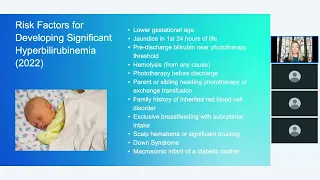
way to prevent hyperbilirubinemia and in K2 they quite clearly say that oral supplementation with either water or with a dextrose solution should never be used in the prevention of hyperbilirubinemia whether you end up supplementing with donor breast milk or formula is a decision that can be made with the team with the parents now now let's talk about the assessment and the monitoring of hyperbilirubinemia what the AAP really emphasized in this section is that we should identify and be aware of babies that are especially at high risk of developing hyperbilirubinemia they list the risk factors for
developing jaundice in table one of the paper and they're exactly what you would expect so prematurity hemolysis need for phototherapy in the first 24 hours of Life exclusive breastfeeding seilah hematomas LGA IDM babies what we all know so they also spent a couple of paragraphs talking about G6PD deficiency and the importance of recognizing whether a baby has it or not so remember G6PD deficiency and we discussed this in the previous videos is a genetic variant of red blood cell metabolism so if the infants are lacking that enzyme then the red blood cells are more likely
to hemolyze so obviously it's a non-immune hemolysis it is inherited in an exlink manner so remember g6pdx I don't know that might help so obviously it's more common in males it's also more common in African Middle Eastern and Southeastern Asian communities and about 133% of africanamerican males have G6PD deficiency so obviously a lot of babies in the US as well so what the paper really emphasizes is that if you have a Billy rubben that's Rising rapidly and it looks like it's hemolytic so you have a high reticular sight count but it's not immune then you
should definitely be thinking about G6PD deficiency especially if it's a boy these babies are at higher risk of developing korus so obviously a big part of assessment and monitoring is to actually identify which babies you have to start phototherapy on so that brings us to key action statement number three and key action statement three is the the total serum Billy Rubin levels should guide whether you start phototherapy or not so whether you start phototherapy or not or eventually whether you escalate care really depends on three different things number one the hour specific total serum Billy
Rubin level so how many hours old the baby is when that Billy Rubin level is checked two the gestational age of the baby and three whether the baby has any potential neuro toxic risk factors the neurotoxicity risk factors are all listed out in table two of the paper and again they're exactly what you would imagine them to be so a gestational age of less than 38 weeks albumin of Less Than 3 G per deciliter and remember this is because Billy ruin is normally bound to albumin so if the albumin is low then you'll have more
free Billy ruin that can cross the bloodb brain barrier into the brain so then a hemolytic cause is another risk factor so isoimmune or for example G6PD deficiency also sepsis or significant clinical instability within the last 24 hours and that's kind of like a clinician decision they didn't really provide a pH or kneading presses or whatever but really that's under the understanding that if the baby is unstable then there's more likely to be a breach in the bloodb brain barrier and you're more likely to end up with korus if the baby's unstable now let's cover
the Visual Diagnosis as you all probably know we're not very good at looking at babies and seeing how yellow they are and then estimating the Billy Rubin levels it's not an accurate way of deciding whether a baby needs phototherapy or not the exception to that is if you look at a baby and the baby doesn't look jaundice at all it is incredibly unlikely that that baby is going to have a high or a critical level of Billy rubben so again if you look at a baby and they're not jaundice then their Billy Ruben is probably
low if you look at a baby in their jaundice then we are awful at actually guessing what that number is so it is helpful in that if a baby doesn't look jaundice you can feel pretty good about it key action statement four is that every baby in the hospital should be visually assessed for jaundice every 12 hours until discharge if they look like they're jaundice then we should be sending either a serum Billy or at least a transcutaneous billy Ruben on on that baby which brings us to our next Point are transcutaneous Billy Rubin accurate
well the AAP thinks that they are a reliable and accurate screening tool to figure out which babies actually should be getting a serum Billy rubben and it's good at reducing overall blood draws generally the serum Billy Ruben is about three Mig per deciliter off from the transcutaneous Billy Rubin it can be one way or another but that also really depends on how much melanin the baby has in its skin also at above 15 migs per deciliter the transcutaneous Billy ruin is not accurate at all after that fifth key action statement is is that serum or
transcutaneous Billy Rubin should be measured at least once between 24 and 48 Hours of life or before discharge and straight on to k6 and that is that a serum Billy rubben should be measured if the transcutaneous Billy Rubin is within 3 mg per deciliter of phototherapy levels or obviously if that number is above 15 K7 is about the rate of Rise of the Billy Rubin so if you have two points then you can calculate the rate of Rise of the Billy Rubin and it can kind of try to help you figure out whether it's rising
really quickly and it's more likely to be hemolytic or not if the rate of Rise is above 0.3 migs per kig per hour in the first 24 hours or above 0.2 migs per kig per hour after 24 hours then this is a high rate of rise and it's more likely to be hemolytic so just based on these two Billy Rubin points it might be reasonable to go ahead and get the baby's blood type and the and everything K8 is if you can't get adequate followup for a baby that's being discharged to go get that Billy
Ruben checked then you should actually delay discharge and K9 in infants who are still jaundice at 2 to 3 weeks of life you should also measure a direct Billy Ruben so if the direct Billy rubben is above 1 Mig per decler then this is more suggestive of a liver issue so for example the baby could have bat treia an inborn error metabolism a UTI sepsis a whole list of things which brings us to three the treatment of hyperbilirubinemia which is probably why you're all here I won't go into a lot of details about phototherapy just
realize that giving phototherapy chemically Alters the Billy Rubin so it's easier for the baby to actually excrete it as much as the baby's body should be uncovered when you're actually giving phototherapy and the phototherapy is basically the blue light with an average wavelength of 475 nanom so between 430 and 490 so realize that this is regular blue light it's not UV light or anything so it's not especially dangerous to Baby eyes babies just find it irritating that's why we put the goggles on the current known risk factors of phototherapy according to the AAP is that
it slightly increases the risk of epilepsy however per the AAP if phototherapy is being used to prevent an exchange transfusion then obviously this risk is worth it we should be measuring the IR Radiance level so how much phototherapy is actually been given to a baby on all babies that are receiving it and the average should be about 8 to 10 microwatts per CM squar that's the unit that it's measured in when intensive phototherapy is given we can give up to 30 microwatts per cim squared they also discussed the possibility of using sunlight as a treatment
to lower Billy Rubin levels but they kind of go through some of the issues and that is that we don't know how much the baby is getting we're worried about the baby getting sunburnt and stuff so using sunlight is not recommended where we actually have the resources to give phototherapy and that's really what these guidelines were used for so when do we actually start phototherapy well key action statement 10 shows when you start phototherapy based on figures two and three that are available to everybody so for each Billy ruin level and gestational age you plot
out the Billy ruin at which hour it is and figure out whether the baby needs phototherapy or not figure two is is for when there are no neurotoxicity risk factors and then you can see there are lines for different gestational ages and again this is for gestational age at Birth and it's also dependent on the time the Billy was checked again this is the total serum Billy Rubin not transcutaneous Billy Rubin and you don't subtract the direct Billy rubben so let's say you have a 39 we infant who is 24 hours old with a billy
Ruben of nine do we start photo therapy so let's plot that out officially not starting phototherapy at that level figure three is for when there is at least one neurotoxicity risk factor so apart from gestational age so again gestational age less than 38 weeks albumin less than three sepsis hemolysis or being critical in at least 24 hours note that infants above 38 weeks are all grouped together here basically all these thresholds have increased slightly from the previous normograms that were released by The AAP probably about 2 Mig per less a liter higher so we are
starting less phototherapy now than we were a few years ago the AAP also notes that it would be acceptable to start phototherapy at a slightly lower level just if the baby's about to go home just to make sure that the baby doesn't have to get readmitted K1 though is that if a baby does go home and ends up needing phototherapy then home phototherapy can be done as long as the baby doesn't have any neurotoxic risk factors I'm not going to go over this small because it's kind of outside the realm of the ncu the importance
of feeds are also emphasized and we all need to make sure that these babies are feeding very well you can stop the phototherapy while the baby is being breastfed so remember phototherapy kind of starts an enzymatic reaction so the baby doesn't have to be continuously under the phototherapy for it to work but the more time the better Ivy fluids should only be used if the baby is actually dehydrated so it's like breastfeeding jaundice and your sodium 152 or whatever or if you're actually escalating care so you're getting closer and closer to need an exchange transfusion
then yes you should be starting IV fluid 12 Billy Ruben should be checked once you've started a baby on the phototherapy at a maximum of 12 hours after starting the phototherapy if the baby's Billy Rubin is high or there's a rapid rate of Rise then you should be checking the Billy ruin levels before that and again it should only be the serum Billy rubben that you're checking when a baby is under phototherapy when you put them under the phototherapy the transcutaneous Billy rubben is the one that's going to go down the first so once you're
under phototherapy transcutaneous Billy Rubin are not accurate so it needs to be a serum Billy rubben k 13 I'm including this so you don't wonder where number 13 is babies who are on home phototherapy have to have their Billy Rubin leveled at least every 24 hours remember those are babies without neurotoxic risk factor k14 is important clinically watch should you be checking if a baby is placed on the phototherapy well the AAP recommends at least a hematocrite or a CBC checking to see if the baby is anemic if you're worried about hemolysis you can also
check a reticulite count they don't mention that but I'm just adding that obviously you should be checking the baby's blood type if the mother is o or she had a positive antibody screen and then really you should be trying to figure out what is actually causing the baby's jaundice and should you be worried about hemolysis should you be considering G6PD so depending on what the cause is then you're more likely to be more or less aggressive kas5 is when you stop the phototherapy so you can stop the phototherapy when it's at least to below two
migs per deciliter below the threshold level for phototherapy for that age if the baby has additional risk factors so for example the hyperbilirubinemia is HEM or phototherapy was started when the baby was less than 48 hours old then you can wait for that Billy Rubin level to get further away from the phototherapy level so three or four or whatever else you choose let's go on to ks16 when do you get a rebound Billy Ruben so to make sure that it hasn't shut up after you've St phototherapy so the AAP recommends that you get oh my
glasses so the AAP recommends that you get a followup Billy Ruben between 12 and 24 hours after stopping phototherapy and if it's hemolytic then you can get a billy Rubin earlier than that so 6 to 12 hours after stopping photo theapy remember if the baby's been under phototherapy then you have to get a serum Billy Rubin to check the rebound if you're checking a rebound Billy Rubin Beyond 24 hours after the phototherapy has stopped then you can check a transcutaneous billy Rubin because after 24 hours kind of all the Billy ruin has equilibrated again now
let's talk about escalation of care which is basically anything that you do Beyond phototherapy to prevent an exchange transfusion again we've spoken about exchange transfusions as well so go back and look at that video if you want to know anything more about that an algorithm is in place for what should occur when you are escalating care and basically escalation of care should happen when you are 2 milligrams per deciliters or less away from the exchange transfusion levels and we'll cover the exchange transf Fusion level graphs in a second k17 refers to the figures that you
have to look at to determine whether a baby needs an exchange transfusion or not so they're just like the phototherapy graphs but these are all obviously a little bit higher the numbers because they're the levels that you actually have to do in exchange transfusion again there's one graph for babies without neurotoxicity risk factors and one graph for babies with neurotoxicity risk factors so alt together there's four graphs that you should be aware of two graphs for the phototherapy levels and two graphs for the exchange transfusion levels so again when you are looking at the graphs
you plot out the age specific serum Billy Rubin level so the hours that the Billy Ruben was checked at on the right gestational age for the baby and then you see where it plots out if you're within 2 milligram per deciliter of the exchange transfusion level then you need to escalate care probably the most important aspect of escalation of care is making sure that the baby is somewhere where an exchange transfusion could be done so if the baby is still on the floor with their mothers then they need to be transferred to the ncu if
you're in a hospital where you can't do an exchange transfusion then you need to send that baby somewhere where they can there are three key action statements covering the escalation of care so 18 K 18 is that for any babies that are having escalation of care then you should immediately send a stat serum Billy and a direct Billy a CBC an album in level chemistries like checking if the baby's dehydrated or anything as well as a tight and cross match because if you end up giving blood obviously we need to have that blood ready K9
infants needing escalation of care need intensive phototherapy so check the radiance it needs to be closer to that 30 microwatt per cm squared number so intensive phototherapy as well as IV hydration and there should be a neologist on board so to admit the baby to the Neu K20 is that the serum Billy Rubin level when in infants who are requiring escalation of care the serum Billy Rubin level should be measured every 2 hours until you are no longer in the zone of escalation of care so when until you're at least two or three or four
away from needing the exchange transfusion k21 is that IVIG or IV immunoglobulin can be given to babies with the isoimmune hemolytic type of jaundice so obviously the babies that are kums positive and we made a whole video about this so if you want to know more then go back and watch these videos generally we can give between 0.5 and 1 G per kilo um honestly I by the time I'm giving IVIG I pretty much always give the 1 gram per kilo and it needs to be given over 2 hours if you do need to repeat
this then you can repeat this dose 12 hours later and then this is figure four which beautifully delineates what you're doing for the babies when you're escalating care and again you can see it starts very clearly with make sure that you are somewhere where an exchange transfusion can be done K22 is that an an urgent exchange transfusion should be performed in babies with high Billy Rubin levels even if they're not quite at the exchange transfusion level and any signs of acute Billy rubben and sephy opathy so things like hypotonia so the babies a lot stiffer
remember normally when Billy Rubin levels are a little bit elevated like the high teens normally babies are a lot sleepier and more tied and less likely to eat as much if they're really going into the hyperb Ruben inphy opathy stage then they can become really stiff and they can have arching also opisthotonus I think that's how you pronounce it and that's a really bad stage where like it's kind of what you can see in adults with menitis or something where like their whole backs and necks are kind of arching and very stiff going backwards other
signs of Billy Ruben andopa are a really high-pitched cry and also the baby developing apneas like true Central atne and k23 is that an urgent exchange transfusion should be performed once you actually reach the threshold levels for the exchange transfusion depending on which graph you're following so as you all know it can take about 4 hours at least for the blood to be set up getting it ready for the exchange transfusion so while you're waiting for that you should be checking the Billy Rubin every 2 hours if the Billy Rubin level ends up coming down
below the exchange transfusion level even if the blood is getting ready then you can hold off actually doing the exchange transfusion just as a reminder we do the exchange transfusion by taking out obviously the baby's whole blood and putting back in red blood cells reconstituted with ffp or basically with fresh frozen plasma all the good proteins that are in blood so normally the blood bank has to take red blood cells and then take ffp and make the hematocrite of the blood that we're giving about 45% so the blood that we're giving doesn't have white blood
cells or platelets if you want to know more about this go look at the exchange transfusion video the AAP also mentions that you can use the Billy Rubin divided by the alamin ratio to decide whether you do want to go forward with an exchange transfusion or not I've actually never used this number trying to make that decision or not but they lay it out very well the numbers that you accept depending on the risk factors for the baby so the ratio levels are anywhere between 6.8 to8 Billy Ruben over albumin now let's cover four the
postd discharge followup and honestly I think this could be my favorite part of this entire paper because previously when we were sending babies home from the hospital and they had to follow up with their pediatricians or whatever we just kind of went on a hunch when the babies should be followed up to check their Billy rubben again but in this updated policy statement from 2022 they cover exactly when the baby needs to be followed up and when the baby needs to be followed up is dependent from what their discharge Billy Ruben is or the Billy
Rubin closest to discharge and how far away that Billy Ruben is from the phototherapy level so K24 is exactly that that the followup that the baby needs will be determined by the last Billy ruin that was checked before the baby went home so as you can see from this beautiful figure seven if the Billy at discharge or right before discharge is for example four away from light level then the baby needs to follow up in 1 to 2 days obviously there are caveats here that you may want to follow up sooner than that or later
than that um depending on for example if the baby's breastfeeding or if the baby's already lost a little bit of weight then obviously you'd want to follow up a little bit sooner than that also we need to have policies in place for how these babies follow up and that includes when we send babies home on weekends or on holidays I always think that the Wednesday before Thanksgiving is absolutely the worst cuz Thanksgiving for all you non-americans falls on a Thursday always and so if you're sending a baby home on the Wednesday nobody works on Friday
of Thanksgiving Black Friday so Thursday Friday Saturday Sunday so it's really tough sending babies home on the Wednesday before Thanksgiving and the last KAS key action statement so key action statement 25 is that all families being discharged from the hospital should re receive verbal and written information about jaundice and the risks of korus and they should also have the last Billy Ruben level that was checked on their baby and a good plan for followup okay I hope that that helped you all clinically going through that paper I can do that more often if you're all
interested in it if there's kind of like a big policy statement or something like that that comes out in the meantime can you tell me where you're watching from like this video and again I really just want to tell you thank you so much for being here