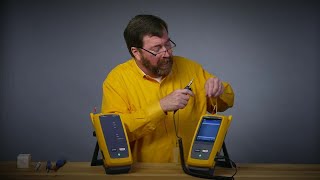
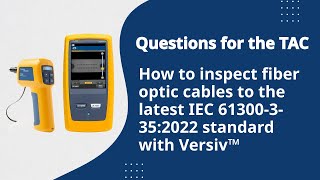
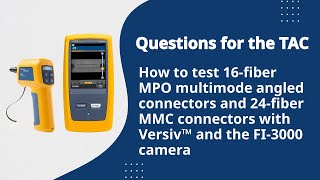
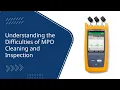
As we are often explaining with fiber optics, we're very concerned about dust and dirt that we might get on the tester. So, we can add a camera to Versive. Now, different from the FI1000 camera that you've used that works for a single fiber.
Our FI3000 camera has a port that can be used to measure MO connectors. It also has a port to measure MMC connectors, but MO is what I have in front of me today. Now, this is an interesting tip that I'm using.
The tip that I'm using, I'm going to call keyless. And this keyless tip, notice that there's also a slight angle to it. There's a slight bend to the tip.
That's so that it can inspect MO connectors. And the reason that I don't have a key on it is that will allow me to test either 16 fiber MO that has an offset key as well as 12 fiber mo that has the alignment key in the center. So with the same adapter piece I can measure both 12 and 16 base 12 and base 16 MO.
So, if I have a 24 fiber no, it will also work with this. And who knows, maybe they'll make a 32 fiber no in the future. While we're doing this test, let's take a look at an inspection test.
So, I'm going to attach this the right way so we get a good test result. I'm going to change my test limit here and I'm going to select Oh, there we go. So, I only have 10 minutes left till I need to run a test.
I'm going to select the 24 fiber test limit. I have a 24 and a 16 because my output fiber happens to be 16 fibers. Uh, my input is 24.
Use selected and I will push test to start. Now, the first thing that the screen gives us, I'm going to tap autofocus here, is a live view. And the live view is helpful because I want to look at this and I want to make sure that there's not some awful gop of dirt dust that's highly visible that I know to remove as you work with the tester.
More experienced technicians will be able to look at this view and determine if the connector is in good condition or not. Now, if you're a new technician and you don't have as much experience, you're going to tap analyze here. And this can also serve as a learning experience to teach you what a good and a bad connector look like.
Let's see what we get here. Oh, we're failing. Great.
So, here's the overall view, and it's telling us which of the fibers are failing. Let's drill into this. Now, I'm going to expand it, and I'm going to tap on the fiber here to see why we're failing.
And let me make this a little bit more visible. I'm going to take off these rings and scale on the outside edge and so we can see. Yes.
See that little teeny tiny red dot? Oh no. A fail is a fail.
Okay. And I have to put myself in the shoes of a technician who is new and has less experience. That dot is almost on the core and the single mode core is small.
So, let's take our connector, take our cleaner, and we're just going to give this a click. And we'll put it back in there. There we go.
And let's save this. We'll save this for training purposes. And let's tap analyze one more time and take a look.
Because not only do I need to inspect it, clean if necessary, there was a speck of dirt on it. I might have ignored that speck of dirt, but a speck of dirt is a speck of dirt, and I'm trying to show you the right way to do it. So, after we clean it, let's analyze it again to make sure that we got rid of that speck of dirt.
Oh, now we're down to just one failure. That's okay. Again, we'll tap on it to drill in.
We will expand the image. And that looked like it was about five or 12 that was giving us a problem. Is five or 12 that's giving us a problem.
There is fiber 11. It's green because it's in good condition. And there's fiber 12.
And look at that. There's just the tiniest speck in the core of the fiber. So, excuse me as I slide off camera here for a moment.
I'm fortunate enough to get to do a lot of international travel with the company. And one of the things that I've learned in international travel is you can't take test equipment across borders. People want to collect taxes on the test equipment.
So I don't travel with testers. But I do travel with a fully equipped cleaning kit because many times when I get overseas, people have run out of their cleaners and I say, "You really, really need the cleaners. " So this is a special fiber optic solvent.
It does a great job cleaning fiber. Let me give you a simple tip for how I have been using these cleaners. I actually have them labeled as wet and dry.
And one of these click cleaners, I'm going to put a drop of solvent on it. Now, I know that solvent is going to wick down and soak the tape. So, I can slide in here and give it a wet clean.
And then I'm going to follow up with a dry clean. Here we go. It's a nice dry clean to follow up with.
Now, after I do the wet and the dry clean, I'm going to inspect it again. And let's just inspect this one again to make sure that it's clean. We will say fix later and save that for training purposes.
Okay. And let's say test and autofocus and analyze. And let's make sure that we've gotten this connector clean now.
Okay, we're going to have to make an executive decision here. We are in the field. This is the cord that we have.
Is this cord going to be acceptable for us to use? Where is my speck of dirt? It's not this fiber that's failing.
Which fiber was failing? Oh, one down. All right, let's go to 24 H.
This is the chord I have. Do I leave it behind? I'm going to say that this speck of dirt is offcore.
And because this speck of dirt is offcore, I'm gonna use this cord today. I am gonna try one last time to give it a cleaning. Let's save that for training purposes.
I'm sorry, the inspection is not necessarily cut and dry. I would love for the technology to be green good, red bad, but the inspection is only so good and we only have so many chords and sometimes we need to use them. Now, one thing to keep in mind because we're using the addition three of the IEC61300-3-35 test limits, it does give us an out if when we are using this connector, we get acceptable optical performance in spite of the con contaminant or the defect on the end face.
If it has acceptable optical performance, then it will be considered a pass. And in this example where we have that speck of dirt off core. Oh, we were able to get the spec off.