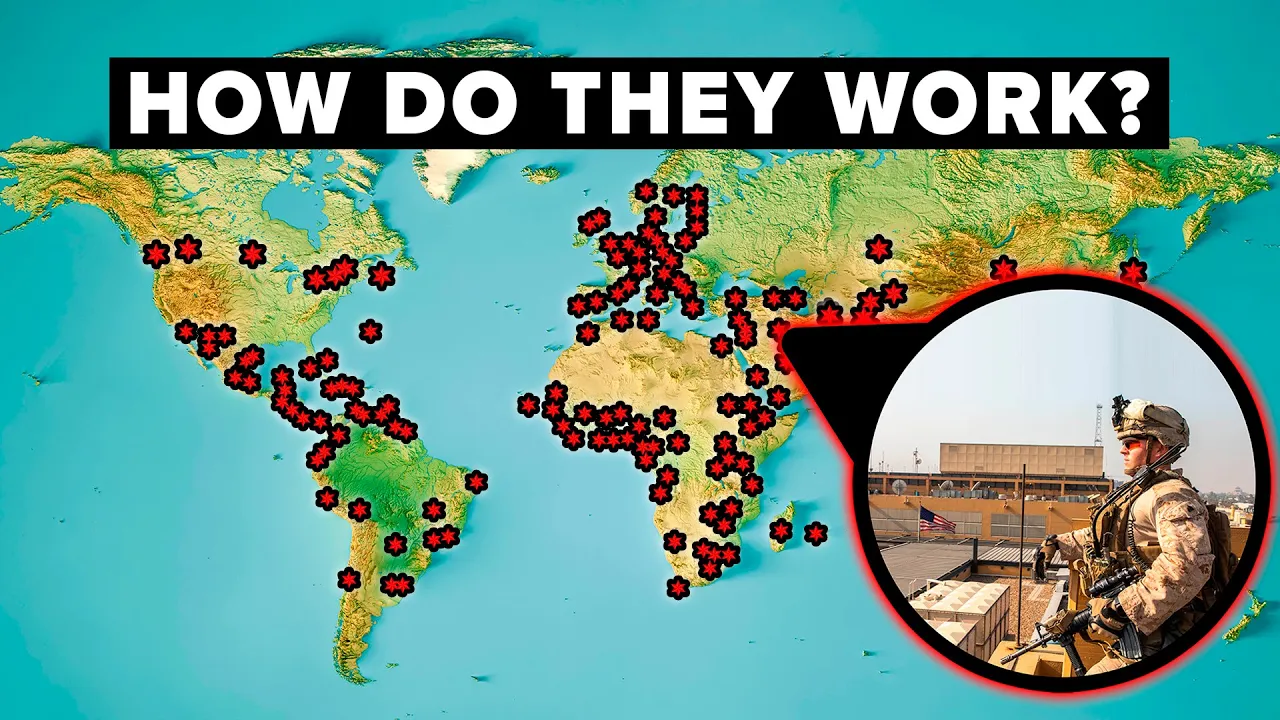
Let’s talk about embassies. Why are they important and how do the actually work? Often overlooked, embassies are more crucial to our modern world than you might realize, acting as the channels through which international diplomacy is conducted.
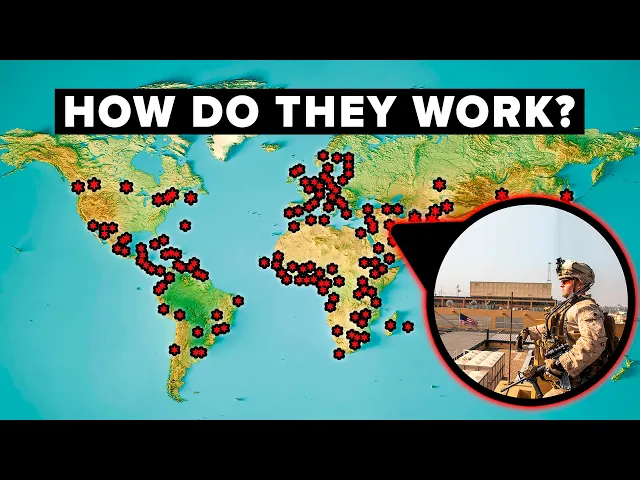
They are the physical footprint of a country abroad, the points by which governments can formally interact, and the main point of contact for citizens living abroad. Embassies can also range in size, from tiny outposts with less than 10 people, to enormous compounds like the US embassy in Iraq, which was once 16,000 strong. The world’s largest, most influential countries, like the US, often have embassies nearly everywhere in the world, except for a few small or hostile states.
However, small countries often only have a handful of embassies, necessary for connecting them to key allies and international centers of power. There are also embassies to non-state actors such as the EU, UN, and its various agencies. Embassies are important enough that even the most isolated countries in the world, such as North Korea and Iran, maintain at least a few.
North Korea, for example, even has embassies in Western countries like Germany, Sweden, and the UK, although their London outpost is little more than a suburban home. One reason why countries so strongly opposed to each other can maintain embassies is because they are codified in international law. Almost every country in the world is a signatory to the 1961 Vienna Convention on International Relations, which sets out the framework for how embassies function today.
Set out near the peak of the Cold War, this treaty has since become one of the most important cornerstones of modern international relations. Probably the most important part of the Vienna Convention is Article 22, which states that “The premises of the mission shall be inviolable” and that “the agents of the receiving state may not enter them, except with the consent of the head of the mission. ” In a nutshell, this means that everything inside the embassy is legally part of the country it belongs to, not the one in which the embassy actually sits.
In recent years, this is how international fugitive Julian Assange was able to stay in the Ecuadorian Embassy in London for more than 7 years. Assange entered the embassy in 2012, after becoming wanted for arrest in the UK and extradition to Sweden. While most asylum seekers would then proceed to the country sheltering them, UK police stayed posted outside the embassy, waiting to arrest Assange if he ever left.
Eventually, Assange overstayed his welcome and the Ecuadorians surrendered him to the UK. But if that had not happened, British police could not have entered the embassy to arrest him, despite his status as a fugitive. This is just one small example of how influential embassies can be, and how seriously countries take their international legal status.
The Vienna Convention also laid out several other important diplomatic protections. While the idea of diplomatic immunity existed long before 1961, it had previously been decided on a case-by-case basis, with no standard level of security guarantees for foreign diplomats. But the Vienna Convention standardized a number of principles: that diplomats and the embassy itself are exempt from all taxes in the host country, that diplomats are guaranteed freedom of movement, allows embassies to have couriers carrying diplomatic bags which cannot be searched or seized, and that diplomats and their residences enjoy similar protections and cannot be entered by authorities.
However, diplomats also cannot earn any income in the host country outside of the embassy, and are subject to heightened scrutiny from their own governments, at least most of the time. There’s also a reason why the Vienna Convention set up rules regarding people. That’s because the “embassy” is actually the people making up the diplomatic mission, while the building itself is properly called the chancery.
It’s a common misconception that the chancery is actually the sovereign territory of the state they represent, but this isn’t actually true. Chanceries are neither sovereign territory, nor extraterritorial like the UN Headquarters in New York City. Rather, while the laws of the host country technically apply to the chancery, most of the individuals who make up the embassy cannot be prosecuted for breaking those laws, while the Vienna Treaty stops local law enforcement from entering uninvited.
This delicate balance is one reason why diplomatic standards are so high: getting caught breaking the laws of a host country can lead to serious international incidents. One of the most recent international scandals involving diplomatic immunity took place between the US and UK. In 2019, a 19-year old British man named Harry Dunn was driving a motorcycle when he was struck by a car driving the wrong way.
Authorities found that the driver was Anne Sacoolas, a US intelligence worker married to a CIA employee, both stationed in the UK. It erupted into an international incident when Sacoolas fled the country, and the US embassy claimed she had diplomatic immunity as the wife of a US agent abroad. However, several specialists in diplomatic law argued that Sacoolas was not entitled to diplomatic immunity, as her husband was not listed as a diplomat.
They also stated diplomatic immunity no longer applied upon Sacoolas's return to her home country; so it would be possible to take civil action in the US courts. At the time then Foreign Secretary Dominic Raab claimed that according to "arrangements" agreed upon by the US and the UK in 1995, the spouses and children of US intelligence officers at RAF Croughton were considered part of the US embassy and thus eligible for diplomatic immunity under the terms of the Vienna Convention, even though the officers themselves were deemed ineligible to claim diplomatic immunity for criminal behavior outside the base. While COVID-19 put the matter on the back-burner for several years, Sacoolas would eventually plead guilty to causing Dunn’s death.
However, she did not appear in the UK for the sentencing, and will likely never serve time there. This is just one example of many, but it shows just how messy the legal issues around embassies can become, despite their necessity for international relations. In most cases, where immunity is not in question, any diplomat involved would simply be expelled from the country, since they could not be charged.
This strategy also applies to big geopolitical issues: Russia has had its diplomats expelled from countries on multiple occasions. From the US in response to interference in the 2016 US Election, from the UK after the 2018 Salisbury Poisoning, and from dozens of other countries following the 2022 Invasion of Ukraine. Basically, expelling diplomats is a way for countries to signal their displeasure, turning the revocation of diplomatic privileges into another part of their geopolitical toolkit.
However, most of the time, embassies around the world operate normally and without incident. Typically, but not in every case, an embassy will be headed by an ambassador. An ambassador’s job is extremely broad, as they are basically there to represent their country in whatever way their government wishes.
Obviously, this varies widely between people, countries, and postings, but usually involves a whole lot of meetings. There’s a perception that ambassadors spend most of their time schmoozing people at fancy events, and that’s not entirely wrong. An ambassador needs to build and maintain relationships with influential people who can help their country politically or economically.
Sometimes that means direct diplomacy, with the ambassador meeting the host country’s officials or head of state, or less direct “soft” channels of diplomacy. This can take many forms, anything from facilitating cultural or educational exchange programs to private dinners with influential individuals. So who are ambassadors?
Well, theoretically they can be anyone. Some ambassadors, especially those in difficult posts, have often spent years working their way up through their country’s foreign service, and are considered experts in diplomacy or conflict management. On the other hand, many ambassadors, especially from the US, are appointed to the post as a reward for supporting a successful candidate politically or financially.
This means that the actual skills and experience of ambassadors tends to vary widely, although each is generally supported by a staff of seasoned professionals from the country’s foreign service. In the event that an ambassador is recalled, or otherwise unable to head an embassy, the responsibility usually falls to a chargés d'affaires, the second-most senior diplomat in a mission. You also might have heard of other types of diplomatic missions as well.
While embassies are almost always located in a country’s capital, consulates are usually found in the other more populated cities in a host country. Consulates provide additional diplomatic representation and also carry out several consular tasks such as assisting expats and tourists, and public administration. Consular offices are the most common place for governments to issue visas to the businesses and individuals of the host country.
Additionally, they assist their citizens by providing passport services and necessary documents, issuing birth certificates, registering marriages, notarizing documents, and many other services. Embassies sometimes offer many of the same services, but are generally more focused on actual diplomacy. Another variation comes from so-called “Commonwealth” countries, a group of 56 states —mostly part of the former British Empire— who all have or had the British monarch as their official head of state.
Because of this, they do not exchange ambassadors, but instead have High Commissioners, who represent the government, rather than the head of state. Similarly, the diplomat representing the Holy See, the political arm of the Vatican, is titled a nuncio. Other embassy staff are also often charged with showcasing their country’s culture or ideas at various events and gatherings.
For instance, embassies will often financially support or sponsor concerts or art exhibitions relating to their country, with an ambassador giving the introduction or keynote. It’s not just events either: the chancery buildings of an embassy often represent that country in some way. To see this, you just have to take a walk through a city like Washington DC, which has an embassy for almost every country on earth.
The Chinese embassy, for instance, was designed by the firm of I. M Pei, perhaps China’s most well-known architect. The building combines modernism with grandeur and traditional Chinese motifs, in order to show the country’s ancient history and status as a modern power.
The LEED certified Finnish Embassy building is the first so-called “green embassy” in the US, and is a prime example of both form and functionality. Resembling a modern cabin in the woods, the building is nestled into DC’s lush Rock Creek Park, and is a demonstration of Finnish values in the workplace — lots of natural light, open areas, and a connection with nature. The back wall looking onto the park is glass, and also has a wooden deck and catwalk in the back area overlooking the picturesque landscape.
The same sort of idea can be seen in dozens of other embassies across the city, which act as a physical manifestation of a country’s identity and culture. Of course, not every embassy or consulate is designed with aesthetics in mind. This is especially true for US embassy complexes, many of which are located in areas with persistent security threats.
Even in low-risk areas, many US embassies around the world are built as enormous compounds, surrounded by walls or high fences, partly as a way of projecting American power. Most US embassies also use innovative, modern designs, in a conscious effort to associate the country with these values. Not all of them are like this of course— the Georgian House of the US Embassy in Australia is a low-security, quintessential Southern mansion, built in 1942 and meant to demonstrate American architecture.
On the flipside are behemoths like the US Embassy in Baghdad, which, as noted above, swelled to more than 16,000 people during the height of the US occupation of Iraq. The embassy compound itself was built in the so-called ‘Green Zone’, a highly fortified area along the Tigris River. Access to this area was tightly controlled through checkpoints, armed guards, and 9-foot-tall walls, allowing Western countries like the US, UK, and Australia to set up embassies there.
The same went for a number of powerful, Western corporations which were involved in the war effort. These included engineering, construction, logistics, and private military companies, placing thousands of civilians in a dangerous area. For this reason, the US embassy building was constructed to be a potential safe haven: self sufficient, with its own generators, wells, filtration and sewage, fire stations, and internet uplink independent of the Iraqi network.
The compound even has its own cellular networks, using New York and Virginia area codes. All embassy staff live in a fortified apartment block with direct access to the embassy and evacuation routes. But this extreme separation from the host country also meant that even at the height of the war, inside the US embassy compound there were amenities like a swimming pool, tennis courts, fitness center, nail salon, movie theater, and department store.
These effectively made the compound into its own mini-city, where important diplomats and politicians could be helicoptered into the middle of the compound and enjoy all the luxuries from back home. In addition to the comforts of the embassy compound, US and other Western diplomats serving on missions to Iraq receive higher pay. A 5 to 35% salary bonus is standard practice for diplomats serving in any country struggling with crime, pollution, terrorism, or any other factor making life difficult.
These salary incentives are one way for powerful countries to ensure that even the least desirable diplomatic postings are still filled voluntarily, and they generally seem to work. But do we really need all this? In today’s modern, globalized world, there are those who have questioned whether the formal, physical embassy and consular system is still necessary.
Some have argued that the costs involved in formalized diplomacy privilege wealthier or more developed countries, who can expand their influence through a larger diplomatic footprint, thus widening global inequality. Another argument is that in the age of internet technology, most functions of physical embassies have become obsolete. Former Filipino Diplomat Moira G Gallaga has covered this debate extensively.
She notes that proponents of a transition away from in-person embassy-based diplomacy “cite the benefits of modern telecommunications and information systems and networks. Instead of spending millions to keep ambassadors, security teams, and other support staff resident in a foreign country, presidents and prime ministers can now conveniently communicate directly on matters of urgency and importance. ” This idea has received support from other prominent voices, like long-time British diplomat Carne Ross, who has written that embassies must become more responsive and make better use of communication technology, or risk becoming a relic of the last century.
The COVID-19 Pandemic also reinforced this point for some, as any future global diseases or other catastrophes may make in-person diplomacy impossible again. But Gallaga herself argues against this idea, pointing out that for less wealthy and connected nations, the outlays of maintaining an embassy are actually small compared to the benefit they provide. She cites Zambia, which in 2009 spent around US$20 million on its foreign missions.
That’s a significant amount, but considering the country has an economy worth around $20 billion USD, that year diplomacy only represented 0. 1 percent of its GDP. And embassies often play a key role for helping developing countries obtain access to much-needed goods and services to grow their national wealth.
Similarly, Gallaga points out that diplomacy is not just a matter of money spent, and “is as much about form and symbolism as it is about substance. Specifically, establishing or maintaining an embassy is a clear sign to the host government of a commitment to deepening bilateral relations. In addition, having people on the ground provides added value in terms of obtaining insight into what is going on in the host country.
While it is plausible that the information gathering and country assessment functions of an embassy can be done remotely using modern technology, the quality is not the same. ” And as many of us discovered during COVID, virtual communication in business is rarely as effective as in-person meetings. It can be very difficult, if not impossible, for a country’s diplomats to replicate the type of relationships they maintain in person in an online setting.
Finally, Gallaga argues that virtual diplomacy cannot offer the level of support to citizens living abroad that they may need. This is especially true for a place like the Philippines, where roughly 10% of the population lives overseas, and a huge chunk of GDP comes from foreign remittances. At least for the moment, embassies and consulates offer consular services and protections to overseas citizens that an online portal cannot.
She ends by proposing that governments with limited resources can adopt a middle-ground approach, via methods like limiting their in-person footprint, or even agreements to share diplomatic facilities, such as Estonia’s agreement to place their diplomats in Brazil in the already-built Portuguese Embassy. Such diplomatic ‘timeshare’ agreements could become more and more popular in the near future. Ultimately though, it seems that for the moment, embassies and other diplomatic missions are too valuable to get rid of.
They provide a window through which countries can coordinate with each other, expand their international reach, and keep their citizens around the world relatively secure. As Gallaga concludes: “The way they will operate and conduct their work will necessarily change and evolve to keep them relevant and responsive to global developments, but in one form or another, the embassy will continue to be key to the conduct of international relations. ” But what do you think?
How important are embassies in today’s modern world, and will they continue to be the center of global diplomacy? Let us know in the comments below, and don’t forget to like and subscribe.