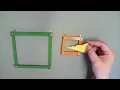
Okay, this is different types of quadrilaterals. You are going to use the geometry box of sticks, the geometry plane. You can have geometry nomenclature F1 with you.
You are not using that for the presentation, but to to reference um for the children uh which booklet it is, you will use the box of sticks for the presentation. Um, the children can also reference the drawer of quadrilaterals in our geometry cabinet. So, you're going to first gather your small group, bring over your box of sticks and your geometry plane.
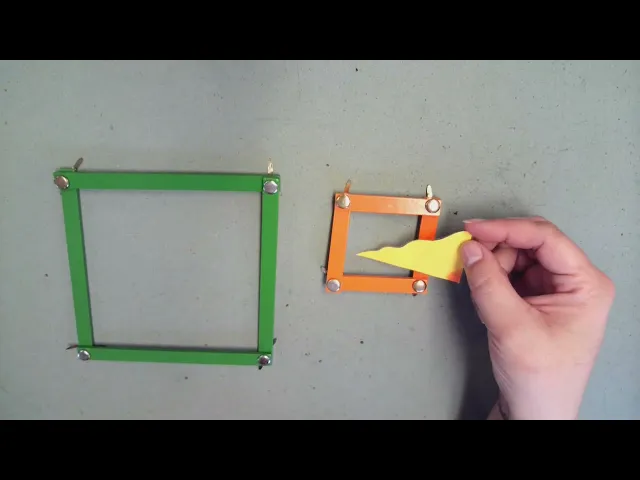
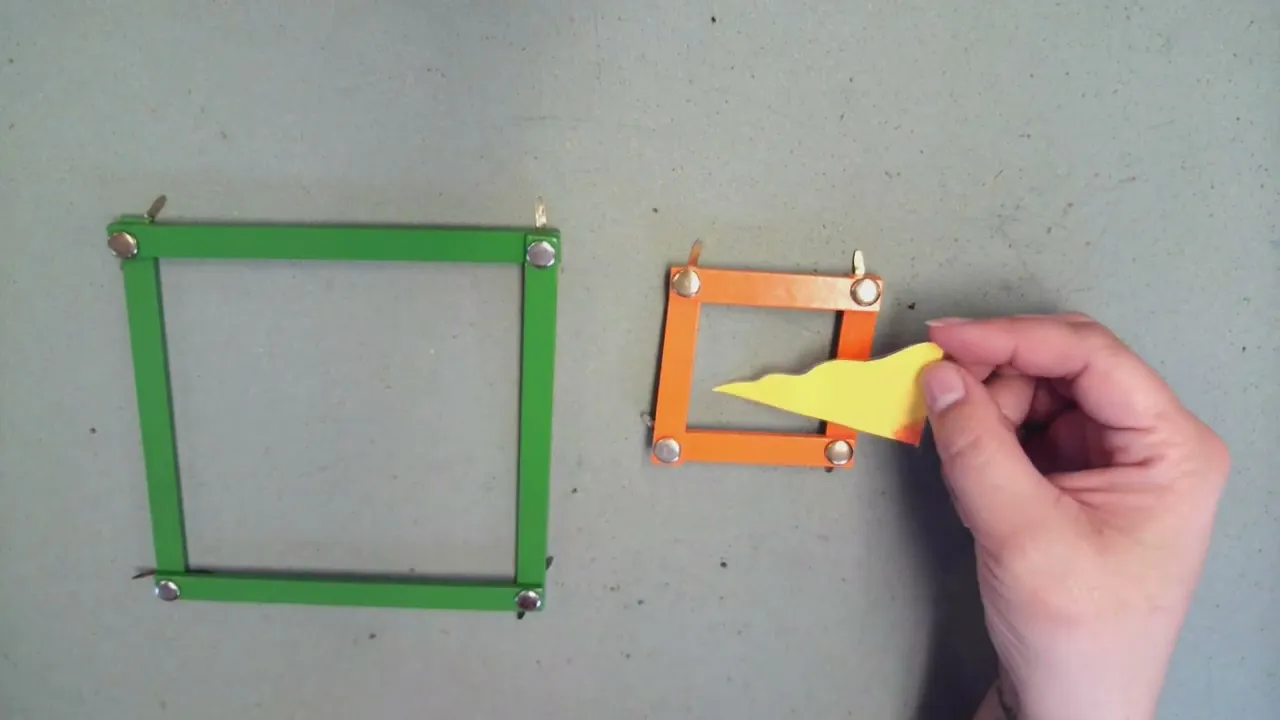
Um, you could use a mat, but you need the geometry plane for the next thing. So, I'm going to just use continue to use this and we're going to begin the presentation with the children. And I'll start this by handing out four sticks in one color to one child and four sticks in a different color to another child and ask them to make a quadrilateral.
I've done it here for expediency's sake. We're going to think about and work on different types of quadrilaterals we can make. We know a quadrilateral means it has four sides.
It is a polygon with four sides. I have a quadrilateral with four equal sides and four equal angles. Okay.
And four equal angles. They're all right angles. What is the shape that I've made?
Yes, it is a square. Now, Yolanda, what did you make over here? Hm.
It has four equal sides and it has four equal angles. It's a little hard because this is small, but we can we can do hard things. for equal angles.
It is also a square. You made a square and I made a square. So, we would say that these two are h.
Do you remember the term for two figures that do not take up the same amount of space but are the same shape? Yes, they're similar. These two are similar.
Even though they look a little bit different, we wouldn't say that there are two different quadrilaterals because they're both squares. But let's see what I can do. Are you ready?
H Oh. Huh. Does it still have four sides that are the same?
Yes, it does. They're all green sticks. But let's take a look at the angles.
Oh wow. They are not right angles anymore. They're not right angles anymore.
Nope. These are bigger than right angles. These are smaller.
These two are smaller than right angles. Huh? We have an acute angle, an obtuse angle, an acute angle, and an obtuse angle.
H. When a quadrilateral has four sides that are the same length but is not equangular, it is called a rhombus. A rhombus.
So I have a rhombus here now and I have a square. H. Let's take a look at this one.
Let's move these over. When a quadrilateral has quadrilateral has four sides and there are two sides that are the same length and the other two sides are each different lengths and all of the angles All of the angles are acute. All of the angles are acute.
Let me do this one again. That was a that was a poor poor measure. I apologize.
Okay. All of the angles are acute. They're all acute.
You have a trapezoid. Let's see what other quadrilaterals we can make. If you're not sure what quadrilaterals there are, you could always look at our nomenclature book.
Okay, so the notes on this, we want to get the children to the point where they are exploring and building with the sticks and coming across a rhombus, a square, a rectangle, a parallelogram, a trapezoid, a common quadrilateral, and a kite. Please illustrate each of these so that you have a reference. Now, kite is the only one that they're not going to see in the nomenclature book, but they would see in the drawer of our uh geometry cabinet.
You want to build all of these. Have the children build them. You're sitting and helping somebody else now.
They're working on this. Then make sure you're naming them with the children, reviewing with them, and helping them know the names of the quadrilaterals, giving whatever support is necessary. If you have a group where support is necessary, you might say something like, "Okay, you're going to get these four sticks and build it, but don't put the colored ones together.
That's what you'll get. " Um, and let's see what you get. Right.
So they do that, you name it. And maybe this is what we name um now and then come back for another twominut lesson and do rectangles and parallelograms tomorrow. Um for example, um come back two minutes later for a two-minute lesson the next day and do trapezoids and common quadrilateral.
You're doing whatever you need to do to help the children know this nomenclature. You're going to do the same thing just like you did with the triangles. You're going to be specific about what they're talking about with the quadrilaterals.
And that's going to take repetition.