[music] Hello everyone [music] and welcome back to Mr English channel where learning English is easy and fun. [music] I'm Emily. >> Hello Emily.
Hi everyone. Oh, it is so good to be here today. I am very very excited for this episode.
I am happy to hear that, Paul. You look very energetic today. Did you have a lot of coffee?
[laughter] >> Yes, I had a big cup of coffee and a very nice breakfast. The sun is shining and I feel great. How are you, Emily?
>> I am wonderful, thank you. I am ready to talk about something very special. It is a topic that many students ask about.
>> Oh, what is it? Is it about grammar or maybe big difficult words? >> No, Paul, it is something even more important.
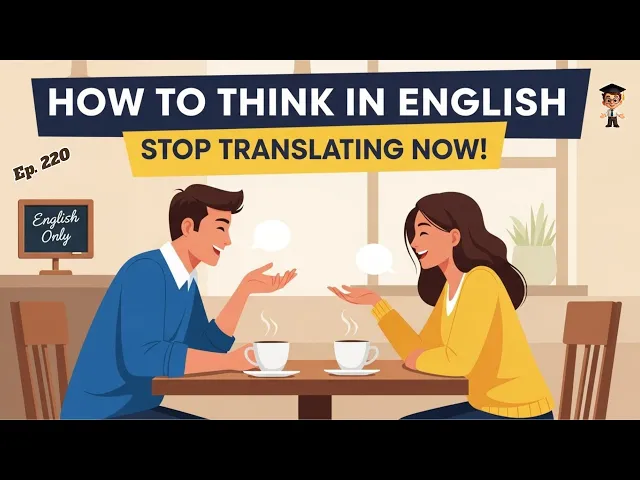
Today we are talking about how to think in English. >> Wow. Thinking in English.
That sounds like a dream. Many people say, "Paul, I always translate in my head. It is so slow.
" >> Exactly. Translating from your language to English is like taking a very long road. We want to take the fast road.
>> I love fast roads. But wait, Emily, before we share our secrets, we should talk to our friends listening. >> Oh yes, you are right.
Hello to everyone listening. We are so happy you are here with us. >> Yes, you are part of our English family.
And if you like our family, please click the like button right now. Yes, please. And subscribe to Mr English channel.
When you subscribe, you help us make more and more podcasts for you. >> And share this. If you have a friend who wants to speak English fast, send this episode to them.
It helps everyone. >> Thank you, Paul. Okay, let's start.
So, thinking in English. Paul, when you started learning, did you translate every word? >> Oh, yes.
It was a nightmare. My brain was so tired. I would hear a question, translate it to my language, think of the answer, and then translate the answer back to English.
>> Phew, that is a lot of work for the brain. >> It is. By the time I was ready to speak, the other person was already talking about something else.
It was very frustrating. >> I understand. That is why we need to stop the translation.
Our first big tip today is stop the dictionary in your head. >> Stop the dictionary. But Emily, how?
I need words. >> Yes, you need words, but you don't need translations. Try this.
Use pictures. >> Pictures? Like a movie?
>> Yes. When you see a dog, do not think of the word for dog in your language. Just see the animal, see the fur, the tail, and think dog.
[snorts] >> H. So I connect the image directly to the English word. No middleman.
>> Exactly. No middleman. If I say apple, don't translate it.
Just see a red sweet fruit in your mind. >> Ah, I see. So if I am eating an apple, I just look at it and say apple in my head.
I don't think of any other language. >> That's it. That is step one.
It's like building a new brain for English. >> I like that. A new English brain.
Huh. Okay. What is another tip?
Because pictures are good for objects, but what about actions? >> Good question. For actions, you should narrate your day.
>> Narrate my day like I am a person in a book. >> Yes. Talk to yourself in English about what you are doing.
But don't just say the names of things. Use simple sentences. >> Can you give me an example?
>> Sure. Imagine you are in your kitchen in the morning. You can say in your head, I am making coffee.
The water is hot. I am hungry. Where is the bread?
>> Oh, I do that. But I usually do it in my language. So, I should just switch the language.
>> Yes, even if the sentences are very small. I am walking. I am opening the door.
It is raining. This helps your brain stay in English mode. >> Wow, that is a great idea.
It's like practicing all day, but you're only talking to yourself. >> Exactly. No pressure.
No one is listening, so you can make mistakes and it's okay. >> I love that. No pressure is my favorite phrase.
[laughter] >> Mine, too. Now, Paul, here is a tip that is a little different. Change your world to English.
>> Change my world. Do I need to move to London? >> No.
No. I mean your digital world. Change your phone settings to English.
>> Oh, my phone. But that is scary. What if I get lost in my settings?
>> You won't get lost. You already know where everything is. You know the button for settings.
You know the button for messages. That is true. I know the position of the buttons.
>> Yes. So when you see the word settings instead of your language, your brain starts to learn that word naturally. You don't translate it because you already know what the button does.
>> Ah, so the action of using the phone teaches me the word. That is very smart, Emily. >> It works for social media too.
If you use Instagram or Facebook, change it to English. You see, like, comment, share every day. Soon those words feel natural.
>> I'm going to do that today. It is a small change, but it keeps my brain busy with English. >> Good job, Paul.
Now, let's talk about another secret. This one is very important. Learn phrases, not just words.
>> Chunks, like pieces of chocolate. >> Yes, pieces of language. For example, don't just learn the word hungry.
Learn the phrase I'm hungry. >> Why is that better? >> Because when you want to speak, you don't have to build the sentence like a puzzle.
You have the whole piece ready. >> H. So instead of thinking I plus am plus hungry, I just grab the whole piece.
I'm hungry. >> Yes. It's like a fast food menu.
You don't order bread, meat, and cheese. You just order a burger. [gasps] >> I love the food examples, Emily.
Now I am hungry. But I understand chunks make the brain faster because there is less work. >> Exactly.
If you learn how's it going or have a good day, you don't translate the grammar. You just use the sound and the meaning. >> That makes so much sense.
I used to look at how's it going and think going where I am not going anywhere. >> See translation is confusing. How's it going just means how are you in a chunk?
>> Okay, I have a question. What happens when I don't know a word? My brain wants to translate because I'm stuck.
>> That is a big moment. When you're stuck, do not run to the dictionary. Try to describe the word in English.
>> Describe it. But I don't know the word. >> Use the words you do know.
If you don't know the word tailor, you can say the person who makes my clothes short. >> Oh, so I stay in English. I use my English brain to solve the problem.
>> Yes. It's like a game. If you can't remember the word for refrigerator, you say the big cold box in the kitchen.
[laughter] >> The big cold box. I like that. This keeps the English brain on.
If I look at a dictionary, the English brain turns off and the other brain turns on. >> Exactly, Paul. You are a star.
We want to keep that English light shining. >> This is very helpful. But Emily, sometimes I feel slow.
My brain feels heavy when I try to think in English. Is that normal? >> Oh, it is very normal.
It's like going to the gym for the first time. Your muscles are tired because they are working hard. >> So, my English muscle is just weak.
>> For now, yes. But every time you think the sky is blue or I need water, your muscle gets stronger. >> That makes me feel better.
I thought I was just bad at English. >> Not at all. You are just training.
And here's another tip for training. Listen to English as much as possible. Even if you don't understand everything >> like a background song.
>> Yes. Listen to podcasts like ours or music. When you hear the rhythm of the language, your brain starts to copy it.
>> Ah, so the music of English enters my head and then it is easier to think with that same rhythm. >> Yes. It's like when you have a song stuck in your head.
You want English to be that stuck song. [laughter] >> I want our podcast to be the stuck song for everyone. >> Me too.
Now Paul, what about when you are reading? Do you translate when you read? >> Sometimes when the sentence is long, I stop and try to translate.
>> That is a trap. When you read, try to read for the idea, not the words. >> How do I do that?
>> Read simple things. Read books for children or news for English learners. If you know 70% of the words, you can guess the rest.
>> Guessing? Is that allowed? I thought I had to be 100% correct.
[laughter] >> No, guessing is a superpower. When you guess from the context, you are thinking in English. You are using logic in English.
>> Wow. So, if I see the man sat on the sofa and I don't know sofa, but I see a picture of a man sitting on a big chair, I can guess it. >> Yes.
And you learned sofa without a dictionary. That is a permanent win for your English brain. >> I feel more confident already.
Thinking in English is not about being a genius. It is about small habits. >> Exactly.
It's about being brave and being a little bit silly sometimes. Talking to your dog in English is great practice. >> My dog loves it when I speak English.
He doesn't know what I'm saying, but he likes the sound. >> See, he's a good English friend. >> Emily, we talked about many things today.
I feel like my head is full of good ideas. >> That's great. Thinking in English is a journey.
It doesn't happen in one day. >> No, but it starts with one thought. Hello world.
>> Yes. Hello English world. >> Phew, we covered a lot today.
I'm not even tired. Usually English makes me tired, but this was fun. >> I am glad.
When you stop translating, English becomes fun. It is not a test. It is a way to share your life.
>> That is a beautiful way to say it. A way to share your life. >> Yes.
Well, Paul, look at the time. Oh, time really flies when we're having a good conversation. >> It really does.
But before we go, let's remember the main points from today. >> Good idea. I remember the first one was about pictures.
No more translating words. Just see the image in your mind like a movie. >> Yes.
And then we talked about being the narrator of your own life. Telling yourself what you are doing while you do it. I am drinking coffee.
I am walking. That's right. And I'm definitely going to change my phone settings to English today.
It's a great way to learn without even trying. >> Yes. And don't forget the chunks.
Learn whole phrases so your brain can grab them quickly. >> And my favorite, the guessing game. If I don't know a word, I'll describe it in English or just guess from the story.
No dictionaries allowed. >> Exactly. and keep listening to English music and podcasts to get that rhythm in your head.
>> This was so helpful, Emily. I feel like my English muscle is already getting a little stronger. >> I'm so happy to hear that, Paul, and I hope all our listeners feel the same way.
>> Yes, we believe in you. You can do this. >> We really hope you enjoyed our chat today.
It was so much fun for us. >> It was. And now we want to hear from you.
We have a question for our wonderful listeners. >> Oh, I love the questions. What should we ask them, Paul?
>> H, tell us in the comments, what is one thing you're going to do today to think in English? >> Ooh, that's a great [music] one. Are you going to change your phone settings or maybe talk to yourself in the kitchen?
>> Or maybe describe your dog in English. Please leave a comment below. We love reading them and we always reply.
Yes, it is our favorite part of the day. And don't forget to subscribe if you haven't yet >> and give us [music] a like and share this with your friends. Let's help everyone think in English.
>> Thank you all so much for listening. You are amazing students. >> Yes.
Thank you everyone. [music] We will see you in the next episode. >> Bye-bye.
>> Goodbye. >> See you soon. >> Happy thinking.