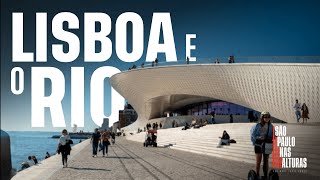
São Paulo nas Alturas is totally at height Today we premiere the channel's first international series. "Lisboa nas Alturas", because Lisbon has become a global topic. It attracts digital nomads, Europeans from everywhere and people from as many countries come to live here; but also Chinese, Russians, many Americans and over 200,000 Brazilians.
What does Lisbon have? What can we learn from the transformation of a city that was a kind of European Havana, with a decadent charm and crumbling buildings, to having become a kind of Florida of Europe, but that attracts people from all over the world and that has a walkable, compact urbanism, much better than Miami's. Here, they knew how to reuse the historic center.
Here, they knew how to create more spaces for pedestrians, but they are facing a serious problem, which is how to make housing affordable. A global drama as well. And with you: Lisboa nas Alturas!
Lisbon received 1 million Brazilian tourists last year. TAP, the Portuguese airline, announced 91 weekly flights starting in March, taking Brazilian tourists there. 91 flights!
Almost a shuttle service. 6 million tourists visited Portugal in 2010. Last year, that number jumped to 22 million.
19 million visited Lisbon. The whole of Brazil received 3. 6 million tourists in 2022.
Lisbon, indeed, is sexy. But there's a great irony there. The charm and quality of life in Lisbon are possible due to urban rules and neighborhood configurations that would be prohibited in much of Brazil.
Master plans, zoning, and even neighborhood associations would prevent Lisbon's urbanism from being replicated in Brazil. And that's what we're going to talk about. In this episode we will talk about what Lisbon has, and study a bit of this successful format.
Lisbon does not need to have setbacks. The buildings are right up against the sidewalk and are very close to each other. A very symmetrical and pleasant whole.
Anyone who has walked through Buenos Aires, Paris, or Madrid, or the oldest neighborhoods of New York, can really notice a pattern. The breathing areas, so to speak, are at the back, the heart of the block is where light and ventilation come in. In the front, what matters is to keep an eye on the street.
It's the opposite of the blocks in São Paulo, where the buildings are in the middle of the lot, creating a toothpick holder and the space next to the sidewalk is empty. As the lot is much less occupied, in São Paulo, the buildings need to be much taller to contain the same built area as the low-rise buildings of Lisbon. All mixed together.
In Lisbon, there are all kinds of shops, and not just luxury ones: on the ground floor of residential buildings, even the luxury ones. There is no strictly residential neighborhood in the central areas of Lisbon, not at all. And it is very common to have parklets and tables on the sidewalks, the terraces.
Yes, in Brazil there are people who shout against the occupation of these spaces by restaurants and bars. "Oh my God, they are profiting! " But they are silent when those same spaces are occupied for hours and hours by an empty vehicle.
What matters more to these people? The fight against profit of whoever it may be or livelier, safer streets, with outdoor life? Many people love to compare Brazilian cities with European cities or rich countries, but one thing is certain European cities, cities of rich countries, have been making changes that many Brazilians find beautiful here, but take up arms if those laws are passed in Brazil.
One of them is the absolute priority for cars. Giving more space to the car than to pedestrians. Underdeveloped cities around the world spend fortunes on overpasses, tunnels and bridges and pave everything over.
Yeah. Lisbon, for some decades now, transformed this square, which was a large parking lot, back into a square. The Commerce Square.
That bunch of cars that was here evaporated. People had to get used to the fact that this historic square was not a place for cars, and nobody died. Yes, Lisbon's traffic is bad, quite bad.
And yet the Lisbon City Hall is reducing the space for cars throughout the city. You see sidewalks being doubled in size, lanes for cars disappearing, squares being expanded. Well, developed cities have already discovered something: if there's an option for comfort, humans will go for comfort.
And even with quality public transport, people will continue to use cars for everything, even for short trips, even more trips than they should. It's like asking a child if they want candy, and they will always say yes. So, thinking about the human body, but especially the planet, developed and smart cities are either charging an urban toll like London, Singapore, and Stockholm, or they are reducing the space for cars, like New York did right on Broadway at Times Square.
Today we know that there is this metric. If a city is still creating more and more space for cars, it is underdeveloped. For those who never want to change anything or do anything, there's always an excuse at hand.
But I'm sure you know people who live next to a subway station or a bus corridor in São Paulo and never use public transport. Yeah, as long as these upper classes don't use public transport, there won't be much pressure for it to improve. Nowadays there is an increasingly intense policy of not letting cars into the city and, therefore, in 15 years or ten years it won't make any difference not having parking, because people won't be able to bring their car here.
Campo de Ourique, a former working-class neighborhood and now a sought-after address by the French community, has 13,000 inhabitants per square kilometer. Not much by European standards, but it's 50% more populous than Pinheiros, Moema or Itaim, per square kilometer. Bairro Alto has the same density.
Lapa, one of the most noble neighborhoods in Lisbon, is even denser, with 15,000 inhabitants per square kilometer, five times more than Pacaembu or Jardim Europa. The neighborhoods of Encarnação, Anjos, Santa Catarina, Socorro, and Alvalade are even denser and yes, they manage to house more people in less space, reducing distances. They don't need very tall buildings to house so many people, but they don't waste space.
Of course, there are no party rooms or playgrounds or somewhat useless little lawns on the ground floors, nor security booths. Leisure happens on the street, in the neighborhood. The apartments don't have maid's rooms, unless Brazilian buyers demand them.
Washing machines are in the kitchen. It can never be overstated that without real security, urban planning suffers greatly. Yes, this is a taboo in Brazil.
So much so that practically all democratic governments promised and did not create national security plans that would reduce not only homicides, but also thefts, robberies, assaults, rapes, all kinds of violence that Brazilians face on the streets. Okay, this does not excuse that many people, especially in São Paulo, do not leave their homes as a matter of status, to avoid mixing. Yes, even in very safe neighborhoods of São Paulo, there are those who don't go out and don't know what they're missing.
But here in Lisbon, part of this huge success of tourists from all over the world, people from the entire planet moving to live here, has to do with the feeling of safety. I'm here at night, I can be showing off on my cellphone, I can work on my cellphone while I'm on the sidewalk, as in much of the world, but not in Brazil. This is Largo do Intendente, an area that was once a drug trafficking hotspot and consumption, it was a tough spot in Lisbon.
But in 2001, the then Prime Minister, António Guterres, today the UN Secretary-General, decriminalized the use of all drugs, of all drugs. The government then decided to spend more resources on rehabilitation and treatment of patients than on repression and the fight against drug trafficking. What happened?
Consumption even dropped a bit, but violence plummeted. It was one of the great transformations in these 22 years of this policy quite revolutionary here in Europe, which some countries are trying to copy. During my days here in Lisbon, don't ask me why, but several dealers offered me drugs on the street.
Yes, in the more touristy areas there are people offering everything from hashish to cocaine, but clearly drug trafficking does not dominate public space. It was something discreet in a city and a country increasingly with less violence. This is also very surprising.
In this huge growth of the country, violence did not increase, that is, drugs still exist, like in New York, in fact, like in Amsterdam, and other places as well. But drug trafficking is not showing its face. And it's an extra advantage in learning from Lisbon's experience.
It's not distant from our culture. Yes, whenever I talk here about Asian cities - Singapore, Seoul - there are people who say "no, no, no, it's not possible to copy, it's not possible to learn, because, after all, they are very hierarchical and obedient. " I disagree, but that's how they are seen.
Germany, the United States, and England have a Protestant ethic, we will never be like them. With the Portuguese, that excuse doesn't stick. They are as Catholic as Brazil.
Christians, love football, love soap operas, but especially they are very, but very, very indeed, bureaucratic. Yes, slow; there's stamping, there's notary, there's paperwork. Come back tomorrow, come back next week.
And yet, Lisbon had this enormous transformation. So, we have no more excuses! (Do not forget to subscribe the channel!
Do share this video with your friends. Cities and urbanism deserve a wider audience!



![Brasil: país de cidades mal resolvidas? [RE]think #23](https://img.youtube.com/vi/9gd3l4xVCWY/mqdefault.jpg)