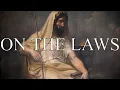
§ 2. 18 …I shall begin by describing the Laws of Laws… There are certain maxims of laws, my Quintus, not so ancient as the primitive sacred laws, but still possessing greater authority, and greater antiquity too, than the common parlance of the people. These legal maxims, I shall mention with as much brevity as possible; and I shall endeavour to expound the laws, not indeed in their whole extent, for this would be infinitely laborious, but those which involve the principles and contain the sum and substance of the rest.
Such are the following; -- Approach the gods with purity -- appear before them in the spirit of devotion -- remove riches from their temples; whoever doth otherwise shall suffer the vengeance of heaven -- let no one have private gods -- neither new gods nor strange gods, unless publicly acknowledged, are to be worshiped privately -- let the temples which the fathers have constructed in the cities, be upheld -- let the sacred chapels and consecrated groves in country places be protected -- let the customs of the fathers be preserved in the families -- let the gods who have always been accounted celestial be worshipped, and those gods likewise who have merited celestial honours by their illustrious actions, as Hercules, Bacchus, Aesculapius, Castor, Pollux and Quirinus. Let due honour be likewise paid to those virtues, by which man is exalted to heaven, -- as intelligence, valour, piety, fidelity; and let temples be consecrated to them. But with regard to the vices, let no sacred sacrifices be paid to them.
Let all contentions of every kind cease on the sacred festivals, and let servants enjoy them, their toils being remitted, for therefore they were appointed at certain seasons. -- Let the priests duly render the public thank-offerings to heaven, with herbs and fruits, on the sacrificial days. Also, on the appointed holidays, let them offer up the cream of milk, and the sucklings; and lest the priests should commit any mistakes in these sacrifices, or the reason of these sacrifices, let them carefully observe the calendar, and the revolutions of the stars.
-- Let them provide those particular sacrifices which are most appropriate and agreeable to the particular deities: the Priests directing the service of some gods, the Flamens regulating the rites of others, and the Pontiffs superintending the worship of all. Let the Vestal Virgins in the city carefully keep the sempiternal fire always burning on the public altar, and let those who are not instructed in the order of the ceremonials in these private and public ministrations, learn them from the priests. Let there be two classes of these priests, one to preside over ceremonials and sacrifices, and another to interpret the obscure predictions of the prophets, diviners, and sibyls, whenever the senate or the people require it.
-- Let the public Augurs, who are the interpreters of Jupiter, the best and greatest, likewise examine the presages and auspices, according to the discipline of their art. Let the priests who are conversant in auguries implore the prosperity of the vineyards and gardens, and the general welfare of the people. -- Let those who give counsel in military or civic affairs, attend to the auspices, and take their measures accordingly.
-- Let them observe from what parts of heaven the lightnings burst forth. -- Let them declare what lands, cities, and temples, are to be held free and consecrated. -- Whatever things the augur declares to be unjust, wicked, vicious, and accursed, let them be forsaken as prohibited and disastrous, and whoever will not obey these divine indications, let him suffer capital punishment.
As to alliances, peace, war, truces, and the rights of ambassadors, the Fetial priests are the appropriate judges, who determine all questions relating to military affairs. The interpretation of all prodigies and portents, belongs to the Etruscans and Haruspices, if the senate seeks their advice, and these shall inform the partricians respecting the line of conduct they should pursue. Then will they learn what deities it behoves them to propitiate, and deprecate the fury of the thunderbolt against the object of its vengeance.
Let nocturnal sacrifices be interdicted to women, except those they offer according to popular custom -- and let none be initiated in the mysteries except by the usual forms consecrated to Ceres, according to the Grecian ceremonials. Let there be sacrifice made, (by the criminal) for crimes which cannot be expiated (by the priest), being acts of impiety, -- the faults which can be expiated by the public priests, let them expiate. (Sacrum commissum, quod neque expiari poterit, impie commissum esto -- quod expiari poterit, publici sacerdotes expianto.
) With regard to public spectacles, excepting those of the race-course and the ring, let them restrain the violence of the people, by the soothing influence of vocal and instrumental music; and let the honours of the gods be inseparable from the amusements of these diversions. Let them retain whatever is best and purest in the ancient form of worship. Except the devotees of Cybele (ideae matris famulos), to whom this privilege is allowed on certain days, let no one presume to levy rates for private emolument.
Whoever purloins or robs the sacred property of the temples, let the sacrilegious wretch be accounted as no better than a parricide. The divine punishment of perjury is destruction: the human penalty is infamy. With regard to incest, let the chief priests sentence it to the extremest penalty of the law.
Let not the impious man, who should render sacrifice, attempt to appease the gods by gifts and offerings. Let vows be piously performed. Wherever law is violated, let its punishments be executed.
Let no private person presume to consecrate his land; and let his consecration of gold, silver and ivory, be made within the limits of moderation. Let private devotions be perpetually practised. Let the rights of the deities of the dead be punctually discharged.
Let those who have past into the world of souls be considered as divinified; thus unnecessary expense and sorrow with regard to our departed friends will be reduced and diminished.