foreign [Music] let me once again very quickly introduce our speakers who come together under this topic of developing and implementing digital foreign policy and there are a lot of questions uh that we discuss we can discuss under this topic so i'm really interested in what they have to say and then also i'm just as interested in your comments and questions again which you can post in the chat and this time uh my colleague natasha pirutica from the belgrade office will be monitoring the chat closely and will bring your questions and comments back to us but
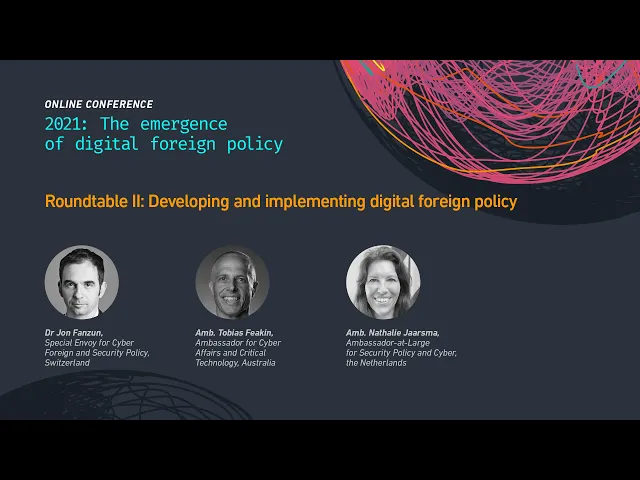
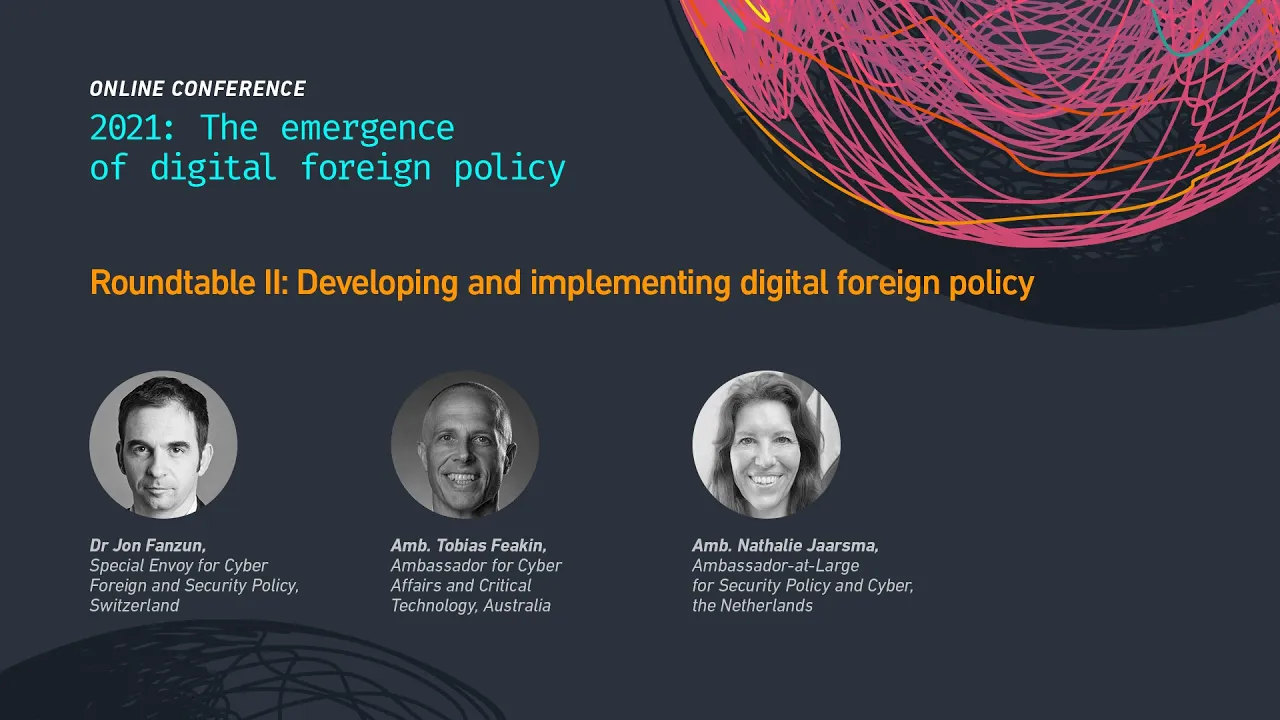
without further ado let me again introduce the speakers for this roundtable we have dr johan van soon who is the special envoy for cyber firing and security policy in switzerland we have ambassador tobias feaken who is ambassador for cyber affairs and critical technology from australia and certainly last but not least ambassador natalie yasma who is the ambassador at large for security policy and cyber from the netherlands so i think without further ado let us um dive into the discussion and uh with an initial question which i have prepared um for each speaker i would like
to start with you yon if i may and it's a very broad question so we know switzerland just launched its comprehensive digital foreign policy strategy um that kind of brings me to the question why should states have a digital foreign policy and what should be its main pillars from your perspective yeah thank you very much thank you for the invitation dear colleagues ladies and gentlemen uh thank you also for joining this session uh i can answer it for switzerland but probably it is true for for other countries as well why to have a digital foreign
policy i see four reasons for for that the first reason is that the technology technological transformation itself which is transforming our societies with increasing speed developments in areas such as cloud computing machine learning and domain and automation and moving at the rapid space so we can also expect to see further sometimes disruptive changes uh i think this poses many new questions with regard to how we live work and also interact with each with each other i mean this this uh session or this conference is a practical example for that a year ago probably we would
have met in geneva or somewhere else or now we meet uh virtually and each of us is in another place in in the world in another another area and so we can meet the second reason um is the increase are the increasing geopolitical and authoritarian trends that we all are witnessing the last last years i would say 15 years ago thomas friedman published his bestseller the world is flat predicting a level playing field across the world today i would say we have to admit that this was an expression of excessive optimism today we see on
the one hand uh break breathtaking speed with regard to the spread of technologies around the world on the other hand we also see ground growing political fragmentation new regulatory and technological barriers and new technologies are increasingly used for surveillance or control we are also witnessing a race between different powers for the development of new technologies and fragmentations of supply chains so today today's world is far from flat and homogeneous but increasingly fragmented in short we see a digital geopolitics as uh as a return of geopolitics the consequence countries like switzerland and others need to define
their position on on these issues the third reason is the increasing importance of the private sector large corporation based in the u.s or in china not and elsewhere uh our dominant are are assuming dominant positions and are establishing their own standards thanks to their general terms and condition of use they're also able to influence the everyday lives of billions of users also that poses new challenges to to governments and states how to engage with these actors a fourth reason that i see is uh to get active in digital diplomacy is that the rules applying to
cyberspace are still not well defined there is of course the general consensus that international law applies in cyberspace yet much work remains to be done in defining what this means for the governance of cyberspace the ongoing discussion at the u.n showed that these issues require require a long breath and a lot of diplomatic work in geneva and also elsewhere uh ladies and gentlemen just two a few points uh for the second question uh what are the pillars for for digital foreign policy um i will not repeat what uh federal council cases uh already told us
and and explained also the strategy i just want to highlight just a few a few elements of the strategy or or a few thoughts about this first uh a digital firm policy needs to engage with rule making for the digital area this takes place in many international forums cyber security is discussed within the un at usc the itu or the oecd and also in in settings like the g20 or g7 internet governance is happening also in multi-stakeholder forests such as icann and at the u.n governance internet governance forum there are also also many emerging 404
discussing the governance of artificial intelligence what means that that means that digital issues are being discussed almost everywhere and that requires for governments a lot of coordination and an efficient managing of resources and i think it is necessary to get the priorities right and that must that is for every account a little bit different i would say the second i want to add here is the digital form policy also needs to deal with increasing geopolitic political competition as i told before and and over critical technologies and the usage their usage this requires enforced bilateral bilateral
as well as multi-stakeholder engagement standard setting is is getting more important and we have to engage also in this in this forum the third point just want to mention is there is a is also opportunity to promote digital technologies for development and economic growth we would we should also be supporting others in the safe secure and people-centered deployment of digital technologies that is also that is about capacity building and the last but not least point the fourth point i want to mention here is uh the human human dimension of the digital technologies those technologies enable
data collection and surveillance at scale that we have seen never before therefore they pose also new ethical and political questions for governments our approach in in switzerland is to put in the individual at the center of our policy for this reason we developed already developing i would say the concept of digital self-determination i know it i was a little bit long but in a nutshell it is this is the swiss perspective why a digital foreign policy and what are the pillars of this policy thank you very much back to you thank you so much uh
it's a good reminder the world is not flat the world is extremely complex i think there's also a point which makes the work of those in the field of digital foreign policy uh a complex thing which brings me um to my next question to perhaps better understand what that were what that work looks like um so i would like to ask ambassador nathaliasma a little bit to explain a little bit on on her work what that looks like um your official title is ambassador at large for security policy and cyber um so i would like
to know and i guess we all would like to know what is your role in supporting the ditch the dutch digital foreign policy and how does your work look like yeah thank you uh katarina and good day to uh to all of you um well let me start with a little bit of history on our cyber activities um in 2014 we decided to establish a task force specifically for cyber policy within the ministry of foreign affairs and the task force because it would not fall in the traditional hierarchy of the mfa why because we wanted
the task force to combine three perspectives first security second human rights and third the economic and multi-stakeholder angle in the sense that the private sector owns and controls the majority of the internet and engagement with the private sector would be needed for any kind of foreign policy and the tech community and academia also form part of this approach but for practical reasons it was officially placed under the security directorate in those years we as mfa were really pioneers within our government the global conference on cyberspace that we hosted in the hague in 2015 created the
center of gravity for our interagency coordination and especially with our ministries of justice homeland security and economic affairs and that was really key for us to develop a joint international cyber strategy that was sent to parliament in 2017 a year later in 2018 um while meanwhile the international attention for cyber and digital challenges had grown we established the position of ambassador for security policy and cyber that my predecessor timo koster held for two years so i took over last fall and the dutch ministerial council actually decides about the appointments and thus gives the mandate to
this ambassador to represent the entire dutch government and i actually liked what john was just saying that indeed a lot of coordination is needed and that is what i also notice um policy wise what i'm what am i involved with basically in five streams of work first to contribute to an international normative framework so for example i represent the netherlands in the open-ended working group second to higher the costs for malicious actors by among others diplomatic response and this includes coordination with other countries but also the question how the private sector can play a stronger
role third capacity building in order to help other countries increase their cyber resilience and to also be part of this international discussion so for example by providing trainings on uh international law and capacity building and sharing of best practices is also at the core of the global forum on cyber expertise and i noticed that chris painter is in the other panel of course and so in the global forum on cyber expertise the dutch government helped to establish it some years ago um the fourth working stream links to human rights and individual freedoms so for example
we do how to deal with disinformation counter internet shutdowns and how to address challenges around algorithms and the freedom online coalition is important to mention in this regard and in addition there is a fifth working stream that is growing and that concerns new digital technology challenges around 5g artificial intelligence quantum computing for example and of course our ministry works on some other areas of digital foreign policy that i would just likely just briefly like to mention so you have the full picture one of them is development assistance and the way we try to help bridge
the digital divide seconds is the area of how we use digital means for our own external communication third is the way we deliver consular services and lastly we have started to use big data for better predictions for example on early warning for conflicts thank you back to you katarina thank you so much again for this very broad overview and it really gives us a sense of all the things that are included in digital foreign policy and all the things that are included um in your work which is very interesting also noting the overlaps between countries
in their approach to digital foreign policy but also perhaps the more specific differences i would like uh to turn now to ambassador feeken and australia really um there's one particular reason for this because australia was one of the first countries that published a comparative digital foreign policy strategy in 2017 and has since already published um a progress report and so basically with that question i would uh like to turn to you ambassador figan for um [Music] basically your role in the process and any lessons learned from this process that uh if you compare different countries
has been going on for quite a while katrina thank you very much i could probably complete a uh hat-trick as well there which is we are currently in the final stages of a development of a new strategy which encompasses the new mandate of this position which is to encompass critical technologies as well i firstly got to say i love the format of this it feels like the battle of the ambassadors the fact that we've got two rooms full of ambassadors facing off against each other my anxiety started to rise when i saw people wanting to
leave so my job and our job for natalie and john is to keep everyone in the room and maybe we can get word across to the other room that they should come into our room i love it um look yeah you're right in 2017 my when i landed in this job my biggest task was developing an international cyber engagement strategy putting into paper into a strategy what australia wanted out of cyber space um across its whole spectrum of national interest and that's where we began it's you know it's not just a national security issue this
is about all i can see someone's joined with winning um so it's it's um you know it's across the spectrum of interest that we have and we made sure that our strategy really was about well what's our economic interest what's our national security interests how are we going to assist others um in developing their ability to respond to the threats that we see how do we champion human rights how do we address internet governance issues and how do we use tech for development purposes so you know you're hearing some similar themes now in the way
that governments are approaching it and really that's been in response to this strategic prioritization of the whole tech landscape um i could wax lyrical for hours about you know content of strategy and and what the importance of it is i think needless to say every country needs one now it's a modern part of uh foreign policy full stop um so if a country doesn't have one i'd implore them to get moving on it what lessons can i give them from this process what have i learned well i've learned an awful lot um perhaps if i
distill it into three key areas always seems like good things come in threes firstly well what is it good for um well it gives you your global partners an understanding of what it is you're trying to represent in the international arena you know what kind of values what kind of principles are you wanting to try and embody um and it gives countries and uh um the private sector ngos a point of entry into understanding what it is you as a country want and then from that point they can then engage with you and develop off
the back of the ideas that you have and that from our point of view that's been hugely successful um and i'll come on to that in a moment what it also does under this first point is it binds you as a community domestically so it binds your cross-government coordination as long as you've engaged with all the relevant departments it pulls them in as long as you've engaged with your private sector to listen to what it is they want to offer in the international domain as well and they can see their words in that strategy it
binds them into what it is you're representing and similarly with ngos and also academia making sure and civil society sorry that they are included in the words they see them and that gives you buy-in from your your broader digital community which is vital in this area as john and natalie have been outlining um it also helps your ministers really have top lines to speak to and and the trick is is to give whilst a reasonable amount of information keep it simple enough that it gives good clear messaging for ministers to take out into the international
environment and deliver when they're on their travels too um the second part of this is a the lesson that i learned is it's vital to push the boundaries of what it is you're saying um especially when we talk about the cyberspace aspects or in the government cyber aspects of a strategy so much of that has traditionally been masked in secrecy and you know the intelligence world and and probably one of the biggest lessons i could give is push the boundaries of what you're saying increase the level of transparency because there is so much that you
can say um which doesn't necessarily need to say stay in the top secret lock-ups of of darkened rooms necessarily still there will be an awful lot that does go on still in that secret world but there's so much that you can say as a government about what it means to operate in cyberspace you know whether it be you know for australia or our quite lengthy discussion about our offensive cyber capability and our position on international law and constantly pushing the boundary of what's being said and but also even in an area like digital trade where
you know we felt it was almost like playing a game with poker if we put down maybe our first couple of cards on the table i here's your rules of engagement here are digital principles if you want to do trade with us you need to be looking at these digital principles in order to get into that you know the first base of a digital agreement and then we'll take it from there so you know pushing the boundaries is vital then and thirdly ensure that you do bring along as many of the community as possible yes
all your government colleagues and you'll spend a lot of time rallying everyone around the cores and keeping everyone together as a group um but also your private sector stakeholders um and find your allies in the private sector and one area that i've found invaluable in this is through the capacity building work that we've done um it it has accelerated at a rate that i probably didn't even envisage when we started when i began this position we had a four million dollar australian four million dollar investment in capacity building which in government spend is you know
it's a beginning but it's not a great deal now we've invested well over 60 million and that is going to increase a lot um over the coming months when we make particular announcements you know there's a lot um that we we now see the value in assisting our partners in upgrading their cyber resilience and their broad engagement in digital and critical technology um issues policy standard setting and the like um and what i've seen with that is if you harness what the private sector have and work with a whole range of different private sector entities
you access so many different partners so many parts of the globe that wouldn't necessarily listen to a government so for example you know we've worked with qantas on uplifting aviation cyber security in the asia pacific and that has bought a whole range of different airports other aviation firms systems integrators into that community we've worked with banking sector commonwealth bank has been a big partner for us a big bank here in australia telstra big telecommunications firm here in australia um a whole range even down to tiny little small to medium enterprises which have very distinct small
capabilities which are incredibly effective at assisting other partners in uplifting their capabilities so doing that also creates a great narrative for everyone who's involved your uplifting capability you are assisting in development um in in particular parts of of the globe and i think bringing you know freedom of communications um good principles of human rights access to that communications um and encouraging if you like the all the good things that the internet has brought us certainly in that area now i mean i'm leaving a whole part of the discussion really which is this broader critical technology
space but i'm sure we'll get into that in a moment and that's probably more than enough from me for this first question so thanks very much thank you so much thank you to our three speakers for really um making us think and um to to use not so much pushing our buttons but really you know getting getting our heads um going i'm personally really interested in two aspects which is this coordination challenge that most of you mentioned and how you how you address it specifically in your countries and within the ministry but also this capacity
building aspect however this event is not about me but about the questions from the audience so i would like to bring in those questions and comments um first and for that i turned to my colleague natasha peru teacher from belgrade hello to everyone uh even though initially our participants were rather shy in the chat we were able to get her some very pertinent question i would like to start first with a comment that was raised that big data foresight planning is very important and useful for the development of effective foreign policy including its digital aspects
but now to get back to the questions which are related to data but more specifically to ai we had a question from brazilian diplomat eugenio garcia who asked which ai tools do you think would be most useful for diplomatic practice another question that was related that is related to ai has been raised with regard to the comfort level and capabilities of incorporating machine learning in designing and executing foreign policies there was also a question related to internet resources um so the the exact question was is there any digital policy with internet resource domain name or
ip address policy or routing security policy or in digital transformation in each country and this was an open question tool panelists and lastly we received a question for small island states the question was the following do you see the benefit of small states designating an ambassador for security and technology and who have been your external stakeholders that would be all from the chat right now thank you so much natasha quite a quite a broad range of questions and challenges we only have 15 minutes left so basically i want to use this opportunity to hand over
these questions and comments to our speakers but maybe perhaps also combine this with a final word from each of you so um to just sum up from myself i have this question on the challenge of coordination within the ministry within the country they made a number of questions on technological tools for diplomacy and foreign policy big data ai machine learning specifically and then how you handle the question of internet resources so with that and perhaps also keeping in mind with a final word from you before we all join back together and the battle of the
ambassadors continues in person um over to you for a final word let's go in the same uh in the same order so i would like to hand over to yon first yeah thank you very much a lot of interesting uh uh points uh and and difficult questions also about tools uh in that sense um the coordination is a coordinating coordination issue i mean uh switzerland we don't have a prime minister i think that is a difference for for us uh compared to to the netherlands and australia i think you your coordination role is probably in
that sense a little bit easier you can if you are in the prime minister's office or if you have the power to uh to uh uh to set the agenda or to uh to to uh to go in one direction with uh with a decision a little bit easier way to do it but i think uh for the rest we have the the um the situation that order in our in our case and probably also in in the case of australia and the netherlands different agencies are uh are competent for different issues and fora and
that is a lot that is really a challenge i would say and also as uh stowy uh said i mean uh we have to get modern and to get to to change out the way we uh we coordinate and sometimes i i think the covet 19 situation is an accelerator how to to accelerate also our thinking and how we work together i don't say that this is a positive thing about the about the current situation but i think that is also the question about digital tools i cannot answer the the the specific questions but uh
but i think uh we we made a lot of progress but still when we talk about digital diplomacy i think we are uh further down the road when it comes to how to engage as also toby explained how to engage with others how to to share experience experience we are we are further uh advanced than we are in case of switzerland i would say in terms of how we are organized with digital tools and such such things um and uh and just one one word uh when i look at uh at my colleagues in the
netherlands and then and and australia i saw your map digital map uh diplomat that we are three examples of of of uh of comprehensive um digital form policy it's good to see that but my experience i'm doing that for more for two years or so a lot of work to be done to really have uh implement to implement the strategy and to really get get the results out i look you'll also at australia when you talk about budgets uh that is also i think one one important aspect when it comes to capacity building and there
is a lot to do and i think a lot of us to do in in a cooperative manner together with other countries that are like-minded thank you thank you so much natalie your last words so to speak yeah thank you katarina unfortunately i'm not an expert in digital tools but i noticed in the chat that there is interest in big data um perhaps even though i'm not an expert but perhaps for further reading i know that on the website of the eu there is information on early warning for um for for conflict uh prevention um
and a lot of uh sort of data and and what you follow and what what kind of trigger so perhaps people want to look at that but on the coordination i definitely would like to say a few words and um john even though we do have a prime minister we don't have a big prime minister's office so we don't have sort of this executive system um so coordination is equally challenging i i i assume um what what helps in our system i think first of all is that we have cyber diplomats abroad so they are
part of our team they are the eyes and ears and also mouth of the ministry of foreign affairs um so of course they need to receive information and they sometimes as sometimes is the case um notice that there is not entirely a coherent policy coming from the hague so they can flag hey this needs to be coordinated at the same time it also works brilliantly as a one team currently somebody in our ministry is doing an independent evaluation of how our cyber policy is actually being implemented and i just forwarded an email by our colleague
in geneva who is actually also listening in at the moment um who forwarded an an email with reports to um our diplomats cyber diplomats in bilateral missions in multilateral missions but also to our ministry of economic affairs our ministry of justice so in a way by sharing the information there is already some sort of coordinating mechanism so that's for our diplomats what also helps is that we are part of the eu so of course the commission comes with proposals and we have a system to reflect on those proposals we have a coordinating mechanism for that
and it forces us to actually coordinates between well among the various ministries to come up with a coherent response to the commission's proposals and also if we want to bring certain initiatives to the attention of the broader eu sorry that was a glass and but yeah of course it is it is challenging and especially if the main negotiator in a certain multilateral organization is from another ministry and we tend as mfa tend to support this person by sort of including or creating some sort of team around that person with experts from the various ministries but
then also people who understand the geopolitical realities and that's more mfa related thank you thank you so much i really appreciate those comments on on coordination questions and those kind of practical examples excellent um yeah sure what can i pick up on um i love the idea that maybe machine learning can take the jobs of diplomats um sorry i know i'm over translating what that was uh the question was i mean serious question on the the data holdings that departments diplomatic departments have um certainly something we're going through is looking at how we can use
our data holdings more smartly and you know look across our data sets to ensure that we're making more evidence-based decisions um you know there's always a time and a place for a gut instinct but actually i'm a big believer in evidence-based policy um and the team that i work with you know very cognizant of that so we try and make sure that that's in our decision-making it's evidence-based there's data there to back it up and that we provide data to show how we're tracking against the things that we promised to do so you rightly said
we produced an update report well you know that's one way that we want to produce data a bit of transparency around what it is that we have done and where we're moving towards um i think on um the really important question of small island states now we in australia we spend a lot of time with our pacific friends and partners in working on basic issues of connectivity of what cyber security looks like but also equally well how how do the pacific islands engage internationally so i do see an important role for these kinds of positions
in pacific islands and in small islands to ensure that their voices are very clearly heard within organizations like the un within the itu uh within icann uh wherever it might be you know this very disparate conversation that we're having to ensure that their voices are there um and well represented so i do think it's vital that we do that we um and natalie has also been part of this uh effort that we've done together of trying to be more inclusive in the international law and norms discussion um and i'm you know really proud of some
of the work we've done with pacific island partners in in ensuring that the right representation is there at the un uh with good knowledge on the various issues that are going to be discussed so i think it's a really important part of capacity building as we go forward because the last thing that you want is those that are least connected um and least able to deliver cyber security at the current point are left behind in this discussion um that's not a good place it's it's going to increase the digital divide it's going to reinforce a
lot of the inequalities that we see already so i think it reinforces the importance of capacity building and how we do that and how we coordinate that capacity building too because everyone wants to be in the capacity building game and there is a lot of duplication that's going on right now so efforts are really important to pull that together like the gfc thank you so much and i mean if i look at the digital foreign policy strategies of your three countries capacity building um plays a substantial role in each of these strategies so that's that's
very interesting to note in the meantime we had two more questions i'm not sure if we have time to actually answer them um but i would like to ask my colleague natasha to kind of reflect on on those last two questions we had national interests and then perhaps also the evidence-based policies over to you natasha thank you cat so initially we received a comment from yolanda who noted that in the near future we might be dealing with representation issues in the domain of ai uh for instance when we have ai staff working at embassies or
maybe even attending conferences uh she therefore noted that we might need to tighten up the vienna conventions and then there was the question that you just mentioned by nabi layad who who asked how can we reconcile universal values with national interests in the digital age over to you thank you um perhaps can i invite each of you for a comment on on that last question because i think that's a challenge that is on all of our minds especially as you mentioned this different international forum of coordination of negotiating about norms in cyberspace um and things
like that so i think that's an interesting question i would like to hear your reflections on and perhaps again let's go in in the same order so um any thoughts uh from you on this admittedly very challenging question uh an easy question for me so um i i would say i would say uh for switzerland uh we we uh we stand for a free open secure cyberspace in that sense our national interest is corresponding to the to the into the to the values but uh to the values that were but that the question is referring
referring to um but when we look at the international scene and as i explained at the beginning uh we see digital geopolitics that means that there is a division so uh and that is also the role of switzerland i would say we are like-minded with with our colleagues in australia and the netherlands but we we are not part of the european union uh of nato so we have a different approach and i would say as a bridge builder we try to bridge the national interest and the values in the sense that we are uh that
that we are trying to to to advance uh these values and and to talk to each other but when it comes to to cyber i would say the difficulty is to find where is the common ground and uh probably there there is in some areas probably supply chain or other areas that are that is of interest of every everybody can be uh part for for to try to find more consensus not the big questions probably supply chain is is the wrong answer is just is what's just coming to my mind but to find where the
niches are where we can talk together and and find solutions that are in correspondence with the universal values that the questionnaire was referring to nothing over to you yeah i think the starting point is international law and also being transparent in the way you as a country interpreted the international law and so communicate about that i mean toby mentioned the the transparency and that it is very important to understand each other but also to create expectations towards others so i think that is that is very clear as a starting point but also with activities that
are more covered um i think for the netherlands i can say that we will also we will always follow international law and the um and we have sort of checks and balances within our systems to control the covert uh more covert action so for example the the laws that we have in place for our security services and the oversight also by parliament is very well organized i think and is being reviewed every so many years so by having checks and balances i think one can also sort of reconcile those different interests within a nation and
stay in check with universal values that we of course subscribe to you and and align ourselves with yeah thank you so much uh last but not least um yeah i saw the digital counter going down so i probably only got like five seconds to say something weirdly i think there's a similar answer you can give to the idea of representations being made by ai some sort of ai and actually ethical principles universal uh principles that kind of question because it all boils down to the same thing right we are in a moment in time where
there are these technological leaves taking place from uh sorry natalie oh thank you um we're a long way off from you know ai taking the place of the the kind of diplomatic conversations that are currently going on but where we are right now is in a window to be able to affect how these technologies are absorbed into our societies and that means that i think we need to be quite clear about what our values are what our expectations are from an ethical point of view from a human rights point of view of how these technologies
are absorbed and and that is absolutely essential so you know if we had an ai representing us i would want to know that that had been programmed with certain values and principles that i value um as uh you know coming from a liberal democratic nation and that's the problem we have at the moment is well how do we reach that point how do we find the common ground that john was talking about so clearly [Music] [Music] so [Music] you