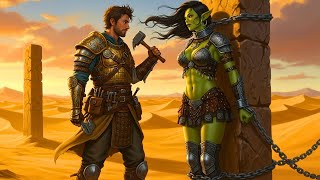
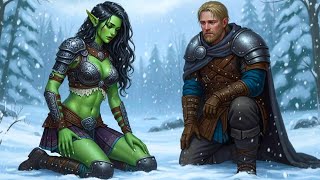
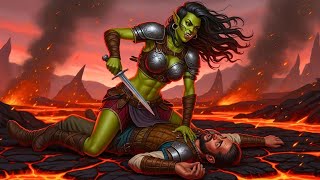
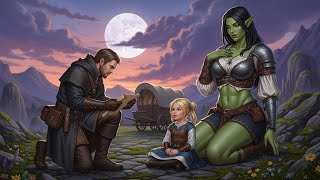
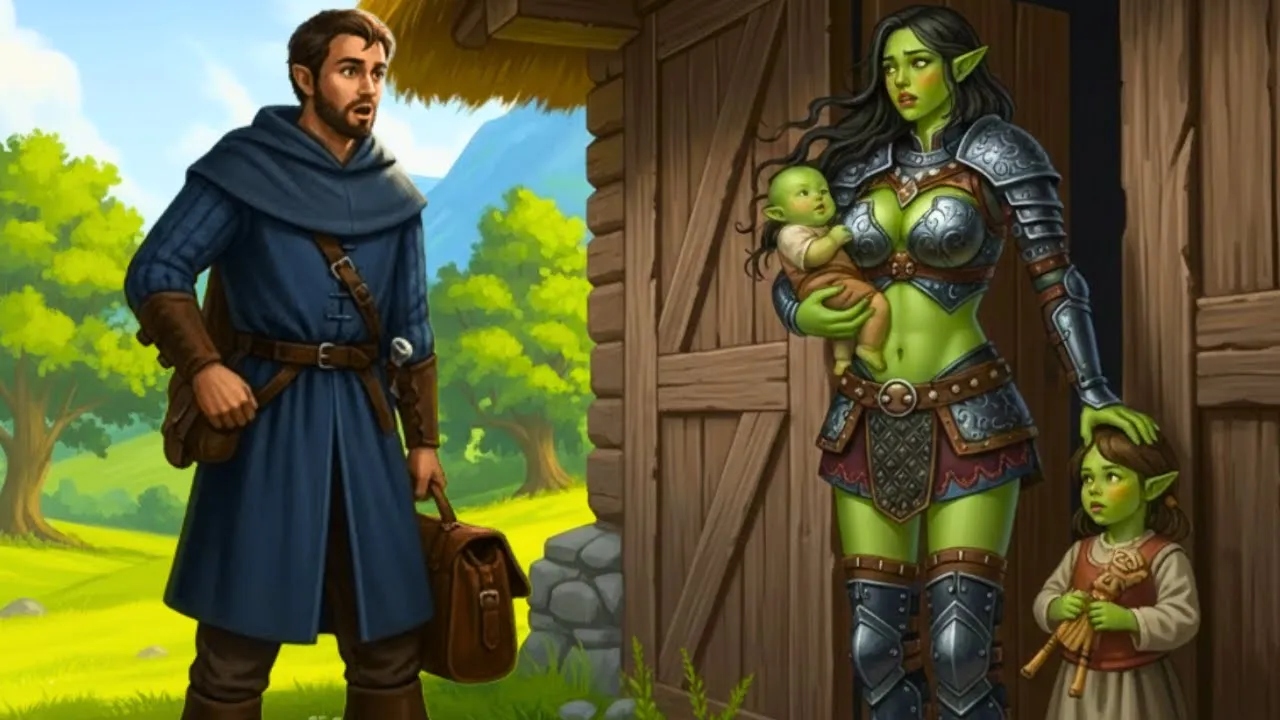
A man finds an orc widow and two kids living in his house. What happened next changed everything. Warren had been walking for 3 days straight when he finally saw his house or what used to be his house. The war had ended 6 months ago, but nobody had bothered to tell the countryside. Villages still smoldered in places. Roads were more holes than path. and his farm, the place he'd spent 28 years calling home, looked like it had aged 50. The roof sagged in the middle like a tired horse. The fence posts leaned at angles that defied
basic carpentry. His apple trees were overgrown, branches reaching toward the sky like they were trying to escape the ground, but there was smoke coming from the chimney. Warren stopped walking, stared at that thin line of gray rising into the autumn air. Someone was in his house. Someone had been living in his house. He touched the sword at his hip. More habit than threat. The war had taught him that most problems couldn't be solved by hitting them. But it helped to have options. The door opened before he reached it. And Warren experienced what scholars might call
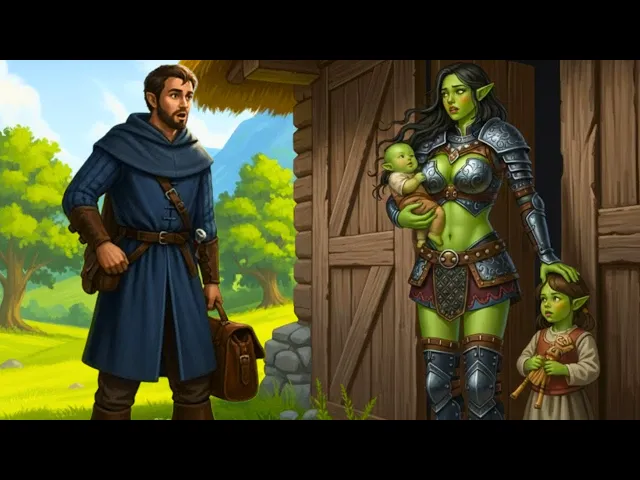
cognitive dissonance. But what most people would describe as the moment your brain looks at reality and says, "Absolutely not." because standing in his doorway wearing armor that had definitely seen better days, specifically days when it wasn't covered in dents, scratches, and what looked suspiciously like dried blood, was an orc, not just any orc, a female orc holding a baby. Behind her, peeking around her armored leg, was a smaller orc, a child, maybe 7 years old, holding a wooden sword that had been carved with surprising detail. Warren's mouth did that thing mouths do when the brain
stops providing useful instructions. It opened, stayed open, forgot why it had opened in the first place. The orc woman looked at him with eyes that were the color of amber, which would have been beautiful under different circumstances. Circumstances where she wasn't occupying his house, circumstances where her hand wasn't resting on the hilt of a very real, very sharplooking blade at her waist. "You are Warren," she said. Not a question, a statement. Her accent was thick. The kind of thick that happened when you learned a language by listening rather than studying. This is your house. Yes.
Warren's voice came out smaller than he intended. He cleared his throat, tried again. Yes, this is my house, which means you're squatting. The orc woman finished. Yes, the correct word is squatting. She shifted the baby to her other arm. The child made a small cooing sound. I am Wulma. This is Grock. Behind me is N. We have been living here for 4 months. 4 months. Warren did the math in his head. The war had ended 6 months ago, which meant you moved in while people were still dying. He said, "Yes." Vulma's face didn't change. While
my husband was dying specifically while he was bleeding on a battlefield 3 days walk from here, I was breaking into your house and making soup from your stores. The honesty was somehow worse than a lie would have been. I should call the guards. Warren said, "You could." Vulma agreed. They would come. They would remove us. N would cry. Grock would cry. I would not cry because orc widows do not cry where humans can see. We would leave. We would die somewhere between here and wherever somewhere is. And you would have your house back. She said
it the way someone might describe the weather. Factual. Unconcerned. like she'd already accepted every possible outcome and was just waiting to see which one arrived first. Warren looked past her into his house. He could see his table, his father's table, his chairs, his fireplace, where someone had hung clothes to dry, orc clothes, leather, and rough fabric that had been mended so many times the patches had patches. "The war is over," he said. "There are camps, resources, aid stations for humans," Vulma interrupted. Humans get camps. Humans get resources. Humans get aid. Orcs get stones thrown at
them. Orcs get chased. Orcs get told that the war may be over, but memory lasts longer than peace treaties. She wasn't wrong. Warren had seen it himself on the journey home. Two orc children begging for food in a village. A shopkeeper throwing water on them like they were stray dogs. The crowd that gathered to watch laughing. I do not ask for charity, Vulma continued. I have been hunting small game. I have been maintaining your house. Fixing what I could fix. I am a smith was a smith before the war. I can work. I can pay.
With what? Warren asked. Vulma looked down at the baby in her arms. Then at N behind her, then back at Warren with eyes that held the kind of exhaustion that went deeper than just being tired. The kind of exhaustion that came from carrying weight that was never supposed to be yours alone. With whatever you require, she said quietly. The words hung in the air between them like smoke. Warren felt something twist in his chest. It wasn't quite anger, wasn't quite pity. It was the uncomfortable middle ground where you realize that the problem standing in front
of you doesn't have a good solution, just less terrible ones. I'm not. He stopped, started over. I don't want anything from you. I just want my house back. Then you should have returned sooner. Vulma said before your roof started leaking. Before your chimney became bird nest before everything your father built started forgetting it was supposed to be house. You fixed the roof? N helped. She is small, good at climbing. Behind Wulma, the little orc girl puffed up with pride. She was missing one of her tusks. Probably baby tusk, Warren thought. She looked at him with
the kind of suspicious curiosity that children directed at strangers who might be threats or might be interesting. The jury was still out. Warren ran a hand through his hair. It needed cutting. Everything needed something. I need to think, he said finally. Then think inside. Wulma stepped back from the doorway. It is cold. Thinking is more effective when you are not freezing. which was how Warren found himself sitting at his own table in his own house, drinking tea that an orc had made from his tea stores, while an orc child stared at him with unblinking golden
eyes, and an orc baby gummed on what appeared to be a piece of dried meat. The tea was good, better than he remembered his tea being. "You added something," he said. "Honey," Vulma replied. She sat across from him, the baby now on her lap. "And mint. Humans drink tea like punishment. It should taste like reward. Warren took another sip. She wasn't wrong. 4 months, he said. You've been here 4 months. Why this house? It was empty, far from village. No neighbors close enough to notice smoke. And Vulma hesitated. It had garden. Small garden behind house
already growing. Potatoes, carrots, onions. Someone had planted them and left. I thought perhaps person who planted them would not return. War takes more than it gives back. My mother planted that garden. Warren said before the conscription before they took every man between 16 and 40. She said I'd need food when I got back. She was wise. She was dead before I made it past the third battle. Silence fell like a curtain. Vulma didn't offer condolences. Didn't say she was sorry. She just sat there holding her baby, being the kind of quiet that acknowledged shared loss
without trying to fix it. Your husband, Warren said. How did he arrow to the throat? Vulma replied. Her voice was steady. Too steady. Like she'd practiced saying it without breaking. Quick death. He did not suffer long. I tell Nar he died brave. I tell her his spirit is in the mountains. I tell her many things that make grief smaller for children. N had stopped staring at Warren. She was now sitting on the floor near the fireplace, making her wooden sword fight an invisible enemy. She made small grunting sounds with each strike. The universal language of
children playing war without understanding what war actually was. I can't let you stay, Warren said. It came out sounding more like a question than a statement. Cannot or will not, Vulma asked. Both either. I don't. Warren set down his teacup harder than he meant to. This is my house. I came back to rebuild my life, to have something that's mine again, not to be a a charity, Vulma suggested. Yes, good. I do not want charity. She shifted Grock to her shoulder, patting his back in that rhythmic way all mothers seem to know instinctively. I want
arrangement. What kind of arrangement? You need house repaired. Roof, fence, garden expanded. I can do this. I have tools. I have skills. I have strength. She paused. I also have two children who cannot live in woods through winter. Mountains are already cold. In 3 weeks, first snow falls. In 6 weeks, roads become impossible. Anything that cannot find shelter dies. Warren knew she was right. He'd seen enough frozen corpses during the war to understand exactly what winter did to the unprepared. So what? He asked. We just live together. A human and three orcs sharing a farmhouse
like it's normal. Nothing is normal anymore, Vulma said. Normal died with the first thousand soldiers. What we have now is what comes after Normal. We can make it work or we can make it not work. Either way, choice is what matters. Nara suddenly appeared at Warren's elbow. She'd moved silently, which was impressive for a 7-year-old wearing leather boots. "You have sad face," she announced in common. That was rougher than her mother's, like the cat we found with her leg. It had sad face, too, until mama fixed it. Then it had normal face. Nulma said sharply.
Manners. I have manners. I am using words, not biting. Words are polite biting. Warren felt something crack inside him. Not break. Just crack. The way ice cracks when you step on it but doesn't quite fall apart yet. He looked at this orc child who thought words were polite biting. at the baby drooling on his mother's armor, at Vulma herself, who sat at his father's table with the kind of dignity that came from having nothing left to lose but refusing to apologize for surviving. One week, Warren heard himself say, "You can stay one week. That's it.
That's all I'm offering." "One week is better than no weeks," Bulma replied. "We accept." And that should have been the end of it. A simple arrangement. Seven days of shared space and then back to their respective corners of the world. But the universe has a sense of humor about these things because one week became two, two weeks became a month. A month became the point where Warren stopped counting and started wondering when exactly his house had stopped feeling like just his. The first week was uncomfortable in the way everything new and wrong is uncomfortable, like
wearing someone else's boots. It technically functions but feels strange at every step. Warren took the small bedroom upstairs, the one that had been his as a child. Wulma and the children took the main bedroom on the ground floor. They stayed out of each other's way as much as two parties occupying a small farmhouse could. Warren woke before dawn. Wulma woke earlier. He'd come downstairs to find her already working, sharpening tools, mending clothes, doing the thousand small tasks that keeping a household alive required. She didn't make conversation. Neither did he. They moved around each other like
two cats sharing territory by pretending the other didn't exist. Nara had no such reservations. "Why do you breathe so loud when you sleep?" she asked on the third day. Warren, who'd been drinking his morning tea, choked, "I don't breathe loud when I sleep." "Yes, you do, like wind through cave." "Who?" She demonstrated with impressive accuracy. "That's called snoring," Warren said. "Adults do it. Mama doesn't snore. Grock doesn't snore. Only you snore. Maybe you are sick. I'm not sick. Maybe you have curse. Father Oswin says humans get cursed when they anger God. Did you anger God?
Nulma's voice cut through the conversation like a blade. Enough. The child scured away, but Warren caught the grin on her face. She wasn't curious. She was testing, seeing how far she could push before the human pushed back. Smart kid. On the fifth day, Warren found Nara standing in the middle of his mother's garden holding a small leather pouch. "What are you doing?" he asked. "Planting?" she replied. Like, this should be obvious. Planting what? She opened the pouch. Inside were seeds. Apple seeds specifically. The small cloth bag Warren had brought back from the war. The last
remnants of his mother's trees from the old family farm. His heart did something complicated. Where did you get that? His voice came out sharper than intended. Found it in your room under bed. Nar looked up at him with complete innocence. Mama says things that hide want to be found. You went through my things. I was looking for interesting objects. You have very boring things. But seeds are not boring. Seeds are potential trees. Warren crouched down to her level. Those seeds are mine. They're special. They're dead if not planted. N interrupted. Seeds are not pets. cannot
keep them in bag forever. Must put in ground or they forget how to grow. The logic was childish and simple and completely correct. I was waiting for the right time. Warren said time is now time. Mama says now time is only time that matters. Past time is just memory. Future time is just worry. Now time is when planting happens. Warren looked at this small orc child holding his mother's seeds. seeds he'd carried through three years of war. Seeds he'd been too afraid to plant. Because planting meant accepting that this was home now, this was life
now. That the past wasn't coming back, no matter how tightly he held on to its pieces. Do you even know how to plant apple seeds? He asked. Nar's face lit up. No, but you can teach. Teaching is sharing knowledge. Sharing knowledge makes tribe stronger. Are we tribe now? We're Warren struggled for the right word. We're housemates. Housemates's small tribe still counts. She thrust the pouch toward him. Show me how to make trees. Which was how Warren spent the next hour teaching an orc child the proper depth to plant seeds? How to space them, how to
mark where each one went so you didn't forget and step on them, how to water without drowning, how to hope without expecting. Vulma watched from the house. Warren could feel her eyes on them. When he finally looked up, she nodded once, a small acknowledgement. They were in the second week when the village found out. Ida appeared first. She was Warren's nearest neighbor. Nearest being relative when you lived in scattered farmland. Her property was a 20-minute walk through the woods. She arrived carrying a basket of bread and curiosity. Warren. She embraced him with the enthusiasm of
someone who genuinely believed he might be dead. I heard you were back. We all thought, "Well, never mind what we thought. You're here. You're alive. That's what matters. Thank you, Ida." Warren tried to position himself in the doorway. A human wall between her and the interior of the house. That's kind of you to bring bread. Oh, it's nothing. Just wanted to check on you. Make sure you were settling in. All right. Must be strange being back. Everything's changed so much. The war, you know, it changed everything. People died. Whole family's gone. Poor Susan lost all
three of her boys. Can you imagine? All three. And she stopped talking because Nara had appeared behind Warren, ducking under his arm to see who was visiting. Ida's face went through several expressions in rapid succession. Confusion, shock, horror. The kind of horror that came from seeing something that violated the fundamental rules of reality as you understood them. That's Ida's voice was barely a whisper. That's an orc. Yes, Warren said. In your house? Yes. There's an orc child in your house. Her name is N. Ida took a step backward, then another. The basket of bread hung
forgotten in her hand. Warren, what have you done? I've made an arrangement. An arrangement with orcs? Warren, they're they're She lowered her voice like saying it quieter made it less true. They're monsters. Nara tilted her head, studying Ida with the clinical interest of a child trying to understand adult fear. I am not monster. Monsters have three heads and eat villages. I have one head and eat porridge. It talks. Ida breathed. She talks. Warren corrected. And yes, because she's a person. Persons are human. Persons are whoever can think and feel and choose. Last I checked, that
definition doesn't require specific skin color. Ida's face flushed. You always were too clever for your own good, Warren. But cleverness doesn't change facts. Facts are that orcs killed our people. Facts are that your own mother died because of orc raids on supply lines. Facts are that having them in your house is my choice. Warren interrupted. My house. My choice. Then you're a fool. Ida thrust the basket at him. A fool who's going to get himself killed in his sleep by the same monsters who destroyed everything we knew. She turned and walked away, her stride quick
and angry. Nar watched her go with thoughtful eyes. She has big fear. The child observed. Fear makes people say not true things. Sometimes, Warren agreed. Did my people kill her family? Warren looked down at N serious face and golden eyes at the wooden sword on her back that she carried everywhere because her mother had taught her that warriors were always prepared. Probably he said honestly just like my people probably killed hers. That is sad circle. Nara said everyone killing everyone nobody winning. Yeah, Warren said that's what war is. By evening everyone knew. Father Oswin arrived
at sunset. He was a thin man with kind eyes and hands that trembled slightly. Whether from age or something else, Warren had never asked. He carried his book of prayers, but Warren noticed he kept forgetting to actually open it. Warren, Father Oswin said carefully. I've heard concerning reports. I'm sure you have. The village is unsettled. People are afraid. They're saying you're harboring enemies. That you've gone mad from the war. That you're betraying the memory of everyone who died. And what do you think? Warren asked. Father Oswin was quiet for a long moment. His eyes drifted
past Warren to where Vulma sat visible through the window, mending clothing by lamplight while Grock slept in a basket beside her. I think, the priest said slowly, that mercy is supposed to be hard, that forgiveness is supposed to cost something, that the scripture says to love your enemies, but doesn't specify what that love should look like in practice. He finally met Warren's eyes. I also think you're either the bravest man I know or the most foolish, possibly both. And which should I be? Whichever one helps you sleep at night. Father Oswin finally opened his prayer
book, flipped through pages without really reading. The village will petition the Lord. They'll want the orcs removed. Possibly punished. For what crime? For existing where they're not wanted. Warren felt anger rise hot in his chest. Is that what we fought for? three years of blood so we could come home and keep spilling it for different reasons. War doesn't teach peace, Warren. It just teaches more war with longer pauses between. Father Oswin closed his book. I'll pray for you, for all of you. Prayer may not solve anything, but it's all I have to offer. He left
before Warren could respond. That night, Warren sat at his table long after everyone else had gone to bed. He could hear Grock fussing upstairs. Vulma's low voice singing something in orcish, a lullaby, probably. The words were rough and deep, but the melody was gentle. Nara appeared on the stairs. She was wearing a night shirt that had clearly been made for a human child and was way too long. She looked like a small orc drowning in fabric. Cannot sleep, she announced. Why not? Thinking too loud. Thoughts are noisy when worried. What are you worried about? Nar
climbed onto the chair across from him. Her feet didn't touch the ground. She swung them back and forth in that restless way children did when their bodies needed to move, even if they weren't going anywhere. If humans make us leave, she said quietly. "If they say we cannot stay, where do we go?" Warren didn't have an answer that wouldn't be a lie. "Your mama is strong," he said instead. "She'll figure something out. Mama is strong, but also tired. Very tired. She does not sleep sometimes. Just sits and stares at nothing." Nar's voice dropped even quieter.
When Papa died, part of Mama died, too. The part that makes choices easy. Now every choice is heavy. The observation was too old for a seven-year-old, but war aed children faster than time did. I'm sorry about your father, Warren said. Are you sorry or polite sorry? What's the difference? Sorry is when heart hurts for someone. Polite sorry is when mouth makes sounds because sounds are expected. Smart kid, too smart. Sorry, sorry, Warren said. Nar nodded, accepting this. I do not remember much of Papa. Mostly I remember his voice. Deep voice like thunder, but friendlier. He
would tell stories about ancestors, about orcs who fought giants, about orcs who chose honor over victory, about how strength means protecting, not destroying. He sounds like he was a good father. Yes, but good fathers still die in wars. Being good does not make you bulletproof or arrow proof or any kind of proof that matters when fighting happens. She looked at Warren with eyes that held too much understanding. War is stupid. Everyone dies and nobody wins and then when it stops, people just find new reasons to hate each other. You're absolutely right, Warren said. I know.
I am smart. It wasn't arrogance, just fact. Question is, are you smart enough to choose different? Different from what? Different from hate. Different from fear. Different from all the stupid that makes wars happen in first place. Nara hopped down from the chair. Good night, housemate. Maybe tribe member Warren. She patted back upstairs, leaving Warren sitting alone with thoughts that were indeed very noisy. The next two weeks were a test. The village didn't send the Lord. They sent something worse. They sent cold shoulders, slammed doors, whispers that followed Warren whenever he went to trade for supplies.
Mukar found him in the market square 3 weeks after Ida's visit. The old orc veteran looked like he'd been through a war and several bar fights and had lost most of both. He was missing his left arm, had scars crossing his face like a map of bad decisions and walked with a limp that suggested his leg and hip had violent disagreements about basic mobility. Mukar hears things. The old orc said in third person, "He always did that." Mukar hears Warren is housing orc widow and cubs. Mukar thinks this is very foolish or very brave. Everyone
keeps saying that Warren replied. Nobody's decided which yet. Mukar knows which is both. Always both when doing right thing in wrong world. The old orc grunted. Mukkar also knows Widow knew her husband. Fought beside him three battles before Arrow took him. Was good orc. Strong, smart, died protecting others when he could have run. Vulma says he died quickly. Vulma lies to make child's grief smaller. He did not die quickly. Took 6 hours, screamed most of it, but fought to live until medic arrived. Fought to give message for wife. Message was tell her to survive. Tell
her to choose life over honor. Tell her that being alive for cubs matters more than dying pretty for ancestors. Warren felt something heavy settle in his chest. She never mentioned that, he said. Would you? If person you loved most used their last breath to tell you to forget everything your culture values in order to keep breathing. Mukar spat on the ground. Being widow is hard for any species. Being orc widow is impossible. Orc widows are supposed to take warriors blade and join him in death. Supposed to choose honor over survival. Vulma chose survival. Village of
orcs cast her out. Called her coward. Called her unworthy because she wanted to stay alive for her children. Because she broke tradition. Because she chose human logic over orc honor. Because she decided her children's future mattered more than her dead husband's reputation. Mukar's one good eye fixed on Warren. So now she lives in human world that hates her and orc world that has forgotten her. She is nowhere belonging to nothing. Keeping two children alive through sheer stubborn refusal to die. Warren thought about Wulma, about the way she worked from before dawn until after dark. about
how she never complained, never asked for help, never showed weakness, about the exhaustion in her eyes that came from carrying weight that would have broken most people months ago. Why are you telling me this? He asked. Because Mukar sees how you look at them like they are problem to solve. They are not problem. They are people who survived when everyone expected them to die. That deserves respect, not calculation. The old orc turned to limp away, then paused. Also, he added, "Warren should know that village idiots are planning something." Mukkar heard talk. Talk about teaching lessons,
about reminding orcs of their place, about making sure no other human gets funny ideas about hospitality. Warren's blood went cold. When? Soon, maybe tonight. Maybe tomorrow. Mukar does not know details. Just knows that angry men with too much beer and too few brains are dangerous combination. Why help us? Mukar looked back over his shoulder. Because Mukar is old, crippled, and living on human charity. But Mukar still remembers when orcs valued protecting the weak over punishing the different. Maybe someday orcs remember that again. Until then, Mukar does what he can. Warren ran back to the farmhouse
faster than his legs wanted to cooperate. Found Vulma outside chopping wood. She looked up as he approached, read his face immediately. "What happened?" she asked. He told her all of it. Mukar's warning, the village plans, the danger. WMA set down her ax, wiped sweat from her forehead, looked at her house. Because Warren had started thinking of it as their house somewhere around week three and hadn't noticed until now. We will leave, she said simply. Tonight, before trouble comes, we will take what we can carry. And no, Warren interrupted. No, no, you're not leaving. This is
your home. This is your home. We are just temporary. No, Warren repeated firmer this time. This is your home because I'm saying it is. Because I'm choosing it to be. Because he stopped, found the words he'd been avoiding saying. Because you belong here. Vulma stared at him. Really stared like she was seeing him for the first time. Why? She asked quietly. Why does this matter to you? We are nothing to you. Strangers, enemies by birth, burden by circumstance. You owe us nothing. I owe you everything. Warren said, "You fixed my house. You planted my mother's
seeds. You made a home in a place that was just empty rooms. You took something dead and made it alive again." He gestured around them. "Look at this place. Look at what it was when I came back. Just structure, just walls. Now it's home." Nar said from the doorway. She'd been listening. Of course, she'd been listening. Children heard everything adults thought was private. Is home now, not just house. Home is where people choose to stay, even when leaving is easier. Yes, Warren agreed. Exactly that. Vulma's jaw tightened. For a moment, Warren thought she might cry,
but orc widows don't cry where humans can see. She told him that the first day, what he hadn't understood until now was that it wasn't about pride. It was about control, about holding on to the last pieces of strength when everything else had been stripped away. If village comes, she said finally. What will you do? I'll handle it. You are one man and you're one orc with two children. But here we are still standing. Warren felt something solid settle in his chest. A decision that went from abstract to concrete, from maybe to definitely. I didn't
survive 3 years of war just to come home and let bullies dictate who gets to exist. You stay. We figure it out. Together. Together is dangerous word. Together is the only word that matters. They came that night. Warren heard them before he saw them. Boots on gravel. Low voices trying to be quiet and failing. The kind of noise that drunk confidence makes when it thinks it's being stealthy. Seven men. Eight if you counted the one hanging back like he wasn't sure he wanted to be there, but was too afraid to leave. Warren met them at
the property line. sword visible but not drawn. Vulma stood beside him. She'd insisted, had put Nar in charge of watching Grock, had strapped her blade on, had walked out the door with the kind of calm that came from having already decided that some things were worth dying for. The lead man was Marcus, blacksmith's son, big like his father, but none of the old man's wisdom, just shoulders and anger, looking for purpose. Warren Marcus said he was trying to sound authoritative official like he had the right to be there. We need to talk then talk. Warren
replied not out here inside. Here is fine. We want to see them. The orcs want to make sure they're Marcus struggled for words. Not a threat. They're not a threat. That's not for you to decide. It's exactly for me to decide. My property, my house, my choice who stays. Your choice affects the whole village. Another man called out. Stefan farmer had lost a son in the war. Warren could smell alcohol on him from 10 ft away. You harboring orc scum sends a message. Says we're weak. Says they can just walk in. And they didn't walk
in. Warren interrupted. I let them stay. Then you're a traitor. The word hung in the air like smoke. Wulma shifted slightly. Her hand didn't move toward her blade, but Warren could feel the readiness in her. the coiled violence that three years of war had taught her body to access instantly. "I'm not a traitor for choosing compassion over cruelty," Warren said carefully. "I'm not a traitor for seeing people instead of labels. I'm not a traitor for refusing to perpetuate the same cycle of violence that took 3 years of our lives." "Fancy words," Marcus sneered. "But words
don't change reality. Reality is their orcs. Reality is their kind killed our people. Reality is, reality is I killed orcs. Warren cut him off. The crowd went quiet. 23 of them that I counted. Probably more I didn't see fall. Cut them down on battlefields while following orders I didn't question because questioning wasn't allowed. He stepped forward. I killed children who'd been conscripted too young. I killed farmers who'd been forced to fight. I killed scared boys who cried for their mothers in a language I didn't understand. I did all of that because someone told me it
was necessary. He could feel every eye on him. And then I came home, Warren continued, and found three orcs in my house. A widow, two children, the enemy, the monsters, the justification for 3 years of blood. His voice dropped quieter. But you know what I actually found? I found a mother trying to keep her children alive. I found a child who plants seeds because she believes in futures. I found a baby who laughs at stupid faces regardless of whose face it is. They're manipulating you, Marcus insisted. Making you soft, making you making me human, Warren
said, which is more than I was when I came back from the war. War strips your humanity piece by piece until you forget what it feels like to care. Until you can look at suffering and feel nothing, until other people's pain becomes white noise. He glanced at Vulma. They reminded me how to care again, how to see people as people, how to choose compassion when anger is easier. This is insane, Stefan muttered. We came here to to what? Wulma spoke for the first time. Her accent was thick, her words careful. To remove us by force,
to beat widow and children. To prove that your hate is stronger than our will to live. She stepped forward. Then do it. We will not run. We will not beg. If you want our blood, come take it. But know that we will fight and orc mothers fight differently than orc warriors. We fight with nothing to lose and everything to protect. The crowd shifted uncomfortably. But before you decide, Vulma continued. Answer question. What will it change? Will killing us bring back your dead? Will it make war on happen? Will it heal wounds that scar will always
show? She looked at each man individually, or will it just add more bodies to pile, more grief to world that already drowns in it? more proof that humans and orcs are both very good at destroying and very bad at building. Silence. Long, heavy silence. Then the man who'd been hanging back, Warren recognized him now as Peter, the baker's apprentice, spoke up. "This is wrong," Peter said quietly. "We're not. This isn't what we should be doing." "Shut up, Peter," Marcus snapped. "No," Peter's voice got stronger. "I won't shut up. We came here to to what exactly?
intimidate a woman and two children. That's what we're doing now. That's who we are. They're orcs, Marcus repeated. Like saying it enough times would make it matter more. So what? Peter challenged. My best friend was orc. Fought beside him for 2 years. He saved my life four times. I saved his twice. We had plans to open a bakery together when the war ended. Combined human bread techniques with orc spice knowledge. His voice cracked. Then he took an arrow meant for me. died choking on his own blood while I held him. Last thing he said was,
"Make the bread anyway. Prove that something good can come from all this terrible." "More silence." "I'm not doing this," Peter said. He turned and walked away into the darkness back toward the village. One by one, the others followed, uncomfortable, ashamed, not quite meeting Warren's eyes until only Marcus remained. "This isn't over," Marcus said. But his voice had lost its certainty. "Yes, it is," Warren replied. "It was over before you arrived. You just hadn't realized it yet." Marcus left without another word. Vulma let out a breath she'd been holding. "That was either very brave or very
stupid. Everyone keeps saying that because it keeps being true." She looked at him with something in her eyes Warren couldn't quite identify. Respect, maybe, or recognition. "You did not have to defend us." "Yes, I did." "Why?" Warren thought about the seeds Nara had planted, about the small green shoots that had started pushing up through the soil, about how hope looked like foolishness until it grew into something real. Because you're my family, he said simply. Vulma's breath caught just for a second, almost imperceptible. Orcs do not use word family lightly, she said quietly. Family is bond
deeper than blood. Is choice that cannot be unchosen. is oath that holds even when everything else breaks. I know then you understand what you are saying. I understand that family isn't who you're born to. It's who you choose to stand beside when everyone else walks away. Nar's voice came from the house. Grock is crying and I do not know why. His face is wet and red and loud. He probably needs changing. Vulma called back then to Warren. Welcome to family. It is messy and exhausting and completely worth it. The next 3 months were adjustment. The
village didn't exactly accept them, but they stopped actively opposing them. It was that cold middle ground where people ignore what they can't control. Father Oswin visited weekly, ostensibly to pray, actually to teach N to read common. The child devoured books the way Grock devoured anything he could fit in his mouth. Ida started leaving bread on the doorstep again. She never knocked, never stayed, just left bread and disappeared. small gestures of apology that didn't require actual words. Mukkar stopped by occasionally. Taught Warren Orc drinking songs that were entirely inappropriate for family gatherings. Taught Wulma where to
buy good leather for armor repair. Told Nara stories about her father that made the child laugh and cry in equal measure. The apple seeds grew. small shoots at first, fragile but persistent, growing despite the odds, despite the cold, despite everything that said they shouldn't survive. Warren caught himself checking on them every morning, measuring their growth, worrying about frost, celebrating each new leaf like it was a personal victory. They will be trees someday, Nar observed, kneeling beside him in the garden. Big trees, trees that make apples for many years. If they survive the winter, Warren said
they will survive. Seeds from warrior farmer always survive is in their nature. I'm not a warrior. You fought in war. You defend family. You choose hard path over easy path. That is warrior. Sword is just decoration. Warren laughed. Actual laughter. The kind that came from the belly instead of polite obligation. When did you become so wise? He asked. Was always wise. You were just too busy being sad to notice. Nar patted his hand with surprising gentleness. Is okay. Sad takes time to leave. Like winter. Eventually spring comes. Must just survive until then. That night Warren
sat at the table after everyone else had gone to bed. Vulma came downstairs drawn by the lamplight. Cannot sleep? She asked. Too much thinking. Dangerous for humans. Thinking leads to philosophy. Philosophy leads to headache. Warren smiled. Sit with me, Vulma sat. They shared comfortable silence. The kind of silence that happened between people who'd learned each other's rhythms. I need to ask you something, Warren said finally. And I need you to answer honestly. Orcs do not know how to answer any other way. Do you think we can make this work, really work? Not just survive, but
actually build something that lasts. Wulma considered this. I think she said slowly that what we are building has no map, no previous example, no guarantee. We are writing new story in world that only knows old stories. She met his eyes. But old stories end in war, end in blood, end in repetition of same mistakes by different people. Maybe new story ends differently. Maybe new story ends in hope. Maybe is not a promise. Maybe is better than no. Maybe is better than never. Maybe is seed waiting to become tree. Warren reached across the table, took her
hand. She didn't pull away. Then let's be maybe, he said. Together. Together. Vulma agreed. Spring came slowly. The apple shoots survived winter. Against odds, against expectations, against everything that said fragile things shouldn't make it through harsh seasons. But they did. The village began to accept reality. Not because they wanted to, but because fighting reality was exhausting and ultimately pointless. Warren and his strange family became just another fixture. Odd, yes. Controversial, yes. But there, Nara started playing with village children. Carefully at first. Then with increasing confidence. Turned out children didn't care about species labels nearly as
much as adults did. Children cared about who could climb trees highest, who knew best games, who shared snacks. Grock learned to walk, toddled around the house with the enthusiastic clumsiness of a small creature discovering mobility called Warren Wahwa, which Nar insisted meant honorary papa, who is not real papa, but is important anyway. Vulma's armor came off. Not all at once, not dramatically, but piece by piece. until one day Warren realized she hadn't worn it in weeks. Just regular clothes, just leather and cloth like any other person doing farm work. "You stopped wearing your armor," he
commented one evening. "Do not need it anymore," Vulma replied. Armor is for warriors preparing for battle. "I am not warrior anymore. Am just mother trying to raise children in peace. You'll always be a warrior." Yes, but warrior can choose when to fight and when to rest. I choose rest now. I choose safety. I choose boring. She smiled. It was the first real smile Warren had seen from her. Boring is luxury. Boring is gift. Boring means no one is trying to kill you. I'll drink to boring, Warren said. They clinkedked cups. Water for her, tea for
him. The most mundane toast imaginable. That summer, the first apples appeared. Small, green, nothing impressive, but apples nonetheless. N found them first. Came running into the house with the kind of excitement that made Grock start laughing just because his sister was laughing. Warren, wah wah. Trees have baby apples. Small apples. Future apples. They all went outside. Stood in the garden looking at three small apple saplings bearing their first tiny fruits. We'll be years before apples are good for eating. Wulma observed. Apple trees are patient, require time. Good thing we have time, Warren said. Nar looked
up at him with golden eyes that held too much wisdom for her age. We have more than time. We have family. Family is tree that keeps growing even after person who planted it is gone. That's very profound, N. I know. I am profound sometimes. Other times I am just loud. Depends on day. That evening, as sunset painted the sky in shades of orange and purple, Warren stood at the property line of his farm, their farm, looking at the house. At the fence, Wulma had repaired at the garden where his mother's seeds had become trees. Father
Oswin approached from the road. They stood in companionable silence. "You proved everyone wrong," the priest said finally. "I proved everyone right," Warren corrected. I was both foolish and brave, both idealistic and practical, both right and wrong depending on whose perspective you ask. But you made it work. We made it work, all of us, together. The village is starting to change. Father Oswin observed slowly, very slowly. But I've heard people talking, wondering if maybe the lines we drew between us and them were always arbitrary. If maybe enemies could become neighbors if we just let them. It's
still an uphill battle. All worthwhile things are. The priest adjusted his prayer book. I wanted you to know two more orc families have petitioned to settle near the village. Widows mostly refugees. They heard about this. He gestured at the farm. About human and orcs living in peace. They want the same want chance to rebuild. Warren felt something warm spread through his chest. Not pride exactly, more like vindication. Proof that maybe was becoming yes. What did the village say? He asked. They're considering it, which is more than they would have said 6 months ago. Father Oswin
smiled. You planted seeds, Warren. Not just apple seeds. You planted idea that different futures are possible. Ideas grow slower than trees, but eventually bear fruit. After the priest left, Warren went back inside, found Wulma reading to both children. Brock was already asleep in her lap. Nar was fighting sleep and losing. Story time? Warren asked. Yes. Old orc legend about first orc who chose peace over war. Tribe called him coward. Cast him out. He walked for many years. Found valley. Built home. Raised crops. Lived in peace. Vulma turned the page. Other orcs heard about valley where
no fighting happened. Slowly they came one family at a time until Valley was full of orcs who chose peace. Became strongest tribe in history. Not through violence, through survival. Does the story have a happy ending? Warren asked. Story has true ending which is better than happy. Happy is fantasy. True is real. She closed the book. Valley still exists in mountains north of here. Orcp peace valley is real place. Real history. Maybe we should visit someday. Maybe. Wulma agreed. She looked at him with those amber eyes. Or maybe we build our own valley right here. Start
small. Just us. But small beginnings lead to large futures. That night, Warren couldn't sleep. He went downstairs, found the small wooden carving he'd made as a child. Two hands holding each other, one large, one small. Symbol of connection, of promise, of family. He set it on the mantle above the fireplace where everyone could see it. In the morning, N found it first. "What is this?" she asked. "It's us," Warren said simply. "All of us together. Can I make one too, but with four hands? For four people? I think that would be perfect. Nara spent the
entire day carving. Her technique was rough. The proportions were wrong. One hand ended up bigger than the others. But when she finished, she placed it next to Warren's on the mantle. "Now is complete," she declared. "Now is real family symbol." WMA came to look, studied both carvings, reached up, and adjusted them so they sat perfectly side by side. In orc tradition, she said quietly, "Family carvings are sacred, are passed down through generations. Our promise that connection continues beyond death. Then these will be passed to your children," Warren said. "And their children and whoever comes after
our children," Vulma corrected. "Not mine, ours. Family is not possession, is shared responsibility." Warren didn't know what to say to that, so he didn't say anything. just stood beside her, watching two small pieces of wood that meant everything and nothing that were just wood and were also promise, were just objects and were also future. Two years later, the valley had 17 families, mixed human and orc, learning to coexist, learning to build something new from the ruins of something old. The apple trees were taller now, strong, still years away from mature fruit, but growing, patient, sure.
Nar was nine, loud, opinionated, terrifyingly smart, teaching younger children to read, both human and orc, refusing to accept that different species meant different opportunities. Brock was three, walked, talked, got into everything, called Warren Papa without the honorary qualifier. Warren had stopped correcting him. WMA and Warren sat on the porch one evening watching the sun set over their valley, their community, their impossible, improbable, absolutely real family. "Do you ever regret it?" Warren asked. Staying choosing this. Vulma was quiet for a long moment. "I regret many things. Regret that my children grew up without father. Regret that
war happened at all. Regret that world is still not fully ready for what we are building here." She looked at him. But I do not regret staying. Do not regret choosing life over tradition. Do not regret believing that maybe could become yes. And has it has maybe become yes? Look around. Vulma gestured at the valley, at the houses, at the mixed families, at the children playing together, at the small market where orcs and humans traded goods and stories and recipes. What do you think? Warren looked really looked at at everything they'd built, everything that shouldn't
exist but did anyway. I think he said slowly that we planted seeds, some in garden, sum in hearts and both kinds grew into something worth keeping. Poetic, very human. Bulma smiled. Orc saying is simpler. Says together is stronger than alone. Always. Then let's be together. Warren said always, always. Vulma agreed. Inside the house, they could hear N teaching Grock a new song. Something about warriors and peace and families that chose each other instead of being chosen by blood. The apple trees rustled in the evening breeze. Small fruits growing in the branches. Not perfect, not impressive
by commercial standards, but real growing, promising future harvests. Some victories aren't won on battlefields. They're one in quiet moments when people choose connection over division. When they choose to see persons instead of labels, when they choose hope over fear. Warren had gone to war. A young man who thought he understood how the world worked. He'd come home broken. Found his house occupied by the enemy. Found his heart occupied by something stronger than hate. He'd found family in the last place he expected to look. And in building that impossible family, he'd helped build something larger. A
community, a valley, a future where maybe different species could stop killing each other long enough to realize they were all just people trying to survive. The work wasn't finished. Probably would never be finished. There would always be resistance. Always be people who saw difference as threat instead of opportunity. But that was tomorrow's problem. Tonight, Warren had family, had home, had small apple trees growing in garden planted by hands that should have been enemies, but chose to be allies instead. Had proof that sometimes the bravest thing you can do is open your door to someone the
world says you should fear. Had learned that walls are strongest when they shelter everyone. That gardens grow better when more hands tend them. That family isn't defined by blood, but by choice. The moon rose over the valley. Silver light on mixed rooftops. On gardens growing food for multiple species. On children sleeping in beds provided by parents who looked nothing alike but loved just the same. In the end, the world didn't need perfect heroes. It needed broken people willing to fix each other. And sometimes that was enough.