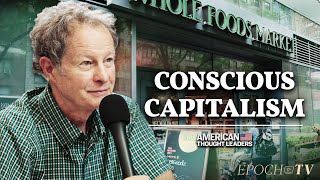
from a macro perspective conscious capitalism is becoming conscious of the framework that capitalism has to exist in order to in order to be successful in order to flourish there's certain key principles that that have to be in place and we have to nurture those principles or we won't have a capitalistic order it's not something that automatically exists it has to be it has to have principles that's to be grounded in those principles and some of those principles include property rights we have to have the right for people to be able to own property at the
same time there needs to be the freedom to exchange property we need to be able to trade it we need to be able to create something and then trade it or sell it to someone else we need we need a rule of law there needs to be laws that are just and laws that are predictable and laws that apply to everyone in the society including the government a rule of law is essentially you cannot have a a capitalistic order without the rule of law and whenever that comes into doubt or if they're not stable property
rights you don't really have the the basis for the capitalistic order and finally you need a freedom to trade usually the greater the the fewer restrictions on the freedom to trade across the between people but also between people in different states people in different countries the the greater value creation that occurs so anytime you see a society that's beginning to restrict the ability to trade you see a society that is going to lessen its prosperity it tends to happen when people get preoccupied with loss of jobs not understanding that you may lose some jobs too
foreign country if you allow freedom to trade but you're gaining jobs became time your gain more net jobs because the people won't give you their goods for free they want to trade with you as well and so those jobs and the goods that they want to trade for the good and services they want that will create greater employment at home but that's very hard for the average person to understand and so but anyway conscious capitalism is understanding these these basic core economic values and becoming more conscious of them now conscious business is is there are
certain principles behind that and one principle is that business has the potential for higher purpose that maximizing profits if you ask people what the purpose of business is they usually say if you go to a cocktail party and ask that question they'll generally say well everybody knows that the purpose of business is to maximize profits it's to maximize shareholder value and it's but that's a very odd answer because that's not the answer we would give if you asked what the purpose of a doctor is need to heal the sick or what the purpose of a
teacher is to educate people or what the purpose of lawyer is or what the purpose of an architect is or what the purpose of an engineer is so so why is it that we would come to this odd answer that the purpose of business is to maximize profits when I've known literally hundreds of entrepreneurs in my life and with very few exceptions very few of them actually created their businesses to try to maximize profits of course they need to make money but that's I need to eat in order to live I need to breathe in
order to live I need my I need to create red blood cells in order to live but that's not the purpose of my life to eat to breathe to create red blood cells I have a much more transcendent purpose in my life that gives my life meaning and value to it business is no different a business has the potential for a higher and deeper purpose and that's the first principle of conscious business second principle is is that there's a variety of stakeholders that are interdependent that are connected together customers employees pliers investors communities both local
and larger communities and then the larger environment that were part of those are the most important stakeholders there are other stakeholders that are unlike a formal wider circle such as the government labor unions the media activists of various cons but the idea being that these stakeholders are interdependent on one another and that the conscious business attempts to create value simultaneously for all of these interdependent stakeholders that it seeks the win-win-win business strategy that you know may be a way to explain that in a simple model version as a retail business that which Whole Foods is
is that management's job is to help our is to hire good people train them well and help them to be happy and fulfilled in their workplace and their work and their jobs and then the team members job is to satisfy our customers help the customers to be happy in their exchanges with the business so happy team members leads to happy customers and happy customers do more business with the with the company and that leads to happy investors so you have a virtuous circle of happy team members happy customers happy investors that reflects and a simplified
version this idea of the interdependent nature of the stakeholders and why you can't just focus on creating value for the investors alone because you must create value for the team members who then create value for the customers who then create value for the investors so the conscious business is recognized as conscious of it and works to optimize value for all of the key independent or dependent stakeholders third principle of the conscious business is what we call conscious leadership or you might also think of it as servant leadership that that the leaders of the organization they're
not there to line their pockets and try to maximize their own personal gain instead their job is to fulfill the higher purpose of the business recognize and fulfill the interdependent stakeholder model and in a sense to serve the organization to sublimate their own ego and their own ambitions for the good of the organization and again it's not self sacrificial or I'm not talking about altruism I'm talking about recognizing that in the long term they will also gain the most through the flourishing of the business and through flourishing of all the stakeholders they too will flourish
that their identity is linked and their own their own gain is linked to the gain of all these other stakeholders and then the fourth principle is is that to realize these first three principles you have to create a culture a conscious culture that has strategies structures and processes that create a culture that optimizes the stakeholder model fills the purpose and allows the conscious leadership to do their jobs so the culture provides that background and the processes and structures that the conscious business needs in order to to achieve its highest potential so when you add those
four principles together you have a conscious business when you add the conscious business with the key principles of the conscious of the conscious capitalism you truly have the larger ecosystem of the conscious capitalistic society one with conscious businesses that are exchanging in a consciously capitalistic way