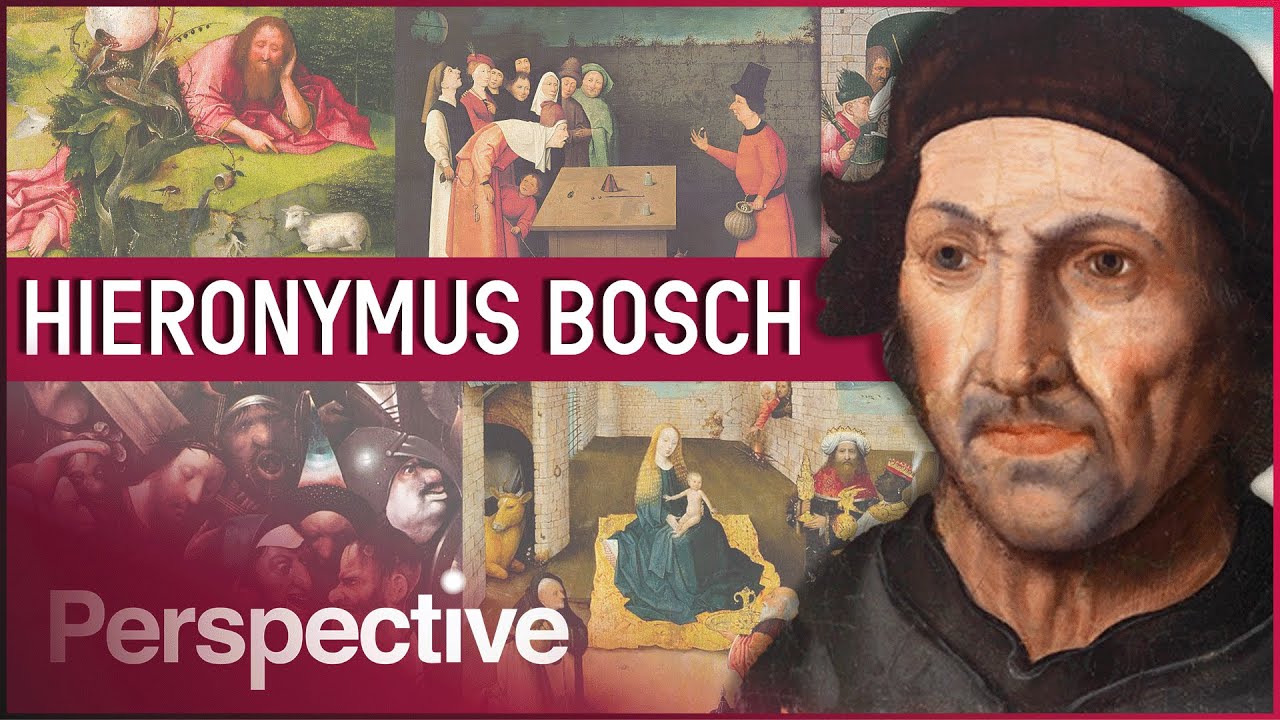
We are in the Netherlands in the XV century, in the workshop of a revolutionary painter, Hieronymus Bosch. We know little about his life. Who was?
A genius? A forerunner or maybe a heretic influenced by a secret society? A man who has known the greatest of princes and scholars of his era has.
He has been forgotten for two centuries and then rediscovered. There is no doubt but that he was the first surrealist in the world. Only a little over 20 of his works are come down to us, all painted on wood panels.
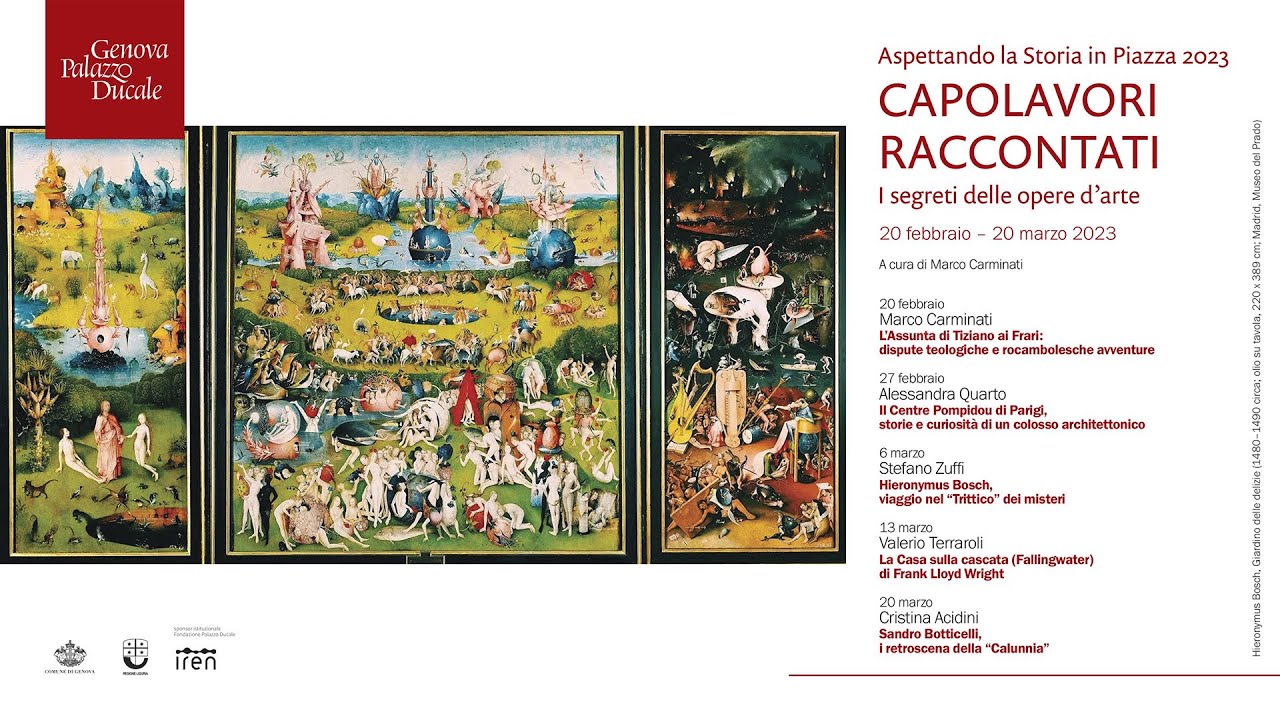
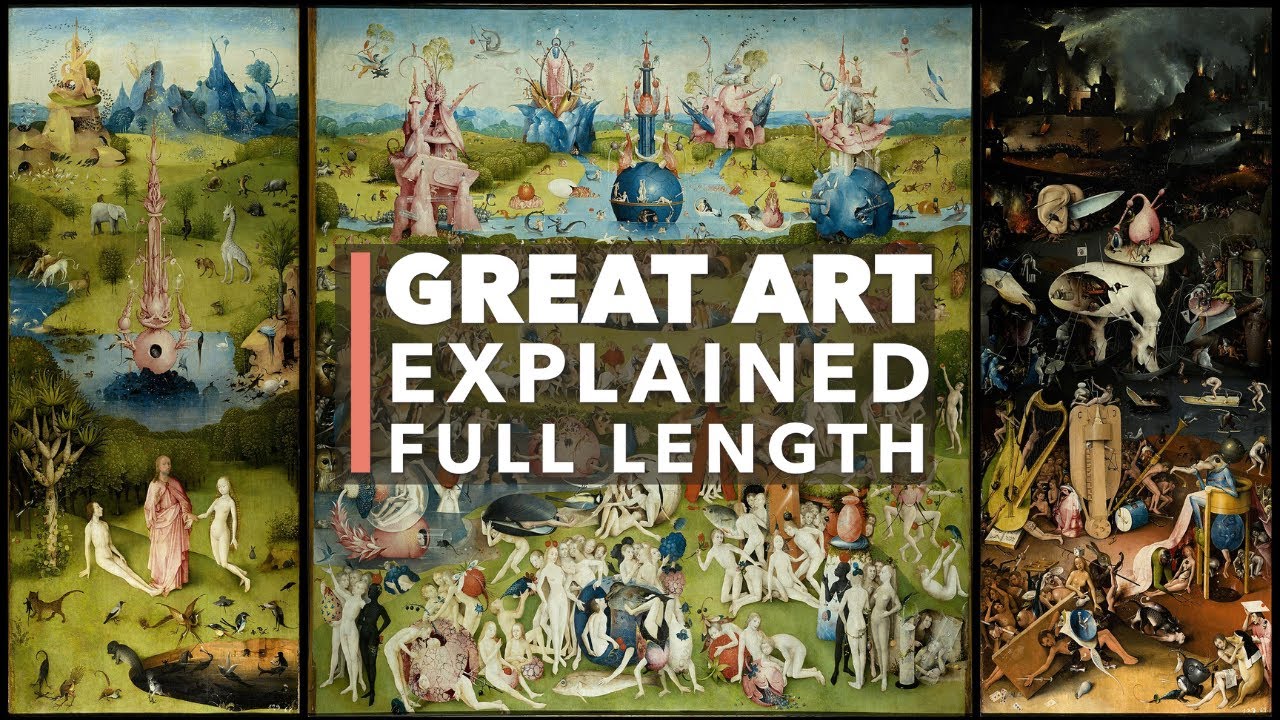
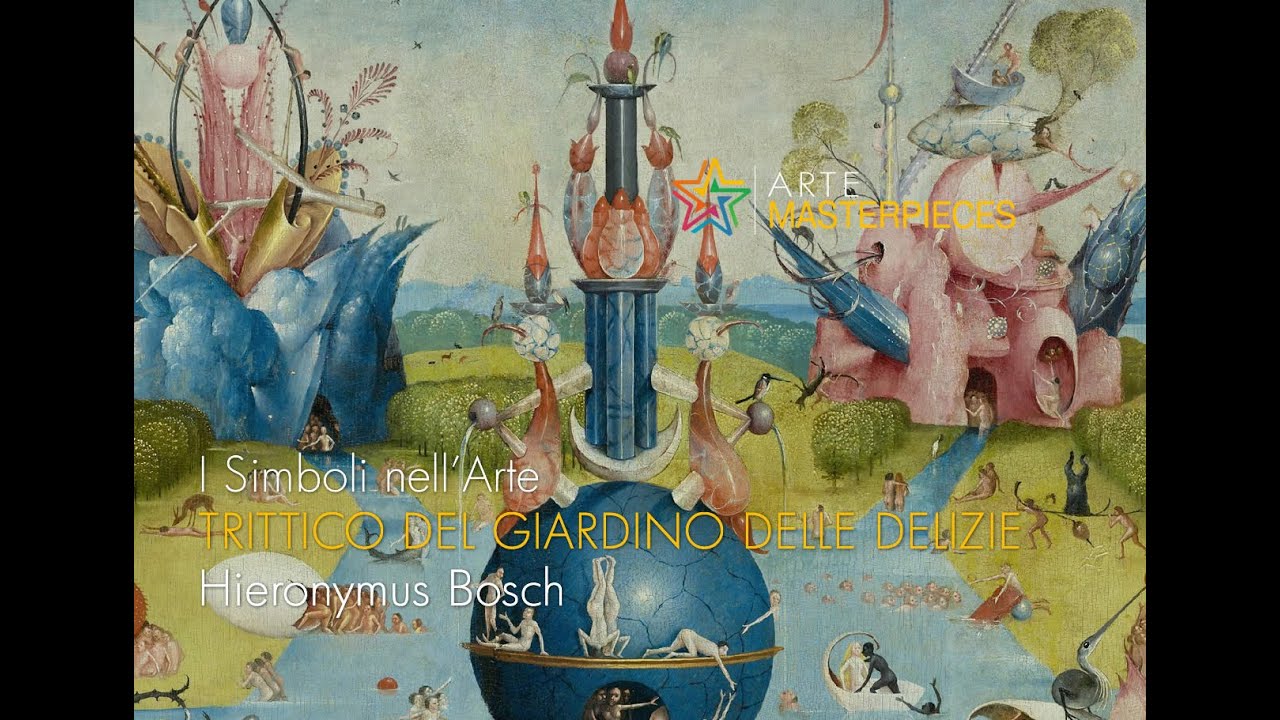
They are mainly triptychs that were exhibited in churches, remained closed six days out of seven, on Sunday they came open to be shown to the faithful. The most famous is "The Garden of Delights", the most enigmatic work of Hieronymus Bosch. At the center small naked characters indulge in pleasures of life, but on the right the punishment and death are waiting.
Bosch's imagination feeds on hellish chaos and gives the artist the nickname of "creator of devils", but is this definition enough to solve mystery about him? All of Bosch's work resorts to religious symbology, but marks the break with the medieval world through an almost sacrilegious vision of the new man. However the painter will never be persecuted by the Church.
Bosch remains an enigma. Jeroen van Aken was born in the Netherlands, around to 1450, in the city of 's-Hertogenbosch, important cultural commercial centre of the region together with Brussels and Antwerp. The city is protected by strong dams which allow navigation to the center.
Jeroen Bosch grows up in a family of painters, originally from Aachen. In the middle of 15th century the Van Aken are a wealthy and prominent family. They live on the square of the market.
Jeroen will live on in the same place also later, with the wife. After working in his father's workshop, he will open his own elsewhere, but always in the city. He will only walk away once in his life , in contrast to most part of the artists of his era, he doesn't travel, the world goes to him.
From what we know about the life of Bosch and his family in 's-Hertogenbosch, from the documents in our possession, we can assume that he led a very devout life, at least from what it appears. His life was marked by belonging to one of the most elite religious fraternities of the city, indeed, one of the most elite of all of northern Europe. So, Hieronymus Bosch lived immersed in the religiosity of the end of the Middle Ages that it was expressed through collective activities, but that also focused attention on life private of every believer.
The inner journey of each confrere was examined to come to establish what kind of sinners were, confession with penance and the rest followed. The intellectual, commercial and political elite of the city belong to the Confraternity of our Beloved Lady, it have a great resonance in Europe. In 1478 the marriage with Aleid van de Meervenne, a rich aristocrat of her fellow citizen, assures Bosch of a comfortable existence, a higher social condition, and makes him reach the higher level of the brotherhood: notability.
At the time of Hieronynus Bosch that charge required participation with great regularity at masses and other religious functions in the cathedral. With great regularity I mean five times a week, and all the celebrations were dedicated to the Virgin Mary. After the function, the brethren gathered in the same building, they ate together and most likely discussed religious and social issues, as well as other issues of cultural interest.
It should not be forgotten that the fraternity members at the timeof Hieronymus Bosch were aristocrats, men of the world. Iin this context the swan was the symbol of the wealth of the noble class. Hieronymus Bosch becomes the officer painter of the brotherhood, organizes feast in his abode and consolidate links with other members from all over Europe.
Religion is one of the pillars of his life and his work. His paintings depict biblical scenes, Passion of Christ, hell, representation of the temptations of the saints and the Genesis for remind everyone of Original Sin. Bosch's art makes use of religious allegories in use in the Middle Ages understandable to everyone at the time.
The fish, for example, much present in all its forms in the works by Bosch, symbolizes Christ the Savior, The goldfinch is instead the symbol of passion of hrist. According to legend the little bird seeing suffering Jesus tries to snatch the crown from him of thorns; stained by the blood of Christ his plumage turns red. Since that day his head is scarlet in remembrance of passion.
Even his name seems to derive from Thistle plant that recalls the crown itself. In the Middle Ages the symbols are everywhere. In this painting Saint John the Evangelist exiled on the island of Patmos is lost in his vision: at his feet an eagle watches over inkwell and the feather with which he must perform the miracle of his writing; the devil on rightwants to take over it; the fire on his head betrays its infernal origin, has short arms so that he cannot reach for the inkwell, the body, enclosed in heavy armour, it is formed from parts of hybrid animals.
A bluish, marshy landscape gives depth to the painting highlighting the foreground scen. To represent Greece he paints his city. 's-Hertogenbosch and its surroundings form the background to depictions of everyday life in several works of Bosch that paints the village festivals, the peasants and the sinners, but also wickedness and vanity and the transience of earthly things.
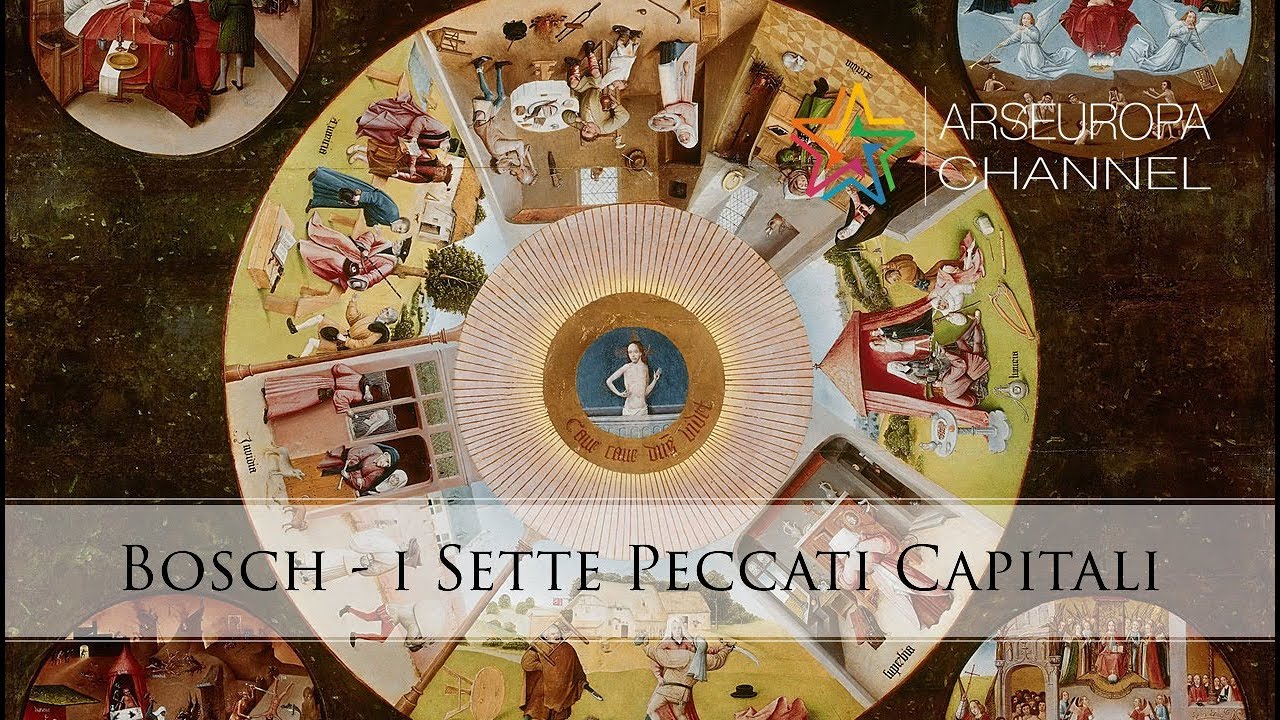
Bosch is a keen observer of the daily life and catches accurately human behavior. If they asked me to choose only one painting to explain Bosch's work as a whole, I would answer without hesitation The Seven Deadly Sins and the Four Last Things . We find there a spectacular representation of the world and its bizarreness, with a detailed description of the characters in the images of the seven scenes of sin.
We do not see allegories, but deep-rooted sins in everyday life. In one scene a man goes overboard and at his feet his son calls for food while a woman brings other things to eat, she is an accomplice of that voracious character. This painting clearly shows who Bosch is was the first master of realist painting of European art, with its detailed scenes of daily life.
The depictions show the sin, no doubt, but they also contain a certain humor; they are cruel, but very interesting to look at, The painting as a whole wants be a warning, as if the painter wanted to warn us. This is the message by Bosch: each character is like one caption that reads: "Be careful, because God is watching you, but maybe the devil too. It does it's sure that someone sees you.
" Good and evil exist only in relation to each other. Bosch relates the two entities through religious symbols known to all and creates an ambiguity sometimes unbalanced towards hell, sometimes towards heaven. God creates angels first and then men, and when he creates angels he gives birth to Lucifer, the prince among them, but Lucifer revolts against God, disobeys, puffs up with pride and wants to rise to the level himself of God.
For this reason will be punished with the expulsion from paradise together with all the angels who followed him into the rebellion. During the fall from the sky, Lucifer and the others angels of him are transformed into devilish monsters. That transformative strengh, from that moment, infects everything, the ideal world that men had dreamed.
That mighty, evil force changes the work of God in a creation of Lucifer. On what aspect of the Christian message Bosch pays more attention? It is definitely a religion founded on love, which sometimes shows its aggressive face.
Im my opinion, Bosch lines up on the violent side of Christianity. This does not mean that it is faith that pushes him in that direction, but that, as an artist, through his imagination, shows the darkest aspect of religious iconography. In his paintings Bosch emphasizes the ambiguity between good and evil, by entering esoteric symbols decipherable only by initiates.
In the "St. Jerome at Prayer" the saint is focused on the crucifix between his arms. Crucifix and prayers protect him from the dark menace of the dark cavity and the strange skull that the surmount it.
Clearly it is of the infernal cave and the eye sockets of that skull are looking at you. But there is also an owl staring at us, motionless, with his big eyes open on us. His prey is blind, as he sees through the darkness of the unconscious and of the human soul.
Owl is always an ambivalent animal: sometimes seen as a symbol of wisdom, but in general it is a sinister creature, a nocturnal predator closely related to darkness, to night. Non by chance it is often associated with witchcraft and in medieval bestiaries it always appears among the most abject and frightening creatures. Owls are always very present in Bosch's work.
Many scholars agree in affirming that it is some kind of signature of the artist. My favorite owl occupies the geometric center of the panel which represents the earthly paradise in triptych of the Garden of Earthly Delights. He watches us, crouched in the shadows, his is a disturbing presence.
Bosch loves games looks, sometimes evident, sometimes cleverly concealed. Here we notice a strange profile cut into the rock. Contours clearly outline a nose with a serpent positioned in such a way to look like a pair of full lips, Below, dark forms of strange animals appear come to life.
The whole atmosphere is dreamlike, it is simply not of a face, but of the face of someone sleeping. The strange animal what shape the eye is there to confirm. This profile is in front of a fountain, but the fountain is not the source of life as often we see in many medieval representations of the creation, it looks rather like a sneaky source of death.
The black owl that can be seen in the center at the time it was a well-known symbol of the devil. Bosch's imagery is deeply influenced by the life of the end of the Middle Ages, where death is omnipresent. In 1463 a fire destroys part of the city of 's-Hertogenbosch, Hieromymus is just 13 years old.
Throughout Europe plague, wars and famines devastate the villages and decimate people. . Church reigns with terror.
In 1478 the Inquisition was established in Spain. The Christians reconquer the Moorish Muslims territories. Jews are driven out and it emerges a national identity founded on the Catholic faith.
We know that Bosch had access to different fields of knowledge and there is no doubt that he must be an expert connoisseur of tool torture, a bit like the craftsman who made those machines knew of the operation and the terrible tortures that were inflicted through them. All Bosch's imagery draws on a double origin: on the one hand there is the strength of unbridled imagination of the artist, Bosch rides the imaginative creation, already its contemporaries loved him, because he was a master of the fantastic, but on the other side there is the reality the knowledge. He knew what torture machines were and he often depicts them in his spontaneous works.
It is natural to wonder how many of those tools he has seen in operation with one's own eyes, and how far he knew the violent techniques of interrogation used in his time. In the same period Constantinople falls under Ottoman rule. Scholars and men of learning flee to Italy bringing with them precious ancient texts.
Bosch paints several symbols of Islam, including the crescent. I think he wanted to terrorize the public, imagining what it would become the world if Islam had conquered Europe, if all the flags of the kingdoms of that time had been replaced by the banner of enemy. He mixes Islam's real threat with the less material one of sin and the devil.
A rather high level, although accepted, of anti-clerical sentiment can be found not only at Bosch, but also at numerous others contemporary Let's say that with his ostentatious opulence, riches conquered and continually exhibited and the known sexual conduct of men of church despite the vow of celibacy, the clergy appeared as a corrupt order. And for this reason many artists were encouraged to denounce its many vices, to offer some a decidedly critical representation. Boss's days are marked from the activities of the confraternity.
Church, chasing money, sells letters of indulgence for the remission of sins. Annoyed by this practice, Bosch moves away little by little by Christian morality marred by a greedy Church, and approaches a new ethic humanistic. He also composes musical scores.
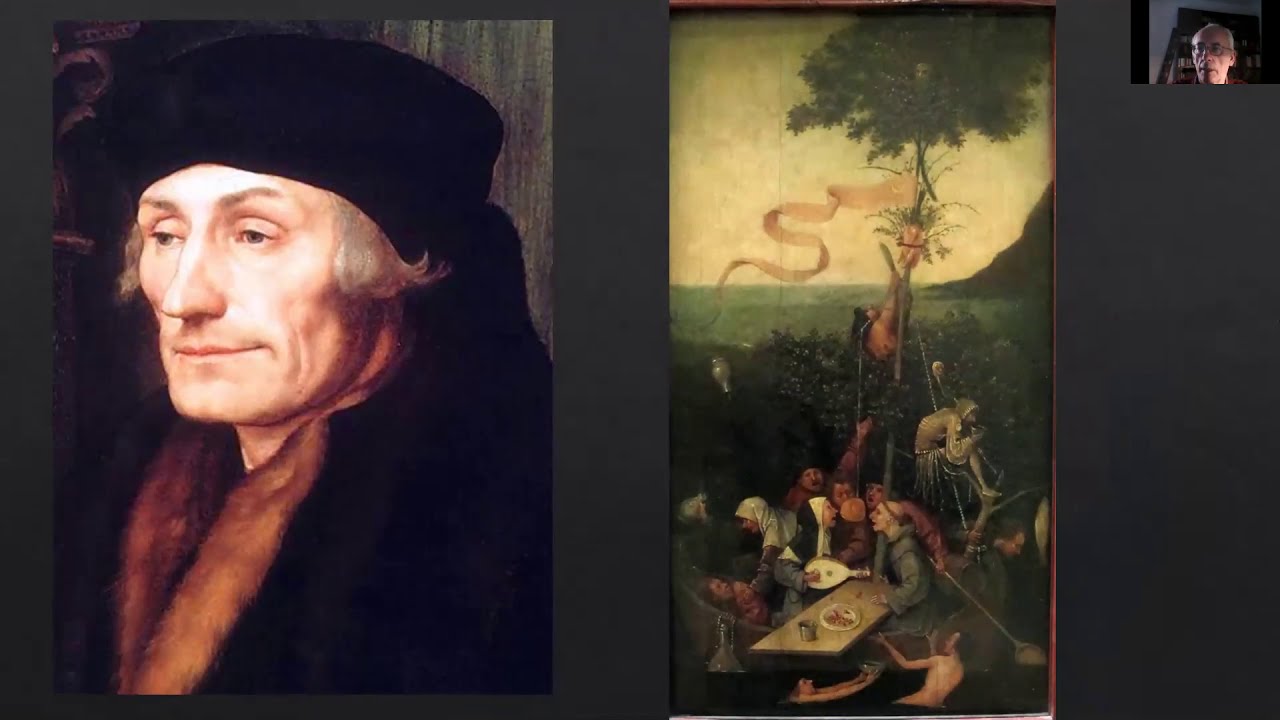
World dwells in deep darkness and endures blind in sin, the streets are full of madmen they bring madness everywhere but they don't want it known, that's why I studied the project of setting up the ship of fools for them. This is the incipit of Sebastian Brant's satirical work, printed in 1494, proposing a violent criticism of the society. Bosch also creates his own "ship of fools".
Twelve figures around a table, on a drifting boat. High up in a tree an owl stands guard. In the same years, in Italy, Leonardo da Vinci, Michelangelo and Raphael are at the height of their creativity.
In Northern Europe the masters are Van Eyck, Dürer and Holbein. Is the dawn of the Renaissance. Erasmus, humanist philosopher, writes "In Praise of Folly", a criticism directed at various categories, social especially monks and high clergy, fervently he defends man's free will, reason and faith, and affirms:"Ego mundi civis esse cupio", I want to be a citizen of the world.
Thanks to the printing the texts are translated in various languages, they spread throughout Europe. Printing is the invention of a German goldsmith, Johannes Gutenberg, the first printed book in 1455 is the Bible, the first best seller will be Sebastian Brandt's "Ship of Fools". Bosch clearly takes up some themes explored by Sebastian Brands, especially the image of the madness that spreads among men and integrates these themes into his work by giving them to him an entirely new development.
In his paintings he follows the classical compositions of religious art and replaces the figures usual of the genre - a saint the Virgin and Christ - with borrowed elements from burlesque and profane literature. The inverted funnel on the head indicates in whom it is wear the doctor of the insane than with a knife digs into the patient's skull to extract the stone of madness. Here, however, there is no stone, but a flower, the tulip.
The book on the nun's head symbolizes the erroneous use of medical science. "The Extraction of the Stone of Madness" exposes gullibility and the absurdity it brings people to trust to charlatans surrounded by religious doubts. Bosch paints figures in a clearly negative light religious engaged in sinful activities.
In general speaking, from his work emerges the awareness that sacred art is a form critical expression and problematic that it poses the Renaissance man many questions. For exemple. in the "Temptation of St.
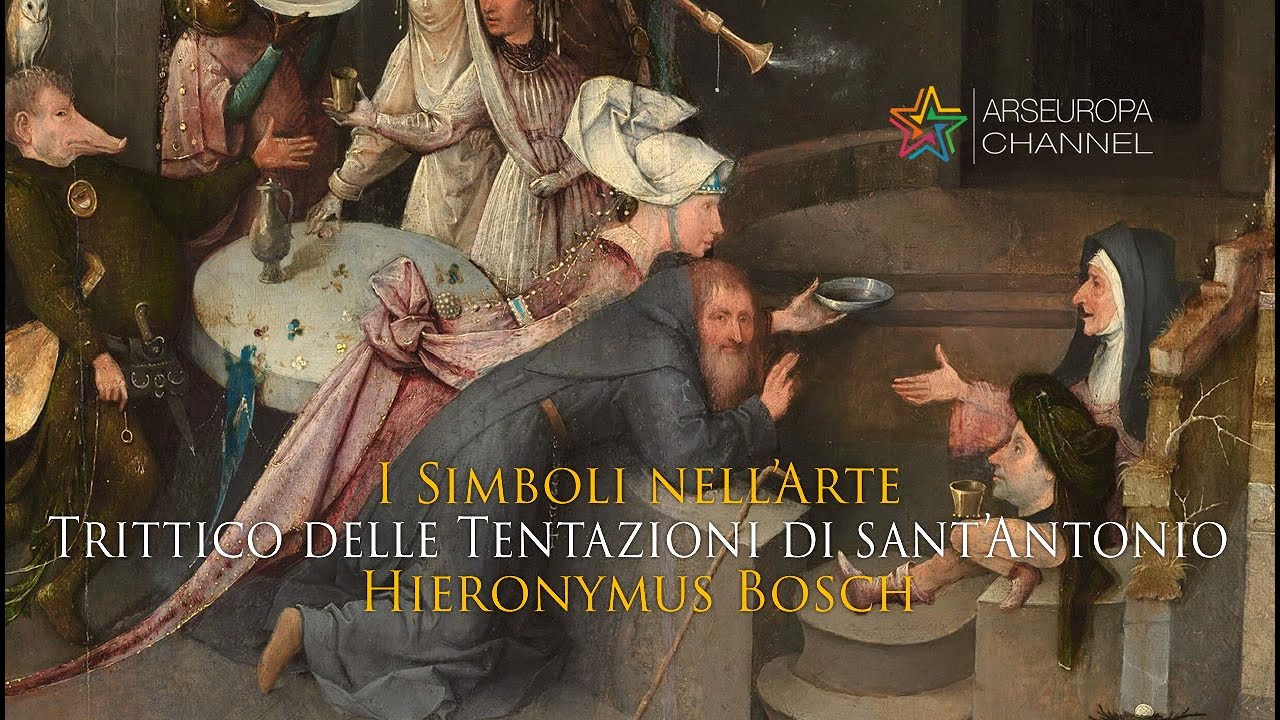
Anthony" he stages a world from which all religious symbolst each element of hope have disappeared, and where heretical, devils and enemies filled with hatre crowd. In Bosch's painting religious symbols are sometimes more discreet and give way to extraordinary imagination of the artist. His works are teeming with bizarre creatures of monsters and countless hybrid animals.
Bosch's unbridled imagination does feeds on the knowledge of his time. Thanks to the brotherhood he has the opportunity to meet philosophers, scientists and artists from all over Europe, he approaches the circles humanists, to the thought of Erasmus and of Thomas More, and becomes familiar with the latest scientific discoveries. He definitely has had access to the astronomy treatise by Copernicus long before its publication.
Challenging the conventions of the era, Copernicus proves that it is not the earth, but the sun at the center of the universe and that the planets revolve around it. This implies a horizon in which being human is no longer central. Observing the stars Bosch in his work alludes to this revolution which outright refutes the explanation of the world given up to then by the Church.
Europe it goes from a closed world to an infinite world. In 1486 the sultan of Egypt gives a giraffe to Lorenzo de' Medici, first giraffe that arrives in Europe and the Medici Court invites to various designers in Florence to portray her. The animal is young and in the habit of eating the flowers from the first floor balcony.
The giraffe of the Garden of Earthly Delights is a copy of one of the drawings collected by the Medici Court. In 1492 Christopher Columbus went on a quest of a new route to the Indies e discover the American continent. The news of the landing of Christopher Columbus had a huge resonance throughout Europe.
It couldn't escape the attention of an artist curious about the world, who paints it and depicts it as only Hieronymus Bosch knew how to do. There was a phase in which Bosch was considered a provincial painter who painted only for himself and a small group of all initiates very pious. Certainly true at the beginning of his career.
On the other hand, we know that Philip the Handsome of Burgundy, founder of the dynasty of the Habsburgs, and the most powerful man of his time in Northern Europe, commissioned from Bosch an opera that represented the Last Judgment by paying in advance, a fact unheard of in those years. We also know that Philip II of Spain was an avid collector of the works of Bosch: he had exposed "The Seven Deadly Sins" at the Escorial in his oratory. Anyone visiting the Escorial would have noticed that the oratory is perfectly located in the center between two distinct spheres.
On one side, you could see the sacred wall of the Basilica and the place where mass was celebrated, on the other side you enjoyed the views of the Spanish countryside and the territory on which the king reigned. Between the two worlds this enigmatic picture dominated the space. Philip II of Spain buys five paintings by Bosch and gives him great notoriety.
The artist's studio gets bigger and other painters work there, including his brother and nephews. He assumes as stage name "Bosch" in homage to the city of 's-Hertogenbosch of which is one of the most esteemed citizens. Rare documents that attest to this have been found.
Hieronymus Bosh was certainly a revolutionary artist, the thing is quite evident. His painting is not innovative only because of the extraordinary imagination that comes to life in his paintings which is also the first thing that comes to mind when we talk about him. His art is innovative also for one aspect of which it is he talks too little about, his pictorial technique.
Bosh is undoubtedly the first great draftsman of the history of European art. Also others artists drew: Albrecht Durer is perhaps the most famous, he made extraordinary sketches and drawings. The same way we know the magnificent drawings of Leonardo Da Vinci.
Every blank sheet for those artists was a infinity where they can express their intimacy. The triptych of the "Garden of Earthly Delights" is the perfect example of this. His fabulous drawings transport the beholder in the fantastic universe of Bosch.
For this work, commissioned in 1500 by a Count in Brussels, Bosch is inspired by a very popular poem at the time, "The Romance of the Rose", the story of a man who dreams and tries to enter a garden to woo his beloved, but he will have to face his inner demons represented by allegorical characters. The painting seems to play with the imagination of the observer, with suggestions that everyone has from that period. It is a game in which the artist entertains the beholder.
It is clear like the day that the scenes portrayed form like a mechanism that aims to stimulate the memory and imagination of the viewer. The work does not want or must not communicate a message, but rather allow many multiple interpretations to make their way. It is a kaleidoscope of scenes, of situations, a bit like meeting at seven seasons of a TV series at the same time on the screen.
All the events and vicissitudes they take place simultaneously in one scene. The left panel evokes heaven terrestrial. It is a mountain landscape with exotic animals: giraffe, elephant, white unicorn symbol of power and purity.
Adam is seated at the foot of the tree of knowledge. God presents Eve to him holding her hand. Behind her a rabbit symbol of future fertility.
Below, hybrid monsters, among which a black unicorn stands out, the most evil of unicorns. Earthly paradise heralds the fall. The right panel draws the hell.
Men are prey to beasts, demons and other men. In the center the tree-man looks at us as if to ask us a question: what we have made of the world? The central panel is the most enigmatic.
Animal hybrids crowd nature lush, with giant strawberry and grape, sumptuous flowers, but above all a multitude of naked youth, perhaps the children of Adam and Eve, devoted to the pleasures of the flesh. The erotic aspect of the picture goes to forcefully tease the process of understanding and interpretation, it obliges us to bring out the essence of its meaning both mentally and physically. The painting calls all the senses into action.
I think it's not that risky affirm that this extraordinary triptych appeal to our capacity interpretation through smell, taste and touch, more than through the spirit. If we look closely at the blue fountain in the center, we notice that there is a hole, inside a woman - forgive the indelicacy - gets caught from behind by one man, while another man, standing nearby, streaches out to touch her genitals. The woman's hand also points to a third naked man ,seen from behind, showing her his buttocks.
The scene leaves little room for interpretation: it depicts a sexual act of dubious nature that, if you will, quite colorfully summarizes that which happens throughout the Garden of Earthly Delights. Groups of naked men in extravagant poses, perform bizarre gestures, ride amazing animals and are engaged in a circle around a pond where naked women are bathing. We know from several paintings from the end of the Middle that it was the custom during parties at court ask a woman to hold an apple or other pledge in hand.
The courtiers were invited to dance around her. Who performed the most original gesture conquered the prize, which consisted not only in the fruit or in the object that the woman had in hand, but included the woman herself. Bosch allowed himself to paint a series of onscene moments, we could say even pornographic, and the amazing thing more is that the Church as an institution does not have never ever dared to say a single word against Hieronymus Bosch.
I don't know. . .
such a warning "you're going a little too far with these symbols". The licentiousness of the artist appears surprising, almost bewildering, when you consider it that Bosch was actually a devoted believer. Despite his vehement criticism of the Church, Bosch will never be persecuted.
The painter dies In 1516, perhaps killed by the plague and not leave children. At the funeral the coffin crosses the doors of the cathedral of San Giovanni carried by members of the brotherhood. The success of his art is such that immediately after his death many painters start to imitate him.
It is sometimes difficult to distinguish whether some paintings are the work of the pupils or the master. Hieronymus Bosch inspires Salvador Dali, René Magritte and others. André Breton, who see in him a great one visionary, writes: "The work of his, output from oblivion, calls into question the very foundations of pictorial art.
" Five centuries after the disappearance of Hieronymus Bosch, his more famous painting and admired in the world, "The Garden of Delights", is always subject to new interpretations and is of greater importance than ever. I think this painting even takes on greater strength if you admire it in a group, not alone. It makes want to talk about it, to analyze with other people as represented.
Perhaps not even the swap of words is needed, the involvement comes to the physical level, we feel in tune with the picture, especially in front of the love scenes. Bosch does not depict his own imaginary world, but that of those who look at the painting. It is your spirit, mine, the spirit of all the world that Bosch tries to grasp in his painting, not it is limited to his imagination.
Perhaps "The Garden of Earthly Delights" still holds secrets. In the upper part of the central panel one body of water in human form stretching in the landscape, is reminiscent of the "Vitruvian man" of Leonardo Da Vinci, symbol of the Renaissance. As Leonardo, Bosch knew depict the upheavals of his time, the violence, the discoveries scientific, reflection on faith.
But it seems to ask if man is basically always the same, animated by same passions and the same desires, if yet seek a justice that goes beyond the human justice. Bosch, the "devil with angel wings" tells all this.