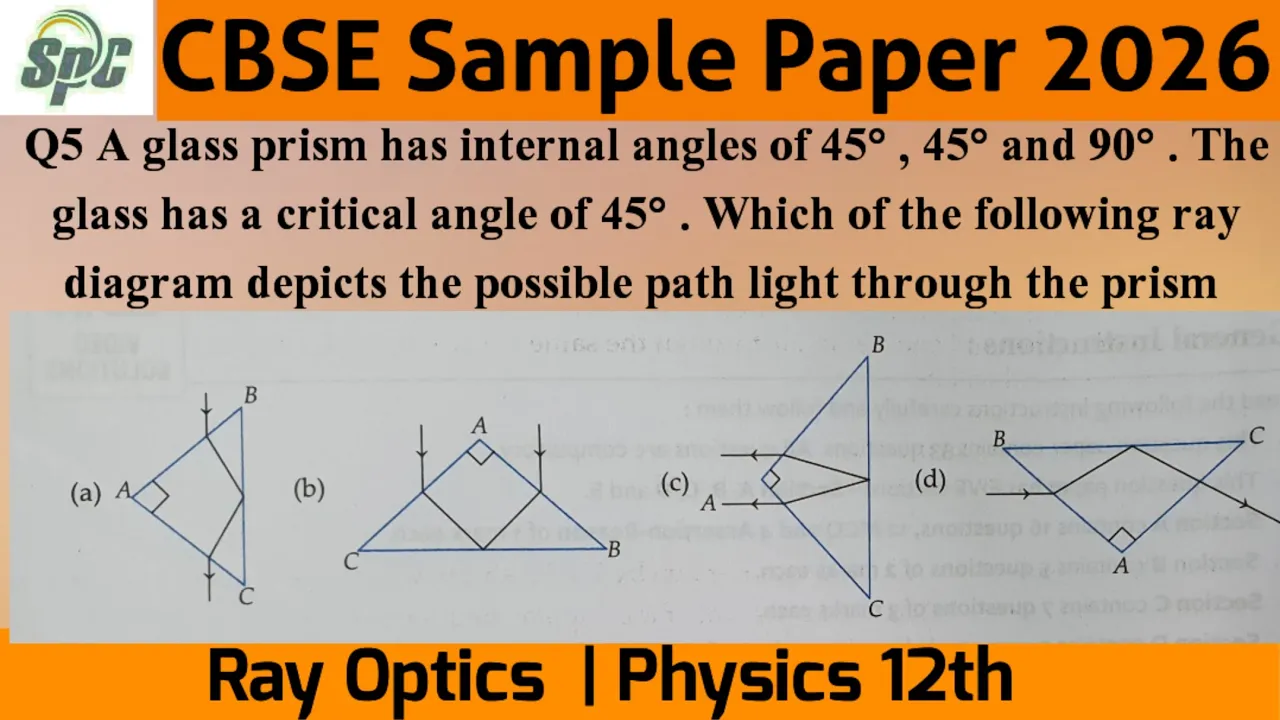
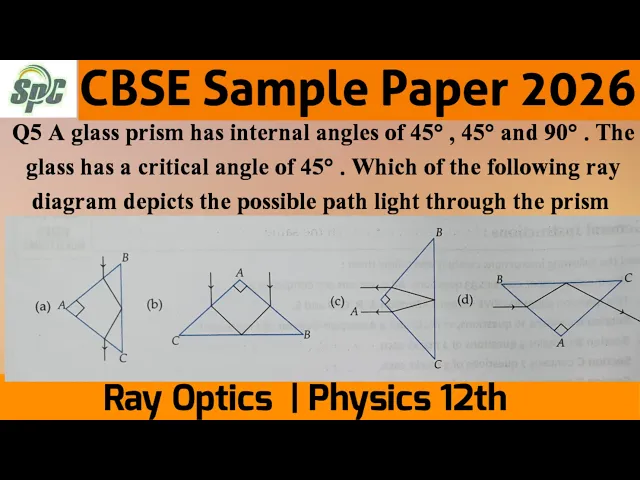
Hello dear students, welcome back to my channel Physics SPC, question number five of the latest CBSE sample paper 2026. A glass prism has internal angles of 45, 45, and 90°? The glass has a critical angle of 45°.
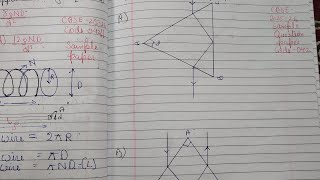
Which of the following ray diagrams reflects the possible paths of light through the prism? These four paths are given. I've also drawn them.
Look, first, we've given this critical angle. So, from this, you can calculate the refractive index of the prism material. What is the formula for such a critical angle?
sinc = Here we write nr / n. Many students remember sinc = 1 / μ. It is valid only when one side is air.
It is always valid. Always write here the refractive index of the optical rarer medium and the refractive index of the optical denser medium. Remember this, son.
Isn't that right ? If it were air, the rarer medium here would be air, so it would become one. If we assume the mu of the denser medium, the prism, then it would appear as 1 / mμ.
Right? Well, one thing, from here, C has given us the critical angle of 45. And here, if you have air, the rarer medium is this.
And we assume the refractive index of the prism material to be nd, the denser medium. So, sin 45 is equal to one for air, and its nd index for the glass prism is 1 / 2 1 / nd, so the refractive index of the material of the glass prism is 2. Now let's understand the benefit of this.
Look, this ray of yours is parallel to its base . So, this angle will definitely be 45. From geometry, it becomes an alternate degree angle.
From here, when you draw a normal to it, it will be 45°. So, the incidence angle is 45° . For this face, A has been put for AB.
B has been put. So the incidence angle of AB is 45, so put it at this place, if you apply Snes's law then 1 * for face AB we are writing 1 * sin 45 equal to one, so the index of air is 2, now we have calculated it, let's write 2 * sin r1. So its value is 1 / 2 and this 2 and this sin r1, so from here whatever comes out, see, bring it down to 1 / 2 1 / 2, let me increase one step, r1 is the value of sin 30°, so the value of r1 will come out to be 30°.
Okay? Now just think, if this is 90, then the angle of light refraction is 30°. So from here when we bend it by 30°, the light becomes rare to dense and becomes towards the normal .
So you are turning it towards the normal, from 30° it will go like this. So this angle will be 30° in this. Now think, this angle between this and this was 90°, so the normal was this.
This 90 + 30, so look at this triangle, this one. Look at this triangle, this triangle . Okay?
The one I drew, till here it became 120 120 + 45 120 + 45 this became 165, so what will be this angle? If this one is 165, then it will be 15° 15° and if we draw the normal here like this, then the angle that will come between this ray and this normal, this one will be 75 and this angle is greater than what? It is greater than the critical angle.
When light goes from denser to rarer, then one thing we know is that whenever light goes from denser to rarer and that angle, if the incidence angle is greater than the critical angle, then the light comes back at the same angle in the same medium. It will come back. If the incident angle is greater than the critical angle, look here, this is the incident angle.
For which face? For AC. The incidence angle for face AC is 75°, and the critical angle is 45°, so I > C, so here it will be TR.
Okay? So if it's TIR, it will return from 75°. So keep in mind, it will be formed exactly like this.
The symmetry will be towards this side and this side. If this is returned from 75, it will become 15°. And if this becomes 15°, then this becomes 45°, and this becomes 15°, so this becomes 120° again.
Exactly the same symmetry will be formed. It will become 120°. So if we draw the normal from here, it will become 30°.
Now think, this is 30°, so this 30 seems to be the Principle of Reversibility. Exactly. So this will be 100% 45° here, and the parallel will turn out like this.
If you want, try placing a snail at this spot and it will still be 45°. So, it has to be exactly the same, exactly like this. So, a choice is correct.
I'll explain everything for all four cases. You must have understood this, but okay? Now come to the second.
If you come to this, then see, if you extend it here, dash dash dash dash dash, then this is 90°, then you will say this is 45°, this is 45, so this 45, this 90, if you look at it geometrically, then this is also 45 and this is 45, so if you draw a normal here, it will also be 45. So, here too, the incidence angle is 45°. Think, I just calculated it, and the critical angle is the same for all.
So, if we place it at 45°, the refraction angle which was coming out to be 30°, will come out to be 30° here too. So, think of it as 45. So, this 45, so 30°, goes something like this.
It should have gone like this. So, it will come to 30° here. Think of it as 30, so this is the total angle.
That's going to be 60. 60 plus 45 is how much? 60 and 45 is your 105 and if you subtract 180 from 105 then what will be left here will be 75 and 75 will be left so if we draw the normal here then it will come out to be 15° and it is coming out to be 15° so let us talk about this face which is the cb face, for the cv face the incidence angle which is coming out is 15° and the critical angle is given as 45 so it is less than c means no, only refraction will not happen, there are three cases of simple refraction, brother, if you put your light and if this angle incidence angle is less than c then the light is going denser then it will go away from the normal, that means it will get reflected and will go out but keep increasing the incidence angle, then at an incidence angle for which the refraction angle is 90°, that incidence angle is called critical angle.
For this, R is 90 degrees. If we increase the angle of incidence further, as soon as the angle exceeds the critical angle, it returns to the same medium . That same angle is called TIR.
Right? You must have come across these three cases. So, here, i < c means the light will simply refract.
It will move away from the normal. It should have gone out like this. It shouldn't have caused TIR.
But it is causing TIR here . So, this case is completely wrong. This case and this one are exactly the same.
I don't know why they are given here, and this is the same thing. He has made the arrow wrong. Let's say this arrow is like this.
There is no difference between this and this one. He just rotated it. It's the same story.
Same ditto, this story and this one and this one are the same. Think about how? The light went in from here like this.
Normal was picked up like this. This is 45, this is also 45, this is also 45, if you draw the normal from here then it will come out to be 45 and then if you apply the same formula here then R will come out to be 30° and it will go like this, this one is 30 , so this one will be 60° and if 60 45 then it will come out to be 75 only and if you draw this 75 as normal then it will come out to be 15° and if it is 15° then from this face also it is less than C, so the light will go away from the normal and will go out, that is why this is also wrong. This question and this question are same.
But he has made a mistake here. Look here, it came in parallel and was emitted parallel. So in this also it should have gone in parallel but it did not go in parallel.
Everything else is same. Everything is same. If you see in this then the same story will be formed.
If you draw the normal from here then it will come out to be 45. Then it will go from 30° like this. So if this is 30° then it will be exactly 120°, then it will come to 15° and if it comes to 15° then this angle will come to 75° and if it comes to 75 then for this face B is for which face and this is C and for this B will be i > C.
So TR will be 75 and will come back from 75. This will come to 15°. This will come to 120.
If you draw it normally then it will come to 30. And when it comes to 30 then it should come to 45°. It should come out like this.
Whereas in this, instead of taking it out like this, the first one was taken out and then it was taken out directly. That is why this is also wrong. I hope you understood this.
I drew all four cases and showed them to you and explained them too. Keep reading and be happy.



![Q29 The Value of Vo and Id for the network are .....[ CBSE Sample Paper 2026 Class 12th Physics ]](https://img.youtube.com/vi/CFyZzm38MRc/mqdefault.jpg)