hi everyone welcome back to this series of project management key concepts where we're delving deeper into the project management body of knowledge this one in particular is project estimating techniques now you will definitely see these mentioned as part of the PMP exam so it's good to know that there are four main different types and the differences between those times so what are project estimating techniques well throughout your project you'll be asked to make those estimations of future performance and that could be in your schedule could be in the cost of the project it could even
be in the quality of your project but the four main methods that you will come across as part of the PMBOK guide our parametric estimating bottom up estimating analogous estimating and 3-point estimating now they might sound a little bit funny but we'll go into them in a little bit more detail first of all we've got parametric estimating this is where we're actually using a parameter to estimate per item so it's it's a simple parameter let's say 55 meters are $55 per square meter or square foot we might have a thousand dollars per roll of metal
or whatever that is twenty days delivery for example in our schedule that it might take to get to another country or we might be looking at two-week sprints per each feature that we're delivering in a software project a team might take an eight-hour workshop to complete a risk assessment all of these are parameters that we might assign to the activities so that we can estimate for those activities next up we've got bottom up estimating now this is where we're estimating project resources by assigning a value to the lower-level components of the work breakdown structure we're
starting from the bottom and we're working our way up and when we say the bottom we mean the the lower level tasks that have been assigned to our teams now these of course go up in the work breakdown structure to the notes to larger tasks or features and then to an overall delivered feature for example and this is where we start getting into agile potentially or feature driven development but all of those things are interrelated they're all ways of working that are across the disciplines but the idea of that is that we will assign you
know this team can estimate on their piece of work this team can estimate on their piece of work or their single task or one or two tasks and that might be let's say you know $10,000 this one might be $20,000 this one might be $5,000 and then we take all of those items and we bring them up into the feature so the total there could be 50 and then the total for the overall feature could be $100,000 for example but the key is that we're starting at the very lowest level of the activity we're starting
from the bottom next up we have analogous estimating now this is where we're finding an analogy something similar to what we're currently doing so we're estimating the duration or cost of an activity or a project using historical data from a similar activity or a similar project now of course this is frequently used to estimate project duration when there is a limited amount of detailed information so we haven't gotten down into the work breakdown structure yet at the team level we only have a really high-level idea maybe we can get a rough idea of how much
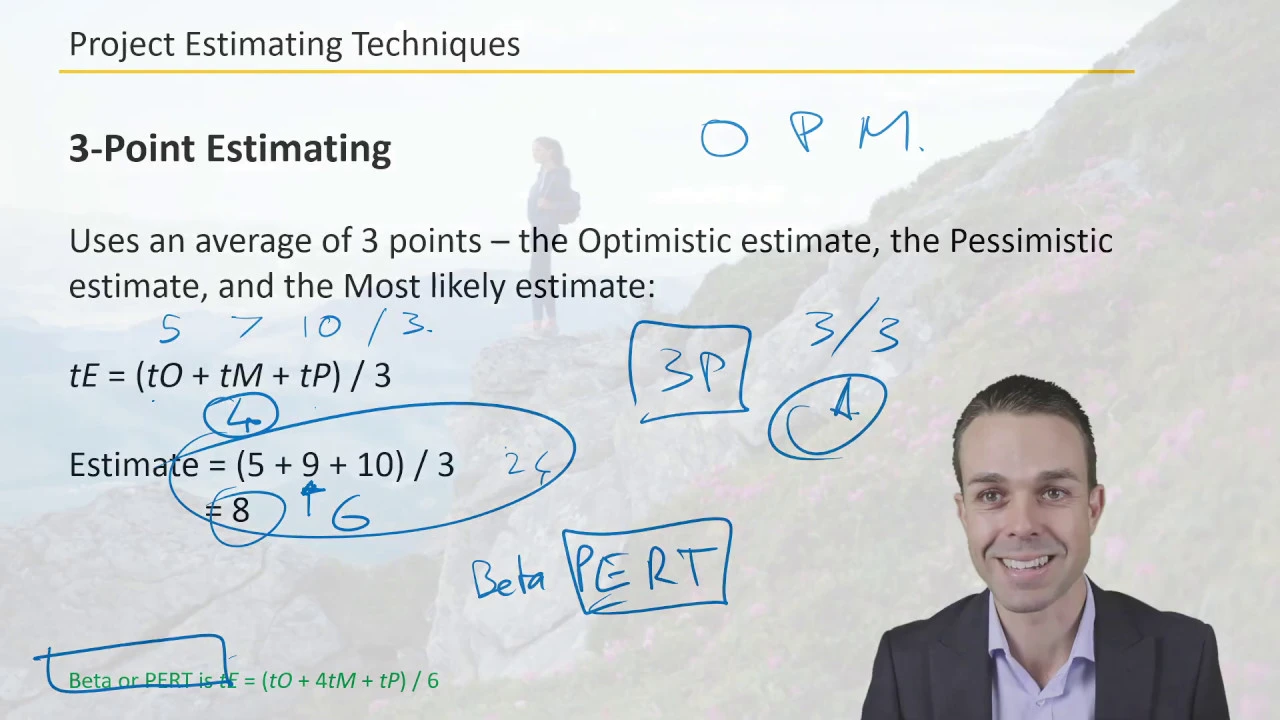
it will cost or how long it will take by looking at another similar project it's like an analogy it's similar to what we're currently doing now generally it's less costly and less time-consuming than our other techniques but also it is less accurate because we're not really delving into the detail now last but not least there is 3-point estimating that you will come across this uses an average of three points we might have the optimistic estimate the pessimistic estimate and the most likely estimate and the way that we end up working it out is the optimistic
let's say our optimistic schedule for example is five days our most likely is seven days and then our pessimistic is ten built ten days and then we divide that by three and that gives us their answer in fact I've got a better version of that that doesn't take it as much maths or any decimals let's say we've got five nine and ten divided by three because nice round number of 24 and and divide that by three we've got eight and that's how we do three-point estimating you might see a variation of this which is beta
or pert so that is basically where we've got optimistic but four times the most likely and then our pessimistic as well and those are the project estimating techniques we will come across [Music] you [Applause]