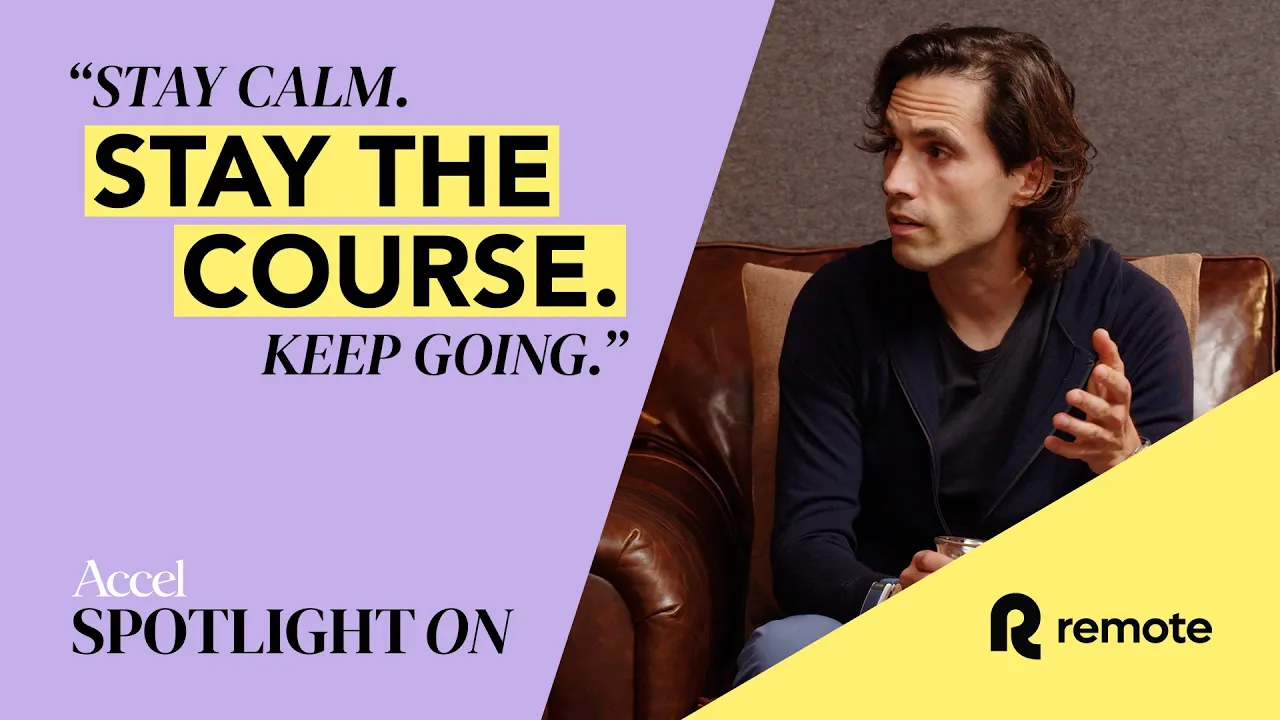
you stay calm you stay the course right and you keep going welcome to Spotlight on where we examine the technology shaping our world through conversations with the people building it welcome to Spotlight on I'm miles Clemens I'm here with Marcel labre the co-founder and president of remote it's nice to see you in person by the way in all the years we've been working together I think this is like the third or the fourth time we've actually met in the same room so I'm going to start with an easy one can you share with us for
folks who don't know what is remote and where did the idea come from sure remote is a global HR platform I like to think about us as the um HR backbone of companies we help companies find hire manage pay people across the world um which is a very nice way to say that we break down barriers between telling an opportunity uh for companies to hire and pay people manage people across the world and people to just find their best job of their lives um and be hired whatever they are I always think the found story
of this company is so interesting because you were living in Lisbon running engineering for unbabel which is a translation service yo your co-founder was living outside of Amsterdam and he was running product for uh klab a devop software company how on Earth did the two of you actually meet how were you introduced and then how did you go from a translation API and a devop software company to spinning your life building tools for remote teams so my girlfriend she said hey my my friend from school Carla is back in town she used to be in
in the Netherlands and she's now back in town we should go grab a coffee and I said okay and and my wife said and by the way she has a boyfriend and I'm like oh no it's one of those bring like double date kind of thing I don't feel like it I don't like you know I'm not a social um animal and I went and I was sitting in a very small cof place with this Dutch guy um and we were like you know trying to make up for topics for discussion and and we realized
that hey we're both kind of on the same page we're both Geeks um and we started talking and talking and it was actually okay it was not like oh my God uh I fell in love but it was okay uh a couple of hours that we went for a nice coffee then a few days later he emailed me about he had an idea uh he wanted to explore and if I could help him out from a tech side and then we met up for another coffee and we started talking about we were both very passionate
about people doing the things that they really really into right if you get a job you know it should be a job that you know of course puts foot on the table but actually makes you makes you happy right and the idea this time was around remote work specifically no we were very much on just just getting people to find the right companies and the companies to find the right people right not necessarily it was more about quality right than um anything else and we we started building stuff randomly um it was like this compulsive
thing you know some friends go out and they play football or basketball or whatever and we would get together or just work remotely and and build stuff we built over the years so many different apps that we never launched why because we would have fun building them and then when it came a time to actually you know publish the app and start making money out of it we always were uh the barrier was always the same it was like okay he was in he went back to the Netherlands and I was in Portugal we have
to you know set up an entity that sucks you know so who's going to pay the taxes who's going to make the money how can we you know if if I do it in Portugal how can I give you the money or half the money and vice versa so fast forward um we I I ended up after different jobs and while building stuff on the side with Y um joining in Babble as their VP of engineering and I was leading a team of 50 Engineers give or take out in Lisbon and he was at good
lab so y join G laabs early on as well and we kept building our stuff and but we both serve suffered the same problem from different ends of the spectrum he was hiring people across the world trouble had troubles you know properly you know uh streamlining how you employ people how you pay people how you create this homogenous experience for everyone straightforward and I on the other side because the company was super cool but was so local bound whenever I was hiring my pool of candidates and and talent was super limited either I would spend
months and months and months trying to find someone that was willing to move um out of their job or convince someone to move into Lisbon sometimes with their family take a pay cut uh because we couldn't pay in Lisbon what you often pay outside because otherwise you'd create an imbalance and Injustice with your colleague local colleagues and so it was like this massive massive pain and there was this one moment I remember having this conversation with Y where we were like okay we know enough we've done enough um we know people that you know if
we want to do something can help us can enjoy the journey or whatever when are we going to do something right right we we now have the belief because one of the things that we one of the reasons we never really pursued any of those out that we built was because we never felt that Annie was strong enough for us to put our careers behind it right you know my wife was five months pregnant um yob had a 9month old baby and that's when you know came a time where I said look it's never a
great time but now we both know enough about building businesses building teams building our organizations that we can really make a dent into something and so collectively what is the point that we both understand what is the topic we both understand so deeply that can we we can really make it ENT and that was it so we met around the this distributive way of working space and to be fairly transparent when we both quit I remember quitting the day on on the day and I said y I'm going to quit I think we're close to
the a we want to build um I'm going to quit and so I quit um and then the next day Carla his wife just sends me a video of him coming down the stairs half shaking saying I quit I just quit I had a conversation with my boss and it was uh somewhere beginning December and this is like 2019 18 December 2018 2018 and so we have a lot of um a lot of Founders who listen to this podcast and I think they'd really benefit from your perspective on what happened from there so this is
late 2018 and you and yob share this insight it around remote work and that the best companies in the world even if they're based at a physical headquarters are still going to want to tap into great talent globally that's 2018 uh fast forward and not too long after that covid hits Y and everything gets flipped upside down and the growth of the company just starts completely you know accelerating during a very difficult time in the world um and then you know a lot of growth happens for remote from there and you guys are building a
real company and then the market turns yeah and um the focus for everybody goes to efficiency and you look at your customer base that everybody's been hiring like crazy all a sudden people have hiring freezes and then all of a sudden workforces are Contracting and that all happen in the span of three years I mean I always say that that remote has lived like a decade of most company building Journeys in three years so when you reflect on it all what lessons are there to take from the experience you could almost call it a show
but it is it is it is it is life for all the different things that happened the pandemic you know a lot of things happen um in a very short period of time and as a company you have to build this sort of figurative raft that enables you to be a float of all this change because this change will not go away we will not see less you know crazy days they will be different but it will continue to happen right and that is a a very important lesson the fact that you have to keep
adjust adjusting be light on your feet take your lessons fast um and move doesn't mean that you keep pivoting your business or you keeping keep Mak making drastic decisions but like rocket ships and uh High highspeed um planes you can't make really knee-jerk decisions otherwise you're going to deteriorate and crash into the atmosphere you have to make small subtle continuous changes into your course so that you keep adjusting into the right yeah I really always have admired um the thoughtfulness that you and yob have applied to a series of events over the last couple of
years that really have been like existential for the company and you seem to have this clear decision-making framework around doing the right thing and I think Co and the market fluctuations have been challenging for every founder out there but you also happen to be in like the global Workforce business and your core business is like how people get paid it's like a very personal sort of thing and so I go back to covid when when everybody in the world was dealing with really really difficult circumstances and customers were scared and didn't know what to do
and then I fast forward to like the banking crisis which we were right in the middle of because we provide payroll to people yes and all of a sudden banks are crashing people don't know and that if you were if you recall the dates which I know you do it was like on a Wednesday Thursday and people needed to hit their mid-mon payroll the next Monday yes and I just remember the clarity of thought amidst a lot of panic that you and yob sort of you've always known well this is the right thing to do
and it may or may not impact the p&l may or may not impact our cash balance but we're going to be there for customers and um maybe there's some lessons you could share about like how you find Clarity of thought amidst all that chaos I think it has a lot to do with our character and the way we do things so your point is you stay calm you stay the course right and you keep going um one that is the rational analys analogy analysis that we did but also from a human standpoint I think this
is fundamentally also important to all the decisions is because I'm very rational sometimes I look at a a spreadsheet or I look at a chart and something and I say well this sucks I'm going to do this but when you look and think on the back of that what does this mean are you're going to go through a room and figuratively because remote doesn't have rooms and say Hey you know 30 people out like you're you're fired or you know we're now going to hire 100 people temporarily just to do this or no um forget
about it we don't want the risk uh we're not going to support payroll sex to beu we have more customers by the way our exposure was very small given our exposure across the world and the amount of customers we have our exposure there was not that crazy right but it it was still a few million right at the end of it those few million could have had a massive massive impact um in those customers and so from a human standpoint what is the right thing to do right put aside the company what is the right
thing to do right um and that is I mean it's also Up For Debate because in that case was like a financial scenario but remote is also exposed to Wars and geopolitical uh crisis and in those cases the right thing to do is not sometimes as trivial okay I want to talk about remote work for a second because I I literally think there's no better expert in the world than you on this topic um to put this into context when I go back to the original investment when we first got to know each other when
we invested in remote I think the company had $4 million of ARR was growing quickly um but a lot of people said this is crazy it's a CO phenomenon this growth rate's not going sustain itself and you know this is two years later you've got hundreds of millions of dollars of Revenue and tens of thousands of customers and more than a thousand employs and it's it's a real company yeah um something's obviously working yeah so can you give me the definitive argument in favor of remote work being a permanent thing numbers um when you look
at the analysis that has been done by researchers and economical researchers in this space even before the pandemic hit we already seeing quite some growth and all of a sudden you have this another way that actually companies progress very well and succeeded across this pandemic and then this this period which to us it now feels like a blurred few days but it was actually two years um and and and so it's huge huge amount of time and companies adapted to it learned uh to deal with it and evolved with it and so it actually proved
that you can do it but then okay then you you you're out of it and people are like oh are people going up back to the office then we started to see a lot of people refusing to we started to see companies realizing that they had a growth in productivity achieving more with the same amount of people right now it's actually an economical phenomenon where a lot of the people that work in this remote or distributed setting move to different countries or within the same country outside of the big cities right because they can have
you know a better um better house better quality of life cheaper and have access to a lot of different other things that to some they consider more healthy on the back side of it there is a huge amount of people that are now putting money into an local economy that did not exist right up until then so the numbers show us today that there's a huge peak in terms of people and companies allowing remote work and like a year or two after it starts falling out and then it's stabilized across the last years and in
some in and there's actually an indication that it could be growing but at the very least has stabilized right and so we could say like from the numbers at least 30 40% of the people or companies that went into remote work did not want to um um to uh go back to an office right it it seems like um remote work in some circles became this polarizing Topic at some point but people miss a lot of the subtlety and they don't totally understand what the spectrum of remote versus inperson looks like so sure on the
one hand you have maybe a progressive set of companies that are fully remote no everybody works from home and then you have companies that are like really really culturally committed to being physically in person at a headquarters that's great but in the middle you have companies that maybe they have a headquarters in San Francisco and it's like a work three out of five days from the office and two out of five from home policy and then they have some local entities across the country and then they need to hire some distributed employees across the world
and it's just a little bit of a lot of different employment needs being met the takeaway for me has always been you know the traditional way of like running payroll on ADP every other week doesn't really work for that kind of a Workforce and it seems like that's where the world is heading but yes I don't know you're the expert tell me if that's wrong we learned that the the world went through the pandemic you have to find a new way of working a new way to engage with people one second you have to through
economical crisis you need to be better at running companies money isn't free you can't raise around just because you feel like it um and because today you're going to say that you're going to use crypto or blockchain or something else for no reason whatsoever um and and people are all of a sudden realizing that good CFOs are hard to find right and that you need to know um your way around an Excel sheet right and you need to understand how to best deploy your cash right so if you're all all of a sudden realizing okay
I need to hire 10 people and I have you know a million dollars what am I going to do with it am I going to hire those people out of London out of SF out of New York or can I actually hire um the same level and skill set across the world and rather than 10 people I can actually go to 15 and still have my w chest money right because I made a significant um uh smart investment in a way that I hire people across the world and at the same time these people are
mostly well paid above local average so you give people great work life um great work conditions great pay um it's a win-win win right and that is another learning that came into in the back of all this change I think there's um in my mind there's kind of two defining characteristics to how you and yob have built remote the first is that you yourself are a remote company so you sort of live the Journey of your customers on a daily basis the other is this commitment that you share um to doing things that are hard
we talk about like building a full stack product or a vertically integrated product yeah and I think that the commitment to doing the hard things and taking a long-term view on the competitive landscape is a really unique thing that I've appreciated from the two of you um help me with the definition what does it mean to be vertically integrated what does it mean to build a full stack product in this market having a full stackct product essentially is you not depending on others and building the the your own things the things that you truly depend
on and they are fundamental to your uh mission to us when we started this company it was very obvious that looking at around the incumbents and the companies that were offering um uh something similar in this space still today um they depend on third parties to do the basics the so the first principles are not there meaning of course there's one problem which is the experience not having the platform clunky um go through it's clunky going through the whole life cycle with with this sort of experience but a lot of companies were built and big
companies were built in this space like that right now we're in a much more demanding world where knowledge is around all these spaces is much prevalent you can go to any llm and ask any questions about employ or payroll across the world right which is awesome but at the same time when you're offering this sort of basic important offering because what we offer is necessary in every company in the world right and what we do is is fundamental it's people's livelihoods if we don't pay your salary on time you may not be able to afford
a food to put on a table for your family that is a big weight on our shoulders and when we saw how fragmented the space was we had a firm belief in need to build something that would absolutely address this it would go from taking the status quo of every definition of what running payroll running employment in the different countries take it apart and build it better even today we are the only one company that fully understands what it is to operate in all these countries that we operate across the world and we're all across
the world right now this means that we of course we have a big team that understands in every country what you need to do but we also understand that there's knowledge that not only you take and that you offer this to your customers because we also often seen and as an expansion to the HR teams across the world but that you're often requested to have a seat at the table with the local governments right and um sometimes uh uh more broad GE organizations right that want to know what it means to operate in this future
of work and we are always requested to have a seat at the table and we're happy to do so why because there is what we have today as this understanding of what an employment and what work relationship could look like or paying contractors or offering um payroll or even just managing people on a platform and what it means but also how it is seen in the eyes of new technologies right you know what where can you use AI in this space right um what should countries do in order to Foster this travel of people and
of companies right um hiring across multiple geographies in some companies in some countries the definition of employment is so outdated so old that doesn't even doesn't even allow you to classify properly how um one company in country a canot hire someone in country B but also have this person being having a visa from country C right so all of this is insanely important and in order to operate properly and not take shortcuts not get people in a dangerous situation of being deported of not being uh paid on time or even not having the answers that
you know all of a sudden I'm me I'm Port cheese I'm now in the US um you know if I need to know like right now you know if my my wife's going to have another baby um and and and and we get another dog and also you know I got run over by a bus and I got a Parrot and a parakeet and whatnot do I get any tax exemption is there any changes to it I need to know and I also want to know that my the the company that is supporting me has
all this knowledge and will walk me through through all this right but but go deeper on that the point of um sort of having a place at the table in these local markets because I remember when we were in the early days of doing our homework and building our thesis on this category if you just peruse the websites of a bunch of the competitors people are like you know we're uh we have presence in 350 countries and I was like oh this must be an easy thing to do but you sort of nominally have a
presence in 350 countries but you don't have employees there you don't own entities there you don't really have relationships with the local um officials there so if that's what it is to sort of move fast and break things and just throw the big number on your website how did you do it and I always found that there was just more substance yeah to the numbers behind remote what was it like in the early days of doing this ditch digging in local GEOS whenever you operate and you set up an entity in a in a country
you need time to understand um how to run uh how tax corporated taxes work how payroll taxes work how HR uh laws are applied um how HR life cycle is applied what are the benefits what is the market culture right because let me give you an example in Portugal there are 14 salaries in a year um in other countries there are 13 now in Portugal you can have 12 or 14 up until a few years ago it was normal for an employer to negotiate net salary and and still is in many countries you don't negotiate
gross gross is calculated very differently in many countries split into different Parcels into different entities sometimes if you don't understand the basics of this and of course this doesn't mean that the founders Founders have to sit through and read through literally every manual and uh but sometimes we do um we don't like it but we do and then take the time to learn codify it in some way that enables you to be faster and serve that on to your customers shortcuts do not exist and so you have to do the work it's like a PNP
problem either their problems for which before you do the journey you know how this journey will look like and you know the solution there are other problems you have to go through it first to understand the solution and this is very much the case you have to learn hire the right people um have the right handh holding at the beginning and then detach and build it because if you vicariously try to build it you're going to make a lot of mistakes and you're inevitably going to go through shortcuts they're are not going to cost you
but they will cost your employers um and your your the people you're supporting on the ground quite a lot um and that is first principles right it is not it's about Direction it's not about speed it's about quality it's about building a great product with an excellent service totally um and that to me that is you know to each their own I will always have respect for anyone building uh companies in this space because it's hard yeah um because it's old you have to continuously push for Innovation internally and also externally with your stakeholders yeah
um but you also have to understand that you're working with laws and sometimes regulations that exist for hundreds of years yeah you can't just come in um because you just got you know a huge amount of investment and go into one country and say hey you're not going to do this because no I think I think this is the perfect encapsulation of how you guys do things differently I mean if I just play back some of the things that you said in the last 45 minutes or so do the right thing when we were talking
about you know navigating the global Pand mic navigating the bank failures and the guiding principle was do the right thing for your customers now you're saying there are no shortcuts do the work and you know I think that is kind of the ethos of the company that you've built and you know I we could um you've never chosen from a marketing perspective to Market our you know exponential growth rate and and all the other great you know metrics that this company generates because we're we're helping people process payroll and pay their employees they don't give
a how fast we're growing they want to know that we're doing things the right ways um you know because I tell you this all the time but I really Envy the way that you guys are building the company thank you appreciate it uh this has been awesome it's really our pleasure thanks again for being with us thank you [Music]