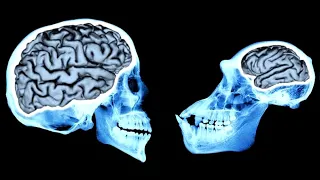
this study fundamentally looks at the of glia in brain function but even more we've been looking for some years at the differences between lower species and humans and glial morphology glial architecture glial physiology glial physiology specifically as a pertains to neuronal communication the traditional role of glial cells is to make the environment perfect for synaptic transmission so what we have noted during several more evolutionary studies is said yourself expand post in complexity and size and diversity as main function become more and more complex so for example the human astrocyte and astrocyte are the most numerous
of glial cells is 24 larger than astrocyte in the rodent brain and they have tenfold more processes so they're very much increased in complexity so that question ella basically raises a question have glial expanded in their function in the voles and maybe they're more implicated in higher cognitive network function in human than the and rodents so if we essentially replace the mouse glial component with their human counterpart what does that do or what would it do to essentially neural processing an information flow within the mouse brain and so that was the the fundamental point of
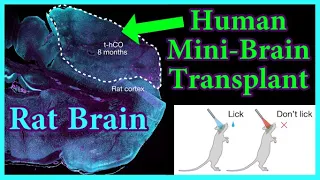
the experiment and it was a way to really investigate what are the role very fundamentally the roles of human glia in human evolution the operational design was actually very straightforward we kamar eyes Daz we call this process of injecting baby mice with human glial progenitors and these are glial progenitors that are derived from tissue sorted purified and then injected into neonatal mice and basically we're out competing that Mouse population with the human glial progenitor po as the mice grow up the human progenitors take over they expand differentially relative to the mouse pool they'll compete the
mouse pool and you end up with as the mouse matures with a mouse brain where all the glial progenitors literally all of the glial progenitors become human it's actually been extraordinary to us just how different these animals are and so first of all anatomically the human astrocytes retain essentially cell autonomous differentiation so that in the mouse context these cells actually grow to the size of normal human astrocytes the progenitor populations the progenitors look like human glial progenitors so we looked at a number of different indices of the function of these human glia and mouse brain
we looked at the rate of spread of a intracellular calcium wave and we found that that was the same in the human cells in the mouse environment as in a normal human cortical tissue so what we first says that in these humanized chimeric mice is what everyone in the neuroscience field would think of as our model for learning and that is long-term potentiation and that is basically that we prepare a brain slice from the humanized chimeric mice we stimulate them and if you stimulate them very strong but for short time we would see a potentiation
of the electrical responses in the year slice so we did that and we found that the humanized chimeric mice exhibited much stronger long-term potentiation than the mice that was raised in parallel but didn't have implantation of human cells and that told us that these chimeras really had significantly different neurophysiology than normal mice and on that basis since LTP we look at is essentially a surrogate for learning in a neural system we then went to actual behavioral assessments we first looked at fear conditioning then we looked at a variety of other behavioral tests and the bottom
line is that the animals that were calmer eyes with the human cells had much more rapid learning learning in terms of the electrophysiologic surrogate long-term potentiation learning in actual point of fact and the behavioral testing and so here we were essentially changing if you will the the functional capabilities of these mice by virtue of the human glial conversation telling us that human glia have a a species specific role in species specific intellectual capability and cognitive processing capability that the previously we've suspected but this is our first proof of the point you