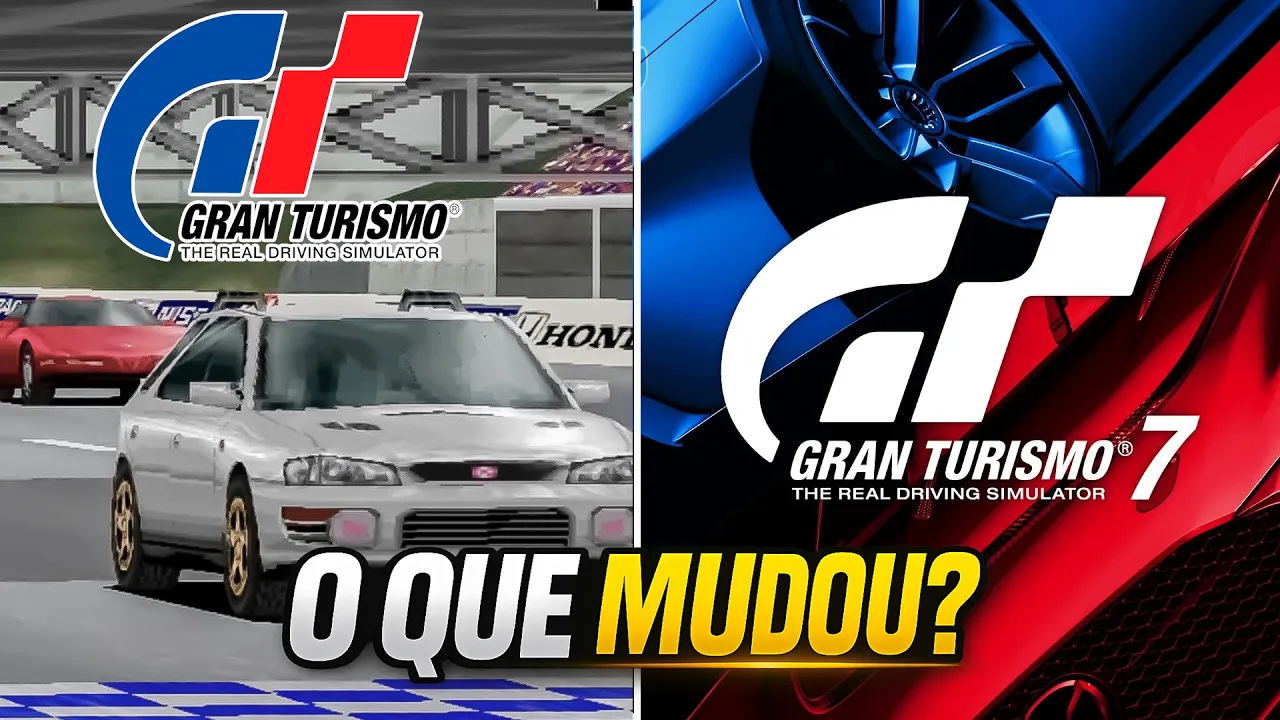
Imagine a team of only 7 people, sleeping under desks for almost 5 years, trying to do something that not even Sony itself believed possible. A game that taught an entire generation to drive, it became the biggest franchise on PlayStation but that today many fans say has lost its soul. And in this video, you will understand how this happened.
So, hey guys, this is Tony and welcome to another video from the Get Start Games Brasil channel. Today we will learn the complete story of Gran Turismo, from the almost impossible idea to the absurd success, and understand how one of the biggest franchises in games may be going through an identity crisis. If you like this type of content about behind the scenes and history of games, leave the like because this video here is special.
It all starts with a name: Kazunori Yamauchi. But not only with him. Also with the Polyphony Digital studio, which was basically born to turn this vision into reality.
Unlike many developers at the time, Yamauchi didn't just want to make a fun game. He was completely obsessed with real cars. It wasn't just looks, it was engineering, behavior, physics, sound, and driving feel.
And that created a dangerous idea for the '90s. He wanted to turn video games into simulations. The problem is that back then, racing games were arcade.
They were fast, exaggerated and made for immediate amusement. The idea of a game that would force you to learn to drive seemed wrong. And even worse, it seemed impossible on the hardware of the time.
The first PlayStation was not designed to simulate realistic physics. It had serious processing limitations, low memory, and difficulties handling complex calculations in real time. Simulating the car's weight, mass transfer, tire grip and cornering behavior required a level of calculation that simply wasn't the focus of that console.
And yet, Yamauchi insisted. The development of the first Gran Turismo has become practically an obsession. The team was small, the project grew non-stop and time passed.
There are reports of developers sleeping inside the company to get the job done. It was literally people sacrificing routine, sleep and personal life to make that vision happen. And the most impressive thing is that it almost went wrong.
The game took years to complete, much longer than expected. But when it was finally released in 1997, the impact was immediate. Not only for the graphics.
Not only because of the number of cars. But for the way he made you play. Gran Turismo didn't start in the race.
He started learning. The license system forced the player to understand the basics. Braking at the right time, cornering, controlling the car.
If you messed up, you failed. And that was strange at the time, because few games had the courage to demand that from the player. And here comes one of the most important parts of the franchise.
You didn't start with a dream car. You started with what you gave. A used, simple, weak car.
And little by little, racing, earning money and improving your car, you evolved. It wasn't just progress. It was a journey.
And that's what made Gran Turismo sell millions and become a worldwide phenomenon. Many people got to know makes, models and even developed an interest in real cars because of the game. He not only entertained, he educated.
But if the first game was already ambitious, what came after was even bigger. Gran Turismo 2 took everything to the extreme. More than 600 cars, dozens of tracks and an absurd amount of content for a 32-bit console.
It was so big that it had to be split into two discs. It was practically unbelievable for the time. With the arrival of the PlayStation 2, everything changed.
Gran Turismo 3 A-Spec was an absurd leap. It wasn't just evolution, it seemed like another world. Reflections on the cars, more advanced lighting, tracks with much more detail.
It was that kind of game where you showed someone and they asked if it was real. And more than that, he became a true console salesman. A lot of people bought the PlayStation 2 because of it.
And then came the peak. Gran Turismo 4. More than 700 cars, about 50 tracks and a simply gigantic level of content.
But it wasn't just quantity. It was balance. Everything worked.
The photo mode, for example, was something surreal for the time and showed the level of obsession with detail. Gran Turismo 4 wasn't just a racing game. It was almost a playable automotive encyclopedia.
At this point, the franchise seemed untouchable. But that's exactly when the story began to change. The games started to take longer to come out.
Development became more complex and the technical focus became increasingly heavy. Gran Turismo 5 and Gran Turismo 6 were still good, but they were already showing clear signs of change. And then came an important turnaround.
Gran Turismo Sport has brought a much greater focus on online competitions and esports. And that completely changed the experience. That feeling of starting from scratch, buying a simple car and evolving little by little is no longer the center of the game.
And when we come to Gran Turismo 7, technically it's impressive. Incredible graphics, refined physics, and an absurd level of detail. But here comes the question.
If everything is better, why does it seem worse to so many people? Part of the answer lies in the game's economy. Progress can be slower, requiring constant repetition to get enough money to buy certain cars.
In addition, decisions such as mandatory internet connection and the presence of microtransactions have generated strong criticism from the community. I didn't buy it myself because of that. I have always rejected this pay-to-win system.
And this issue of having to always be connected, even without playing online, just doesn't make sense to me. And here comes something even deeper. The same perfectionism that created a masterpiece may have created a problem.
When everything needs to be extremely realistic, extremely faithful, and extremely detailed, the experience can end up getting more rigid. Less spontaneous. Less light.
And perhaps it was precisely this lightness that made millions of people fall in love back then. And I'm going to be very honest with you. I didn't buy or play Gran Turismo 7.
And it wasn't for lack of interest. It was because, looking from the outside, I felt that the franchise had lost that shine, that soul that made me like it in the past. And that's a strong thing to say, because Gran Turismo was one of the franchises that really made me like this kind of car simulation game.
I hadn't done driving school at the time of the release, but it felt like I was training for real life. Today, the franchise is still a technical reference. It's still one of the most impressive simulators ever made.
But the question remains. Is it still the same game that conquered millions of people back then? Or have other franchises already managed to occupy this space?
Because at the end of the day, what made Gran Turismo unforgettable was never just the realism. It was never just the number of cars or the technical fidelity. It was the journey.
It was starting from scratch and winning each victory. It was learning, evolving and connecting with the game. And for you, is Gran Turismo still the king of driving simulators or has it already lost that position?
Which Gran Turismo has marked you the most? Mine was Gran Turismo 2, without a doubt the one I played the most. Comment below that I really want to know.
And if you liked this analysis and time travel, leave your like and subscribe to the channel so you don't miss the next videos. Thank you so much for watching until the end, Thank you so much for watching until the end, God bless you all and I'll see you in the next video. I Bye!





![Fatum - Violet vs Armin van Buuren feat. Kensington - Heading Up High [Live at UMF2018]](https://i.ytimg.com/vi/dHxg3ALcG90/mqdefault.jpg)