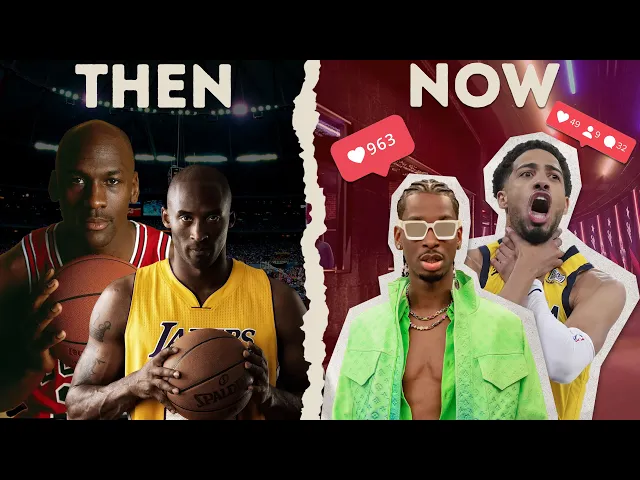
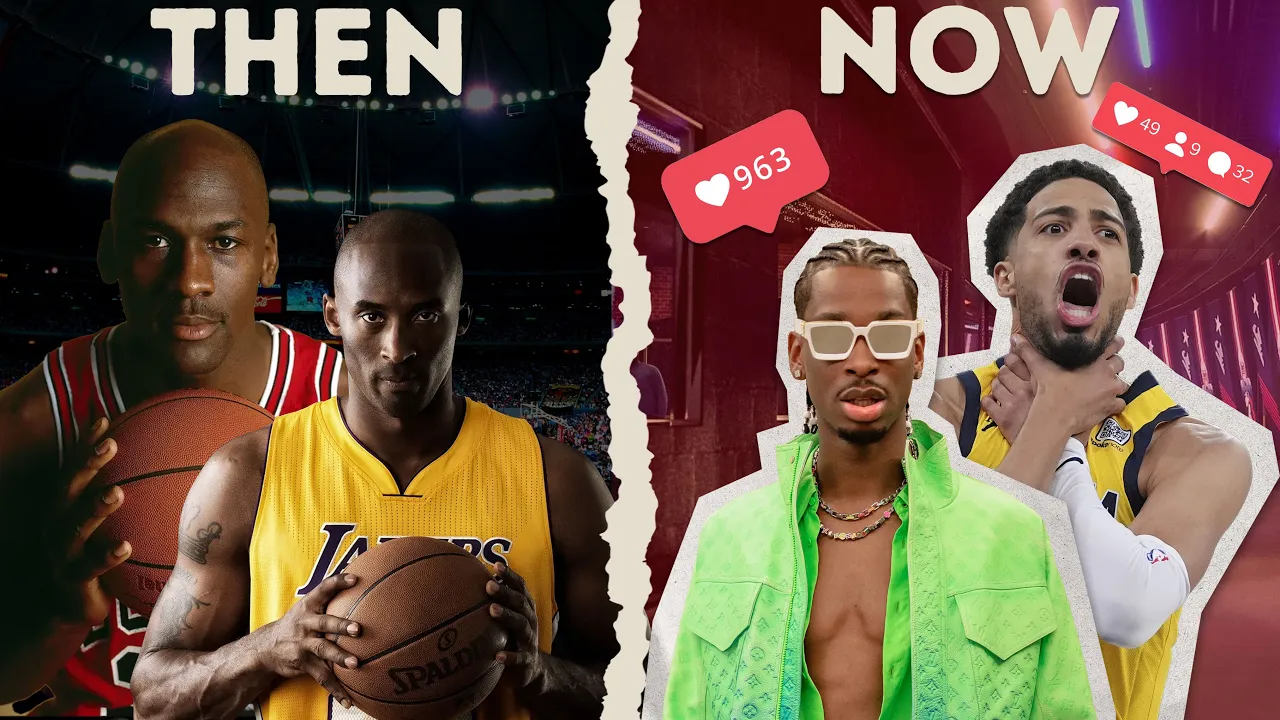
It was game one of the Eastern Conference Finals and Tyrese Haliburn had just tied the game and Madison squared guard. He immediately ran to the sideline and did this. A double-handed choke gesture right at the Knicks bench.
A call back to Reggie Miller's iconic choke taunt from 1995 also against the Knicks. Everybody wanted me to do it like last year at some different point. And when that moment went viral, a lot of people thought it was corny.
But Hallebertton isn't alone. NBA stars like Jason Tatum and Shay Gilis Alexander are catching the same heat. Kanan's coreiness is all in his earnestness.
Shaya's is pure image, and fans are roasting both. So, what's changed? Are yesterday's stars cooler?
Are today's stars more cringe? Or is something else going on here? I think before we all start calling Tatum or Halleurn or SGA corny, we need to take a step back and look at the history of branding in basketball and what it meant to be a superstar.
Let's rewind back to the 1980s when NBA superstardom wasn't just something that happened on social media. It was something that was protected by gatekeepers. Magazines like Sports Illustrated, GQ, Slam, and ESPN shaped the narratives.
Shoe companies like Nike built icons, not just endorsers, and players appeared in carefully staged photo shoots and interviews that emphasized mystery and swagger. I am not a role model. Michael Jordan's Be Like Mike campaign turned him into a cultural icon, but the media never showed us the real Jordan.
his gambling, his trash talk, all of that was very carefully hidden. Fans only saw what Nike and the media wanted them to see. Jordan wasn't supposed to be authentic.
He was supposed to be the superhero who's supposed to be invincible, the type of person that you can never imagine seeing walking down the street. He rarely showed vulnerability in public. His interviews were controlled.
And his encore persona fed into the myth, the legend of Michael Jordan. Fans had to imagine what Jordan was like off the court. It made him larger than life.
He was untouchable, perfect, cool, mysterious. And then LeBron and the media atmosphere that he came up in completely changed the game. As a high schooler, he came up through the old media environment.
His legend was built through the magazine covers and commercials. But then 2010, the decision when he announced that he was going to be going to the Miami Heat became the first time an athlete used live TV to control a free agency announcement. The answer to the question everybody wants to know, LeBron, what's your decision?
Um, and this fall, man, this is very tough. Um, and this fall I'm going to take my talents to South Beach and um, join the Miami Heat. LeBron embraced becoming a meme with his love of tacos, his lipsyncing videos, the videos of him drinking wine.
They saw his dad jokes, the raw, unscripted moments that Jordan never shared, and it felt like the wall between star and fan was crumbling. It felt like this idea of what it meant to be cool was starting to change. And then came the bigger question that transcended basketball.
What did it mean to be yourself in the age of the internet when people were performing for likes and comments? As we entered this era, it felt like we lost a lot of the mystique around these celebrities and these athletes because suddenly we were starting to see the mundane moments of their life. And that's also what we demanded out of them.
At the same time, we wanted our stars to feel relatable. So, how did we get from this era of mystery like with Michael Jordan and the early days of LeBron to where we are now where you log on to Twitter or social media and everyone is constantly complaining about how someone like SGA, Jason Tatum, or Tyrese Hallebertton are too corny to be the face of the NBA. We did it.
Oh my god, we did it. Like, think back to all the moments that made people call these guys corny. Whether it's Jason Tatum saying, "We did it after the Celtics won the championship.
" Or SGA's big tunnel outfits that often look like they should be on fashion runways, or Tyresese Hallebran doing the choke sign after hitting that game-tying shot against the Knicks. In the past, these were moments that we just saw on television and then they would kind of fade into history. But now we have this lingering thing in the back of our heads about whether or not someone's doing this just so they can get retweets on social media.
Like I think about all the time about how different high school must be now. Given that, you know, back in the day when you would talk about someone who was popular with your friends, you didn't have raw data that could back up how popular that person is. But these days, you can look at a follower count.
You can look at how much engagement people are getting. You have a lot more data that gives you information about your social standing within any community. It doesn't matter how famous or how popular you are.
You know, it could be a high school, but in the case of these guys, it's the literal world. It's the NBA. It's all of pop culture.
And I think a lot of this is due to the fact that in the old days, these gatekeepers, the big legacy media outlets, the NBC's that used to broadcast Michael Jordan's games, the Nikes, you know, the big brands used to choose who was in the advertisements, who was in the TV commercials, you know, who was constantly pumped in front of us. Every time Gret Hill drinks Sprite, he's not thirsty anymore. But now as fans, we have way more power to decide who shows up in our Instagram feed.
If you think SGA and his fits are cool, you can choose to follow him. You can choose for him to be the face of your NBA. But if you're a big SGA fan and you think that Tyresese Halleurn or Jason Tatum is corny, you can just choose to not follow them.
And at the same time, we're in an era now where we're seeing the first generation of basketball stars who grew up on social media. They were AU kids who had millions of followers before they even entered high school. You know, guy like Tyler Hero, you know, Mac Mlung, all these guys were internet famous at a really, really young age.
It kind of changes the dynamic of what it's like when you know, from a young age, you're incentivized to put yourself out there. And when you do put yourself out there in kind of a dramatic way in one way or the other, that's when you get attention. That's when you get comments.
That's when you get engagement. You see a lot of athletes making their own documentaries now. But the thing that I've noticed that a lot of these documentaries aren't actually hitting in the way that you might expect.
A lot of these documentaries are seen as kind of corny or as PR spin, not something that actually helps people get to know who these guys are. players in many ways because of the collapse of legacy media have to be their own hype men in a way they haven't had to do in the past. And at the same time, the existing media infrastructure that does exist, a lot of players, I've heard from a lot of my friends who are NBA reporters don't talk to the media anymore.
And so there's kind of this dynamic where athletes are searching for this level of credibility that you can't really get by just posting things on social because inherently when you're posting things on social, it's kind of PR for yourself. And at the same time, athletes are constantly aware of what social media is talking about. And I thought that this was particularly interesting after Tyrese Hallebran did the choke sign after hitting that gamety shot against the Knicks.
He proactively went out in front of the media to say, "I wasn't aura farming. If I do it again, then I might be people might say I'm like or farming, so I'm not uh I don't plan on using it again. " This guy has so much awareness about what people might say about him after a basketball game when he does something like that that he has to go out and almost proactively defend against the accusations that he's had in his head about what people might be saying about him because he did something that was dramatic in a big moment.
Like when you think back to the old school images of what it meant to be cool in the era of Michael Jordan, it was him being serious and focused without showing a smile to anyone. Some like Jason Tatum though, because so much of his life is documented on social media. What makes him stand out is the fact that he's a dad and he's got this famous son, Deuce Tatum, that he always has around and the fact that they have all of these cute moments together.
This plays a lot into what's been happening with Carl Anthony Towns with everything going around about his zestiness. Let me get your zest Carl Anthony impression. God and after all that.
Oh my god. Yes. But in many ways, Cat's zestiness is clearly a response to just homophobia as well because he doesn't fit into that box of what we expected when we would think of the basketball stars like Michael Jordan or Kobe.
Are you a different animal and the same beast? What the does that mean, Kobe Bryant? You're welcome.
What the is he talking about? That old school archetype of what it meant to be a basketball star really lingers with a lot of people to this day. I think it shapes our idea of what it meant to be not just a killer on the court, but a killer off the court as well.
And I think because a lot of athletes today are more open about who they are, what they do off the field, it opens them up to a lot more criticism because social media has allowed them to embrace their true hobbies and identities. Like I remember seeing a video of Miles Turner playing with Legos. Big big big thing.
I build Legos. I don't play with Legos. Being used against him when he had a bad performance on the basketball court.
And so we live in this era where fans have way more power than ever before to define what is cool and what is not. And I think that that has led to a massive domino effect throughout our entire culture. Like so much of a player's aura today, how cool people think they are is completely decided by what the people decide on social media.
And that is priority number one over everything else. It isn't just about what they wear on the court or off the court or even if they have signature shoes. It's about who people decide to hype up or drag down.
We still have the magazine photo shoots. We still have the commercials. We still have the signature sneakers.
But what's also almost just as important are the memes that form around an athlete. The inside jokes that people have within the fan base, the way that fans attack people who criticize their favorite star. Almost all of that is just as important as the signature shoe.
Even more important today for an athlete now. What they wear on the court, what they put on their Instagram feeds, the commercials, that all falls under this branch of marketing. But you can't force someone to like your Instagram post or decide that you're one of the best just players in the NBA.
This is happening everywhere, not just in basketball. Because when you look at Hollywood, you look at the old stars of yesterday like Marlon Brando or Marilyn Monroe, they almost feel like larger than life fairy tale creatures that just happened to be in these movies and grace us with their presence on this earth. But when you look at modern Hollywood today, you look at someone like Timothy Shalomé who became a massive star after Call Me By Your Name and it turned into this like indie boy artist darling.
He didn't have the same resonance and almost same level of fame with men because he felt inaccessible. The moment that changed though was when he started seeing more courtside at Knicks games and really went hard for them during the playoffs. And it was when he went on college game day and showed off his college football knowledge.
I'm going Jackson State. Eight wins in a row, 11 allconerence players. This should be a comfortable, easy win for them.
Breaking it down. Breaking it. It was that moment when it felt like, oh, this is now a guy who I thought was this indie artist guy, but is actually someone who I could talk to at a sports bar about whatever is going on in the world of sports.
All of this ties into what is marketable right now because it's not just about the mythmaking, it's about mythmaking while also being relatable and quirky. Being vulnerable is a brand now. And I think that the line between being vulnerable and being forced is increasingly thin and blurry.
Like this whole situation around these corny NBA stars has made me wonder, is being corny even a bad thing anymore? In my eyes, being corny might be the new cool. It means that someone isn't afraid to be themselves anymore.
It means that you're just posting the way that you want to on social media. It means being like Jerry McCain, doing his Tik Tok dances, painting his nails. It means being yourself and trying not to care as much as humanly possible about what other people think of you.
This old idea of being a stoic, untouchable star doesn't feel as interesting anymore because now we almost know too much. And I wonder if we're going to head into an era where there's a little bit more curation around kind of what people post on social if people try to be a little bit more mysterious. Like I think we saw this a little bit with the beef between Drke and Kendrick where Drke is someone who constantly posts on social media and is trying to shape his image in a very specific way versus someone like Kendrick Lamar who is very mysterious and drops things in a very particular pointed calculated manner.
I wonder what it means to be an NBA star today. What does it mean to actually be a cool NBA star today? What do people actually want out of their stars now?
Let me know what you think in comments because I think this is a question that is going to continue to evolve, not just in basketball, but is reflected across all of our culture and society. Thank you guys for watching. I'll see you in the next one.