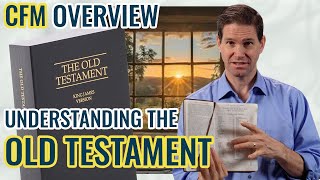
What if we look at the Old Testament as God's original love [music] story? >> Love story. >> Yeah, love story.
>> This is our story that God is creating salvation for all of us. And he's doing it, you mentioned through the covenant. I think we need to be careful not to put the Book of Mormon here in the Bible.
That's not how the [music] Lord frames it in the scriptures. Imagine him talking to a member of the restored church when [music] he says, "Thou fool," that shall say, "A Bible, an Old Testament, and a [music] New Testament. I've already got my Book of Mormon.
>> I don't need another Bible. " Nowhere does God ever say there's a hierarchy, >> right? >> And sometimes we feel like, well, if I work hard enough, God will love me.
It's like no, no, his love is actually the starting point of everything. The question is, will we love him? Welcome to Scripture Insights.
I'm Taylor Halverson. I'm Mike Harris. >> We are so excited to welcome you to the Old Testament year and to this first lesson where we do an introduction to the Old Testament.
When you think about the Old Testament, what's the first thing that comes to mind? For a lot of people, it's not super positive or it's a slog, but what are some of the things that you often heard your students say when they think about the Old Testament? >> It's confusing sometimes.
Some some get really excited, but it is an ancient book. >> It's a very old book, and we hope that as we work together through the Old Testament, people can feel the joy and excitement of this text. We will put out this idea.
What if we look at the Old Testament as God's original love story? >> Love story. >> Yeah.
I know most people think, well, wait a second, that is not what I think about when I >> There's a lot of violence in the Old Testament. >> There is violence. That was just part of the culture, their day.
And people always talk about Taylor, you got the God of the New Testament who's kind >> and you got the God of the Old Testament who's mean and venictive. But you you're saying you want to go love story. >> Yeah.
I think that if we frame this as a love story, we're going to actually see more clearly that if Jesus is the God of the Old and New Testament, why would he not also be a God of love for people anciently before he showed up in the meridian of time? And it turns out, and we hope that you can see this unfold through the Old Testament year, that God's love saturates the text. And some of the things we're going to talk about over the year are themes or words or lessons to look for where you can see God's love.
And yes, there are things in the Old Testament that are hard or difficult. There is violence. There's things that it culturally we're like, "Man, I'm glad I didn't live back then.
" And the thing is we don't actually have to be happy about how ancient culture was. But we can understand it. It's like living today.
Like when you look around your own present culture, can you understand it even if you don't like all of it? The answer is yes. And even though our culture today is not yet perfectly Zion, is God's love still saturating the earth?
The answer is yes. So, we hope that one of the major takeaways for you this year is that you can see that God's love is immediate and available. That the Bible was written to convey God's love.
>> Amen. Absolutely. >> Other things that we will be focusing on throughout the Old Testament year is the covenantal context of scripture.
We've talked a lot in the church about the covenant path and the Old Testament is the origin story for God's covenants. So we will spend time focusing on how to see and understand God's covenantal work that actually again saturates the Old Testament. We also want to work on how to more fully see Jesus in the text.
Now clearly there's lots of symbols about Jesus but one of the most important things is to remember that Jehovah is Jesus. So Jesus in the Old Testament is known as Jehovah. And especially when you're reading the Old Testament, anytime you see Lord in all caps, that's the Hebrew word Jehovah.
Yode vave. >> That's the Hebrew. And Mike is this Hebrew scholar and expert.
So it's great to have him on board. And anytime again that you see the capital phrase Lord, the underlying Hebrew is that it's actually Jehovah, which is the Old Testament version of Jesus, >> the premortal Jesus Christ, the premortal Jehovah. >> Yeah.
The other way of looking at this is anytime you see the phrase Lord God, that also refers to Jehovah. So that's actually one of the fastest ways that you can see Jesus everywhere in the text is just looking for Lord all caps or Lord God and you will see God acting with his people through history history and through covenants. Excellent.
Yeah. Um and I I love Taylor how I think those are just foundational pillars. We want to look for the love of God and we want to look for covenant.
Yeah. If if we miss that, then we are not appreciating the Old Testament. I love your emphasis.
And then we build on that. We want to apply it for us today. Sure, it's kind of interesting to understand what ancient people live like, but we have our own needs today.
And those people had their time on earth is now our time. Are we going to be faithful to God? Are we going to receive his covenantal love?
And so, we can look at the Bible as patterns for how people received or rejected God's covenantal love and what the consequences were. And so we can look at where can we find and see God's love in our lives, accept it, receive it, and there have thereby have a full flourishing that he has uh has designed for us. So those are just some of the overview topic areas.
There's going to be a lot to talk about. It's going to be an amazing year. Mike and I are kind of a little bit geeks on this.
We've been at this for a long time. Mike and I first met I lose track. Was it 35 years ago or something like that?
Are we that old now? We were probably both MTC teachers in the same group. >> That been back in 94 or 95.
>> Yeah, that's right. So, actually, it's going back on 30 years. >> Yeah.
>> And since that time, we've we've had kind of diverging paths, but converging paths that we both have just spent a lot of our lives dedicated to understanding the scriptures and understanding the languages, the culture, and the history. for example, what are you working on right now? >> Um, working on the dissertation, hoping to defend early next year, but we'll see.
Uh, working on Isaiah chapter 13, doing a theological analysis of each verse in Isaiah chapter 13 for my dissertation. So, it's a pretty big deal, Mike. Like, you had a full-time job.
You've been in seminaries and institutes for years. You've learned a lot. You've taught a lot.
And given all that you have learned over the years of your personal studying, your professional engagement scripture, your professional teaching, you decided to pay the price to go get a PhD in Hebrew Bible. That's the academic term for Old Testament. And you've been at it now for what, three or four years, going on seven.
>> Oh, that's right. With the M's program >> because I had to go back and get a masters in biblical studies as well to become familiar with the Hebrew and the Greek. Yeah.
So, it's taking a while because I'm trying to work full-time and get the degree. >> So, you're like Jacob who had to work for Old Testament Jacob became Israel. He had to work for Laban for seven years to >> get the prize.
>> Even though I am happily married. >> Oh, that's I'm not working for Rachel. But yes, >> it's like Mike, I also did a PhD in uh Old Testament and New Testament studies and it took a bunch of years.
And our hope is that you feel enthusiasm and empowered to engage in scripture without actually having to spend seven years doing a PhD. Now, if you would like to spend that much time studying, great. There are awesome resources out there.
Our hope is that we can help bring more tools and resources to accelerate the learning process for you to get you there faster than maybe what it might take some slower learners who had to take seven years. [laughter] >> That's fair. Sometimes it feels like amongst good Latter-day Saints, and I know I've done this, where we want to put the Book of Mormon here and yet we want to put the Bible here.
And I don't know if the Lord's okay with that. It's not a beauty contest. It's not a competition like which and of course the Book of Mormon is the keystone of our religion.
Of course, we understand that we believe the Bible will be the word of God as far as is translated correctly, and we know that some plain and precious truths have been taken out of the Bible. But at the same time, I think we need to be careful not to put the Book of Mormon here in the Bible. That's not how the Lord frames it in the scriptures.
For example, and here in 2 Nephi 3:12, Lehi is explaining to his son Joseph the importance of having the Bible in the Book of Mormon. He says, "The fruit of thy loins shall write. " That's the Book of Mormon.
And the fruit of the loins of Judah shall write. That's the Bible. And that which shall be written by the fruit of thy loins, Book of Mormon.
And also that which shall be written by the fruit of the loins of Judah Bible shall catch this grow together. And that's interesting this this imagery of growing. If you go to Ezekiel chapter 37, those famous verses about the stick of Judah and the stick of Ephraim, the Hebrew word for stick is which really is a tree.
But that would be really weird to say uh the tree of Ephraim and the tree of Judah are going to go together. But you you have this beautiful imagery that they're intentionally supposed to be, how do you want to say it? Interwoven.
There needs to be this growth. Let's continue here. Lehi says, "So they're going to grow together.
" And then listen to the blessings. Number one, unto the confounding of false doctrines. Two, laying down contentions.
We need to be a peacemaker. Three, establishing peace among the fruit of thy loins. Four, bringing them to the knowledge of their fathers in the latter days.
And last but not least, number, this is what Taylor was talking about. Number five, also bringing them to the knowledge of the covenants. And I just don't think we can get that full picture.
I don't know if we're going to be able to fully receive all those blessings of eliminating contention, whether it's in our own lives, our wards, our families, our workplace, if we're just going to exclusively focus on the Book of Mormon at the expense of the Bible. The Lord intends that we implement both into our lives to receive these blessings. What do you What do you think?
It's interesting you bring this up when I think about Ezekiel's comment about the two um scrolls being brought together. He doesn't say one scroll is going to be up here and the other one below it. He just doesn't say that.
Nowhere does God ever say there's a hierarchy, >> right? And I what I hear you teaching, Mike, is that if we truly want to understand the totality of God's work, although the scriptures do not contain the totality of his work, but if we want to understand and move towards understanding the totality of his work, we need to actually engage in what he has provided. Um, so this is a great invitation and the way you laid this out, these four or five core things of why the Bible matters together with the Book of Mormon gives us a frame for the Old Testament years.
Here's our additional things that we could be doing or thinking about. Like, how is my study of the Old Testament helping me avoid contention? Like, Satan loves to rile people up.
And I can be asking myself, okay, am I in charge of my emotions and not acting in anger towards people during this Old Testament year? Or am I going to be Satan's puppet to contend with people over things? Am I going to seek for the covenants?
So, this is really beautiful confounding of false doctrines. There's a lot of false doctrines still flowing around in the world today. We need to be grounded.
>> Yeah. And if we if we combine the Bible with the Book of Mormon, I really think and of course with the words of what our 15 living prophets and apostles are teaching, it's going to we're not going to go astray. >> Uh we're going to be able to stay on the the covenant path.
I also think about I had looked at the Hebrew word ets which means tree back there in Ezekiel. Two trees growing together. That's a pretty firm foundation.
It's really difficult for a human to like push a tree over. Imagine trying to push two trees over that are intertwined like an alloy, >> right? Sometimes we talk about like you you uh like have a board against a wall and you put a nail in, you can spin the board around, but two nails hold it tight.
Two trees grounded, growing together. And by the way, the word tree is etmologically related to the word for trust and true. So that tr is actually the core root meaning the core root letters of the word.
So tree, truth and trust. Which means as God's tree of truth grows, we can trust that it'll give us safety within its branches where we can find God's atonement. with that beautiful fruit.
Nice. >> Taylor, here's something I find really fascinating. Um, the Lord has I mean, don't get me wrong, of course, in our missionary efforts, the Book of Mormon is the instrument, >> the primary instrument in gathering Israel, and we don't want to uh downplay that crucial importance that it plays.
At the same time, when it comes to this competition or um this contest between which one's better, the Bible, the Book of Mormon, the Lord has an interesting interesting thing to say here in Second Nephi 29 verse 6. He says, "Thou fool, that shall say a Bible. " We have got a Bible and we need no more Bible.
And typically, how do we interpret this as Latter-day Saints? That's about our Christian evangelical friends >> that believe in solar scriptor just the Bible. It's infallible.
And by the way, I really admire their devotion towards the Bible. Their academic contribution over the centuries on understanding the Bible needs to be um appreciated and considered. I think at the same time the Lord's calling him out for limiting limiting to just the the Bible.
And so Oh, go ahead. >> If I see where you're going here, it's what you're saying, Mike, is we shouldn't fall into the same trap. >> Yes.
Because I think this isn't just a caution for our good Christian brothers and sisters that don't belong to the church of Jesus Christ. I wonder if we could flip this. I wonder if he's also explicitly talking to us.
Listen to it again. But imagine him talking to a member of the restored church when he says, "Thou fool," that shall say a Bible, an Old Testament, and a New Testament. >> I've already got my Book of Mormon.
>> I don't need another Bible. And I think there's caution that to be had for both our Christian friends, but also for us as Latter- Day Saints. We need to consider the value of both books.
Amen. So, let's summarize some of the things we've discussed so far. First, the Bible is God's love story.
Second, we can find Jesus throughout the text, especially when we're looking for the high the capital Lord or the phrase Lord God. Plus, there's many other ways that we'll be talking about how Jesus shows up in the text. And third, this is your story.
This is this is our story that God is creating salvation for all of us. We're seeing it happen in the old world and he offers it again today. And he's doing it, you mentioned through the covenant, >> right?
That that connection, that heavenly connection. Wow. Isn't that just amazing that what I mean?
He longs to be connected to us and you feel that so powerfully as we go through the Bible. >> I'm actually now that you mentioned that I'm going to add a fourth major concept that we'll probably be talking about during the year. I've been doing a lot of thinking over the last couple of years and I came up with uh an insight struck me and it was actually kind of shocking to me because like you Mike I have spent a lot of my personal professional life mastering belief.
So, I put all my time into studying scriptures and learning languages and cultures. And a few years ago, it dawned on me that belonging is what God is inviting us to do. >> I like that.
>> And that belief is a core ingredient that leads to belonging, but is not the endgame. And so, it dawned on me that imagine belonging is this sphere. Okay?
And in that sphere are two core ingredients. Belief and behavior. And you will see that as church members, we talk about a lot of beliefs or doctrines and behaviors like lists of things that we should do.
Those things are individually very helpful and they help lead to the belonging that God wants where we belong to him in families, in marriages, and of course ultimately in the Zion community where he is in our midst. Emanuel But when we focus only on belief to the exclusion of behavior, it becomes dogmatic. When we focus on behavior to the exclusion of belief, it just becomes pedantic like why am I doing this?
There's no purpose behind it. But when we do either or both of belief and behavior without realizing it's about belonging, we actually really miss the main purpose of why did God send us to this earth and create this entire plan of salvation? What's the whole point of the covenant path?
Covenant is about coming back together. So I invite you to consider where has God invited you to belong? Where have you experienced belonging?
And where do you see belonging saturating God's work? Now it may be belief that's leading to it or behavior or intermingling. But all these things ultimately are meant to lead us to belong to God.
What do we all want ultimately? To be saved in his kingdom. That is belonging.
Now there's other things we want, right? We want to continue to grow and progress, but that's also being belonging to him. So as we look at the covenant, rem remember that God is inviting us to belong to him.
Jesus gave his body, he broke it so that when we go to sacrament, we can be remembered to him. By the way, the members of your body, when you remember something, you're putting it back together, we're attached. >> Reattached.
When we go particular the sacrament, we are being reattached to the body of Jesus Christ. It is a form of belonging. And I not to overstate, but I just really like what you're saying.
We live in a world where people are quick to say, "Well, God loves everyone. " And and that's true. But all throughout scriptures, and you see it so powerfully here in the Old Testament, especially, there is a special connection with God.
But it it comes through a covenant that has always been a part of the gospel of Jesus Christ. It's not just a simple profession. I believe >> or I'm just going to if I just love other people and I'm a good person >> or I keep the word of wisdom, that's good enough.
>> Yeah. No, the Lord has always made it emphatically clear. No.
Yes, that all is important, but I want to formalize it. I want a covenant to seal the deal. >> By the way, the word religion comes from the root word ligament.
A ligament is something that binds things together like there's ligaments. I'm bind my my my arm together at the elbow. Religion, religion literally means to bind again.
And that is about belonging. And that's all that's what he wants, right? He wants to religament us.
He wants to belong. And of course, belief and behavior are the two core ingredients that make that happen. But the ultimate outcome, ultimate purpose is how do we belong?
How do we belong in marriages and families and in communities in Zion and with him? The Old Testament is chock full of stories about belonging. And we see what happens when people choose to belong to God or choose to say, "I don't want to belong.
" And what are the consequences? The Book of Mormon is full of that as well. So, we hope that that perspective in addition to seeing God's love throughout the story helps you to see that a core purpose of the Bible is to reveal to us how we can belong in the consequences of choosing to belong or not.
And if you don't feel that as you listen to our p podcast this year, they get a refund. >> Oh, that's right. Yep.
No, we hope you every podcast we hope that people will see as we go through the Old Testament, Taylor really fascinating insights on how covenants are so important and to feel God's love, right? So it can bless their individual lives and their families and strengthen the kingdom of God here on the earth. So on that note, let's talk about a couple of words that we're going to be sharing throughout the Old Testament year.
Uh they don't show up in English, but these are like the core words that represent kind of God's covenantal love. So you got the Hebrew word chassed. Oh, I liked how you gave it a little bit of a the guttural there.
We don't have that in English. Like my name Halverson is a soft H, but in Hebrew and other Semitic languages, they have soft H and hard H and even a more difficult hard H. And that that's how you pronounce it means enduring covenantal uh effectively non-breakable love especially when it comes from God.
And that's the love that he indicates. It's almost like it's the atmosphere of the air that he operates in and he invites us into that. The KJV translators in 1611 when they saw the word hessid sometimes they translated it as goodness, mercy, loving kindness.
Um there's some other favor favor um but Taylor I think nailed it ultimately and our and our prophet is emphasized this as well. President Nelson he said ultimately hessid refers to this covenantal loyalty and this is a core characteristic of God. Another important thing, we'll talk about this more in the in the next episode when we get into the creation that God is revealing his covenant identity that it is all about.
And again, that's why it's a love story. So, if we can try to avoid some of the distractions that show up in the Old Testament like crazy stories that are confusing or bothersome to us, can we always come back to okay, there were a bunch of people who did not live up to our expectations, but where do we see God's? Um, another important word is favor.
And I actually may have misspoken that favor sometimes translated as hassid. I'd have to go look at that. But the word hen in Hebrew means favor.
In fact, Nephi >> or grace >> or grace, which is another core characteristic that uh exudes. In fact, when Nephi says having been highly favored of the Lord, he's identifying God's his grace. And that original grace which God started the entire plan of salvation with is his hessid, his enduring love.
It's always there. And this is an important point. There is nothing you can do to destroy or earn God's.
You just can't. It is always there. It is eternally existing.
He is welcoming us to receive and experience it. And sometimes we feel like, well, if I work hard enough, God will love me. It's like, no, no, his love is actually the starting point of everything.
The question is, will we love him? And will we be willing to keep trying even when we fail to be as hassled as he is? And guess what?
He understands and he has he has grace for us. Covenant pattern. God delivers.
God invites. People promise and God blesses despite failure. So if you think throughout the Old Testament, you see this in the Book of Mormon, Doctrine of Covenants, church history, God delivers his people.
That is a form of he always invites us to come back into his presence. He invites us to promise we'll do so. If you think about sacrament every week, what has God done?
He has delivered you into his home and he invites you to be at his supper table which signals that there that you're at peace. Anciently, you would never have meals with your enemies. You'd only invite in people that you had a covenantal relationship with.
So God invites us into that relationship. So he invites us in. We promise at his holy table that we will be in this loving relationship.
And guess what? Sometimes we fail during the week. What does he do?
I still love you. You're in relationship with me. Come back to my home.
>> Let's renew it. Let's re. >> That's right.
It's relligion. Let's rebind it. >> Rebind.
>> It's not like, oh, you had one shot and that's it. God blesses us despite failures and he will keep acting with us. And that is the main story in the Old Testament at the micro and macrocosm level.
When the Israelites got spread all over, God gathers them again. That's the point of the Book of Mormon. God gathers.
He's gathering. Now, this is the covenant arc. So, these are the themes that we'll be exploring in the text during this year.
So, a couple of things that could be helpful for you this year to get more out of your Old Testament study is first just slow down your reading a bit and be curious. Now. 75 speed.
>> Yeah, that's exactly right. It turns out sometimes we read so quickly we actually think we already know what's going on in the story. If we pause and ask questions like who is God talking to here and what might it meant to them and what's a principle that I can draw from this?
So just slowing down. Now it is helpful to get to get the lay of the land and read through things. But let me just give a brief example.
If you turn to Genesis 6:8, but Noah found grace in the eyes of the Lord, we had just talked about how these words grace and favor all have to do with God's covenantal love. And if we just slow down and say, "Oh, Noah experienced God's covenantal love. Noah slowed down enough to see it and experience it.
" >> That's one of the messages. If you turn to say Genesis 16, the Hagar story, if you slow down and say, "Huh, Hagar got kicked out of Abraham's tent, and we might be bothered by the inner dynamics of the family. " And there's lots to talk about there, but what ends up happening, God comes to her and basically reinstates the same promises he' given to Abraham.
He gives them to Hagar. We never talk about this. We might say, "What might it have been like for this Egyptian woman who is kind of like the second like the the second favorite wife to have God come to her in her distress when she's out in the wilderness and she thinks her son's going to die.
" And she names the Lord, the God who sees, >> names, >> names not her son, but names the Lord. >> Yeah. She calls him El Roy, which in Hebrew means L is God.
E means to see the God who sees because Hagar says God saw me >> in my distress. >> That's so beautiful. So we can think whatever our life situation maybe we're not the favorite.
We're feeling cast out or lonely. >> We're not feeling the belonging. >> Yeah.
>> Who shows up? God. >> Yeah.
>> He sees and he belongs to us. So again the invitation is in this year just take some time to slow down in some of the passages read and ask who is God talking to or what is this about and what might have felt like for them and what's a principle that applies to me. That little thing that little approach can be very very helpful.
Great example. Thank you for spending time with us today. And we hope you feel our love and enthusiasm for the scriptures, but more importantly, we hope that you feel God's love that is saturating these words intended for you.
And we welcome you as you join us this year as we dive deep into God's love, his love story that is found in the Old Testament.