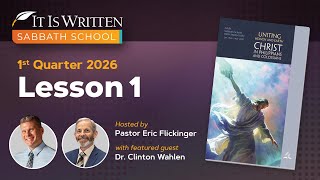
Hello family. I'm Jill Moricone. We just welcome you to another edition of 3ABN Sabbath School panel. We're just launching into first quarter 2026. Our title is uniting heaven and earth, Christ in Philippians and Colossians. And we're going to study this entire quarter, the books of Philippians and Colossians, and see how we find Jesus, the center and circumference of everything. Lesson number one is persecuted but not forsaken. And it's kind of the overview as it were, the introduction as we get into both books of Philippians and Colossians. To my left, Pastor John Denzy. So glad you're
here, pastor. >> It's a blessing to be here. And I have Monday, Paul and Chains. >> In the middle, my sister in Jesus, Shelley Quinn. >> I'm excited. I have Tuesday's lesson, Paul and Philippi. >> Wonderful. To the left of Shellyley. Pastor James Rafferty. >> So good to be here, Jill. I have Wednesday's lesson which is Paul and Colasse. >> Wonderful. Last but not least, at the other end, Pastor John Lumacane. Michael, >> thank you, Jill. I have the churches of Philippi and Colasse. >> Wonderful. It's going to be a great study. And let's go
to the Lord in prayer. Pastor John, would you pray for us? >> Sure. Loving father in heaven, anytime we open our Bibles, we pray that we also open our hearts. We pray for your Holy Spirit, Lord, to anoint this quarter, but today we as we begin, we pray for that double portion that we could lift you up as we talk about history and and the demographics and the administrations and the things that sometimes seem to be mundane. We pray that through it all, Jesus Christ can be seen. We ask in Jesus' name. Amen. >> Amen.
Philippians and Colossians are both what we term prison epistles. Paul wrote four prison epistles as they call it prison epistles. They would be the books of Ephesians, Philippians, Colossians, and Phileimmon. And we believe this was written during Paul's first imprisonment in Rome. That would be about AD61-62. And we'll talk more about why we believe that later. Then after the prison epistles, you have what we call the pastoral epistles. This would be first Timothy and Titus, which would be written after Paul got out of Rome, out of prison there in Rome as he's traveling around. And
then the final epistle he wrote is also from prison. Second Timothy. This would be the very last epistle he wrote right before he's beheaded. As we look at the prison epistles, this quarter we study two of them, Philippians and Colossians. Philippians is only four chapters long. Colossians is only four chapters long. So this whole 13 weeks, we're going to be studying eight chapters from the word of God. The book of Philippians is addressed, of course, to the Christians at Philippi. Paul went there on his second missionary journey. He was there with Silas and with Timothy
and with Luke. And he evangelized the city. Probably two of the most well-known converts of that time would be Lydia, seller of purple, and the jailer. Remember the jailer? They were in stocks and they were singing and the jailer there at Philippi. Now, the audience of Colossians would be the Christians of Colasse. However, Paul never visited there himself. He's addressing his letter to them. One of Paul's converts, Epifras, however you pronounce his name, he evangelized Colasse. And Paul's addressing brothers and sisters in Jesus that he has actually never met. If you look at the themes
of the two books, the theme of Philippians, one of the themes would be joy, would it not? Rejoicing. And we'll study that this quarter. Joy when you're in prison. Can you be have joy in prison? joy even in difficult circumstances. Another theme of the book is humility. We see that in the book of Philippians. Christ is our example of love and humility. But the central theme of the entire book is Jesus. Christ and him crucified. Knowing Christ intimately and fully is the first goal. Christ is the center and circumference of the gospel. He is the
foundation and the assurance of our salvation and he is the reason that Christians can rejoice. Incidentally, the theme of the book of Col Colossians is also Jesus. We see this in Christ motif all throughout the book of Colossians. We see Jesus is central to Paul's work and prayer. And Jesus is central even when Paul is offering pastoral counsel of how to live and work. And Jesus is even central when they deal with heresy and false teachers who come into the church there at Colasse. We'll study that more in Colossians chapter 2. The entire theme is
Christ uniting heaven and earth. The plan of salvation is really reconciliation back to the father. Jesus is the latter as it were stretching from heaven to earth. As the son of man, he redeems us from sin. As the son of God, he intercedes for us. And our commission as his disciples in these last days is to unite with heaven in proclaiming this last day message of Revelation 14, the three angels messages and everlasting gospel to the world. We're going to begin in both books, Philippians and Colossians. Then we'll study Philippians and then jump over to
Colossians. The author of the lesson, not to be confused with the author of these two books, who's the Apostle Paul? But the author of the lesson is Dr. Clinton Wallin. We love him here at 3ABN. So grateful. He's an associate director of at the Biblical Research Institute there, 7th Day Adventist Church, but he's been here at 3ABN. He's a student of the word and a man of prayer. And he did a great job with this lesson. The first week, persecuted, but not forsaken. We study Philippians 1, the first couple verses, and Colossians 1, the first
couple verses. And we really look at the circumstances that Paul faced. There's a story in the lesson. It starts out with about an Adventist pastor who was imprisoned on false charges. And he spent two years in prison for something he did not do and a crime that he's accused of that he did not commit. And at first, he was very disappointed. Why did this happen to me? Why am I in prison? I don't deserve this. And then he said, "God, you've given me a mission field." And that mission field is right here in prison. He
preached. He passed out literature. He conducted communion. And he baptized prisoners. It reminds me of Paul and Silas singing in prison as it were. And it reminds me also of our memory text, which is Philippians 4:E4. Rejoice in the Lord always. >> Amen. >> And again I will say rejoice. Sunday we look at Paul the prisoner of Jesus Christ. Now we talked initially about those prison epistles. Ephesians, Philippians, Colossians and Phileiman. And there's actually some discrepancy as it were amongst scholars. Were those prison epistles written while Paul was in Ephesus? There's not much biblical support
for that position. Were those prison epistles written while Paul was in prison in Cesaria? He was there for a couple years or were those prison epistles written while Paul was in prison his first imprisonment in Rome? Now, the lesson, the Andrews Bible, the Andrews Bible commentary, Christian tradition, and Ellen G. White and Acts of the Apostles all say that they were written while Paul was in Rome in prison his first time. But if you're looking for some biblical evidence, we won't spend a lot of time on this, but if you're looking for biblical evidence, you
can look at Philippians 1:13. Paul talks about how it's evident to the whole palace guard and to everyone that his chains are in Christ. Now, the palace guard were 9,000 elite soldiers in Rome who protected the emperor and guarded his prisoners. So, if Paul is talking about these 9,000 elite guard, you you would think he'd be close to them if he's talking about them. You can also look at Philippians 4:22 and he says, "All the saints greet you, but especially those of Caesar's household." Now, if Paul's talking about Caesar's household, you would think he would
be in Rome, close to where Caesar was. You can also look at Philippians 1 verse 20. He says, "According to my earnest expectation and hope, and nothing I'll be ashamed, but with all boldness as always." So now also, Christ will be magnified in my body, whether by life or by death. You can see that Paul feels there's a threat as it were to his life. You can also see that in Philippians 2:1 17 because he says he's poured out as a drink offering on the sacrifice and service of your faith. And yet even then he
is glad and he rejoices with you all. So this apparent threat as it were on Paul's life indicates as well that he's in Rome because there was no threat to his life when he was in Cesaria. So based on all that biblical evidence as well as the other evidence, we believe Paul was in Rome when he wrote these prison epistles. Now let's look in our remaining moments together. How did Paul see the big picture even in trials? Because he's in chains as Pastor John is going to talk to you about. He's in prison. How did
he see the big picture? Let's look at Ephesians 3:1. Ephesians 3:1. For this reason, I, Paul, the prisoner of Jesus Christ for you Gentiles. You see, Paul was not a prisoner of circumstances. He was not a prisoner of fate or even jealousy or backstabbing or because someone else put him there. He was a prisoner, what did it say? Of Jesus Christ. He's a prisoner of Christ. Takeaway number one. Recognize Jesus in everything. You see, it's not about other people. It's not even about myself. It's not about circumstances that I can't control. It's not even about
Satan or the trials that he throws at us or the temptations that come against us or what we perceive as an attack from the enemy. It's all about Jesus. Even when you're in difficult circumstances, even when it looks like everything is seemingly from an earthly perspective against you, Jesus is still in everything. Paul was in prison and yet he said, "I'm a prisoner of Jesus Christ." He recognized God in everything. If you look at Philippians 4:4, we talked about this theme of joy being prevalent in the book of Philippians. Philippians 4:4, rejoice in the Lord
always. This was our memory text. Again I say to you, rejoice. That Greek word for rejoice occurs 29 times in Paul's letters, but a third of them are in the book of Philippians. We see this theme of Philippians being joy. How can you and I rejoice even in trials, our spouse passes away, or our children leave the Lord, we lose our job, or we're suffering tremendous chronic pain. And yet Paul tells us to rejoice. Are we supposed to rejoice in trials? Are we supposed to rejoice in those difficult times? Takeaway number two, we rejoice in
Christ. Not in the pain and suffering, not even in our present circumstances. We rejoice in Christ because he's our savior. He's our redeemer. He is our sooncoming king. 2 Corinthians 4, Paul puts it this way. 2 Corinthians 4:17, "Our light affliction which is above for a moment, it's working for us a far more exceeding and eternal weight of glory." I was doing a woman's retreat and I met a precious woman whose daughter died at the age of eight and it was her only child and she talked about the tremendous pain and suffering and loss. That
verse got her through. 2 Corinthians 4:17, "My light affliction, which is but for a moment, is working for us a far more eternal and exceeding weight of glory. We can trust Jesus even in the dark times." Pastor John. >> Amen. Great foundation. Praise the Lord. And so, we continue now with Monday's uh portion of the lesson, Paul in chains. And you may ask yourself, what in the world is Paul doing in chains? You know, because what does he have? He has the everlasting gospel, good tidings, joyful news. Why is he in prison? You see, there's
a great controversy between good and evil. And if someone is bringing light and salvation, the devil is going to try to stop that. We think of John the Baptist >> uh used to uh his life was preaching preaching the gospel and suddenly he's in prison. But you know, something happens when God's people are put in prison. God can still use them in prison. I remember interviewing a gentleman by the name of Alexander Noble and uh he was put in prison for preaching the gospel. Actually, he was preaching a sermon about Adam and Eve and how
the serpent came and tempted them and uh two individuals came came to the meeting sat in the back listening to the message and then they say we would like to talk to you for five minutes. He said that turned into over 20 years because he was put in prison. Misinterpreting what he said. Oh, this thing about the serpent. You're talking about the leader of our country. And they put him in prison. Well, what happened while he was in prison? He continued to preach the gospel. Had a little group there about over a hundred people. Praise
the Lord. So, here's Paul in prison. But that does not stop him from writing letters. He's writing letters to the churches. Praise the Lord. So the lesson says that while in Macedonia Paul mentions multiple imprisonments 2 Corinthians 6 verse 5 and verse 2 uh 2 Corinthians 11:23 also 2 Corinthians 7:5 and the first recorded instance was in Philippi Acts 16- 24. Later he was in prison in Jerusalem briefly before being transferred to prison in Cesaria. So Paul knew about being in prison and while he was in prison of course he sang he praised the Lord
and was also a witness to the Lord. This takes us to the lesson pointing out in 2 Corinthians 4 7-12. It says here what reveals how Paul was able to endure the trials he faced. What seems to be the focus of his life? Let's go ahead and begin reading 2 Corinthians chapter 4 beginning in verse 7. But we have this treasure in earthn vessels. Why? That the excellence of the power may be of God and not of us. We are hardpressed on every side yet not crushed. We are perplexed but not in despair. Persecuted but
not forsaken. struck down but not destroyed. You see a pattern of apparently Paul looking at the bright side of things and not letting the situation get him down to the point of considering himself forsaken, considering himself destroyed. Verse 10, always caring about in the body the dying of the Lord Jesus. Why? that the life of Jesus may be manifested in our body. His focus is on the Lord Jesus. For we who live are always delivered to death for Jesus' sake. Why? That the life of Jesus also may be manifested in our mortal flesh. So then
death is working in us but life in you. So these things go along well with uh sister Jill said that the afflictions we face are working in us a far more >> exceeding and eternal weight to glory. >> Exactly. So we praise the Lord that Paul was able to focus on that instead of the situation. And some of us uh you know we focus on the situation and we start looking inwards. Oh, I'm not loved. God is not thinking of me. He's deserted me. I'm all alone in this world. But we have to consider that
the Lord may be allowing that to work out some good even in our own lives to understand our need of him. The lesson points out something very interesting that I'm going to read in a moment. But first, let's look at Hebrews 13 5 and six. Let your conduct be without covetous covetousness. be content with such things as you have, for he himself has said, I will never leave you nor forsake you. So we may boldly say, the Lord is my helper. I will not fear. What can man do to me? Let's continue facing each challenge,
looking unto Jesus, the author and finisher of our faith. Yes, we are facing a world of conflict, controversy between good and evil. Is everything if everything is going uh what are some some of the words people say? Um >> hunky dory. >> Hunky dory. Hunky dory. >> That's a good word. >> If everything's going well for you, smooth all the time, you have to step back and say, "Maybe I am doing something wrong. Maybe I'm not close enough to the Lord." because the devil will try always to uh cause trouble in your life. So I
bring you Ephesians 6:1 16 above all taking the shield of faith with which you will be able to quench all the fiery darts of the wicked one. The wicked one is going to throw throw at you these fiery darts these things to do you harm. And these darts uh when you were involved in war, >> they were meant not only to hurt you, but set you ablaze, to do harm. And so, how do we do that? We need to have the shield of faith. That's a focus on the Lord Jesus Christ. So, in Revelation 2:10,
notice the message here presented to us. And it's very interesting. And this was addressed to the church in Smyrna. Do not fear any of those things which you are about to suffer. So I say to some of you, you perhaps you're about to face something. Do not fear any of those things which you are about to suffer. Indeed, the devil is about to throw some of you into prison. Why? That you may be tested and you will have tribulation 10 days. But what is the encouragement? Be faithful until death and I will give you the
crown of life says Jesus. So let us be faithful until death. What awaits us? The crown of life, eternal life and no suffering at all because of Jesus. Because of Jesus. So in the lesson another passage 2 Corinthians 6:es 3-7. And here is the question. What spiritual resources did Paul have available to him to uh face these difficulties? Whatever resources he had, we also have. So let us focus in. You know, when you read the scriptures, you cannot read them like you're reading a newspaper looking for information or maybe looking for entertainment. Every word in
the Bible is important. We need to uh focus and try to understand, ask the Lord to help us understand. You're reading a newspaper is uh most of the time it's a waste of time. But when you're reading the scriptures is time well spent. >> Let's go. 2 Corinthians 6:3, we give no offense in anything that our ministry may not be blamed. So let us be careful not to give offense. Notice verse four. But in all things we commend ourselves as ministers of God in much patience, in tribulations, in needs, in distresses. We commend ourselves as
ministers of God by letting our light so shine that they may see our good works and do what? glorify >> glorify our heavenly father. So in stripes, verse 5, in imprisonments, in tumults, in labors, in sleeplessness, in fastings, how? By purity, by knowledge, by longsuffering, by kindness, by the Holy Spirit, by sincere love, by the word of truth, by the power of God, by the armor of righteousness on the right hand and on the left. And so these are tools available to us. So it is by the grace of the Lord that we face trials.
It is by the grace of the Lord. And please do not bring any unnecessary troubles in your life. Some of us are very good at bringing trouble upon ourselves by the way we speak and things that we may do to others that may even cause some people to question. I thought Frank was a Christian. And we need to consider how we speak and to be slow to speak and swift to hear less we offend others. And instead of letting light shine, we are bringing darkness. I read to you from the lesson. It says, "Often we
may be tempted to look at our circumstances, our weaknesses or our past failures and become discouraged. It is at times like these that we need to remember all the amazing provisions God has made for our success in battling evil. So let's keep our eyes on Jesus. He says he will never leave us nor forsake us. And with him we will be at peace and victorious. >> Amen. Thank you so much, Pastor Johnny. It's incredible. Paul in chains, persecuted but not forsaken. We're just getting started. We're going to take a short moment for a mission moment
and we'll be right back. >> Hello, I'm Greg Moronei. I'm so glad you joined me for 3ABN mission moment. Lenny grew up in the Philippines in a family where her father was a 7th Day Adventist and her mother was a Roman Catholic. She attended the Adventist church and was baptized when she was 9 years old. She was also an honor student, but always felt empty inside, like something was missing. When Lenny was 14, her life shattered when her aunt removed her from class, sharing that her mother had attempted suicide and was now in the hospital.
Coming home expecting comfort, she was dropped off instead to clean up the blood from the floor. Picking up the blade and the empty pill bottle, Lenny felt scared, alone, and hurt. And while she was still cleaning, her little sister came home in tears. So Lenny tried to comfort her. Later, she was the one who found her mother's suicide note. And the next day, one of the kids began telling her fellow students what had happened, leaving Lenny feeling devastated and alone again. When her mother returned home, she could barely look at her. And no matter how
much she begged for forgiveness, Lenny couldn't speak to her mother. Her trauma, shame, and confusion resulted in isolation from others. Her grades fell and her family stopped attending church. But there was hope. Find out next time on 3ABN Mission Moment. God bless you in a very special way today. You know, Joe, we hear from so many of our 3ABN listeners and viewers that love watching Sabbath School Panel and studying the word for themselves, but then they also use Sabbath School Panel as an evangelistic tool by bringing people into their homes to study the word of
God. And then others actually take Sabbath School Panel and share it on social media. Incredible evangelistic tool. >> I love to hear those stories how Sabbath School Panel makes such a difference in people's lives evangelistically. And if you would like to help support Sabbath School Panel and go forward, go to 3abn.tv and donate. Welcome back to our study. If you would like a copy of our notes as we prepare them from week to week, you can go to 3BSchool panel.com. There's a note tab at the top. Just click on that and you'll be signed up
every week to receive those notes. We want to turn it over now to Shelley Quinn. >> Thank you so much, Jill. I'm Shelley Quinn and I have Tuesday's lesson, Paul and Philippi. If you want to open your Bibles, we're actually starting in Acts chapter 6. We're going to look at, excuse me, Acts 16. We will look at verses 6-15. We don't have time to read them all. will consider them. But let me just ask you this question. Have you ever made plans that God suddenly and completely redirected? You get started doing something. You're you're prayed
up. You feel sure that you're walking in the steps being led by the Lord only to have the doors closed on you and you don't understand. Well, that's exactly what happened to Paul when he was on his second missionary journey. And he, Paul, Silas, Timothy, they're out preaching. They're strengthening the churches. And all of a sudden, everything seems to be going according to plan. But guess what? Suddenly, Acts 16:6 says they were forbidden by whom? by the Holy Spirit. They were forbidden by the Holy Spirit to preach the word in Asia. Now, just think about
that. Preaching is good. Evangelizing is good. >> It's true. >> Yet, God closed the door. He blocked their path. The Holy Spirit was not rejecting their mission. He was redirecting their missions. This was a detour with a divine purpose. God sees the bigger picture. Acts 16:9. Let's look at that. Acts 16:9. And a vision appeared to Paul in the night. A man of Macedonia stood and pleaded with him, saying, "Come over to Macedonia and help us." Immediately he obeys. They set sail from Trrowass across the Aian Sea and they end up in modernday Greece. They
landed in Neopoulos and stepped for the first time onto European soil. Oh, this is getting exciting. The gospel just crossed a continent and the course of history was about to change. Paul was not only spiritfilled. Paul practiced strategic obedience. He didn't linger in Neopoulos, but he and his team, Silas and Timothy, and then Luke joined them at Trrowass. They headed inland to Philippi, the chief city of that part of Macedonia. And this was not just any city. Philippi was a Roman city that was granted the elite status in Latin. It's called lus Italica. And so
it meant that its citizens had the same rights as the citizens of Rome. They were exempt from certain taxes. They had automatic Roman citizenship. So culturally, politically, commercially, this was a gateway city. It was a vital link along this road that connected Rome to the east. The road was called the Via Ignatia. So the Holy Spirit was thinking far beyond Philippi where he sent when he sent Paul there. You know what God was doing? He was planting a beach head. >> Planting a beach head for the gospel in Europe. From from this place the message
would travel to Empilus, Apollo, Appalonia, Thessalonica, Berea, and that's you find those in Acts 17 1-10 and eventually to Rome itself. So God always sees further than we do. There's no question. And here's what I want you. If you don't hear anything else that I say, write this down. Listen to it. Get it in your mind. When God closes a door, it is not rejection. It's redirection. and he may block our Asia because he's preparing our Macedonia. So Paul arrives and when he gets to Philippi, he realizes very few uh Jewish men in Philippi. There
was no synagogue. Ah but he finds out they've got a prayer meeting every Sabbath down by the river. So on the next Sabbath, he goes to the river and joins the group. And in Acts 16:14, he met Vyia. She's a businesswoman from Thyro Tyra. She's a seller of purple, which was a very expensive cloth. So this woman is wealthy. She's influential. And guess what? She's spiritually hungry. This was a divine appointment. And the the scripture says the Lord opened her heart as Paul shared the good news about Jesus, the good news about the everlasting gospel
that is coming to fulfillment. They've got a Riverside revival going on. And Lydia and her entire household were baptized. The woman who traded purple cloth, which was the color of royalty, is now clothed in the righteousness of Christ, the King of Kings. Lydian became one of the first converts in Europe and a strong supporter of Paul's ministry. God opened a new chapter of gospel history. But guess what happened? Obedience to God sometimes brings opposition and persecution, >> doesn't it? >> Paul and Silas are arrested. They're beaten. They're thrown into prison. And from a human perspective,
does that look like success? >> No. Acts 9:16 says that when Jesus called Paul, he said, "I will show him how many things he must suffer for my name's sake." Huh? So Paul's suffering was not punishment. Paul's suffering was partnership with Christ. His trials were not an obstacle to the gospel. Actually, they were the very means by which the gospel was shared. Even in that dark dungeon, God was at work. And at midnight, Paul and Silas are singing and they're praying and praising the Lord. And an earthquake shook the prison foundation. The doors flew open
and the chains fell off. And the jailer is thinking, "Whoops, I'm going to Rome's going to kill me because here they're getting I mean the Philippians would kill me cuz they're getting my prisoners are escaping." So he's ready to take his own life. In Acts 16:28, Paul says with a loud voice, "Do not harm yourself. We're all here." So the jailer fell before them trembling. And I love this. Acts 16:30, he cries out. He He has seen their testimony. They He heard him singing. He heard him praising. They heard him praying. Now he realizes they're
not even trying to escape. And he says to them, "What must I do to be saved?" Oh, that people would look at us and that we would reflect Jesus so much that they would say, "What do I have to do to get what you've got?" And that night, guess what? He and his entire household believed and they were baptized. So that's two households, Lydius and the jailers becoming the founding members of the Philippian church from a closed door in Asia. The gospel was moving exactly where God ext intended it to be in Europe. You know,
the Holy Spirit today still guides us through our victories and our prisons alike. There are people whose hearts can only be reached when they see how we react in persecution through the grace that you reflect when you're under pressure. Persecution can become a platform for witness. >> That's right. Paul and Silas's chains became their testimony. Their midnight songs were their altar of praised. And years later, when Paul wrote to the Philippians from another prison cell in Rome, he called them in Philippians 4:1, "My joy and crown," that little congregation born along the Riverside meeting in
with that midnight earthquake had become one of his strongest supporters in ministry. So remember, when God closes the door, it's not re rejection, it's redirection. >> Praise God. I really, really appreciate it. I love the idea that you brought out there, Shelley, that we can actually know the voice of the Holy Spirit and the Holy Spirit can guide us. >> Pastor James Rafferty, here we are in Wednesday's lesson. It's based on Fleiman 15 and 16. And we're going to look there at these verses as we start our lesson about actually about the subject of slavery.
That's a very insensitive subject, but it starts out here uh Philan 1:15-16. For perhaps he therefore departed for a season that thou shouldest receive him forever, not now as a servant, i.e. slave, but as a servant, but above a servant, a brother beloved, especially to me. But how much more unto thee both in the flesh and in the Lord. So what we have here is we have Paul urging Fleiman to receive on onimus who is a runaway slave but actually also robbed Paul. He he excuse me robbed his master. He actually stole from him and
then he took off. And as he heads away, he comes in contact providentially with the gospel through the preaching of Paul and he ends up being converted and he becomes a believer. This runaway slave does. And uh Roman law actually required Paul to return uh Onissimus to Fleiman. And Paul therefore appeals to Fleiman's heart and conscience as a fellow believer and urges him to treat Omnisimus not as a slave but as a brother. And so this is uh I'm just reading from the quarterly right now. This is what uh Paul does. He writes a letter
and he actually encourages uh this uh runaway slave to give the letter to his master. And you know, you can imagine he's going to show up. He's stolen from him. He's a slave. And he's going to show up. And as soon as his master sees him, you can imagine what he's going to do. And then he gives him this letter. Read this first. Read this first. Now, the biblical allowance for slavery was nothing like what was and is still practiced in our world today. Um, for example, in the Bible, any physical injury to a slave
was an immediate reason for their release. Uh, men could not be stolen. Uh, men could not be sold into slavery. And if slaves were harmed, the law was explicit. An eye for an eye and a tooth for a tooth. And we read this in Exodus. Actually, let's read a couple verses there. Exodus chapter 21:es 20 and 21. And the reason why this is important is because there are times when people will use the Bible to try to say that slavery is okay. And my father, who was a black man, really had a hard time with
that. In fact, one of the reasons he rejected the Bible was because he saw white people using the Bible to try to to to uh promote slavery or I should say to condone slavery. Right? So, Exodus 21 20 and 21. When a man strikes a slave, male or female with a rod and the slave dies under his hand, he shall be avenged. Right? The slave is going to be avenged. But if the slave survives a day or two, he is not to be avenged for the slave is his money. And then verses 26 and 27
of the same chapter, Exodus 21, when a man strikes the eye of his slave, male or female, and destroys it, he shall let the slave go free because of his eye. If he knocks out the tooth of his slave, male or female, he shall let the slave go free because of his tooth. So the idea of slavery was completely different in the context of the Bible. In fact, there were laws about slaves, verses 1-7 of the same chapter. Now, these are the rules that you shall set before them. So, you've got laws protecting uh we
could call them in a sense indentured servants in a way because when you buy a Hebrew slave, he shall serve six years and in the seventh year he goes free for nothing. Right? If he comes in single, he goes out single. If he comes in married, his wife shall go out with him. If the master gives him a wife and she bears some sons or daughters, the wife and the children shall be her masters. Uh the wife and children shall be her masters, and he shall go out alone. But if the slave plainly says, "I
love my master. I love my wife. I love my children. I will not go free." Then his master shall bring him to God and he shall bring him to the door of the dwarf post and his master shall bore his ear through with an all and he shall be his slave forever. And in a sense, in a spiritual sense, this is a picture of the plan of salvation. This is what Christ has done for us. Not only was he pierced through, but he became part of the human race forever. And he became a servant of
servants. In Philippians, it talks about he laid aside his divine nature. He stepped into humanity and he became a servant. Same word as slave. He became a servant and died the death even the death of the cross. Jesus Christ came to this earth and he came into in a sense into our humanity into the bondage of the human race. And he relied upon God to to get through all of the affliction that he experienced as part of the human race. And even in heaven, we're told that Jesus Christ is this servant of servant, you know,
serving his disciples until the end, washing their feet at the last supper. And then finally, he's going to serve us at that great last supper in heaven. The idea, I guess, is is that we are not what men try to make us to be. We are what God has made us. And Jesus Christ kept that focus always in his mind and in his heart. Uh it goes on here and says, "When a man sells his daughter as a slave, she shall not go out as the male slaves do. If she does not please her master
who has designated her for himself, then shall he let her be redeemed. He shall have no right to sell her to foreign people since he has broken faith with her. If he designates her for his son, he shall deal with her as with a daughter. If he takes another to wife, he to himself, he shall not diminish her food or her clothing or her marital rights. And if he does not do these three things for her, she shall go out for nothing uh without payment and without money. Completely different attitude we see here. In fact,
in Exodus 21 verse 6 uh 16, we understand why it is when we read the writings of Ellen White that she gave counsel for God's people not to return slaves to their master in early America. Runaway slaves, the law said to be returned to their master. And Ellen White says, "Don't do that. Do not do that." Because it says in Exodus 21:16, "Whoever steals a man and sells him, and anyone find in possession of him shall be anyone found in possession of him shall be put to death." In other words, men stealing, which is the
very history of American slavery and the slavery in Europe, men steal stealing is forbidden in the Bible. It is wrong. And if someone does that, they die. That's how severe and how strongly God felt about this. So slavery today in America and uh excuse me, slavery today and in American history. And I say today because there's more slavery today than there ever has been in our world at large is a direct violation of biblical teaching. And this is why Ellen White specifically told us as Adventists to defy the law and the law that ordered people
to return uh escaped slaves. Sorry, but this is really I think this is really significant for me at least. Uh, this is important because I think there's been so much controversy about this and I think it's really important that the Bible kind of clears the air for us. So, I want you to look with me in 1 Timothy chapter 1. Just the context of this, it's really interesting. Verse 10 is going to be our key verse that we're going to look at. But 1 Timothy chapter 1, but beginning with verse 8 again is talking about
the law, God's law, because this is a principle that's ingrained in the the law of God. Paul begins here and he says, "But we know that the law is good. that the the Ten Commandments is good if a man uses it lawfully. >> That's right. >> If it's put in the right perspective, we can't be saved by the law. We're saved by Jesus Christ. But the law has a place. Knowing this, that the law is not made for the righteous man. There's no condemnation of those who are in the spirit, and there's no condemnation of
those who are in Christ Jesus. They're walking according to the principles of the law. But the law was made for the lawless, for the disobedient. 1 Timothy chapter 1. Am I in the right place here? for the disobedient and for the ungodly and for sinners and for the unholy and for the profane and for murderers of fathers and murderers of mothers and for man's slayers and for horongas and for them that defile themselves of mankind and for men stealers that's what we're talking about right now slavery historically stealing men stealing men forcing them to serve
right for men stealers for liars for perjured persons and if there be any other thing that is contrary to sound doctrine according to the glorious gospel of the blessed God which was committed to my trust. That's 1 Timothy again 1:es 8-11. So another reason why Paul urged Anissimus to return to his master is that Anissimus had greatly wronged his master by stealing money. He had violated the law. He'd violated the the principles of the law and he needed to make things right. He needed to ask for forgiveness and then be prepared to work in ministry.
I want to read in closing just a small section here from Acts of the Apostles beginning on page 456 talking about this whole experience. Among those who gave their hearts to God through the labors of Paul in Rome was Anissimus, a pagan slave who had wronged his master Fiman. A Christian believer in Colasse and had escaped to Rome. In the kindness of his heart, Paul s sought to relieve the poverty and the stress of the wretched fugitive and endeavor to shed light the light of truth into his darkened mind. Onimus listened to the word of
life, confessed his sins and was converted to the to faith in Christ. So, Enissimus endeared himself to Paul and because of this Paul urged him to return to his master to make things right and urged his master to receive him not as a servant but as a brother in Christ. And that's exactly what took place because it says he had been truly converted and did not turn aside from his duty. When we are truly converted, we do what it is that the Holy Spirit leads us to do despite the way the world or men treat
us. >> Praise God. >> Thank you, James. Thank you, Shel. Thank you, John. Thank you, Joe. I'm going to walk you through a little bit of brief history of uh Philippi and Colasse and Ephesians. Uh my wife and I had an opportunity on two occasions to visit the Mamantine prison uh where Paul was imprisoned. And we learned something. You know, punishment is often the impetus of progress. Imprisonment is often often the seed of freedom. Through Paul's imprisonment, through Paul's punishment, many have found freedom. And I learned something valuable is it is not what happens to
you, but what happens in you that makes the difference. That's why Paul says Christ in you. The hope of glory in imprisonment. Christ was in him. He was in a jail, but Christ was in him. That's why he didn't say I'm a prisoner of humanity, but I'm a prisoner of the Lord. Some of the history though in 356 BC King Philip of Macedonia the father of Alexander the Great took the town and renamed it from Kronitis the city of springs and fountains to the name Philippi which we have today. Rome captured Philippi in the year
168 BC. The same year they celebrated the final demise of the Grecian Empire. It began their reign as the fourth beast of Daniel. And then in 42 BC, Octavian turned Philippi into a Roman colony. Rome brought down the Grecian Empire in 168 BC. And as pagan Rome, they reigned till 476 AD. Papal Rome then began its reign in 476 AD. And for the next 62 years, they fought the Aryan powers, the Vandals, the Herelion, and the Astrods. After defeating the last power, the dark ages began in the year 538 to 1798. So as of 2026,
Philip Phil Philippi is an old city specifically exactly 2,382 years old. So it lasted from the Grecian Empire through the Roman Empire to this very day. And I had an opportunity to go to the city of Philippi. Now Paul looking at the Mammothine prison where we actually saw where he was imprisoned. Uh he wrote three books there uh in the year between 60 to 62 AD Paul wrote the book of Ephesians and the theme of that was the church is the body of Christ unity grace and spiritual blessings. The key verse in Ephesians is Ephesians
2:8 for by grace are we saved through faith. And the tone of Ephesians is encouragement and exaltation focusing on the spiritual riches we find in Christ alone. But he also wrote as a prisoner uh up to the Philippians and this time in Rome he was under house arrest. The theme was joy and contentment in Christ despite suffering. And who else can write that but Paul? The key verse was I can do all things through Christ who strengthens me. How could you write that while you're under house arrest? Only when you are free in Christ. The
tone of that was the warmth, the grace, and the personality. And it was written to the Philippian church to thank them for their support while Paul was a prisoner. And finally to the Colossians, he wrote in his first imprisonment in Rome. The theme was the supremacy and sufficiency of Christ. And the key verse is he is the image of the invisible God. Colossians 1 and verse1 15. And the tone it was doctrinal. The book of Colossians was written to correct a lot of the false teachings. That's why I talked about bringing down the middle wall
of partition. He talked about that in Ephesians and the book of Colossians and showing that the ceremonial system came to an end, but the sufficiency of the of the of the reign of Christ was going to be a permanent one. It's interesting as the author points out my good friend Dr. Clinton Wallen the names that Christians were given in Philippi and also in Colasse. In Philippi they were called saints and in Colossia they were called faithful brethren. Now this is very important because we are not born faithful and we are not born saints. There is
a transition that the Bible brings about that takes place through the beautiful ordinance of baptism. Let's talk about the former standing in the former condition before we give our lives to Christ. We are sinners. That's why in our church you've heard me say it a thousand times. We are saints under construction. We are not. When you accept Christ, you're not a sinner. You are a saint under construction. Paul never said, "Greet the sinners in Rome." He said, "Greet the saints in Rome." The former standing sinner. What is that? Condemned under the penalty of sin. Destined
for eternal death. Enemies of the cross under the condemnation of the law. Disqualified by Adam's nature, worthy of the wages of sin, children of the wicked one, and our final destiny destined for hell. That's our former standing. But after Christ, the present standing, a saint, consecrated, freed from the penalty of sin, destined for eternal life, proponents of the cross, living by the law of liberty, qualified by Christ's nature, and um also made worthy to receive the gift of God through Christ, children of God. And our destiny is not hell but heaven. The beauty of it,
how was the transition made? Ephesians 2:13 talking about that our former life. But he says, "But now in Christ Jesus, you who once were a far off have been brought near by the blood of Christ." Colossians 1:21, "And you who once were alienated and enemies in your mind by wicked works, yet now he has reconciled." Notice the transition. That's what the baptism does. That's what accepting Christ makes a difference in our lives. 1 Peter 2:10, who once were not a people, but are now the people of God, who had not obtained mercy, but now have
obtained mercy. And that's why verse 9 says, "But you are a holy, a chosen generation, a royal priesthood, priesthood, a holy people." There's a transition between sinners and saints. And Paul understood the difference. So Jill, I'm going to bring out five points about saints. First of all, saints are all believers in Christ. You know, in the New Testament, the word saint is the Greek word hagios, meaning holy one, someone set apart for God's purpose. We're not set apart to be church members. We're set apart to be servants in the field with the Lord. Romans 1:7,
to all who are in Rome, beloved of God, called to be saints, grace to you and peace from God our father and Lord Jesus Christ. 1 Corinthians 1 and verse two to the church of God which is in Corinth to those who are sanctified in Christ Jesus called to be saints with all who in every place call on the name of Jesus Christ our Lord. So a saint the meaning of a saint is every Christian is a saint because they are sanctified in Jesus Christ. It is not about perfection but about position being set apart
by God's grace. Secondly, saints are made holy by Christ's blood. Saints are not holy by their own deeds, but by what Christ has done for them. Ephesians 1:7, in him we have redemption through his blood, the forgiveness of sins according to the riches of his grace. That's only through Christ. Hebrews 10:10, by that will we have been sanctified through the offering of the body of Jesus Christ once for all. What's the meaning there? Saints are those who have been cleansed and made holy by the sacrifice of Jesus. You know, I had a lot of demographic
information. I had to find Jesus in it. So, here it is. The third thing, saints live differently. They are set apart from the world. True saints live out their faith in holiness and obedience. Ephesians 5:3, "But fornication and uncleanness or covetousness, let it not be even named among you as is fitting for saints." Colossians 3:12, "Therefore, as the elect of God, holy and beloved, put on tender mercies, kindness, humility, meekness, longsuffering, those are the quality of the saints." What's the meaning? Being a saint means living in a way that reflects Christ's character. Number four, saints
form the household of God. All believers together are part of part of God's family. We are all saints. We're part of the same family. Ephesians 2:1 19. Now therefore, you are no longer strangers and foreigners, but fellow citizens with the saints and members of the household of God. Meaning saints are the community of believers. That's what the church is. And finally, saints will reign with Christ. The Bible also uses saints to describe those who will live eternally with Christ. Daniel 7:18, "But the saints of the most high shall receive the kingdom and possess the kingdom
forever, even forever and ever." And Revelation 14:12, here is the patience of the saints. Here are those who keep the commandments of God and the faith of Jesus. What is the meaning there? Saints are faithful followers of Christ who will share his eternal kingdom. In summary, what are saints? Believers set apart by God. Romans 1:7. Made holy through Christ's blood. Hebrews 10:10. Living a holy life by God's spirit. Ephesians 5:3. Part of God's family, the church. Ephesians 2 and verse 19. And destined to reign with Christ eternally. If you're not a saint, get on board.
There are a lot of eternal benefits. I don't want to be a sinner when Jesus comes and I don't think you either. We want to be saints of the most high God. Not destined for hell and its eternal abandonment from God but destined for kingdom with Jesus eternally. >> Amen. Thank you so much. We are saints under construction submitting to the ownership of Jesus Christ. Thank you, Pastor John, Pastor James, Shelley, and Pastor Johnny. Give you each a moment for a final thought. >> Thank you so much. I would like to share John 16:33. These
things I have spoken unto you that in me you may have peace. In the world you will have tribulation, but be a good cheer. I have overcome the world. >> What I would say is what looks like delay may be divine timing. What looks like a detour may be divine strategy. So just be like Paul. Walk in obedience. Keep listening. Be active. that when the Holy Spirit says no, it's because there's a greater yes on the other side of your obedience. >> Romans chapter 6 and verse 16 says, "Know ye not that to whom you
yield yourself servants to obey, his servants you are, to whom you obey, whether of sin under death or obedience under righteousness." You know, the word servant is the same as slave. And we either are servants of the devil or we're servants of God. And if servants of God, we're set free. Paul says that saints are chosen not just for membership but for holy ship not just for observance but for participation with Christ. Be a saint today and the benefits are out of this world. >> Amen. We're just getting started. What an incredible first lesson as
we talk about uniting heaven and earth Christ in Philippians and Colossians. Join us next week. Lesson number two, reasons for thanksgiving and prayer. Let's close in prayer today. Holy Father, we come before you in the name of Jesus and we're so grateful that even if we are walking in a dark or difficult season, that we are not forsaken, that you are there by our side. We choose you just now in Jesus' name. Amen. >> Amen. >> We love you. We pray for you and we will see you next week.