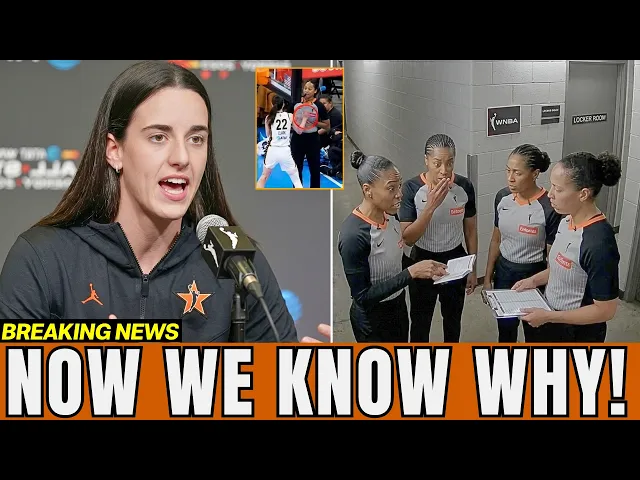
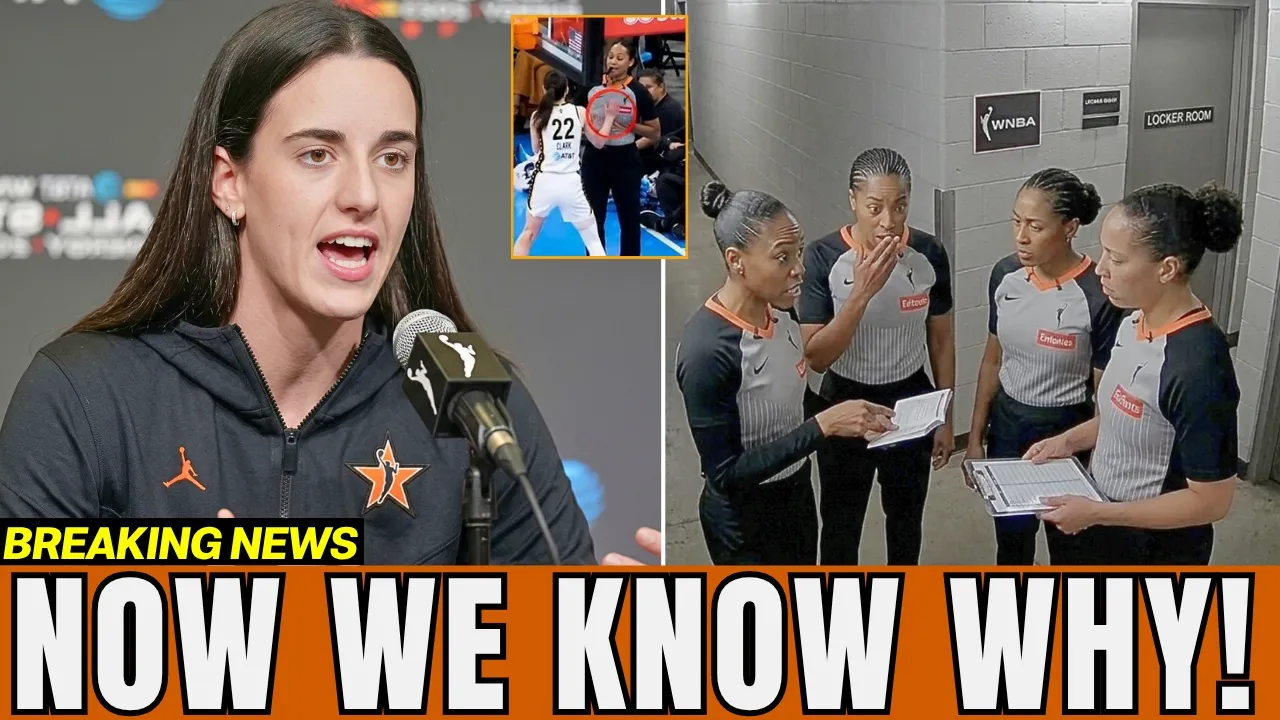
And a technical foul assessed to Caitlyn Clark. I cannot believe this. Caitlyn Clark is getting the WNB suspending Caitlyn Clark for nothing.
She didn't even say anything. Like if she was out, if she went and said something, okay, cool. But like I've never seen this before.
They caught a technical foul on Caitlyn Clark, which would have her suspended for next game versus the New York Liberty. on this. [music] She got fouled.
You She got bumped into the They think What What is that? The digital sports landscape erupted into total chaos the exact moment news broke that the WNBA league office intervened and officially rescended Caitlyn Clark's controversial eighth technical foul. Narrowly averting what would have been a catastrophic one-game suspension.
In a season defined by record-breaking television ratings, packed arenas, and relentless scrutiny, every single whistle carries monumental weight. But few incidents have sparked as much immediate fury and disbelief as the sequence that unfolded during the Indiana Fevers intense 90 to 86 victory over the Chicago Sky. Getting a foul because of reasons.
She got a technical foul for not a damn thing, folks. Not a damn thing. Momentum carried her into the ref.
She brushed up against the ref. And let me keep it real. I'm going to keep it real.
The DEI official Oh, Road said it. You heard me. The DEI official tease up Caitlyn Clark.
By the way, if the WNBA does not resend this technical, Tayen Clark is suspended for the game against the Liberty, the game against New York. When elite athletic competition intersects with questionable officiating decisions, the resulting shock waves reverberate across every major media platform, drawing millions of passionate fans into an intense debate over institutional fairness, player protection, and the arbitrary nature of technical foul assessments. Sports leagues thrive on transparent, consistent application of the rule.
But when a routine play near the baseline is catastrophically misinterpreted as an intentional physical assault on an official, the entire system faces an immediate crisis of credibility. Fans, analysts, and players alike were left staring at their screens in absolute bewilderment, [music] wondering how a standard basketball collision could possibly be twisted into a suspension worthy offense that threatened to derail a crucial matchup against the New York Liberty. And that one is going to put her above the threshold and suspend her for Indiana's game Tuesday against New York.
The roots of this massive controversy trace back to a frantic third quarter sequence where competitive intensity boiled over into an indefensible ruling by the officiating crew as Caitlyn Clark drove hard along the baseline, pushing the pace and fighting to keep the play alive under immense defensive pressure from Chicago's Natasha Cloud. Physical contact altered her trajectory, causing her to stumble out of bounds in the split-second chaos of trying to regain her balance while tracking the ball. Incidental contact occurred between Clark and a nearby referee in what can only be described as an extraordinarily harsh and disconnected reading of the situation.
The officials blew the play dead and slapped Clark with a technical foul, her eighth of the season. He's driving to the basket. She's driving to the basket.
One dribble gets fouled by Tash Cloud. Like legto-le contact gets fouled by Cloud, gets fouled again by Cloud, then gets kned by Cloud [music] and then trips over and then follows through into the referee and then walks back and then gets teed up. She got teed up for tripping and falling into the referee.
Under the strict rulebook guidelines of the WNBA, accumulating eight technical fouls triggers an automatic, non-negotiable one-game suspension alongside financial penalties, which meant this single whistle instantly put Clark's availability for the upcoming highstakes showdown against the New York Liberty in severe jeopardy. The absurdity of the call was not lost on anyone inside the arena or watching from home as slow motion replays clearly demonstrated that Clark was fighting off a hip bump from an opponent while completely offbalance making any notion of intentional contact an absolute fantasy. The immediate aftermath on the court showcased the sheer frustration of the Indiana Fever organization as head coach Stephanie White rushed to challenge the absurdity of the explanation provided by the officiating crew.
When crew chief Matt Forsber and the referee squad attempted to justify the technical foul by claiming that Clark had intentionally sought out the official and delivered a forearmmed shiver, the justification only poured gasoline on an already blazing fire. Ref who probably should be collecting trash on Tuesdays and Thursdays or whichever day your trash men pick up your trash from your curtain. First of all, if you would have called the first foul or the second foul cuz she got bumped twice on that drive which sent her into the baseline which forced her to run into you.
If you would have called one of the first two fouls, she would have never ran into you. She got fouled twice and pushed into you. If you would have called one of the fouls, this wouldn't have been an issue.
But because you are so piss poor at your job, you don't call anything. Now you're forced to Now you're talking, oh, she ran into me with her her forearm. It was what?
Coach White rightly pointed out the ridiculousness of the accusation, noting that incidental contact happens constantly in the high-speed, high impact environment of professional basketball when players are flying out of control to make plays. The frustration boiled over to the point where White herself was assessed a technical foul simply for voicing what every single person watching the broadcast was thinking the broadcast. But it they gave you the tech for bumping the official.
Is that what the description that was given to you was? Well, either of you was for me. [music] Yeah, she she uh intentionally seeped out the official.
[music] Did that's you were backwards to them? Did you Did you even know they were there in that moment? And threw it through the forearm.
That [music] too. Did you know they were there? Right behind you.
Did they give you a different explanation of any kind? No. That's what I was told.
That's what [music] I was told. Was your tech worthy arguing everything you said? My tech was for saying that's Even though I heard the fbomb the whole game.
[music] My tech was for saying that's Like that's a that's a bad that's a bad call. That's a bad call. Incidental contact when you're when you're flying out of control like on a and and I thought her teammates should have come up and and talked to her about that as well.
Like I think that's [music] really bad. Um that happens all the time in the game. Um, you know, officials have to have some awareness in those moments and it [music] didn't happen.
I presume you plan to appeal that one. Yes. Yes.
Postgame interviews captured a remarkably calm and confident Caitlyn Clark who noted that she had already reviewed the tape and trusted that common sense would prevail once the league office had an opportunity to review the footage without the heat of the live game clouding their judgment. Clark's visible composure and reassurance that the situation was already being addressed behind the scenes hinted that a swift correction was already in motion long before official word was publicly released. She said [music] that she was guarding like she said she was locking me up so I said scoreboard and the ref didn't like that.
But I mean was this was in third. Oh, how do you balance that when you know one more is a suspension and I mean like I'm never going to back down [music] and you know I think it was the same thing with the way Kelsey was in the first half too like you know she got one in the eye like she's never going to back down from a moment and I think just like continue to try to control your emotions the best you can and that intensity and that fire is what makes me me but also like knowing my team needs me and and finding a good balance of that but um you know I don't think like I'm going to be playing like with that in the back of my head. I don't think I think that might hinder my play a little bit.
So, uh, I think just continue to be myself and then just just try to refocus to, you know, focusing on my teammates and how I can help. The rapid reversal by the WNBA league office announcing the recision of the technical foul less than 2 hours after the final buzzer brought an immense wave of relief to fans and delivered a massive victory for common sense. Had the league allowed the erroneous call to stand, it would have set a dangerous precedent, rewarding poor officiating execution and penalizing a superstar player for a standard, unpreventable basketball collision.
The decision ensured that the integrity of the league's competitive landscape remained intact, keeping one of its biggest draws on the floor for a pivotal clash against a direct challenger in the standing. [music] Yet, even though the crisis was averted, the incident opened up a much larger necessary conversation regarding the overall state of officiating standards across the WNBA. [music] Throughout a grueling regular season, players endure immense physical punishment, taking hard falls, battling through physical screens, and absorbing contact in the paint nightly.
When officials begin inserting themselves into games by handing out gametering technical fouls for routine incidental contact, it undermines the flow of competition and frustrates consumers who invest their time and money into the sport. The financial and operational implications of technical fouls in the WNBA add another layer of intense pressure for athletes navigating a long demanding schedule. The tiered structure means that reaching milestones like the eighth technical foul carries not only a mandatory $1,500 fine, but also a dreaded one-ame suspension.
With subsequent technicals triggering even harsher penalties and repeated sits because the threshold is so unforgiving, every single technical foul becomes a highstakes legal battle for teams trying to protect their playoff seating and roster stability. When an incorrect call pushes a player to the brink of a suspension, the burden falls entirely on the franchise to scramble for an immediate appeal before the next game countdown expires. The speed with which this particular appeal was processed highlights just how glaringly incorrect the original floor call was, validating the outrage expressed by players, coaches, and analysts across the sports world.
[music] It also serves as a stark reminder that accountability must flow both ways in professional sport. While players are rightfully held to high standards of conduct, and sportsmanship, officiating crews must also be held to high standards of accuracy, objectivity, and situational awareness. [music] As the Indiana Fever prepare to transition focus toward their upcoming battle against New York, the cloud of this controversy serves as both a warning, and a rallying point.
Clark currently walks a tight rope, sitting dangerously close to the technical foul limit with plenty of basketball left to be played in the regular season, meaning every future contest will require an immense level of composure to avoid falling into similar officiating trap. Opposing teams are well aware of this vulnerability and will undoubtedly continue to test the boundaries of physical play, attempting to draw emotional reactions or bait officials into blowing the whistle. However, the resilience shown by the Fever Squad throughout this ordeal proves that they are more than capable of rising above external noise.
Channeling their competitive energy into dominant oncourt performances like their 46 paintoint masterclass against Chicago. The unwavering support of the fan base combined with the rapid correction from League headquarters ensures that the focus can finally shift back to where it belongs. Elite athletic execution, breathtaking assists, deep three-point shooting, and highlevel basketball battles on the hardwood.