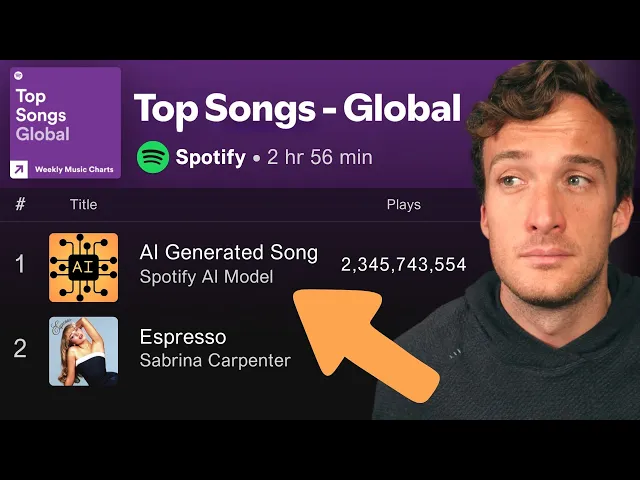
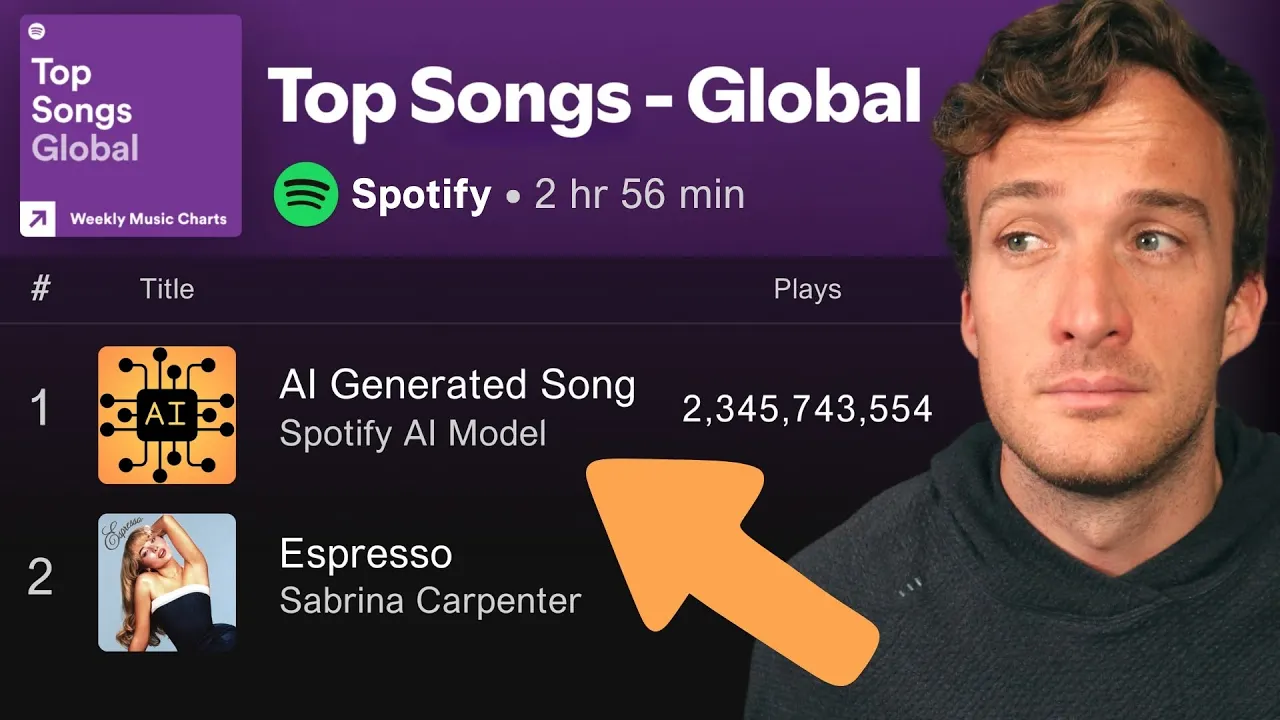
So I wanna go down a rabbit hole. What happens if AI can make better music than humans? Like what happens if the top of the Spotify charts is all AI generated music?
And I don't wanna argue about what's happening right now in AI music. I wanna talk about the future. Like I wanna talk about big picture stuff for the music industry.
I mean, the fact of the matter is that music can be converted into mathematical data using the Fourier transform. All that means is that music and sound can be converted into numbers and then that data can be fed into these AI models and algorithms. And then they can use that data to start recognizing patterns and then match those patterns with certain keywords.
And I'm not gonna pretend to know all the technical details, like most of that stuff is way over my head. But the fact is that if music can be represented by numbers, then a computer can learn how to make music. And obviously that's what's already happening now with the current state of ai.
With these like transformer models like Chat GPT, I think it's really up for debate if they can actually create anything that's completely new. Like the newest models of Chat GPT are really impressive, but they're not like finding new cures for diseases or like coming up with completely new solutions to big problems. They're more like mass information databases and like brainstorming partners.
And they're just networks that can handle a lot of data. And that's really how I see AI music right now too. Like I don't think AI music is really pushing any new boundaries and coming up with any completely new music, like that track I played you, it's kind of a rip off of rap music that I grew up listening to like Jay-Z and Kanye, like it's kind of ripping off Kanye West beats that he made like 20 years ago.
But that's not really what this video is about. This video is about what happens if all of that changes and computers can make music that's exciting and new and competing with human music. So first we gotta lay out some key players in the music industry.
So the first group is like the songwriters, producers, and audio engineers. And they actually make the product, which is music. They make the songs, then you have the artists.
And their job is really to sell and market the product. Like they could be a songwriter or producer too, but at a high level they're really the face of the brand and their job is to sell the product. And then you have record labels.
Their job is really to finance, distribute, and also help market the music. But they're really like venture capital firms. Like their job is to place a bunch of big bets on a bunch of artists and they hope that a few of those artists hit it big and they put all their financial power behind them.
And once a few artists hit it big, that'll cover the costs of all their other projects that didn't do as well. And then you have the streaming platforms like Spotify. They're really just a middleman.
Like they connect the product and the customer, they connect music with the fans and they just do it in a really convenient way with their tech platforms. And then of course there's the music fans themselves. They're the consumers whose money makes this whole machine run.
Now I think we gotta make a distinction between the for-profit corporations like the record labels and streaming platforms and the individual creators, like the songwriters and producers, like the only goal of a big corporation is to maximize shareholder value. Like even when they do something nice for employees, like if they give you a bonus or if they build a new office building for their employees, it's still just in the interest of maximizing shareholder value. But when it comes to individual creators, that's not all they're thinking about.
Like of course they wanna make money and make a living, but they also wanna make music that connects with people like they wanna be happy in their own lives, they wanna be happy with the work that they're doing. And yes, individual people that work at companies also want that. They want those same things, but the corporation itself doesn't care about that.
No one person is really in control 'cause it's such a big complex system that's working off capitalist incentives. So the question is, what happens in this system if computers can all of a sudden make better music than humans? Well, the record labels and streaming platforms are gonna be highly incentivized to generate and distribute their own AI music.
Like remember right now these companies are middlemen. They take the product that the songwriters create and they connect it with the customers who are the fans. But now with AI music, they have the power for the first time ever to create the product themselves.
They wouldn't need to pay the songwriters, producers, audio engineers anymore. They could just make the product themselves and sell it directly through the streaming platform to fans. And unfortunately, a for-profit company whose only goal is to maximize shareholder value would be completely incentivized to do this.
And if for some reason like the executives at Sony Music or Spotify decided this was against their core values and they didn't want to generate AI music, then some other company will just come along like Suno and they'll just do it instead. And I know this seems pretty dystopian, but we haven't talked about where the value in the music industry actually comes from. So what's the inherent value of a product like this water bottle?
It keeps my water cold, it's big, it's durable. Like all that stuff gives it value. Well, what's the value of the product in the music industry?
Like what's the value of music for music fans who are paying for it? And part of the value of music is actually the feeling that a song gives you. Like you can put a song on and it can instantly enhance your mood.
It can make you feel powerful, it can make you feel sad, it can make you feel understood. Music is the best form of escapism. But the problem with that, part of the value is people don't really care how music is made.
They just want that feeling. They don't really care if it's made in a million dollar studio or someone's bedroom or on a computer. They're just partly paying for that feeling.
But everything I've talked about so far is missing a big chunk in the value of the music industry. And that's actually the value of human connection. I went to like 10 concerts last year.
I bought a bunch of t-shirts and merch at them. I bought a bunch of vinyl records for my brother 'cause he's a huge music fan and he likes listening on his record player. I think a big part of the core value of music is the connection between artists and fans.
We like to follow our favorite artists on social media. We wanna know more about their story and who they are. We wanna support them and watch them grow.
We'll buy their merch, we'll buy tickets to their shows. And we just wanna pay to have unique human experiences. Even in a world where computers can make music that's just as good as humans, it can never replace the value we get from human connection.
Like the more we miss out on human connection In the virtual world, I think it's just gonna make live events and the artists and fan connection more valuable. And even with the music streaming industry, there are gonna be some people in the future that are just looking for that feeling from a song. And they'll get it from some AI manufacturer data-driven bullshit.
And that's okay. There's also gonna be people that are looking for that human connection and they're gonna follow their favorite human artists and go to their shows and buy their merch and stream their music and buy their vinyl records and they're gonna pay for VIP meet and greet experiences. I think we always like to look at the future as black or white.
Like everyone in the music industry wants to know, is AI music gonna take our jobs? Is it gonna ruin the music industry? And I think the real answer always lies somewhere in between.
AI music will provide some value to some people and human music will keep providing value to people. Now my question is for the big platforms like Spotify - what side of history do you wanna be on?