Why Antarctica is Off-Limits to You: What They're Not Telling You Get ready, the truth about Antarctica will blow your mind! For centuries, this unexplored frozen wasteland has been shrouded in mystery, hiding unexplained phenomena that will leave you breathless. From blood-red waterfalls to alien-like creatures thriving in sub-zero temperatures, UFO sightings, and pyramids buried beneath miles of ice, the last wilderness on Earth is a hotbed of the unexplained.
But that's not all - lost mountain ranges, subglacial lakes, and dinosaur graveyards lie hidden beneath the ice. And if that's not enough, scientists have discovered evidence of unidentified humanoid creatures and ancient artifacts hinting at civilizations beyond our understanding will leave you questioning everything. What other Lost Civilizations: The Piri Reis Map Can you believe that the same continent now inhabited by just 4000 scientists and military personnel was once home to a vibrant population?
It's hard to fathom, but the frozen desert we think we know was once teeming with life and possibly even a thriving civilization. And yet, one discovered artifact from ancient times would have us believe this. In fact, one of the most compelling theories surrounding Antarctica centers on the potential existence of ancient, advanced civilizations that once thrived on this remote continent.
This idea took shape in the early twentieth century with the discovery of the Piri Reis map, created in 1513 by the renowned Ottoman admiral and cartographer Ahmed Muhiddin Piri. What makes the Piri Reis map so remarkable is the level of detail it contains, including the accurate rendering of geographic features that were thought to be covered in ice. Some researchers believe that the map may have been based on much older source material, potentially dating back thousands of years.
But others speculate that there may have been an advanced civilization, long since lost to history, that once inhabited Antarctica and possessed a sophisticated understanding of its great landmass and geography. They speculate this because the map appears to depict the coastline of Antarctica with startling accuracy—a feat that should not have been possible, given that the continent was not officially discovered until the early 19th century! You might be wondering why it took so long to discover the frozen continent.
The story is far from straightforward, and the answer lies in a series of brave adventures plagued with danger and mystery. Let’s take a quick look at some! Harrowing Expeditions From the harrowing saga of Ernest Shackleton's Endurance Expedition to the ill-fated Terra Nova Expedition led by Robert Falcon Scott, the tales of the explorers who ventured south to discover the continent of Antarctica have become the stuff of legend.
In the epic journey of Shackleton, he and his crew were stranded on the ice for over a year after their ship was crushed and sunk. The crew used their ship’s sails to make tents, ate their sled dogs when they ran out of supplies, and achieved incredible feats of seamanship navigating treacherous waters in tiny lifeboats to reach safety. The story does not end so well for Robert Falcon Scott, who after a failed attempt called the Discovery expedition that ended in 1904, decided to embark on another great expedition to discover the frozen continent.
This expedition, named the Terra Nova Expedition, ended tragically when Robert Falcon Scott and his four companions succumbed to extreme cold, exhaustion, and starvation. Scott and his team perished just miles from their destination. His journal entries, documenting their struggle and final moments, are preserved and maintained by the Scott Polar Research Institute (SPRI) at the University of Cambridge in England and provide a haunting glimpse into the last moments of these brave men as they succumbed, one by one, to the unforgiving Antarctic environment.
It’s no wonder the continent is riddled with mysteries and stories buried under the ice, some of which are so bizarre as to sound made up, but are in fact shockingly true. For instance, what does an icy desert have in common with Nazi officials, aliens, and the end of the world? Keep watching to find out.
But before we get into that, please be sure to subscribe to the Insane Curiosity Channel if you haven't already. By hitting the subscribe button and clicking the notification bell, you'll be alerted whenever a new video is uploaded. This helps support the channel and ensures you don't miss out on future high-quality content!
Mind-Blowing Expeditions and Controversies The icy deserts of Antarctica are some of the most desolate regions of the world and yet there is no shortage of mysterious stories that surround them. From rumors of a supposed Nazi base in the continent in the mid-twentieth century to the hypotheses of flat earth theorists to the fiasco of the ill-fated Operation Highjump, theories constantly pour from this icy desert into the public consciousness. The origins of these theories can be traced back to the end of World War II, when several Nazi officials and scientists were reported to have fled to Antarctica and speculations abounded that the Third Reich may have established secret outposts in this remote and inhospitable region.
Some people think they set up a covert base in Antarctica, where they transported Hitler at the end of the war and battled against the U. S and British special forces, in part by deploying flying saucers to shoot down US planes, a battle which ended in the 1950s when the Americans used nuclear weapons to destroy the base. But there are some who believe that Antarctica is not a continent at all, but rather a vast ice wall that encircles the entire Earth.
Adherents of this belief are usually flat-earthers who claim the wall holds the oceans in place and acts as an impenetrable boundary to the known world, guarded by an international military coalition determined to keep the public from uncovering the truth about the Earth's true shape. These and other speculations have been fueled by bizarre public expeditions such as Operation Highjump. In the late 1940s, the U.
S. Navy launched the operation officially billed as a training exercise and scientific research expedition but the sheer scale of the operation, coupled with the sudden and unexplained withdrawal of the fleet, drew eyebrows across the world and led some to believe that the true purpose was something far more extraordinary. The details surrounding Operation Highjump are shrouded in mystery.
The expedition, led by Rear Admiral Richard E Byrd, involved a staggering 4,700 men, 13 ships, and multiple aircraft – a scale that was unprecedented for Antarctic exploration at the time. And yet, after just a few months, the mission was abruptly terminated, with Byrd and his crew making a hasty retreat from the continent. What exactly happened during those few months that prompted such a sudden withdrawal?
Some speculate that the expedition may have been searching for hidden Nazi bases, or even investigating reports of extraterrestrial activity in the region, buoyed by reports of strange sightings of U. F. Os and unexplained phenomena in the skies over Antarctica.
Of course, mainstream scientists and historians dismiss these outlandish claims as pure fantasy, but humanity’s fascination with the unknown has ensured that these myths continue to endure. But if you think these mysterious stories from Antarctica's past are bizarre, wait till you hear about the present breathtaking features that have perplexed scientists and explorers for centuries. The Wonders Of Antarctica A sight at once terrifying and awe-inspiring.
From the Taylor Glacier in the McMurdo Dr Valleys, blood appears to ooze as if from a wound at the head of the ice, dropping five stories down into Lake Bonney below—an eerie scene. For decades, this sight puzzled early explorers who thought the red water was a sign of a cursed land or an evil presence within the glacier. But from the early 20th century, as scientific exploration of Antarctica increased and more research was conducted, natural explanations began to take hold such as the presence of red algae in the water.
Ultimately, advancements in technology enabled more detailed geochemical studies through which scientists discovered something fascinating. They discovered that the water flowing from Blood Falls was rich in iron which, when it met the oxygen in the air, oxidized and created iron oxide—commonly known as rust—and imparted the water an eerie reddish coloration, which then appeared to "bleed" from the ice. The highly saline, iron-rich water trapped beneath the glacier's surface was key to unlocking this mystery.
Over the course of millennia, this ancient, hypersaline brine became isolated from the outside world and harbored a unique ecosystem of extremophile microbes. As the subglacial brine is exposed to the air, the iron within the water rapidly oxidizes, giving rise to the extravagant bloody hue that continues to marvel all who behold the sight to this very day. Apparently, everything behaves bizarrely on this continent.
Even gravity appears to take on a mysterious character. In the Wilkes Land Gravity Anomaly, a region off the coast of East Antarctica, it’s been confirmed that a puzzling and dramatic increase in gravitational pull can be felt, hypothesized to be the result of a massive impact crater left behind by a colossal meteor strike that occurred millions of years ago. But some of the marvels of the frozen continent are almost paradoxical.
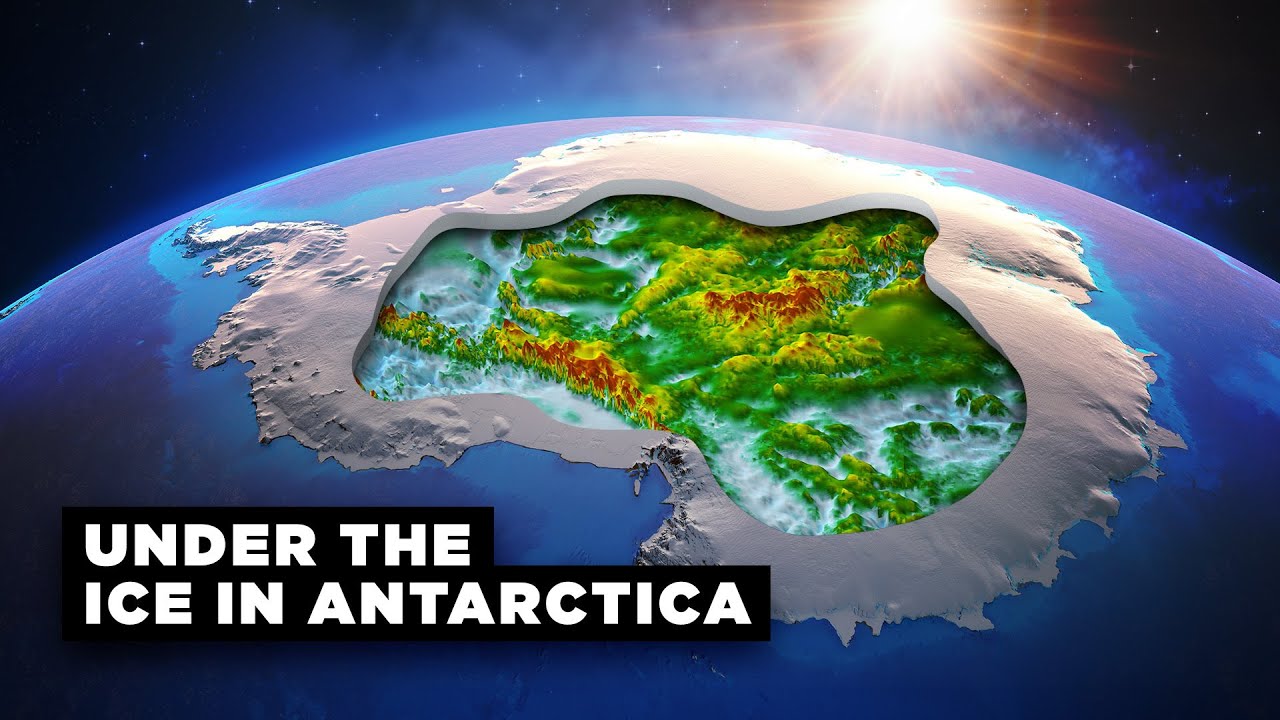
For instance, nestled deep beneath the ice sheets of East Antarctica are over 400 lakes which are part of a vast and complex hydrological network believed to have been isolated from the outside world for millions of years, potentially preserving a unique and highly specialized ecosystem. By far the most famous of these is Lake Vostok, one of the largest subglacial lakes in the world, located beneath Russia's Vostok Station. Lake Vostok, which is buried beneath more than two miles of solid ice in the heart of East Antarctica, has long been a subject of intense scientific fascination.
Spanning an area roughly the size of Lake Ontario, it is thought to harbor unique microbial life forms that have evolved in isolation. Organisms that, if found, would provide insights into how life can survive in extreme environments and offer clues about the potential for life on other planets and moons, such as Jupiter's icy moon Europa. Exploring Lake Vostok however has been a challenging and technically demanding endeavor, requiring the development of complex drilling operations to penetrate the thick, overlying ice.
But who knows what hidden wonders scientists will find the deeper they reach into those isolated waters? Speaking of hidden wonders, did you know it was possible for an entire mountain range to exist and yet go completely unnoticed? Well, strap in, you’re about to learn something that will blow your mind.
The Hidden Wonders The vast expanse of the Antarctic ice sheets is seemingly desolate and featureless. But beneath them, lie something utterly mind-blowing—some of the most extraordinary geological formations on the planet. Chief among these hidden wonders is the Gamburtsev Subglacial Mountains, which are a vast range of towering peaks that rival the majesty of the Alps and yet are completely buried beneath kilometers of ice.
This hidden mountain range, which was first detected through airborne geophysical surveys in the 1950s, extends for over 1,200 kilometers across the East Antarctic Ice Sheet and is believed to have formed through a complex tectonic history that science has yet to completely understand. Equally remarkable are photographs of structures discovered in places such as the Ellsworth mountain range in 1935, which appear to be large pyramid structures similar to the Giza pyramids. While many have theorized that these pyramids are remnants of ancient civilizations such as Atlantis, geophysical research has revealed that they are actually the summits of massive mountains that, like icebergs, have the majority of their shape hidden in ice.
But perhaps the most important secret buried within the ancient ice of Antarctica is a priceless record of the Earth's climatic history, preserved in the form of ice cores. These frozen time capsules provide a wealth of information about past environmental conditions, including temperature fluctuations, atmospheric composition, and the cycling of greenhouse gases. The ramifications of this discovery are astonishing.
See, by analyzing the chemical signatures and trapped air bubbles within these ice cores, scientists have been able to piece together a detailed narrative of how the global climate has evolved over the course of millennia, data that has helped illuminate natural climate cycles as well as helped to contextualize the rapid, human-induced changes in more recent decades. The clues to our climatic past are all right there, beneath the ice. And the implication of this in terms of understanding the Earth’s complex climate system is profound.
Essentially, by deciphering the information stored within these ancient glacial archives, researchers can gain critical insights that can inform our strategies for mitigating and adapting to the challenges posed by the ongoing climate crisis. These and other wonders of Antarctica are not readily accessible to the human eye. Some wonders of the continent, however, are so visually stunning, they will leave you in awe forever.
What Are Other Wonders Of This Mysterious World? Indeed, most of Antarctica is a monochromatic landscape of ice and rock, but for those who know where to look, pockets of ethereal beauty emerge. For instance, in certain regions of Antarctica, such as the Transantarctic Mountains and the Dr Valleys, we encounter something unique—the sight of stunning formations of ice that are completely blue.
This vivid, azure hue is the result of the ancient, highly compressed ice that has been stripped of air bubbles, allowing the scattering of light to create a mesmerizing effect. The formation of these blue ice features is further enhanced by the unique climatic conditions that prevail in these areas. One such phenomenon is the katabatic winds, which are powerful winds driven by gravity that flow from the high interior of the continent towards the coast.
As the ice is scoured and sculpted by these intense winds, the resulting formations can take on a wide range of captivating shapes and patterns, from towering seracs to intricate, lace-like structures, their shimmering, translucent quality combining with the setting to produce a visual spectacle that is both breathtaking and humbling, reminding viewers of the raw, untamed power of the natural world. But despite these wondrous mysteries, discoveries, and secrets, it is clear the continent of Antarctica still has many more secrets to share, waiting underneath the ice to be discovered. Scientists studying Antarctica hope to uncover the mysteries of Earth's magnetic field by studying ancient rock formations and there are also ongoing investigations into the continent's role in global ocean currents and their impact on weather patterns worldwide.
Those who theorize that, hidden beneath the ice, there could be remnants of ancient alien civilizations or advanced technologies waiting to be discovered, have not given up their explorations. Antarctica, the final frontier, holds its breath, waiting to reveal its untold stories to those who listen. Over to you!
What do you think could be hidden beneath Antarctica's vast ice sheets that scientists have yet to discover? Do you believe there's a possibility of ancient civilizations or alien technology buried in the icy depths of Antarctica? Why or why not?
Feel free to leave your answer in the comments below. If you like this video, then here’s another you might like. Could Human Civilization Survive A New Ice Age?
Thanks for watching!