Hi everyone! Today, instead of dealing with a grammar topic, we decided to make a sort of tutorial on: HOW TO WRITE A FORMAL EMAIL. Yeah, nowadays, anyone sooner or later finds himself/herself having to write an email to a professor, employer or to a person we don't know.
. . But don't worry: with this video, you won't have any other problem writing a formal email!
Let's start immediately! The first thing to keep in mind when writing an email is the subject. In fact, the subject is the first thing that our recipient will read!
So, if not written well, it risks not attracting attention or worse, throw away your email as spam. And we don't want the email to be trashed even before opening it, right? So, to prevent our email from being deleted, we must always write a subject that is clear, explicit and concise.
That is, with a few simple words that describe the content of our email, without too manh details. Therefore, if for example we have to submit a job application and we need to send an email with our curriculum vitae, the subject could be: "Candidatura lavoro" or "Curriculum Vitae". Simple and concise.
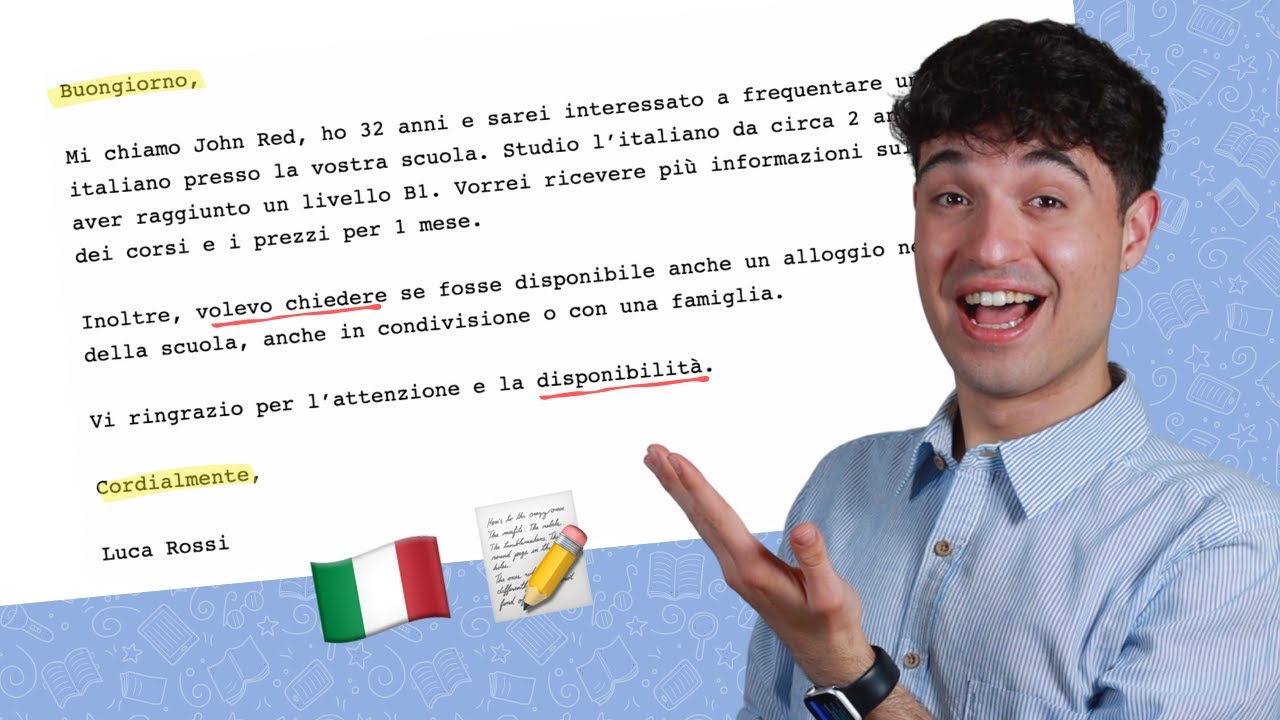
But now let's move on to the actual email! First of all, we need to take care of greetings, because we can't start our formal email with a simple "ciao"! Oh no, when we write a formal email we must first use an adjective to express reverence (as it can be for example EGREGIO, SPETTABILE, GENTILE), followed by the title and the name of our recipient.
EGREGIO and SPETTABILE are more appropriate when you are writing to a person who you don’t know at all or who deserves particular reverence. So, for example, the rector of a university, a potential employer or, I don’t know, the President of the Republic. While GENTILE is more suitable when we already know the person we are writing to and we have some kind of relationship.
I'll give an example, if we write to one of our professors, with whom perhaps we have already spoken earlier, we can use at the beginning the adjective GENTILE. Or if by chance we have to write to one of our work colleague, with whom we aren't friends, but we already know each other. As for the title instead, if we don't know the role of our recipient, we can simply write "signore" or "signora" using these abbreviations.
If we know his/her role, we can use his/her profession directly, then write for example "professore", "professoressa". Or "dottore", "dottoressa" with these abbreviations, and so on. At this point, it will be enough to add the name and surname of the recipient or simply the surname, followed by a comma.
Therefore, we could start our email by writing: "Gentile professor Rossi", comma, or "Egregio dottor Mario Pinco", comma, and so on. Ah. .
. but there's another formula too! "ALLA CORTESE ATTENZIONE DI".
This formula can be used in all cases, but it's perfect when we aren't writing to a person, but for example to an office. In this case, in fact, it would be a little inappropriate to use one of the adjectives mentioned previously. Yes, in fact, for example, we could, in case we had bought a faulty product, want to write an email to the sales department or the complaints office starting with the formula "Alla cortese attenzione del reparto commerciale" or "Alla cortese attenzione dell’ufficio reclami".
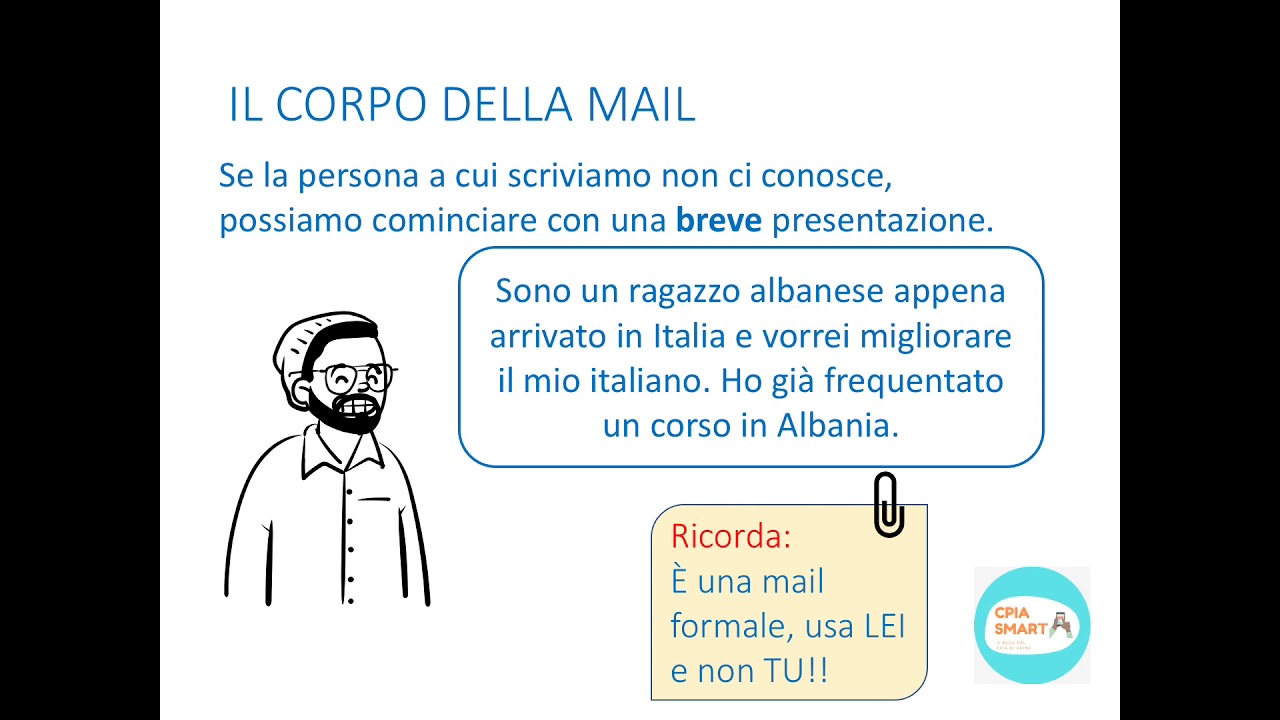
Well, finish greetings, start a new sentence and start writing the body of the email! In the body you must, in case the person doesn't know you, start with your short presentation. Then you can proceed, if the person doesn't expect an email, apologizing, for example with a formula come "Sperando di non arrecarle alcun disturbo.
. . " and then proceed going straight to the point explaining the reason why you are writing the email.
Yes, for example, "Le scrivo in merito a. . .
", "La contatto per illustrarle. . .
", "Le scrivo questa email perché. . .
". Ah, and don't forget to always use the form of courtesy, that is the formal Lei, and, consequently, conjugate all verbs in the 3rd person singular. Other small tips that we can give you are: be clear but brief.
You aren't writing a novel, but an email! So don't risk boring your recipient! And don't forget to be organized.
So, as a result, try to divide the body of the email into paragraphs. It will certainly be smoother. Pay attention to punctuation and to lexicon, but also to spelling and grammar.
You don't want to give a bad impression, do you? In this regard, if you have already written an email but you have doubts and want to correct it before sending it, you can write it here in the comments and we will correct it! Right?
Sure! And finally, I remind you to always report the possible presence of attachments, with formulas like for example "Allego alla presente il file con. .
. ". Finally, once the body of the email is finished, it's necessary to go to the final greetings.
How to be taken formally? The most used formulas are: "Distinti saluti", "Cordiali saluti" or "Cordialmente". But you can also use formulas to invite the recipient to reply.
Like for example "In attesa di un suo cortese riscontro, la saluto cordialmente" Or "In attesa di una sua cortese risposta, la saluto distintamente". Immediately after, a nice comma and a full stop! So, sign with your name and surname!
Perfect! Now your email is ready to be sent. However, if you want to check or take a look at a complete example of a formal email, just go to our website, where you can read it calmly.
Ah, but don't forget also to follow us on our Facebook, Instagram and Twitter pages for many other tips and useful contents! See you next time! Bye!