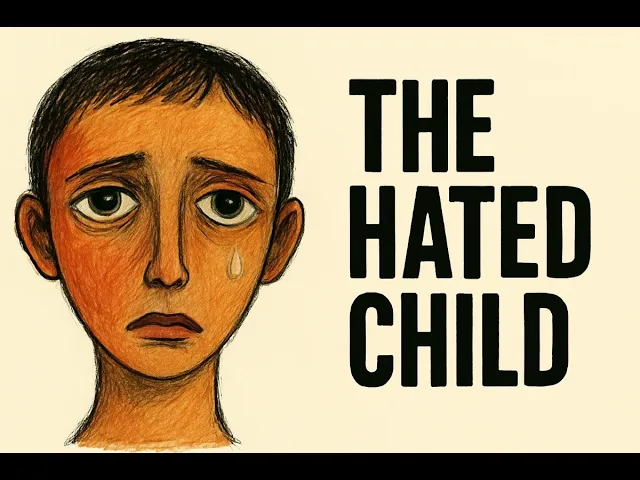
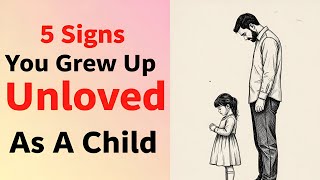
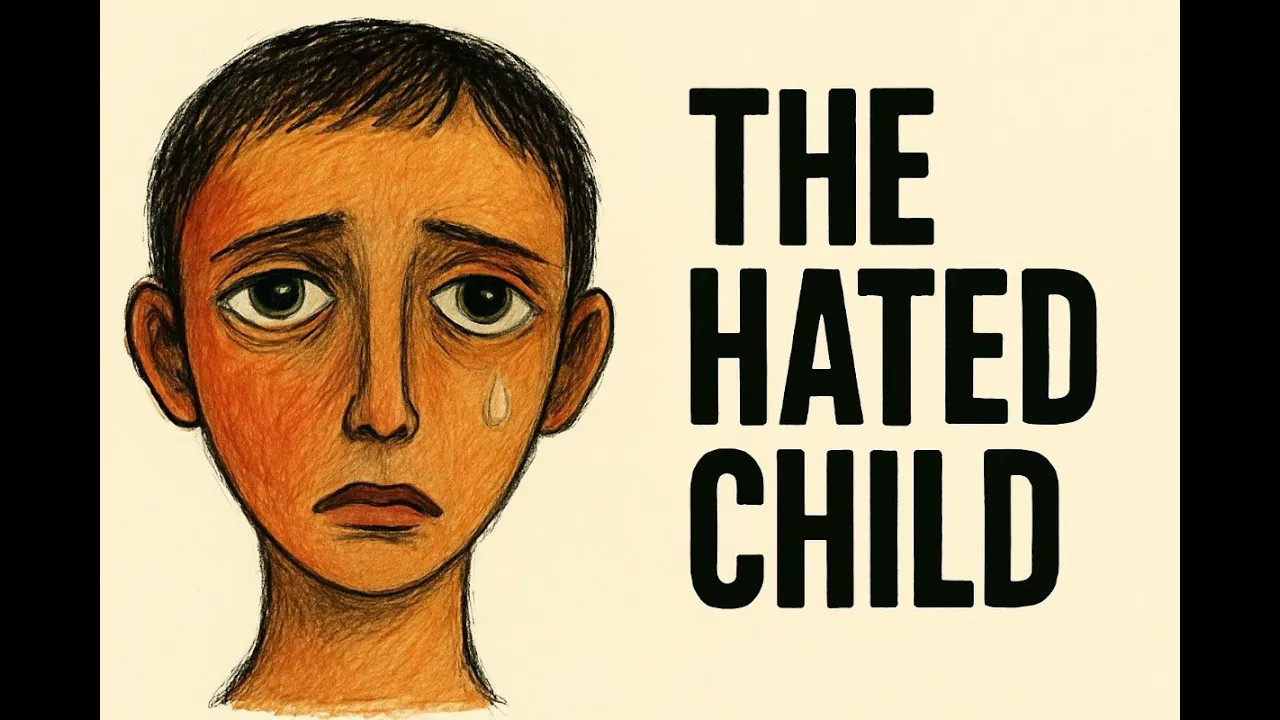
A little boy sits at the dinner table. He doesn't talk much because he knows if he says the wrong thing, the room will go quiet and eyes will turn sharp. He stares at his plate, moving food around, hoping to disappear.
His sister gets a smile for sharing her day. His brother gets encouragement for his grades. But when he speaks, it's different.
The air stiffens. His words are treated not as mistakes, but as offenses. He feels like an intruder in his own home.
This is the silent reality of the hated child. Not always hated in words, not always hated in actions, but hated in energy, in the subtle cues, in the sigh when they enter the room, in the way their presence feels like a disruption rather than a welcome. And for many people, this is not a scene from a story.
It is memory. [Music] The human heart is born seeking belonging. It seeks warmth, safety, and acceptance.
A child does not arrive into the world with walls. They are open, fragile, hungry for love. When that love is withheld or worse replaced with resentment, the child does not merely feel unloved.
They feel unworthy of love. That difference is everything. Because unloved is a condition.
But unworthy that becomes an identity. Psychologists have long studied the impact of childhood rejection and neglect. John Bulby, the father of attachment theory, wrote that a child's first bonds form the blueprint for all future relationships.
When those bonds are warm, the child grows with confidence. When they are cold or hostile, the child internalizes that rejection, carrying it into every corner of life. The hated child becomes the adult who still flinches even when no one is raising a hand.
And here's what makes it more complex. The hated child often doesn't even realize they were hated. Because to a child, parents are not just caregivers.
They are reality itself. If a parent shows disdain, the child doesn't think my parent is flawed. The child thinks I must be flawed.
Their mind bends to protect the bond. The pain becomes self-lame. The rejection becomes selfidentity.
This is why hated children often grow into adults who struggle with the same quiet questions. Am I enough? Do I deserve love?
Why does connection feel so difficult? One of the crulest aspects of being the hated child is comparison. When love is unevenly distributed among siblings, the hated child notices.
They notice who gets praised, who gets celebrated, who gets held with softness. And they notice that when it comes to them, the tone changes. It's not always dramatic.
It can be subtle. Less eye contact, less patience, less celebration of small victories. But to the child's nervous system, it is unmistakable.
This kind of environment conditions the child to expect rejection even in safe places. A teacher's criticism, a friend's distance, a partner's bad day, all of it can feel like proof of what they always suspected. I am not wanted.
Studies in developmental psychology confirm this. Children who experience parental rejection often score lower in measures of self-esteem and higher in anxiety and depressive symptoms. But it doesn't stop there.
Rejection impacts how the brain processes social cues. In other words, the hated child grows into an adult who sees rejection even where it does not exist. The lens of childhood colors the vision of adulthood.
Now, here's something fascinating. Many hated children develop what psychologists call compensatory strategies. They try to earn love in the ways that were denied to them.
Some become perfectionists, believing that flawless achievement will finally make them worthy. Others become people pleasers, molding themselves into whatever shape might gain approval. And some go the opposite route, adopting rebellion as armor, pushing others away before they can be pushed first.
But underneath all these strategies lies the same wound. I was not accepted as I am. Perfection, rebellion, compliance.
These are masks. They are survival mechanisms, not identities. Yet the hated child often forgets this distinction.
They confuse the mask with the self. They live for decades under the weight of a role they never consciously chose. Why does this matter?
Because silence creates repetition. Children who grow up rejected often learn not to talk about it. They fear that speaking about the pain will only prove their defectiveness.
But unspoken pain does not disappear. It hides. It fers.
It shapes choices. For example, a hated child may unconsciously choose partners who recreate the same emotional dynamic. Critical, withholding, dismissive, because it feels familiar.
The brain gravitates toward what it knows even when what it knows is harmful. This is how the cycle repeats across generations. Not because anyone wants it to, but because unhealed patterns echo forward.
And if we step back, we see that this is not just about families. It is about society, a culture that does not recognize or value emotional safety, often produces parents who themselves were once hated children. Trauma echoes until someone chooses to stop the cycle.
Let's look at this from another angle. biology. When a child feels rejected, their nervous system interprets it as a threat.
Stress hormones like cortisol flood the body. Over time, this repeated stress response literally reshapes brain pathways. Research from neuroscience shows that chronic childhood rejection is linked to heightened activity in the amygdala, the brain's fear center, and reduced activity in the preffrontal cortex, which regulates emotional responses.
What does this mean in daily life? It means the hated child grows up hyper alert, scanning constantly for signs of rejection. It means they may overreact to small slights, not because they want to, but because their nervous system has been trained that way.
It means peace feels foreign and chaos feels familiar. And yet, here is the paradox. The hated child often becomes remarkably sensitive to the emotions of others.
They can read a room with uncanny accuracy. They sense moods before words are spoken. This is not magic.
It is survival. When your safety depended on predicting rejection, you learn to become a master of perception. Here's the tragedy most people miss.
The hated child is not always visibly mistreated. Sometimes they grow up in families that look normal from the outside. There are birthdays, vacations, even laughter.
But inside they feel unseen, excluded, or perpetually wrong. This invisibility can hurt even more than open hostility because there's no clear proof. There's nothing they can point to and say, "See, this is why I feel this way.
" So, they question themselves. They doubt their own memory. They think, "Maybe I'm overreacting.
Maybe I'm just sensitive. " Gaslighting is not always intentional. It can be built into the very structure of a family dynamic.
This internalized doubt follows them into adulthood. They might achieve success, build relationships, even create families of their own, but deep down they carry an ache that whispers, "Something is wrong with me. " Fast forward, the hated child is now 30 or 40 or 50.
They may not think of themselves as a hated child anymore, but the echoes remain. They show up in relationships, fear of abandonment, difficulty trusting, and almost magnetic pull toward unavailable people. They show up in careers overworking, fearing failure, doubting their worth even after achievements.
They show up in self-t talk, harsh, unforgiving, echoing the voices they grew up with. This is why healing is not about erasing the past, but about understanding it. To see the patterns clearly is the first step in breaking them.
Let's pause here and step back. Why does rejection cut so deep? Why does being the hated child shape a life so profoundly?
Because love is not optional for a child. Love is oxygen. Acceptance is food.
Belonging is shelter. Without it, the soul does not just ache. It suffocates.
And unlike physical needs, emotional deprivation is invisible. There are no bruises, no broken bones, only a quiet erosion of the self. Philosophers like Surin Kirkagard wrote about despair as the sickness of the soul, the condition of being unable to become oneself.
For the hated child, despair begins not with grand tragedies, but with small daily dismissals. A sigh, a look, a silence. And from these moments, an identity is formed.
But here's the hidden truth. The identity of the hated child is not the essence of the child. It is a scar, not the skin itself.
And scars, while permanent in history, do not have to dictate destiny. The hated child does not only carry wounds, they also carry gifts. Their sensitivity can become empathy.
Their loneliness can become creativity. Their resilience born from surviving rejection can become courage in the face of life's storms. History is full of people who transformed rejection into vision.
Many great artists, thinkers, and leaders were once children who felt unwanted. They turned their pain into fuel, their alienation into insight. This is not to glorify suffering, but to point to a possibility.
The hated child can grow into an adult who sees the world with unusual clarity precisely because they were forced to question belonging from the start. We've traced the roots of the hated child. The early rejection, the quiet comparisons, the invisible wounds that stretch into adulthood.
But the story doesn't end there because human beings are not just the products of their past. We are also the authors of our future. And the hated child though shaped by rejection can still rewrite their life.
The first truth is this. Yes, the cycle can be broken. But it does not break by accident.
It breaks by awareness. Healing begins when the adult recognizes the child they once were. Not to blame parents endlessly, not to wallow in old wounds, but to see clearly what happened.
Because what is not seen is repeated. What is denied remains alive in the shadows. Psychologists call this process reparing.
It means offering to yourself as an adult the care and compassion that you never received as a child. It sounds simple but it is profound. Reparenting is saying to yourself, you are worthy.
You are lovable. You belong. Words you may never have heard, but words that your nervous system desperately needs to absorb.
Naming the experience is a powerful step. When you can say, "I grew up as the unwanted one," something shifts. The fog begins to clear because what was once felt as vague shame, something is wrong with me, is revealed as a wound with a cause, and wounds with causes can be treated.
Studies on trauma show that simply putting experiences into words reduces their emotional intensity. Language brings order to chaos. Naming transforms a private ache into a shared reality.
It allows the hated child, now adult, to understand this was not my fault. It was something that happened to me. Attachment theory tells us that early rejection wires the brain to expect more rejection.
But here's the good news. Attachment styles are not fixed. With intentional relationships, whether through therapy, friendships, or loving partnerships, people can build what psychologists call earned secure attachment.
This means that even if you began life doubting love, you can relearn it. The nervous system can be rewired. The brain can form new pathways.
Science confirms what the human heart has always hoped. It is never too late to feel safe. But healing requires compassion, especially self-compassion.
Dr Christine Nef's research on self-compassion shows that treating ourselves with kindness in moments of pain reduces anxiety, depression, and shame. Yet for the hated child, compassion can feel foreign. Criticism feels familiar.
Harshness feels normal. To practice self-compassion is to break an old pattern. It is to say, "I will not treat myself the way I was once treated.
" And each small act of gentleness, resting when tired, forgiving a mistake, speaking kindly to yourself, becomes a rebellion against the old identity. Remember how the hated child becomes finely attuned to others emotions? That same sensitivity when healed becomes a gift.
Empathy, intuition, depth of understanding. These qualities make for remarkable friends, partners, artists, and leaders. What once was survival can become strength.
The hated child, in other words, is not doomed to be broken. They are invited to transform, to turn rejection into insight, silence into expression, pain into connection. But what about families?
What about when the hated child becomes the parent? Here lies another opportunity. Because many adults who were once rejected vow to never let their children feel the same.
Some succeed, pouring unconditional love into their kids, breaking the chain for good. Others struggle because unhealed wounds echo forward. But again, awareness is the key.
When a parent recognizes, I was once the hated child, they can pause. They can ask, "Am I projecting my pain onto my child? Or am I choosing differently this time?
This pause, this awareness is where cycles end. " Let's step back again to the philosophical. Why does being hated cut so deep?
Because human beings are wired for belonging. Aristotle called us social animals. Modern neuroscience confirms it.
Our brains are designed to connect. Loneliness registers in the brain as physical pain. Rejection activates the same neural pathways as injury.
So when a child is rejected, it does not just hurt emotionally. It hurts biologically. It feels like a wound because it is one.
A wound in the most fundamental fabric of human existence, the need to belong. But here's the hopeful truth. Belonging can be rebuilt.
Not always with the family of origin but with chosen family with friends with communities where you are seen and valued. Belonging is not limited to blood. It can be chosen, created, cultivated.
So what is the transformation? It is the shift from victimhood to authorship. The hated child begins life as a victim of circumstance.
But healing invites them to become a creator of circumstance. Instead of asking why was I unwanted, the healed adult asks, "What kind of life do I now choose to build? " This is not denial of pain.
It is integration of pain. It is saying, "Yes, I was rejected. Yes, it shaped me.
But it does not define me. " That is the turning point. To ground this in the practical, let's highlight a few steps any hated child, now adult, can take.
Awareness journaling. Write out memories of feeling unwanted and then write the truth beneath them. It was not my fault.
I was worthy of love then and I am worthy now. Therapeutic relationships. Seek therapy or safe friendships where consistent acceptance can rewire your nervous system to expect safety.
Boundaries. If old family dynamics continue to wound you, practice setting boundaries. Healing does not require endless exposure to rejection.
Self-expression, art, writing, music. These outlets turn silent pain into visible creation. Expression is the opposite of erasia.
Compassion practice daily. Speak to yourself as you would to a child in pain. This simple shift reshapes identity over time.
The hated child begins life marked by rejection. But rejection need not be the final story. History shows us countless examples of individuals who began unwanted yet transformed their lives.
Some became visionaries. Some became healers. Some simply built quiet, loving families of their own.
The common thread, they refused to let rejection remain the final word. And maybe that is the lesson for all of us. Even if you were once the hated child, even if you still carry the ache of being unwanted, you are not condemned to live there forever.
You can choose a different ending. You can choose to belong first to yourself and then to others who see you truly. So let us return to the image we began with.
The little boy at the table staring at his plate feeling invisible. Perhaps that boy is still within you. Perhaps that girl still waits to be seen.
The invitation now is simple. Look at them. See them.
Tell them what no one else did. You are worthy. You are enough.
You belong. Because healing begins the moment the hated child is finally met with love. Not borrowed love, not conditional love, but love that says, "You exist, therefore you matter.
" And maybe that is the deepest truth. The hated child is not truly hated. They are waiting, waiting for someone, perhaps even themselves, to finally say yes.