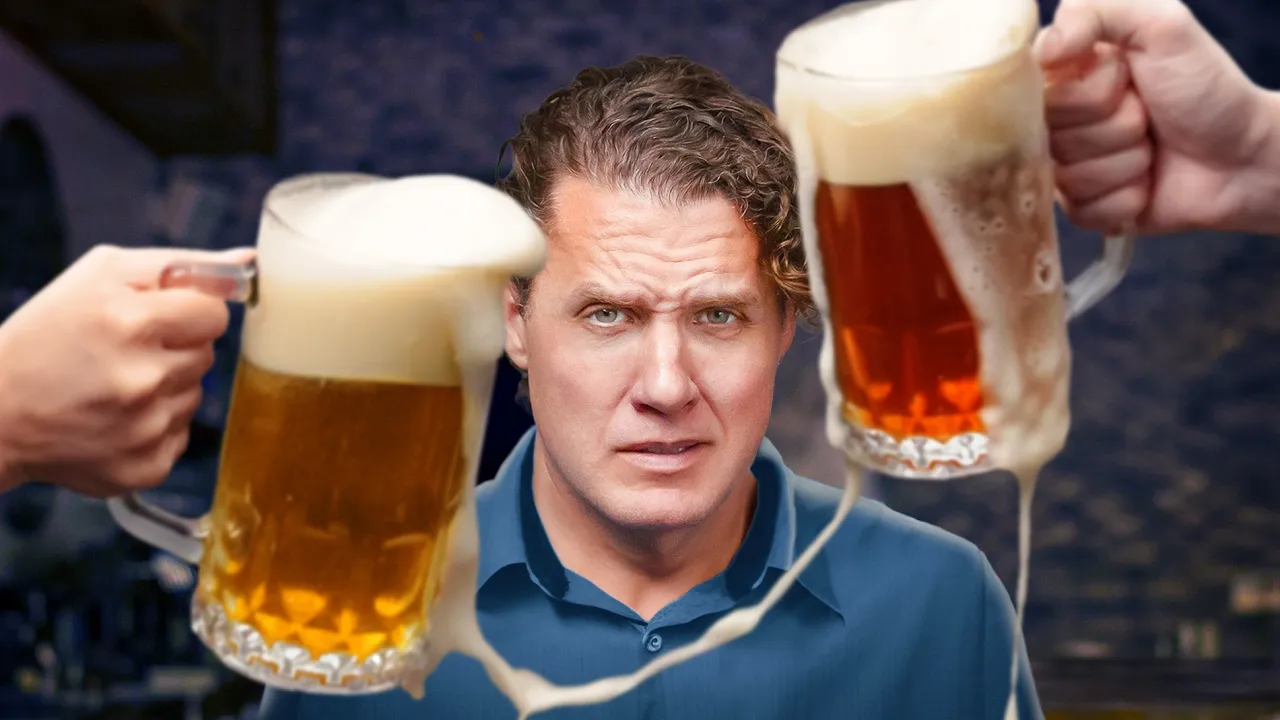
- My name is Mark Manson, and I'm trying to stay sober in the drunkest country in the world. (crowd yells indistinctly) Alcohol, the most addictive substance in the world. - Woo!
- But which country is the most addictive of all? Well, it depends how you measure it. The country that consumes the most alcohol, that's Romania.
It's 17 liters per person. The country that binge drinks the most often, Ireland, with roughly 48% of its population binge drinking at least once a month. The country with the most alcohol-related hospitalizations, Belarus.
The most drunk driving accidents, South Africa. But there is one country that outstrips the drinking of all these other countries by a mile. And this country flies under the radar on these official statistics.
And that's because nearly half of all alcohol made in this country isn't bought in bars, but it's made by citizens right in their own homes. I wanted to see this drunkest country in the world for myself. I wanted to understand why they drink so much, what's driving that alcoholism and why they can't seem to stop.
And that's why I visited Hungry. Hungary's drinking problem is absolutely staggering. Chronic alcohol consumption contributes to nearly 30% of its total deaths each year.
And according to the World Health Organization, this country tops the world in rates of alcoholism with a shocking 21% of the adult population diagnosable as having an alcohol abuse disorder. I had to come here to understand why. What is it about Hungarian culture that makes it so drunk all the time?
What are the social factors leading to the rampant addiction and what can they do to move past it? Why do you think Hungarians drink so much alcohol? - I don't know.
It's a good question. - Are you drunk right now? - Kind of.
- (laughs) It's okay. You can be honest. - Kind of.
- I feel like in Hungary, usually the kids start to drink and smoke at the age of like 14. - Okay. When did you start drinking?
- When I was 12, maybe. - 12? - Yes.
- Oh, wow. Do you know that Hungary has the highest percentage of alcoholics? - Yeah.
It's understandable. A lot of people get their happiness from alcohol, so, yeah. - And what time today did you start drinking?
- It was second o'clock in the afternoon. - Two o'clock? - Yes.
- So you've been drinking for 12 hours. - Yes. - And you're still like, you're very functional.
- Yes, yes, yes. (Mark laughs) A 2006 study published in the Archive of Pediatrics and Adolescent Medicine showed that the earlier in life someone has their first drink, the more likely they are to become an alcoholic in adulthood. And another study in 2010 by Ryan et al found that growing up with parents who encouraged alcohol consumption resulted in more alcoholism later in life.
But it couldn't be that simple. Plenty of countries start their kids drinking early. I'm doing a YouTube video about Hungary.
- Yeah? - And the drinking culture in Hungary. - Oh yeah.
- Hungary has the most alcoholics in the world. - Yeah. we know that.
- Yeah. (laughs) What are you drinking? - I'm drinking, it's called Froeccs.
- Froeccs? What's in it? - It's wine and sparkly water.
- Oh, nice. How long have you been drinking tonight? - Me personally, I started like at 4:00 PM.
- Okay. - It's really cheap to drink in here, so I guess- - And other things are expensive, right? - Yeah.
We can buy a beer or even like a wine cheaper than water. - Wow. And this was another data point.
A study in 2002 published in the Journal of Alcohol Research and Health found that places where alcohol is more affordable produce significantly more alcoholics. But then this raises another question: Why is alcohol so cheap in hungry in the first place? According to some studies, Hungary has the most alcoholics in the world.
- Really? - Yeah. - I didn't know that.
- Why do you think that is? (bell chimes) - Stress. (both laughing) - It's mostly because of party time.
Mostly because of party time. Party time. - Every answer up until now is an explanation that is not unique to Hungary.
Lots of countries are stressed out, lots of countries have cheap booze and have kids drinking at a young age. But Palinka, now we're talking. This is something unique to Hungary.
- Ooh, wow. - Palinka is a traditional fruit brandy and the national drink of Hungary. And as I would soon come to find out, it was everywhere.
- Palinka. - Palinka. - Palinkas.
- Palinka. - Palinka. - Palinka, it's an alcohol that's drunk at every holiday, every special occasion and every party.
Oh, there's like a spice to it. - Yes. Yes.
(Mark laughs) - Palinka is gifted between family and friends and neighbors shared between parents and children and grandparents and grandchildren, and this was a key to understanding Hungary's alcoholism. - Everyone have to drink Palinka, 'cause if you don't drink Palinka, you're a pussy. (Mark laughs) - So does your family support it?
Like when you're young? - Mostly in like family occasions. Grandparents support.
- Yeah. - They are the most passionate about drinking in these occasions. - If I think about my grandparents, every single morning they woke up and they drink Palinka instead of coffee.
So it's the first like waking up routine instead of coffee. - So it's waking up routine. You hear that, Huberman?
It's Palinka in the morning. Palinka was everywhere. Everyone drank it.
And seemingly everyone felt obligated to drink it. I discovered that by some estimates, Hungarians brewed and drank 60 million liters of Palinka each year. In a country of only 9 million people, that's a lot.
But why? Where did Palinka come from and why was it so ubiquitous? Well, to understand that we have to go back into Hungary's history to an unlucky king and a ruthless invader.
In 1526, king Louis II of Hungary marched his army south to confront the invading Ottoman Empire. The Hungarian forces lost the battle. But during the retreat, while crossing a shallow stream, King Louis fell off his horse.
Now, normally this wouldn't have been an issue, but his armor was so heavy that he proceeded to drown. Louise's unexpected death threw the kingdom in the disarray, allowing the Ottomans to walk uncontested in the Budapest and take control. Being Muslim, the Ottomans had strict rules around alcohol.
And as a form of quiet rebellion, a Hungarian peasants began collecting their excess fruit and quietly brew it into brandy inside their homes. This was the birth of Palinka. Palinka became a signifier of solidarity, of Hungarian pride.
For the next 400 years, Hungary would be ruled by Ottomans, then the Austrians, and then the Soviets. Yet through all of that time, Palinka was core to Hungarian identity and culture. It connected the people to each other and symbolically united them against their oppressors.
Now, if you two have been suffering from centuries of intergenerational trauma, then you might consider therapy. Which brings me to the sponsor of this video, Better Help. Better Help is a teletherapy service that you can access anytime through your phone, through video chat, text message, or phone call, however you need to get your shit fixed.
Now, what most people don't realize is that up to 40% of the population does not have access to a therapist or a mental health professional. Better Help is aiming to fix that by giving people access remotely, anywhere they are from the comfort of their home. Now, when you sign up, you do a simple intake form.
You talk about your problems, what you're looking for, what results you're trying to get, and better help automatically matches you with a therapist. And guess what? If you don't get along with your therapist and you're not getting results, you can switch at any time for no cost.
You can get 10% off your first month of therapy by using the link in the description of going to BetterHelp. com/MarkManson. And you know what?
You're cut off. Get yourself together, man. ("The Blue Danube Waltz" by Johann Strauss) You were telling me earlier about Palinka.
- Yeah. - Like what are the laws around like brewing? - You can brew your own Palinka 50 liters of your hard liquor at home.
- Every year? - Every year. I think it's up to 50 liters.
- Which is a shit amount- - It's a lot. I mean, 50 liters of Palinka, that's like one liter a week. - You could kill a horse with that much.
- Easily. Easily. - How common is that?
- With 50 liters? I don't know. But making your own Palinka, it's very common.
- Super common. - And it sounds like Palinka is also, it's like very common for family occasions, special occasions. - Yeah.
Just yesterday, I sold my house and from the buyer, I got a bottle of Palinka as a gift of gratitude for making the deals. - It's incredible that even centuries later, alcohol continues to define Hungarian identity and culture. So I started to wonder, will it ever be able to change?
- You have to understand the Hungarian history, right? Mongols were here, the Turkish were here, Russians, not long ago, like 30, 40 years ago. So Hungary has never been on its own.
Hungary had never had the chance to decide what do we want as people for ourselves. There was always somebody dictating, "You have to make it like that, you have to be like this, and you have to be like that in the future. " But also after the First World War, when Austrian was one country, the treaty of Trianon 1920, they negotiated really badly.
So Hungary lost like two third of its territory, right? - After losing World War I with the Treaty of Trianon, the Western powers divided the Hungarian empire into half a dozen different countries. This crippled the country economically and led to political chaos.
The loss of territory in industries sent the country back to pre-industrial times. Communists came to power, then the Nazis came to power, then they lost World War II, and on and on Hungry was like the neglected middle child of history. - We had a lot of misfortunes during history.
And often these things are phrased as things which happen to us. Like, you know, like even our national anthem has this, what's the direct translation? (choir sings in foreign language) - It is interesting because the word, I think, that describes the best Hungarians, it's apathy, I think.
Yes. And not pessimism. I mean, pessimism is a thing, but apathy is a feeling of, we don't even have control over things.
- Very interesting. - You know? And I think the opposite is true.
I mean, we do have control. - In psychology, there's a popular concept known as locus of control, and it refers to how individuals perceive the causes of their life events. People who have an internal locus of control believe that they have control over their life's outcomes, through their own actions, decisions and abilities.
People with internal locus of control believe that they are responsible for what happens in their lives, and as a result, they tend to achieve more success, exhibit better mental health, and better deal with adversity when it arises. Now people with an external locus of control believe the opposite. They believe that external factors such as luck, fate, or other people, are the primary determinants of their lives.
They feel that they have little control over their circumstances, and that outcomes are dictated by forces beyond their powers. As a result, they tend to be more impulsive, anxious, depressed, and achieve less throughout their lives. But here's what's interesting, it's that the research going all the way back to the 1980s has consistently found that people with an external locus of control are much more likely to struggle with addiction, including alcoholism.
Now, in conversation after conversation, locals I spoke to kept referencing what could only be described as a Hungarian external locus of control. Do you think Hungarians see themselves as in control of their own lives? Or do you think they're- - I don't think so.
I really do not think so. - What's also worth noting is that research finds an external locus of control is often caused by trauma. People who suffer significant traumas tend to spend the rest of their lives seen themselves as powerless to the outside world.
And this causes them to resign themselves to their faith. - I want to sound too bad, but at some point, it's a bit of a loser mentality. "Yes.
We're gonna lose anyway. Oh, we are shit anyway. " Right?
So I don't think they're really thinking, Hungarians, that we are in control of our own life. - It's interesting 'cause, yeah, you can kind of see a chain, right? So you have all these terrible historical events, which causes generations of Hungarians to actually be victims.
So they develop a culture around victimhood. And then when you move into the future and they're not victims anymore, that culture still exists. How do you change that?
(bells chiming) (gentle music) (birds chirping) - In an individual, trauma will cause people to obsess over the past and see themselves as completely out of control of their lives and to give up all hope for the future. The more time I spend here, the more I think trauma is a useful metaphor for Hungarian culture in general. After centuries of war, suffering, and oppression, there is a neurotic obsessive focus on the past here, a constant sense of victimization and a real lack of hope.
I think it's no surprise then that the best selling self-help book here in the country is about intergenerational trauma. Now, I'm here in the thermal baths in Budapest, and bath represents rejuvenation and healing, like a rebirth of sorts. They're all over the city, and they've been here for hundreds of years.
But it's kind of ironic because rejuvenation and rebirth is the one thing that seems to constantly be right outside of Hungary's grasp. Now, to be fair, dealing with trauma is really fucking hard. Even in an individual, it takes years of therapy and introspection and lots of work and self-discovery, and it's a really messy and ugly process a lot of the time.
So how do you even start that process with a culture, with an entire country? Culture is tricky. Because it is so ever present in every event, every interaction, we strain to even notice that it's there.
It's like asking fish to notice the water that it's swimming in. I've come to believe that alcohol is a part of the water that Hungarians are swimming in. They don't even realize that it's there, much less that they can do something about it.
So this leads to the question, how? How do you confront this as a culture? As a people?
("Liebestraum No. 3" by Franz Liszt) - I was the type of alcoholic who didn't drink every day, but when I drank, I drank a lot. - You like couldn't stop.
- And then, you know, I had several attempts to limit, because I was always told, it's not the problem that you drink. The problem is that you cannot take a limit, which at the time seemed sensible for me. But then I realized that it's not senser.
- What inspired you to stop? Was there a moment? - A few years ago, there started a campaign on Sober November.
- Okay. - It's kind of like, you know, the mustache thing. Yeah.
So, it's like a Hungarian version of that in November to, you know, stay sober for one month. I also did that a few times and I think it's getting more and more popular. The reason behind is more and more popular because people realize that, "Oh, that's a good thing," you know?
After even like, you know, two, three weeks of not drinking your mental clarity, it starts to be, like you can function much better if you're not putting the poison into your body. - Yeah. Who would've thought?
(both laughing) Surprise! Embracing change is hard and complex. It's never as simple as stop doing this or start doing that.
Everything is interconnected. So solving a problem like addiction is more like untangling a knot than it is flicking a switch. To do it correctly, you have to tear out some of the fibers of who you are as a person, or, I guess, as a nation.
What happened when you stopped drinking like? - Yeah. At the time I had some problems with my marriage.
I had some problems at work and I felt like, you know, drinking is one cause of these issues. So if I stop drinking, I will be able to resolve all of those problems. Turns out, it became the opposite way.
So I divorced, I resigned, I went on a five-month unpaid break to figure out my life, and I kind to kind of rebuild a sober life. But it wasn't in a way that I left all of my friends behind, all of my previous life behind. I needed to figure out which elements of my drinking life are compatible with my non-drinking life.
- And this is where Hungary sits as well. They're stuck, trying to solve an issue that's centuries-old that wasn't necessarily their fault to begin with. With initiatives like Sober November, the country is trying to fix itself, but the road to recovery isn't as quick and easy as they hoped it'd be.
It never is. It starts with people, everyday people like us, talking, being open about the process, alleviating that shame, coming to terms with our emotions, choosing better ways to channel them. And it's not something that is done in a day or a week or a year, but over many generations.
As they say, it takes one day at a time. - It's not just me who stop drink. I have several friends around me who went through a similar path of like being a habit drinker as a young adult, and now completely stop drinking.
So I think it could be a gateway to a healthier relationship to alcohol. - Do you think it's getting better, the culture? - I think for younger generations, it's getting better.
Yeah. - That's good. Cool.
Thank you. - Thank you very much.