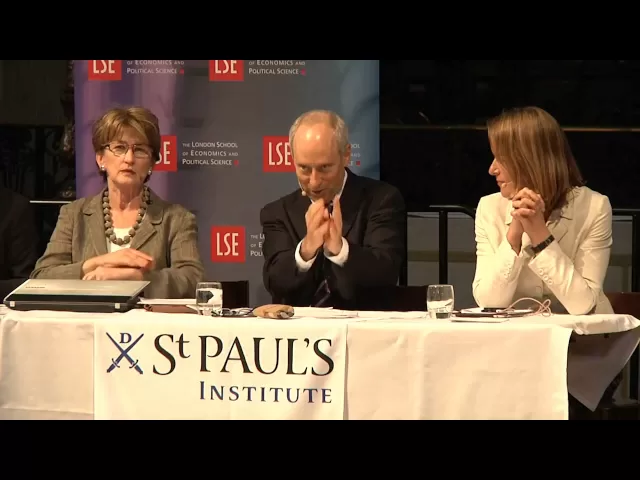
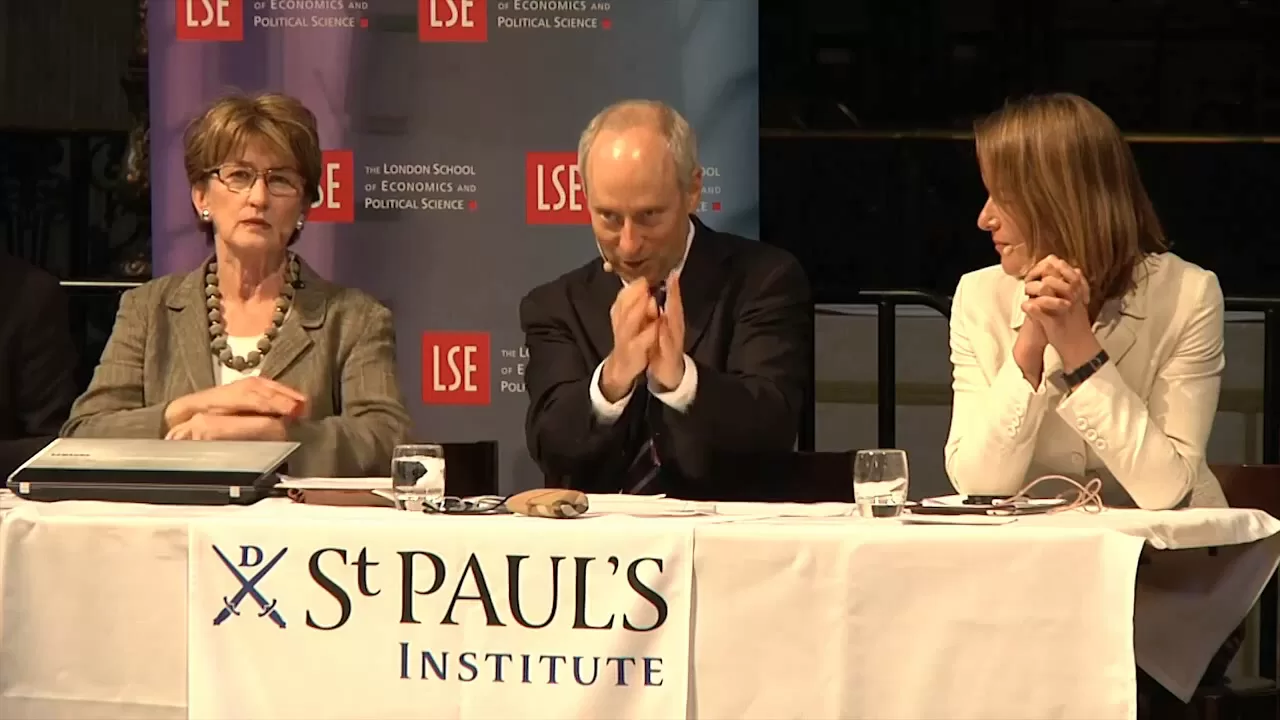
Good evening ladies and gentlemen good evening and a really warm welcome to you to St Paul's tonight for what I believe will be both an engaging but also a vital debate tonight is happening through the partnership of The cathedral's Institute the London School of Economics just share and Penguin Books and St Paul's is privileged to be the Venue and it is fantastic to see so many of you here tonight welcome it's been said that many of us at the moment are spending money we don't have on things we don't want in order to impress people
we don't like that would be funny if it were not so dangerous St Paul's Institute for a number of years now has been raising questions addressed to finance and human behavior trying to Scrutinize the true price we pay when everything has a price and who at the end of the day Bears the cost the voice of occupy here and across the world has quite rightly intensified the urgency of that scrutiny and Professor sandel's work too is a hugely important contribution not to a pleasant chat about lifestyle choices but to an overdue public debate about the
place of money in our lives and how how the decisions we make at Every level always affect others and often the most vulnerable money can have an almost magical ability to turn us into people we would prefer not to be without us noticing I hope you enjoy tonight it is great to have you here and I hand over to Anne pettifer as she takes the chair tonight and introduces professor sandel and the rest of our panel it's a very great honor for me to be here tonight this has been a public Space for 1,400 years
and tonight it's been used as a public space for a public debate on one of the most important issues of our time I feel very moved to be here the last time I was here was when 2,000 Jubilee 2000 Jubilee 2000 supporters gathered here for a meeting with Gordon Brown and W gari maai and the most recent time I was in the precincts of St Paul's was on the First day of the Occupy demonstration outside it was very hard to get in the police made it very difficult and once I was in it was very
difficult to get out in reviewing professor sandel's book The Financial Times says about the Tea Party on the one hand and occupy on the other that few in either Camp offer a radical critique they agree that people have been cheated of what they deserve even if they disagree on who deserves what Their objection to contemporary capitalism is a materialistic one that it falls short of its promise to create prosperity for all they want that promise kept not abandoned we may disagree as to whether or not that is true of the tea party on the one
hand and occupy on the other but what hasn't happened is a debate on the morality on the moral morality of markets in his book Professor sandal says to contend with the condition that We Face ourselves in we need to do more than iny against greed we need to rethink the role that markets should play in our society we need a public debate about what it means to keep markets in their place and I'm really thrilled that St Paul's is hosting this public debate and that you are participating I know you've already asked questions it's going
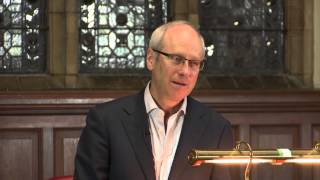
to be very interactive I have Twitter a chat feed and the polling in front of me I'll be Watching and listening to you carefully and we will be feeding through your comments as we go along it gives me very great pleasure therefore to introduce distinguished Professor Michael sandel I'm sure most of you know of him you're here because of of him so I think we should move on as quickly as possible thank you very much thank you Madame chairman for that introduction and thank you to St Paul's for Hosting this occasion in this Sacred Space
that is tonight a public space and as our debate unfolds will become a Civic space it's a great privilege to be here our question is simple to state but not easy to answer it's this what should be the role of money and Markets in a good society today there are very few things that money can't buy if if you ever happen to be convicted to a jail sentence in Santa Barbara California just in case that happens to any of you you should know that it is now possible if you don't like the standard accommodations to
buy a prison cell Upgrade for how much do you suppose $82 a night if you want to contribute to alleviating a tragic social ill thousands of babies born each year to drug addicted mothers you can contribute to a charity that offers a market solution it offers $300 cash to any drug addicted woman with willing to be sterilized a use of cash incentives to Solve social problems or if you are a company with a new product and you're looking for a novel way of bringing that product to public attention you can now buy advertising space on
the foreheads of college students not long long ago a London Ad Agency began recruiting advertising students willing to wear company logos on their Foreheads for 4 pounds 20 an hour one potential sponsor praised the idea saying the forehead ads were quote an extension of the sandwich board but a bit more organic we've just had here in Britain the auctioning off of Olympic torches and to take a more serious example one distinguished free market economist a Nobel Prize winner no Less has recently argued for a market-based solution to the fraught question of who should be allowed
to immigrate to the US or to the UK use the price system he suggested set a fee $50,000 perhaps or a 100,000 and sell the right to immigrate to those willing to pay the past three decades have seen a quiet Revolution we've drifted from having a market economy to becoming a market Society the difference is this a market economy is a tool a valuable and effective tool for organizing productive activity but a market Society is a place where everything is up for sale it's a way of life in which Market values seep In to every
domain of human endeavor why worry about our becoming Market societies there are some things that money can't buy even if it tries friendship for example suppose you'd like to have more friends than you do you've not been able to acquire Enough in the usual way it might occur to you to buy a few but you would quickly realize that it wouldn't work why wouldn't it it's actually an interesting philosophical question why it wouldn't work but most of us sense that a hired friend is not the same as a real one somehow the money that would
buy the Friend dissolves the good you would be aiming at but there are many Goods that are unlike friendship money can buy them even if it shouldn't and there are intermediate cases consider expressions of friendship such as a wedding toast surely some Among Us have been asked to give a wedding Toast to celebrate the marriage of a friend it can be an anxiety inducing request it isn't easy to write an eloquent warm funny wedding toast now there is help you can buy one online you enter information about the couple how they met how you came
to know them whether you want a funny speech or a Tearjerker and within three business days you will receive a custom written wedding toast for how much do you suppose $149 including shipping and handling the question is would it work well it may depend on whether its Providence is known imagine that your best friend at your wedding Delivered a poignant moving wedding toast that brought tears to your eyes and to those of everyone in attendance and then later you learned that he or she had bought it online would it have less meaning probably it would
so unlike friendship a wedding toast can be Bought and yet it's not quite the same somehow the money the purchase the buying corrodes or diminishes its meaning its value and this is true of a great many social practices in our societies today I would like to explore with you a few of Them the use of cash incentives or monetary mechanisms to encourage desirable social behavior avior as you've entered you've been voting now normally I would invite everyone here to raise their hands in answer to these questions but given our number and given the benefits of
new technology you've been able to vote by text Messaging and so let me put the first question the NHS is experimenting with the use of cash incentives to get people to be healthy to motivate them to lose weight to quit smoking or to take their medications there's been a some debate about this practice and this was one of the questions we put to all of you so now Madam chairman if I could turn to You with the help of your laptop and the high technology of St Paul's yes how do we vote on the use
of cash incentives to motivate people to adopt healthy practices um the audience here of the audience here 25% said yes and 75% said no I repeat 25% yes 75% no this makes me wonder how Market friendly is this Audience now we may have an opportunity in the discussion to follow for people to articulate their reasons for voting as they did but I have I think can guess the main arguments on both sides before I come to them I would like to see how our audience voted on a related but different question whether schools should try
to motivate Students by offering them money cash incentives to get good grades or to read books and I should say this is not a Pur hypothetical example it's an experiment being done in a great many American cities right how did we vote on paying motivating students by paying them 10% thought we should try and motivate students by paying them to get good grades or to read books 90% said no so cash incentives in Education seem to be even less popular in this audience than in health before trying to analyze and make sense of these responses
let's see how our audience voted on a third question the blood supply suppose paying people to give blood would increase the supply would you favor a market in blood or do you think blood should only be Donated not bought and sold what did we say about this fully 36% of this audience think that we should have a market in Blood and 64% think not so the audience is friendlier to the use of the market to increase the blood supply then it is to the use of cash incentives to motivate people to lose weight or to
motivate students to Improve their academic performance in each of these cases the argument in favor and here I'll Hazard a guess I stand to be corrected by those who actually voted the argument in favor of using cash incentives are or Market mechanisms is that it involves voluntary Choice voluntary Exchange and the primary question for those who favor the use of Market mechanisms in these areas is would they work if we can succeed in persuading people inducing people to lose weight or students to get better test scores to read more books if we could increase the
blood supply if it works then it's economically efficient and it promotes social utility And who could be against it who is harmed that I'm guessing is the primary argument in favor what about the arguments against why do three4 oppose what some call Health bribes and 90% oppose paying children for good grades or to read books I suspect the reason has something to do With a worry a worry that is not only about the efficacy of the incentive but about the effect of money on attitudes values and Norms that are Central to the goods of health
and education we probably worry many of us here seem to worry that by offering a child as one school district does in the US $2 for each book they Read we may get them to read more books but at the price of crowding out or even corrupting the intrinsic love of reading and learning that's my guess there may also be a worry in the case of paying people for a healthy behavior that health is not only about getting the right body mass index but also about developing the Right sort of attitudes toward one's body and
well-being and the worry may be that the money May crowd out or corrupt or degrade those those attitudes May teach the wrong lesson a friend of mine pays his young children $1 for each thank you note they write I've received some of these thank you notes and I can tell by reading them That they were written under duress my wife and I look a scance at this practice and we wonder how these kids will turn out now it could be here's the hopeful scenario that by writing thank you notes for pay they will get in
the habit of writing thank you notes and will eventually learn the right reason to Write them in which case when the money stops when they grow up they'll car on writing thank you notes out of gratitude not just for pay and all will be well but it could also turn out that the lesson they are learning now is that thank you notes are the kind of thing are are a chore the kind of thing one does for Pay and if that's the lesson they learn when the money stops so will the thank you notes their
moral education will be corrupted and they may find it difficult to learn the virtue of gratitude in Switzerland they were trying some years ago to decide where to locate nuclear waste sites no Community wants one in its backyard a small town in the mountains seemed to be the safest Place but the government had to secure the approval the agreement of the residents before the final decision was made a survey was taken the residents were asked if your town is chosen by the parliament would you agree would you vote to approve the nuclear waste site in
in your town 51% said yes then they asked a follow-up question they sweetened the Deal they said suppose the parliament chooses your town and offers to pay each resident of the Town up to 6,000 Euros per year in compensation then would you vote to approve now how many do you think agreed what would you guess just call out 70% 2 90% I heard 25 25% you've already read The book the number fell in half to 25% now this is from the standpoint of standard economic reasoning a paradox if you offer people money to do something
the assumption is you will get more people willing to do it why did the number drop in half well you might think the Financial offer might have led them to believe this was really riskier than they thought but that turns out not to have Been true their estimate of the risk before and after the Financial offer was the same they asked people who changed their minds why did you do it and they said we didn't want to be bribed see before they were willing 51% were willing to accept this sacrifice out of a sense of
public responsibility The country needed the energy Supply the waste had to go somewhere they were willing to Bear the burden for the common good but when money was offered it became a financial transaction and they weren't prepared to sell out the safety of themselves and their families for 66,000 the monetary offer crowded doubt the motivation of civic virtue in Israel there were daycare Centers with a familiar problem faced by all nurseries and daycare centers parents coming late to pick up their children a teacher had to stay and look after the children until the late arriving
parents came with the help of some economists they tried to solve the problem by establishing a fine for late arriving parents what do you suppose happened more parents arrived Late this too is a paradox from within the standard economic model if you raise the price of something you get less of that behavior not more so what happened attitudes changed before when parents came late they felt guilty they were imposing an inconvenience they felt an obligation to arrive on Time when money could be paid for a late arrival they treated the fine as a fee it
was like hiring a babysitter a fee for a service why feel guilty the money transformed the meaning of a late arrival into a service for pay rather than the failure to meet an obligation what these examples show is I think the force of a reason or at least a Hesitation that many of you have expressed about using cash incentives in the areas of health and education to motivate good behavior what's true in all of these cases health education the civic virtue of the Swiss town the sense of obligation of the parents arriving at the nursery
is something similar to what was going on with the The bought wedding toast the introduction of money and Market mechanisms in certain areas of life changes the character of the goods themselves standard economic reasoning assumes that markets do not touch or taint the goods they exchange markets are inert on the economist's picture now this assumption may be true enough if we're talking about material Goods flat screen televisions and toasters if you sell me a toaster or give me one as a gift the toaster will be the same either way but the same may not be
true when markets come to govern personal relations social life health education criminal justice National Security Civic Life in areas such as these where the goods are defined sometimes constituted by certain attitudes and norms and orientations to Intrinsic Goods in cases such as these markets are not inert they're not neutral instruments they change the meaning of the goods at stake and sometimes they crowd out values worth caring About all of which suggests that to decide where markets serve the public good and where they don't belong it's not enough to ask about economic efficiency it's not enough
to ask will it work because what counts as working is not only an economic question it's also a question about purposes and ends the most perhaps the Most important even worrisome corrosive effect that the marketization of our societies has exerted has to do with the corrosion of commonality because at a time of rising inequality as money comes to buy more and more the effect is that rich and poor increasingly lead separate lives there are fewer and Fewer occasions public spaces where men and women from different walks of life encounter one another in the Ord Ary
course of things and so we look up and we find that after a time there are fewer class mixing institutions we live and work and shop and play in different places our children go to different schools this isn't good for Democracy nor is it even a satisfying way to live even for those who are able to buy their way out of public services and public places democracy does not require perfect equality but it does require that citizens share in a common life what matters is that people of different backgrounds and social positions encounter one Another
bump up against one another in the course of everyday life for this is how we learn to negotiate and abide our differences and this is how we come to care for the common good and so in the end the question of markets is really a question of how we want to live together do we want a society where everything is up for sale or are there certain moral and Civic Goods that markets do not honor and money cannot buy thank you very much thank you so much Professor sandal that was wonderful and and your audience
I have to say was intensely attentive um right now before we move on and discuss these matters further can I just remind you that you still have time to vote on the questions posed uh in those sheets that you were given when you came In so please do because we're interested in what all of you think and and not all of you have voted yet secondly can I just remind you that you're going to be able to ask Professor sandal questions and to comment on his contribution and on the contribution of others but you need
to notify us now you need to let it be known to the ushers and to people around that you want to be called so that we can get the microphones up for you great so I now want to move on and Introduce Julian lran who's a very distinguished professor of social policy at the London School of economics and has worked at the highest echelons of our political life advised Prime Ministers advised the treasury and advised parliamentarians on extremely important matters of social policy it's a great honor to have you with us Julian thank you thank
you I think I'll probably stand here rather than move to the lecture I'd love to actually move to The pulpit but uh but I'm told we're not allowed to do that so I will preach from here uh um Dr Johnson said there are few ways in which a man can be more innocently employed than in making money sounds slightly odd nowadays in a world of Murdoch and made offs but uh um Michael gave an example um about uh the Swiss nuclear depository uh it was undertaken by an economist called Bruno fry um Bruno Frey also
did a study Looking at volunteers um who were paid money uh to undertook what they uh what they were supposed to be doing uh and the result was I think what Michael would have predicted uh that most of them stopped doing any volunteering and only worked for voluntary areas however there was also a study that looked at um elderly as a women looking after uh elderly people elderly people who were not their not their relatives and they were Doing it again voluntarily and these elderly these carers were asked um how would they feel if they
were paid to do what they were doing um uh and uh the prediction most people were expecting was that they would again stop doing the voluntariness just like the uh other cases but in fact the result was they said they would be delighted to be paid uh that they would actually regarded as an honor to be paid that it in some sense be a recognition Of the work that they were providing in other words in that case the market was revaluing or up valuing the activity rather than devaluing it um Michael's jail cell example um
the uh I don't know what goes on in American prisons um thank goodness I have spent a night in the Swedish jail once but uh which is very comfortable indeed I didn't have to pay for an upgrade uh um but uh in many American prisons if if Hollywood is to be Believed the prison is actually ruled by the prisoners rather than by anybody else I don't know who gets the best cells in those circumstances but my guess is is the most violent uh the most difficult is that a better alternative than the alternative that uh
for paying for it Michael also gave the example of blood and he's asked you um to vote about the question of blood that actually comes from my the uh Professor who used to hold the chair that I now Have the honor of holding Richard titmas it's the Richard titmas chair of social policy um Richard tias produced a magisterial book um where he argued many of the things that Michael is arguing um about the crowding out effects of uh of uh payment um was an irony that actually 3 years after the book was published The National
Health Service um was have to was having to buy plasma product uh from um that den of iniquity of the United States where there was a market in Healthcare um what is what is the point of all this what's the point of all these examples well uh the Dr Johnson quote it sounds ironic but in fact actually it was part of a a movement a movement called do Commerce um and do commerce was S soft gentle Commerce uh was actually arguing that it's far better for the people uh like the murdocks and the MOs uh
and indeed more generally the young men mostly the young men to be have their energies channeled Into Commerce than to being uh uh the energy channeled into marauding armies across Europe um in the case of the care for the elderly um the alternative was not paying them uh and they would have felt devalued um uh in the jail cell the alternative to having the paying system might be an alternative in which violence or force force resides in other words to every kind of Market allocation there is an alternative there Are alternatives ways of doing it
uh in fact I think I had a four on the list here there's violence uh it's one way of allocating resources there's bureaucratic rules there's lotteries uh and there are markets now markets corrupt can corrupt and markets can create inequality but so can all the others uh they can all we know how they can corrupt violence obviously bureaucratic rules we see the the anger that they can generate and the Corruption the games that people play to try and avoid the rules uh and so on so in a sense Michael has done half the job uh
he has shown us that markets corrupt markets can generate inequality the other half of the job is to compare the degree of corruption inequality with what occurs with these other ways of doing things these other Alternatives there's no perfection in the world there's no perfect way of allocating scarce resources they're all bad what We're looking for is the least worst and I hope that'll be the subject of Michael's next book Thank you thank you very much Julian and our next speaker is Bishop Peter sby whom many of you will know and whom I know from
very long back Peter wrote a very powerful book back in 97 called Grace and mortgage which deeply influenced me and many others in the Jubilee 2000 movement um I'm really honored to invite Peter to comment on Professor sandel's speech Peter thank you uh every every day in this building um things take place which are among other things designed uh to protect uh the people who come and the society against the worship of Idols by affirming that they're false and I think that uh Michael's book is a remarkable secular warning about idolatry it's about what happens
when a very useful instrument namely Money and money as an activity in the market uh starts to intrude itself into all sorts of areas of life in which it has no place and starts to extract from human beings a degree of uh of delight of Honor uh which it does not deserve so I think what Michael's doing is really important to get us to think straight about that but I also think we need to go a bit further than uh than he has done in Recognizing the immense seriousness of what happens when money intrudes into
everything and as an example I'd just like to take the first one that he gave in the book and the first one he gave tonight which is about those I happen to be involved in this area of work so that's why I it's struck me uh the the cell upgrades that prisoners could buy and of course it sounds bizarre uh we think to ourselves uh I ought to be able to buy a more expensive house to choose Uh to choose the company I keep why shouldn't prisoners be able to do that and we think well
that's because they're prisoners they shouldn't but the real point is this that that little earner of offering Prisoners the chance to pay for a better sell is only possible because because you've already done the big thing which is to sell the prison to a private company as a means of making money prison is now a commercial Enterprise and that is not unconnected with the fact that in the United States one quarter of every person in prison is in the United States and onethird of every of all women who are in prison are in the United
States so if you commercialize this particular activity you will grow it and that raises for me my second question about Michael's work which I think needs taking further which is he has raised these important Philosophical questions and your votes suggested that you had a lot of sympathy with where he was coming from but the reality is the world is going on in the contrary Direction and therefore my next question for I vote for his next book is how did money get this power and the answer of course is that money is produced mainly by Banks
90% of all money that's in use is created by Banks as debt and therefore They have a vested interest in promoting the power of money and that's why however strongly you vote here and whatever how whatever rational may be the thoughts we have we shall continue to be money dominated unless we ask the basic question whether the fractional Reserve banking system which produces money with that degree of power based on debt is not something which can simply be corrected by a bit more regulation here and a bit more uh touch regulation Heavier touch there but
actually is in principle unstable in principle promotes idolatry in principle puts a vested interest in money and in principle is bound to generate the kind of Crisis we're now living with because in the end what it's produced is a situation where people don't just produce good reading for children they actually go out and they've bought Greece and if Spain gets cheaper they'll Buy Spain because there's that much money around around and the banks have that much interest in promoting it so that I think is my vote for your next book thank you Peter well this
really does feel like public philosophy and public debate and I hope that you're all stirred and that you're writing up your questions just one condition your question questions please should be as succinct as our speakers have been Tonight um our next speaker is Stephanie Flanders whom you'll all know I met Stephanie for the first time in one of the most scary meetings I've ever been in and that was when we went as Jubilee 2000 to meet Larry Summers and Stephanie was his advisor at the treasury of the United States Treasury so Stephanie comes tonight with
both an understanding of the economic world of the United States as well as of Europe so it's great pleasure to have you here with us Stephanie well I should say as I'm also a former student of Professor sandal so I feel and I and I'm now making my living talking about all the things that money and Market can buy how much more or less they can buy today than yesterday on BBC so I feel sort of uniquely qualified but conflicted in this discussion but then with relief I remember that as a BBC employee I'm not
allowed to really have any views on any of this um so it's it's a relief to me Probably not to you but I um I'm certainly not going to come down very firmly on one side or another but I I thought there's a there's a few things I thought be interesting to unpick in what Michael was saying he was implicitly saying and he says it very explicitly in the book that there are different concerns you can have about the encroachment of markets in more areas and one is uh about the corruption of that good if
you distribute it by the Market mechanism it changes the good as he was discussing the other is an unfairness critique that it simply magnifies the unfairness of the initial distribution to make income make your income determine other things that maybe we don't want them to determine I think what's interesting when you listen to Michael and when you read the book the compet the the really compelling examples he has of when it really feels like something's being corrupted with The insertion of money they're they're great the prison examples one but I'm not sure they're really they're
not usually the examples that people are really animated by when they worry about the world going to hell in a hand cut and the market becoming too powerful because I think the things that really have worried people maybe about the last few years and uh Peter's just touched on them although in a more dramatic way is more actually about the Inequality point about the distribution of income and not so much about the encroachment of a market mechanism I think that could be true for example in health we could quite simp we could quite clearly I
think have an argument about whether or not your income should determine your health whether you should be allow the market to sort of invade the health sphere but I think that's rather different than having a discussion about Using the market as a mechanism within health and of course there are cases when the one infects the other but I'm not sure that there is many and as fundamental as Michael suggests I also sort of related to that I don't know what incentives Michael uses with his children I do find children need incentives to do things I
have two very young children and I don't give them money if I can help it for doing things like thank you letters but blindman you Do need something and you do end up using I don't know chocolate or you end up you can watch television if you finish your thank you letters or um you can get a big hug from Mom I'm not sure that always works what I'm saying is I think if you do if if people respond to incentives I don't think it's it may make you feel worse if you're using money I'm
not sure I mean are my children not mercenary because they're doing it for chocolate Instead of 50p I'm not sure so I think there's again I think the use of incentives we use them in everyday life sometimes it matters a lot that the incentive is not Financial I'm not sure it always matters intensely whether it's financial and as uh Julian was suggesting sometimes it might even make the good valued more the other thing I would just throw into the to the mix is when you look at the way the world has changed the things that
Have really fundamentally changed the way we live over the last few years even since Michael first started putting forward some of these arguments it's the internet it has changed the way we live and in some ways the internet has made the market strong stronger has made markets more efficient and more dominant but I think if you asked people in this in this wonderful Hall this wonderful Church what what were the things that had really been changed the way they Live we've got most of them for free Wikipedia social networks all of that although despite all
the money being made by Google and apple actually the vast proportion of what the internet has done has not been monetized and I think that has thrown things up in the air in a way that may still leave the market on top but I think it's unpredictable people complain when Facebook tries to monetize the networks and the relationships you know maybe it's the Revolt is the it's the the community is fighting back in some sense against encroachment of the market but I mean I the final thing I'd say is I do like I think it's
important to have this conversation and I think it's a good reminder after the last few years that you can't just neatly subcontract all the kind of important moral judgments as a society to the mark Market I think possibly we did fall into a trap particularly with these wonderful Mathematical economic models that gave such Clear Solutions real answers I think it's right to say are messy it's quite good to have actually the economic and the social value of things bumping up against each other in the examples that Michael gives so I I guess I wouldn't necessarily
draw the line between the limits of markets in the same place as Michael but I think we should be talking about it a lot more in places like this And maybe even on television as well thank you very much so there you go that's our panel Michael I'm I'm going to invite Michael to respond to the panel but I need to just alert those who've put in questions already to the fact that they should now come to the microphone we've had some really interesting question I won't reveal them and they can reveal them themselves but
can Sarah Smith come please and Brad bner and Stuart Joseph And clar O Brien um and those the first batch and if you could queue up um and and after Michael has spoken I'll call you thank you right Michael I'm grateful for three very stimulating responses I'll reply briefly to begin with Stephanie's she emphasized rightly the two different reasons to worry about the marketization of everything one having to do with corrupting or degrading Goods the other having to do with Unfairness with background inequality the unfairness argument I agree is the more familiar of the two
in contemporary public discourse one of the things I'm hoping to encourage with the book is to make the second consideration equally prominent in public discourse because to speak or to worry about the corruption or degradation of goods presupposes higher ideals higher values Than mere use or utility and we hesitate to bring into our public discourse questions about the meaning the intrin intrinsic meaning of good but fairness is not the only thing that's wrong with markets take a familiar example sex for centuries people have debated the morality or immorality of prostitution one objection is that it
may not be truly voluntary typically Prostitutes are poor pressured by economic necessity drug addicted are they really free that's the fairness argument the in the inequality worry but the question would remain even in an equal Society where there were no great inequalities of income and wealth there might still be an objection to prostitution on the ground on the grounds that it's degrading that it's Demeaning even if it's freely agreed to which takes us into the area of the good to sort that out we have to take a view about the meaning of sex and human
sexuality and these are hard arguments to have in public life and we shy away from them Julian mentioned the famous book by Richard titmas about blood and blood is a good example of a good that money can buy Provided it's a good match the blood will work and if a market would increase the supply that would be an argument in its favor but tinas made another observation Beyond economic efficiency Beyond even the supply of blood he attached independent moral value to the generosity that motivates the giving of blood the gift relationship and part of his
worry was that letting some buy and sell blood though it still leaves others free To donate it if they want to doesn't prevent that it undermines the ethic of the gift relationship and so puts altruistic donation in a different life for Imagine in a world where blood is routinely bought and sold is is donating a pint of blood at your local Red Cross still an act of generosity or is it an unfair Labor practice that deprives needy persons of Gainful employment selling their blood a would-be altruist could be forgiven for being confused finally to Peter's
point he asks the question first he describes mine is a secular warning against idolatry I accept that description and it may suggest that the connection and the overlap between what we commonly label as secular Views and faith-based Views may be more fluid than we sometimes think how did markets and money acquire this power Peter asks he offered an account to do with the banks I would offer a different answer I think there is a deep appeal to markets that goes beyond their ability to deliver the goods or to produce Prosperity I think the the deeper
hold of markets is that they seem to offer us A way of avoiding public judgments and disagreements about the meaning of Goods after all a voluntary exchange between content uh consenting adults spares everyone else or so it seems the need to enter into deliberation about whether they valued those goods in the appropriate way there's a powerful incentive in our public discourse to shy away from debates about the meaning of Goods which is why I think we're more familiar with arguments as Stephanie points out about fairness my suggestion is those debates are unavoidable because if we
don't have them publicly and decide them democratically they won't go undecided markets will decide them for us yeah yeah thank you Michael right I'm going to um I'm now going to take some questions from the Floor and I'm going to take a bunch of them and uh and hear from you before I invite the panel to respond now Sarah are you at the mic thank you and then I have here a wonderfully named Maximillian Waldren is he out there could you please join us as well and Felix Martin um please could you join the queue
behind the mic Sarah thank you you seem to think that one one of the reasons we've let the market decide is because some of the moral questions That we Face are so difficult how can we make ourselves engage with them so that we decide thank you Sarah um who's next I think we could take three and then ask the panel to respond yeah uh you've described this commoditization of our societ our gradual acceptance of of this economic Society what in your opinion is the root cause of that why is it because the family has degenerated
or we've rejected Religious foundations succinctly in your opinion what is the cause of that are you Brad Brad bner thank you very much Brad um who's next steuart Joseph who who are you there thank you Stuart please um my question is about the role of speculators and how they their behavior impacts upon the market um as soon as speculators become an important influence in the market their business becomes to speculate on Each other's Behavior this speculation then impacts on market prices do you agree and should this concern us thank you very much CLA Clare O'Brien
please what is your question um my question as an Ethics teacher um is what realistic advice do you have for those who actually support your claim that um capitalism and money is not the answer to social ills bearing in mind that We're in St Paul Cathedral and those who championed your ideals were given such little support by this um great Institute which we're in right I think that's a question we might put to Peter um is is there one more person is Maxim is that Maximillian next no um who have I missed out on please
come forward yeah I'm trying to remember the question now sorry um the question is so I have no truck with the argument that Professor sandel puts forward I think it's very timely and an excellent one what I wonder is that if the fundamental question that we're trying to get at is what constitutes a good Society what do we mean by that and more specifically which kinds of things should we try to protect from Market mechanisms then how do we find out the answer to that question because if we can't adopt a kind of a view
from Nowhere but instead we're being urged to bump up against each other how does that really take place and how do we have those kinds of debates thank you very much those a very big questions panel um Sarah Smith says do we let the market decide because the moral questions are too difficult um Clare O'Brien um what can advice can we offer on how to challenge the common held Assumption that money is the solution to all ills and I think that that's those and Felix was It Felix who said if the market is not to
be the mechanism whereby we allocate scarce resources what is can we start perhaps Julian can you respond to any of those well perhaps I could respond to one that was mentioned which was about why why has why we allowed the market to intrude in all These areas and and I think I think it's a very interesting question um as to why we've seen it and I think and relates to the point I was making about the Alternatives um I think it's because we perceive the Alternatives in many areas to have failed uh and for example
we do have um a large number of obese people we have a large number of people who cannot read uh in the schools we have tried a variety of ways of trying to prevent That of trying to prevent obesity and trying to encourage people to read they are perceived rightly or wrongly most of them to have failed and therefore there is a search around for alternative ways of trying to do it um alternative ways that work or not and I I suppose I would make the point too that sometimes I think Michael uses the words
that will it work as almost as a kind of condemnation of of the policy um and as though there are no moral issues Involved in whether it works or not um whether people can read or not um is seems to me is a massive moral issue and in particular uh if we don't pay people to pay children to learn to read then a lot of people will not learn to read they'll often be poor people so that not only will we have the corruption problem a moral problem but we'll also have the inequality problem Peter
could you address those questions but also in particular the one About occupy and St Pauls uh yes um I I think that I want first of all just to register a a disagreement I feel qualified to speak on the Obesity question um somebody on the panel ought to say something about that and it's embarrassing to do so but I will it's all very well to say that the market might help to cure the problem provided you recognize that the market actually has created the problem in the First place uh because there is a very powerful
vested interest um in in what has led to obesity that that's that question second short point I want to make is that one of the difficulties I have with um with Michael's style is it could lead us to think that getting the ideas right will change our behavior when actually it's our behavior that changes our ideas I got into writing Grace and mortgage over the issue of student debt and one of the things that Became quite clear was that students came to support indebtedness because they had to be indebted and so if you want to
change Behavior to answer one of the other questions what you actually need to do is interrupt your behavior and that will enable you to imagine different ideas and that of course is the creative the creative thrust of what the what the Occupy demonstration did it actually said we refuse to accept these Assumptions we don't necessarily know what to put in their place and it's not our job we refuse the duty of providing what should come in it saying what should come in its place all we know is that what's in place at the moment is
un acceptable and is producing unacceptable results Stephanie I guess I'll I might respond a little bit to the sort of spirit of the convers the question about the speculators and some Of this conversation about markets having done so much harm I think there's always been an understanding and but not always a a a memory because people forget until they have another financial crisis that markets are inherently unstable and just as you describe about the speculators they are reflexive often people in markets are not responding to the underlying situation they're just gaming trying to guess what
other people are going to think and it's more like a A beauty show as um KES used to say people are just wondering how other people will judge the contestants not actually thinking about what they think about them but what we've decided over many years was that these big disadvantages of markets that we knew we're there and we had different desire different beliefs about how to respond to them Kane's thinks you try and intervene and you try and just try and fix the accidents others the kind of Far-right critique says actually you'll have fewer accidents
if people absolutely sure they're not going to get bailed out when they overdo it but that has been an ongoing dialogue and we've continued to have that dialogue with markets and contined to allow markets to spread because rightly or wrongly we've wanted to have the advantages that markets bring and we've kind of put up with the disadvantages now you can have an argument about whether or not there Was ever a real social Choice a democratic choice in favor of markets but I think you could argue at least in many countries in the Soviet Union you
could say there was a choice and it has extended options for people you couldn't borrow anything 40 years ago unless you had a lot of money for a down payment in a house now you can do a lot now you can completely overdo it now you have have the freedom to get yourself into a lot of debt but I don't think it's obvious That we should go back to a situation where people cannot borrow anything at all and then only people who have money for a huge down payment can have a house I don't think
it's obvious for example that we shouldn't have any cheap airflight people here for environmental reasons might not like cheap airlight but deregulating Airlines allowed easy jet ryion a to appear and open up that whole world of opportunities for a lot of people so I'm not I think this is a Difficult argument but I think we can't have the market cake and still complain about it I think we have to realize that they do have costs but we haven't found a better way necessarily of doing it thank you very much Michael um Michael come back first
about first about the speculators there is markets become unstable after a Time Stephanie has reminded us they also become morally Unstable and that the two instabilities may be connected the moral instability is this the activity of investing and in particular financial markets became detached in recent decades from the social purpose that justifies Finance in the first place which is to allocate Capital to useful purposes that's what Finance is For but there's a distinction between investing on the one hand and gambling on the other this is the issue Stuart raises about speculation it's one thing to
short Greek bonds because you hold a lot of them and you want Insurance you hold the underlying asset it's something else if you don't have any interest or stake in Greek bonds just to place a b against Greece it's like the way life insurance now is you used to have to have an insurable interest if I ensure my life I have a stake in my life I'd rather lose that bet than win it but today there is a massive multi-billion dollar market secondary Market in the life insurance policies of strangers which where there is no
insurable interest these are strictly death bets where the Investor wins if the people whose life insurance portfolios he holds die sooner rather than later Wall Street has created death bonds securitizing these portfolios of life insurance policies I would just like to say one thing about the other range of questions which had a Common Thread as I heard them questions about why we've had this rampant Marketization in recent decades and how we can engage with moral questions in public life these questions are connected I think as I see it one powerful source of the market triumphalism
of the past three decades was not just greed it was connected to the holling out of public discourse there was a moral vacuum in our public Discourse which has become mainly managerial and technocratic which inspired nobody or when passion enters it consists of shouting past one another the emptiness the hollowing out of public discourse morally and spiritually in recent decades tracks pretty closely the marketization of everything and the reason for that I think is that each abets the Other markets enter a vacuum of public meaning they seem to offer a value neutral way of allocating
goods and of defining their meanings through individual exchange and they reinforce the hollowing out of public discourse because they seem to provide an alternative to deliberate public debate about the meanings of goods and the meaning of the good life and so the Way to to respond I think the only way to respond is to find our way to a morally more robust form of public discourse not only so we can decide where markets belong but also so we can enrich the content the moral and spiritual character of our public debates right thank you very much
can I can I say that we've been followed on Twitter and there's been much comment on Twitter someone at Twitter asked what has God got to do with this and I think that is a question we should discuss and David Penn says if paying money to soldiers to fight for their country corrupts the meaning why do countries pay soldiers so now I want to move on to one more question I believe Kirk McMorris is there is that right please could you come forward and before I do can I just say That there is going to
be a fourth question and I want you to um I just want to remind you if there's going to be a fourth question which Michael you're going to want to ask is that right I'm happy to do it if you'd like you want me to ask it now be well why don't you ask it now so that people can be prepared for the answer and to answer the question that's it there well the concluding question we wanted to get people's views about out is question Four on the handout do you agree or disagree with the
following statement these days money governs more of life than it should this is I suppose our Capstone question is that it that's it the results to be revealed only as we file out the door that's right all right thank you very much Kirk I do apologize for keeping you please your question okay my question is to Professor sandel in particular but to the panel in General how do you think the postmodern perspective has shaped this Market driven economy and particularly the education in our IV league universities IE objective moral values do not exist thank you
that's Prof profound question is Delbert there is Delbert um where's your Delbert sandiford are you are you there still great last question I'm afraid um because we're going to have to end quite Soon I'm sorry to be critical actually but a lot of what I've been hearing tonight is very descriptive I've read your excellent book Professor also very descriptive my question really is what's all this got to do about future policy if you cast your mind ahead to uh 20 2020 let's say where would we be as a society with all this Corruption of uh
values and the incipient inequality that comes from selling some some uh Community assets Where would we be in about 8 years time as a community thank you right um I I think there's uh I want to mention the poll first we're going to um we're we're going to also put questions or the S Paul's Institute is going to be putting questions to 100 very well-known figures from across British public life including the leaders of our main political parties we're going to ask them about what money can't buy and the Answers are going to appear on
the website of St Paul's Institute www St Paul's Institute .org and don't forget uh to keep um answering the question so far um Michael I'm trying to keep tabs here but 82% of our audience tonight agree that these days money governs more of life than it should and 17 uh disagree finally before we close and before I ask for final quick comments from the panel can I just remind you That the panel have got books at the back you can get professor sandel's book and you can also get uh Bishop Selby's book at the back
here tonight and to thank you very much for your participation in this event for your twitters for your tweets for your questions and for your comments so can we begin with Stephanie perhaps because I know Stephanie has to leave early this evening I was just thinking I was going to make a cheap joke about how you'll Have to pay money for the books but you can watch me for free on BBC in an hour or two but I I won't I won't descend to that level um I think um I suspect that uh Michael sandel
is the best one to answer um the question about uh our postmodern age but I have some sympathy as you would have seen from my comments earlier with this the the more practical perspective which is just where does this leave policy Because I think that is a question that you comp pose also to to other kinds of criticism of the sort of Market fundamentalism that uh certainly seems to have dominated the financial system for too many years and caused a lot of trouble uh if you move to more sort of Behavioral models of Economics which
allow for more uncertainty which assume that people are normal human beings and not just um robots and they don't have Perfect information those kind of models don't produce very clear policy prescriptions either I think what it what I I think I just say again what I said at the beginning I think that the recognition of radical uncertainty not necessarily about values but about the right answers to a given practical question I think is kind of Welcome in itself and I think the both perspectives can learn from each other there's a one example that uh Mr
that Professor sandal didn't use today which he's discussed with me a few days ago is whether you should give the job of executioner in a sense to the highest bidder the person who most wants to do it might actually pay to put the man in the electric chair or whatever the means would be and wouldn't that be a troubling use of the market mechanism and I think of course it is but in a way it ask it even that example actually kind of makes you think about the Underlying policy the Morality In the underlying policy
as much as about the mechanism if we don't want to give that job to the highest bidder because we think there's something a bit bit I'm indecent or wrong about someone paying for the privilege and enjoying that job maybe that's because we think it should be of a different kind of Civic order but it could also be that we feel pretty uncomfortable about the underlying Act of Killing someone and I think that's And making that a legal thing so I think both sides I'm now ending up in a beautifully BBC position I think both sides
do learn from each other and I I think you can't just you don't get very far from just saying markets are always terrible and we've seen in the last few years you don't get far or you go you do get far maybe but you don't go necessarily in the right place if you give put too much faith in markets either thank you um Julian let me just pick up on the point about um objective moral values and it relates to Michael's contention that about the moral hollowing out of society um I don't agree with either
um uh there are um objective moral values um and I believe that if we live in a world in which people die because they do not have enough blood for transfusion purposes if we live in a world where people suffer from diabetes uh uh for because of their uh Obesity if we live in a world in which poor people cannot read um uh then these are all moral issues these and it is it is a an immoral world world where those things occur now if we can demonstrate that a market type solution a market type
way of doing things can actually stop people dying because there's no because um there's not enough blood if they can reduce the degree of obesity can reduce the levels um of diabetes and if it can help poor people to read then It's a morally Superior mechanism to the Alternatives thank you Julian Peter but I think that Michael has raised question of whether these things actually work and I want to respond to the question about whether postmodernity has influenced the marketization of our society by saying I think it's almost exactly the other way around that what
has happened is the explosion of money both in quantity and speed of transmission in the last 30 years 40 Years has actually generated this hollowing out of public discourse because it's easier to let money decide and money has been very happy to fulfill that to fill that vacuum and I think what's interesting both about occupy and about the votes in this building is that there are actually movements of foot movements of the human Spirit to object to that direction of travel and if that's true then what we have to do is to find the political
means to assert That against what otherwise will continue to be the hollowing out of of of disc course by a powerful all powerful market and an all powerful Market is as I've said a classic piece of idolatry thank you Peter just a minute before before I call Michael on Michael to wrap up this uh wonderful public discourse I want to thank the people the organizers of the St Paul's Institute who've put an awful lot of work in making this happen today and I want to thank them for that hard work I want to thank them
for the modernity of the event the Twitter feed the the the polling the participatory nature of it and I'd like to encourage them to do it again because I can see from the way you've come here tonight and from your presence that there is a hunger for the kind of public discourse that Michael is calling for so thank you St Pauls very Much nice I want to begin by identifying what I think is a point of agreement on the panel I think no one has argued as Stephanie have put one polar position that markets are
always terrible the question we need to ask is where markets serve the public good and where they may corrode or dissolve or crowd out other values worth caring about People have asked what can be the Practical implications of a critique of Market overreach how exactly can we deliberate together about the meaning of goods given that we disagree we disagree about the meaning of goods whether of sex and pregnancy and procreation or of health and education And military service criminal justice we disagree about these things so it is a difficult demand to suggest that the only
way we can contend with the market triumphalist faith is to find our way to a morally more robust kind of public discourse we have shied away from debating questions moral and spiritual questions in public life not without Reason my suggestion is not that such a debate would yield agreement but I do think we might learn something from one another we might develop habits of Civility that are pretty much lacking in public discourse these days and we might improve our Democratic life some people everyone here voted on the blood Case and we've discussed the famous Richard
titmas study about blood donation a famous economist wrote a critical review of titus's book and in doing so he ended by articulating a powerful assumption that Li that underlies much economic reasoning it's not an official Axiom of Economics like the law of supply and Demand it's more like an adage a faith Kenneth ER was one of the most distinguished economists of his time he said he was skeptical of titus's desire to rest the blood supply and altruism because Arrow wrote like many economists I do not want to rely too heavily un substituting ethics for self-interest
I think at best he wrote on the whole that the requirement of ethical Behavior be confined to those circumstances where the price system breaks down and then he concluded by saying this we do not wish to use up recklessly the scarce resources of altruistic motivation now this notice this is not a scientific statement it's a metaphor at best and more than a metaphor it's an Article of Faith but is it true is it true that altruism altruism fellow feeling civic virtue are scarce resources like Commodities like fossil fuel that are depleted with use or is
it more reasonable to regard them like muscles that develop and grow Stronger with exercise one of the defects it seems to me of the market Societies in which we live is that it lets these virtues these Civic and public spirited virtues languish we don't call on them enough so rather than tapping them down we I think to renew our public life need to exercise these Civic virtues more strenuously thank you very much So with that I thank you all and I thank our panel and I look forward to seeing you again at such a public
debate thank you