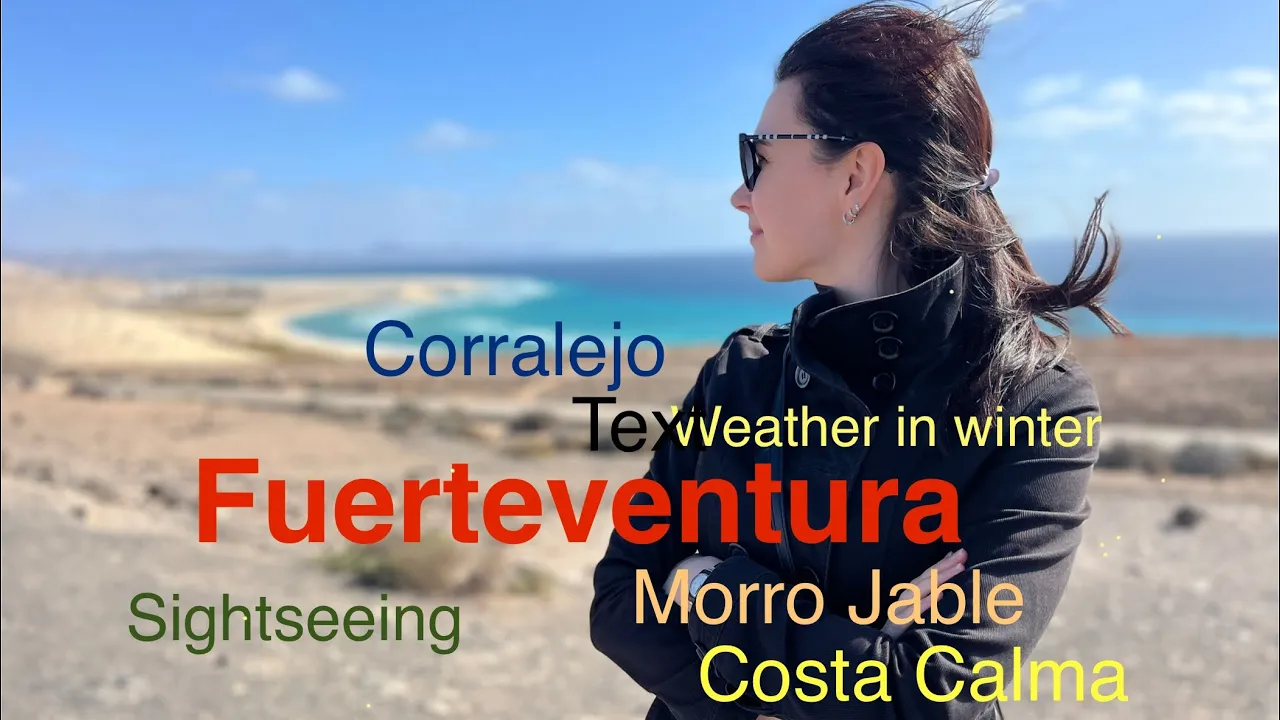
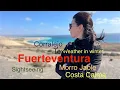
Hello everyone! This video is about the Canary Island of Fuerteventura. In my previous videos, I talked about other more popular Canary Islands—Tenerife and Gran Canaria—here are the links to those.
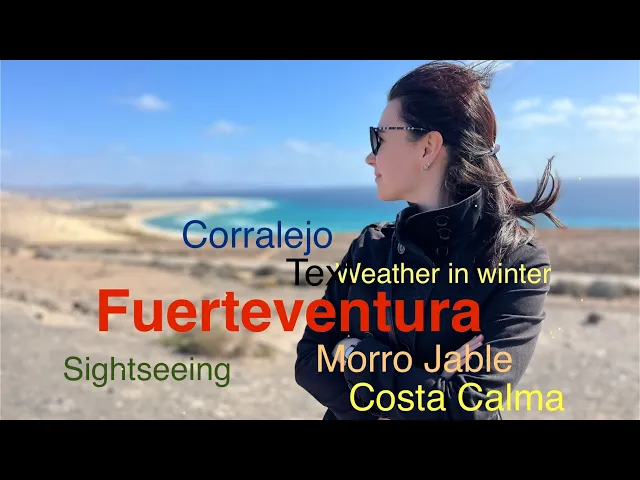
In this video, I’ll share my impressions of Fuerteventura, about the weather on the island in January and February, how it differs from Tenerife and Gran Canaria, and I’ll show you where we stayed and what we managed to see on the island in three days. Fuerteventura, like the other Canary Islands, is a volcanic island in the Atlantic Ocean, part of the Canary archipelago. It’s located 100 km off the coast of Africa, it is the second largest Canarian island after Tenerife, which has the longest beaches in the entire archipelago.
Fuerteventura is also considered one of the oldest Canary Islands, having formed around 20 million years ago. The island is 100 km long and 31 km wide. Its surface is distinctly volcanic, with very little greenery; even the areas marked as green on Google Maps are hardly green at all—maybe just some rocks are a little bit greenish.
You might find a few rare bushes and patches of grass here. The terrain is quite flat, with no towering mountains or volcanoes, just relatively low hills. The highest point on the island, Pico de la Zarza, stands at 807 m.
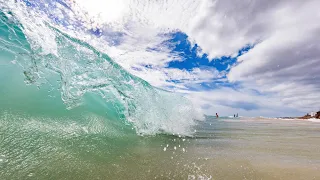
Because of this, clouds don’t linger here, the wind blows through the island, it’s hardly ever raining here, and there are no clearly defined climate zones (unlike in Tenerife and Gran Canaria). Let me tell you a bit more about the WEATHER. As I’ve mentioned, Fuerteventura is a windy island, making it ideal for surfers and windsurfers.
The best wind season for water sports is from June to October. The most sheltered areas from the wind are Costa Calma, Morro Jable. In January and February, you can expect average daytime temperatures of 18-20 degrees Celsius and 15-16 at night.
A light jacket would be very useful in the evenings, especially when watching the sunset in the western part of the island while sitting on an open terrace, as well as during the day when we went up to the Cofete viewpoint, also in the west part. During our stay, the weather was partly cloudy, and as soon as the sun came out in a windless spot, it got quite hot, but when it hid behind the clouds, I wanted to put on a denim jacket. I found swimming quite chilly with those daytime temperatures—both in the ocean and in the pool.
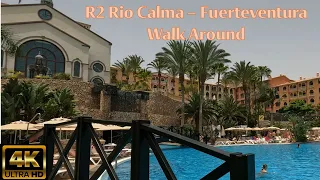
In winter, the ocean temperature is around 17-19°C, while in summer it’s 20-22°C. We stayed in the Costa Calma area at the R2 Río Calma hotel. It’s a decent hotel with a nice territory and good food.
You can find a more detailed review here. As for the resort town of Costa Calma, we nicknamed it "Costa Muerta" (Dead Coast). There are only hotels, a bit of private property, a few supermarkets, and tourist shops, along with beaches.
There’s really nothing to do in the town itself. We couldn’t even find a proper promenade along the sea or a decent pedestrian street. It’s mostly populated by retirees who don’t need nightlife.
It’s very quiet. The name Costa Calma translates to "calm coast," and it got its name because it’s mostly sheltered from the prevailing western winds on the island. Of course, there is wind here too, but after visiting the western part of the island, you’ll appreciate how much less there is in Costa Calma.
Just by switching to satellite view on Google Maps, you can see serious waves in the ocean on the western coast of the island and calm waters on the eastern coast. As for the atmosphere along the coast—if you’re looking for any nightlife, shops, or a more youthful vibe, you should head to Morro Jable in the south or Corralejo in the northern part of the island. And here we go to the island's attractions.
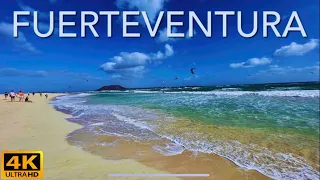
In this regard, Fuerteventura can't really compare to Tenerife or Gran Canaria, but there are still a few interesting places to check out. As I mentioned, there are no high mountains or volcanoes like those on Tenerife and Gran Canaria, nor cable cars like the one to Mount Teide. However, the island is famous for stunning beaches, crystal clear ocean waters, and breathtaking space landscapes.
Getting around to the attractions is definitely easiest by car. There is public transport on the island, but it’s quite limited, so careful planning is required. Many attractions are simply not accessible by public transport.
CAR RENTAL We rented a car from AVIS Budget, leaving a €200 deposit, which was promptly refunded when we returned the car. You can park almost anywhere on the island. There are a couple of speed cameras on the roads, so be careful!
We encountered one on our way from Corralejo to Puerto del Rosario. We also came across the road patrol for the first time in Spain, and can you imagine, they do actually stop you! We were taking over a cyclist and going around a car pulling out of a parking space near Playa del Pozo when we crossed a solid line.
Somehow, we were let off with a warning, probably because a Spaniard was driving. The officer was quite serious but softened a bit when he heard native speech. If you’re also staying in Costa Calma, you should definitely drive around the Jandía Peninsula and visit the town of Morro Jable, which has beautiful wide beaches with fine light sand.
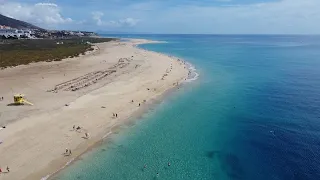
There’s some infrastructure here, and plenty of places to stroll and have lunch with a great view. On the way to Morro Jable, we stopped at several lovely, wild beaches: Playa de Esmeralda, Playa de Sotavento de Jandía with its gorgeous clear waters, Playa de Mal Nombre, and Playa de Esquinzo. After visiting 4 or 5 beaches, we decided not to stop at every one since they were all quite similar—equally beautiful.
Next, we visited the lighthouse Faro Punta de Jandia. The road there was gravel, narrow and relatively flat. It wasn’t great, but it was manageable, with some steep slopes, and sometimes you had to yield to oncoming traffic, and also there were no guardrails.
Be careful, as you might encounter wild goats along the way. They are an integral part of Fuerteventura’s landscape—there are significantly more of them on the island than locals. It turns out that the goat is a symbol of Fuerteventura, so you might even see some sculptures of them in certain places.
The Faro Punta de Jandia lighthouse and the little bar there were closed, and we were starting to get blown away by the strong western wind at this southern tip of the island. We also tried to check out the Cueva de Playa de los Ojos—the photos in Google maps looked very tempting, but due to the high tide, we couldn’t reach the cave with the view. Then we headed to the Mirador de Cofete viewpoint, again by gravel roads.
The view of the island from here is truly beautiful, but the wind was so strong it nearly knocked us off our feet, and I even found it hard to hold my phone while filming a video. We managed to stay there for about 30 seconds before we ran back to the car. By the way, there were some parking difficulties here—even in the off-season, spots were limited.
The road beyond the viewpoint didn’t look very inviting – it was hard to pass oncoming cars, with steep turns and slopes. We had already had enough for our first day on the island, so we decided not to continue and headed to our hotel. The next day, we went to the town Corralejo.
On the way, we decided to visit the sacred mountain of Tindaya and the Calderón Hondo volcano. As for Tindaya Mountain – honestly, we didn’t really get the hype. It’s just a mountain, there are many like it all over the island.
Maybe a guide could have told an interesting story about why it was considered sacred in the past. But from a sightseeing perspective, it wasn’t anything special. However, the Calderón Hondo volcano is definitely worth a visit in my opinion.
From here, you can look into the crater from a special viewing platform, and the view of the island and the ocean is absolutely stunning. The chipmunks here are very friendly. Take some nuts, feed them by hand, and you can even take selfies with them – they’re so fearless.
The only downside is the little bugs, especially if there’s no wind – they’ll swarm around you. So, wear pants and long sleeves. Also, it’s important to wear comfortable shoes, as the climb to the crater and the descent are quite steep, narrow, and uncomfortable.
Next, we went to the Popcorn Beach, Playa de Majanicho. We had seen lots of pictures of popcorn, but we could barely find any. Maybe it was just high tide, or we weren’t looking in the right place.
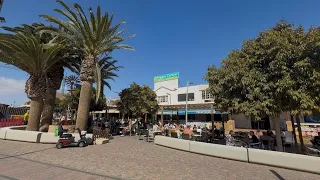
We ended up finding more “popcorn” on the beaches of Corralejo. Corralejo looks much better than Costa Calma. It has a completely different vibe, a lot of young people, surfers and bigger stores.
It’s a great place to have lunch on a terrace with a view. We also visited a beach near Corralejo, Playa del Pozo – a popular spot for surfers, windsurfers, and kite surfers. The sand here is almost white, and along the shore, there are many round stone kind of structures where people hide from the constant wind and sunbathe.
Then we headed to the Corralejo Dunes – in my opinion, a must-see. The dunes are real, quite high, and the sand is almost white. On our way back to the hotel, we passed through the town of Puerto del Rosario – the administrative center of the island.
It has a nice promenade for walks and a port, but we didn’t find anything particularly remarkable and didn’t stop. The next day, we decided to drive to the western part of the island again to watch the sunset and visit a couple of other attractions. One of the best places for watching the sunset in Fuerteventura is the Caretta Beach restaurant near the beach and viewpoint of La Pared and Punta Guadalupe.
La Pared – translated as "The Wall," has its own history. Until the 14th century, the island was divided into two kingdoms of the Guanches, the indigenous people of the island. One belonged to King Guise, and the other to King Ayose.
Their territories were called Maxorata (in the north) and Jandía (in the south). They were separated by a wall - La Pared. Some remainings of the wall are still visible today.
I would have also liked to visit the Mirador de Guise y Ayose with the iron statues of Kings. But we didn’t make it there. well, maybe next time.
Among the offered excursions, there is also stargazing at night. My advice – just take a good pair of binoculars and drive a bit away from your hotel. There is almost no light pollution.
You can see plenty of stars with the naked eye. We were mesmerized by the starry sky right from the hotel territory, without even needing binoculars. That’s everything we managed to see in three days.
If I remember anything else, I’ll add it in the video description. Feel free to ask questions, and at the end, I’ll leave links to my videos about other Canary Islands. Wishing you bright travels!
See you soon!