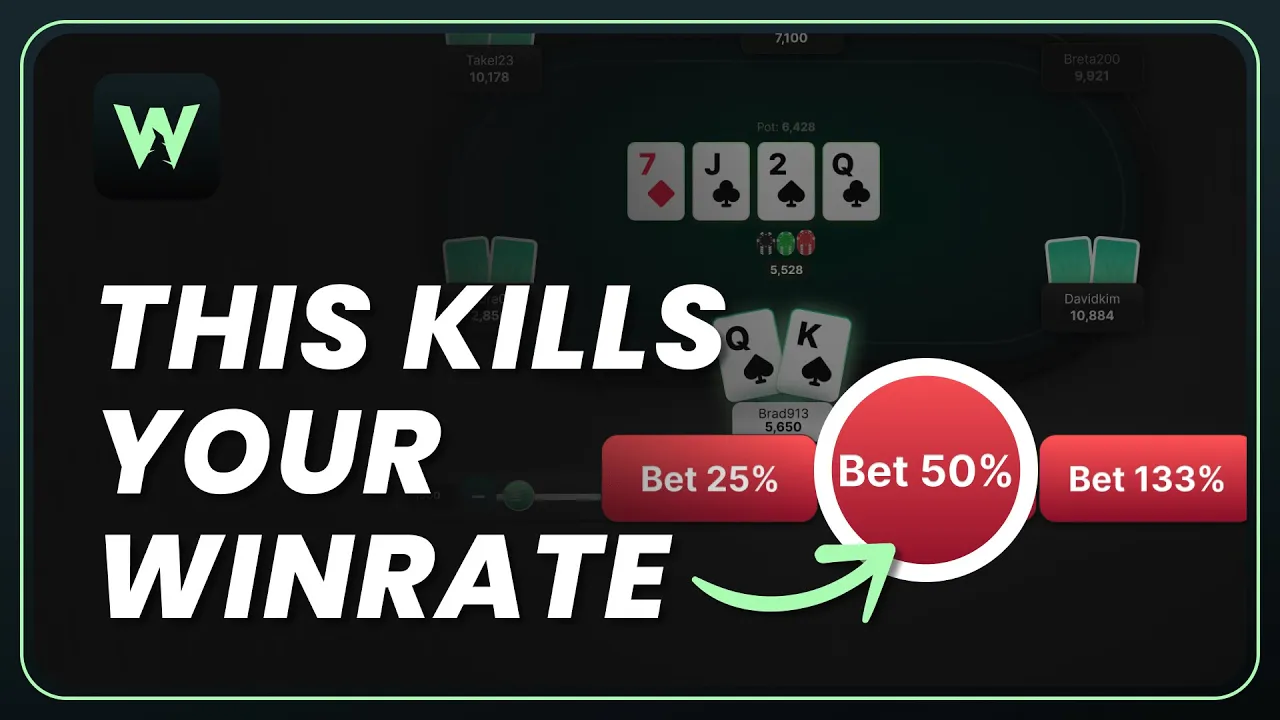
[Music] are you someone who bets half pot all the time just because you're not sure what else to do it might seem like a safe option but in reality you could be leaving a ton of money on the table in this video we'll look at some spots where sizing up or down can make a big difference to your win rate so that you too can be the shark on your table [Music] [Applause] when it comes to over betting the number one rule is to only do it when villain is kept the last thing you want
to do is to be bombing it into a range full of straits and flashes because not only do we lose a huge pot against these hands we also lose a lot of value against the hands that we beat and that's because the more that hands villain has the more BL catchers they can fold without overfolded best spots to overb are really those where our opponent has almost zero nut hands because then it also means that he has to pay us off with a ton of weak Bluff catchers as for how we can identify if our
opponent's range is capped that really comes down to a combination of the action and the run out so whenever our opponent takes a passive action like check calling or checking behind it really makes it much less likely that he has a very strong head because all of his nut hands are going to want to be batting or raising to build the Pod so whenever our opponent fails to do that then it's much more likely that he has some kind of weak BL catcher that's just trying to get to show out and when you combine that
with a blank run out meaning nothing really changes on the next card then that's the perfect situation to be over betting and putting a ton of pressure on our opponent's Bluff catchers for example on this King highboard button versus big blind let's imagine if we make a small CED in position and big blind responds by just calling so now we have the first criteria which is our opponent taking a passive action if he did have something like a two pair orad then these hands would be raising most of the time right they're very strong they
want to be building a big pot so the fact that our opponent didn't raise takes away a lot of these hands from his range and you can see most of the calling range is really just weak BL catchers right there's a lot of stuff like second pair third pair has like weak top pairs that just want to get to show up and if we combine that with a blank turn so on the DU of clubs for example it's not a turn that really changes much big blind will of course hit some new strong hands like
King du and pocket Dees but these hands are really not that big of a part of our opponent's range and even if we add them up with all of the previously slow played you know hands like King eight and 108 it still barely makes up 4% of the Big blind's Range so now we have both pieces of the puzzle passive action Plus blank run out and this actually makes it the perfect spot to be overbetting you can see the only size that Buton uses here is the 1.3x part overb so let's take a look at
big blind's response in order to better understand why the overb is so effective here you can see big blind is continuing all of his top pair he's also calling with most of his second pair and there's even a little bit of ax and USX that's calling as well and just from this response alone you can already start to see we don't even need that strong of a hand to be overbed even if we have a decent top pair like king queen or King Jack there's still plenty of wor hands that can be calling us and
we're also not that worried about running into a better hand and this is actually a very common mistake which is for players to go for a normal kind of size right with king queen king Jack you'll see a lot of players just go for a half bad or 2/3 spot size bad uh and while that does get us caught by more hands the problem is that the times you do get called by these hands you just win such a small partt so overall is actually better to size up and sort of accept the fact that
we're going to get caught by a tighter range but at the same time we just generate so much more value from the hands that do call on the other hand if the flush completes on the turn then this is a spot where it makes a lot of sense to be sizing down so if we try going for the over bad you know with the same kind of idea in mind maybe we want to win a bigger bat from hands like top pair at the expense of folding out a little bit more second pair you can
see the same kind of logic doesn't really work here simply because big bline doesn't even have to defend with all of his top pair and that's because he has an extra 9% of flushes to defend with so all we're doing when we size up is just making the big play's calling range really strong and in spots like these it becomes very important to go for a smaller size so if we go for a 66% % pot size sped and it you can see that we get called by pretty much every single top pair and even
second pair and third pair are calling at a slightly higher frequency so this is our strategy in the nutshell you can see that on all of the turns that introduce new strong heads in our opponent's range like straight and Flash completing turns we want to go for the smaller size in order to avoid making our opponents range too strong and on all of the turns that don't change anything such as the deals through the five we are able to go for the overb simply because we're not that worried about running into a strong hand and
therefore we can just focus on extracting the maximum against the hands that do call for our second example we have an a highboard utg open versus big blank call and here you can see that the moment utg checks behind his range is relatively capped it's not really checking back set and two pairs at any significant frequency so on most turns big bline actually gets to go for a massive size right there's over BS up to two and a half times apart and the reason is the same it's just that we're not very worried about running
into a better hand in this case the five might not look like a blank because it completes a bunch of straights and maybe even some two pairs but the thing is that utg isn't really going to be raising hands like 56 and 78 at full frequency so these hands make up a really small part of his range and for the most part you can see his range is really saturated with BL catchers like top pairs as well as under pairs so even if we go for a really large size utg is still forced to call
us with a lot of desent you can see that every single ASX has to call at some frequency because he simply doesn't have anything better to be calling with looking at Big blind's strategy on various SS we see a very familiar Trend where anytime the turn is a blank big blind is just going for a massive size so on any de 3 four 5 six big blind is going to have a bunch of two pack and sets and Straits and crucially these are hands that utg is lacking so again we have both pieces of the
puzzle utg takes a passive action on the Flop turn doesn't really introduce any strong heads in this range and these are really the kinds of situations where we want to be sizing up and getting the maximum amount of value from his bluff catchers and on the other hand if the fluff completes on the turn then now we have to be a little bit more careful utg is going to have a bunch of suited BR ways and it's is going to have a bigger proportion of Str strong hands so if we want to Value bet something
like aad then now it's important to go for a slightly smaller size in order to get called by more hands that we actually beat here's a question to test your understanding big blind checks twice on the board of a645 what size should utg use when delay c BIC take your time to think about it and you can resume the video when you have an answer so it turns out that utg actually wants to bet quite small here and at first this seems a little bit strange because big blind has checked not just once but twice
so surely this is going to remove a lot of the strong strong hands from his range and allow utg to be sizing up but the thing is when we're out of position specifically checking doesn't actually have the effect of capping our range and this is because we have the extra option of going for the check Race So looking at Big blind's very strongest hands you can see they're all checking at some frequency because unlike when we're in position and closing the action our opponent actually has the chance to put in a bed himself when we
check so we can always go a little bit more greedy check and hope that our opponent puts in the bat so that we can raise and build an even bigger pot and because utg has to worry about the threat of being check raised this actually makes him want to go for a much smaller size so the same formula still applies we always want to look out for Passive actions plus blank run out but in this case case we just have to be a little bit more aware that checking is considered a passive action when we're
in position but it's not necessarily one when we are out of position right simply because out of position has the extra option of check raising his very strongest heads so now that we know when to offet let's talk about when we might want to use a smaller size like a third or a quarter of the pot typically we want to bet small when we have lots of marginal hands that are interested in betting and there can many different reasons why it could be important to bet them but the one that we see the most often
is protection for example on most par boards the aggressor tends to go for quite a small C so for button versus big blank on a flop of 774 if you look at the composition of buttons range you can see that it's quite weighted towards marginal hands right there's a lot of hands that have between 60 to 70% equity and crucially these hands have quite a bit of incentive to be batting so just imagine if we have a hand like Ace King or Ace green and let's say we make a small bat of 33% part look
at all of the worst Ace highs and King highs that we can get value from and at the same time we also fold out PL pants that have six outs against us so with Ace King if you make a small bed and you fold out Jack 10 and Jack n that's actually a pretty good result because you're denying your opponent his 25% equity share so whenever we have these two components right if we have some component of thin value and we have some component of equity denial right that's usually sufficient reason to be batting our
head but of course with aing or a scen we don't really really want to go that large uh just imagine if we we were to go 75% part right now when you look at big blind range is going to become much tighter right now we're starting to lose value against all of these worse King highs or even ace high is starting to fall sometimes and while we still deny a fair bit of equity it's no longer enough to justify Bing and basically if you want to bet a hand like aing or if you want a
b hand like Forex uh you're just forced to use a small size and that's really what's driving this 33% that size that we see here on the other hand if our range lacks marginal hands or perhaps the marginal hands that we do have are not very interested in beding then it wouldn't make sense to use a small size so for example imagine if we see back the same flop of 774 the big blank calls and now we get an ace on the turn right this is actually a spot where the solver mostly goes for the
overb so looking at the equity buckets over here you can actually see we are missing the bucket of 60 to 70% Equity hands and that's because uh in this kind of situation if you have an ace or better then you're going to have more than 70% equity and on the other hand if you don't have an A so let's say if we have kings queens and Jacks then these send only have 50 something per Equity so this creates a situation where anything that is not an ace so Kings s and Jacks they're just not strong
enough to be value betting and anything Ace X or better so if you have Ace King or if you have a hand like trips uh these hands are allowed to be going for a very big size right so there's not a lot of hands that make sense to be Bing small and while you can consider a hand like weak ASX a marginal hand right so hands like ace5 A6 if we did want to bet these hands right maybe we would see more small bets but the problem is that even these hands don't gain that much
from Equity denial so imagine if we make a small bat with a hand like A6 and now if you look at the hands that are folding right we just don't need to be fold holding out any of these hands right they're pretty much drawing de against us so while we have quite decent Equity when call right the lack of equity denial just makes it much better to be playing these hands as a check and once again if we're checking hands like ace5 and A6 then there is really no reason to be using such a small
size here's another question to think about pick BL three bet versus cut off on a flop of 774 what size should big blind C bet a should we go for a 33% po size bed or B should we go for a 3/4 po size bed and don't forget to think about what our marginal hands want to be doing so if you guessed B then that is absolutely correct it might seem a little bit strange to be betting so big on such a dry board but at the end of the day if we don't have any
marginal hands that we're interested in betting then there is simply no reason to be sizing down so looking at the composition of Big blind's Range you can actually see that big blind doesn't have any hands in the region of 60 to 70% acity and that's because if you think about the kind of range that he's three betting we're either three betting some kind of big overpar we even have a bunch of 78 and 67 that has hit trips and all of these hands are strong enough to go for a large size so it's not like
the previous example where it was Buton versus pick planine in the single race pod but's going to have left hands like Forex right hands like small pocket pairs that want to bet for protection and big blade doesn't really have that many of these s and because of that it really makes more sense to be using a slightly larger size that is consistent with how polarized our ranges another key difference has to do with how much Equity a hand like Ace kinging has previously in the single race pod Ace King was quite clearly a magal h
we were able to make a small bad get plenty of D value and deny a bunch of equity at the same time right but here in the three bet part cut off range is much stronger after calling our three bad and you can see this reflected in the equity of our hand as well Ace King only has 53% Equity so it's not really able to make the same kind of small bad and get caught by that many wor heads most of the stuff that c either beats us or has a lot of equity against us
and it's not like in a single race spot where our opponent has a ton of ASX offsuit that we can get plenty of th value from and as a result Ace King is really betting as a bluff on the Flop instead of trying to go for a small bat it's it makes a lot more sense to size up hopefully fold out some pocket pairs or if not on the Flop then on a later street but at the end of the day Bluffs are really not that particular about beted sizing right they're really just there to
make sure that our value hands get paid and in this case if our value region wants to go for a large size then that's what aing and all of our other Bluffs are going to do as well if you enjoyed this video don't forget to leave a like and you can also check out my channel poop for more strategy content [Music]







![WSOP Main Event 2024 FINAL TABLE - A Champion is Crowned [$10,000,000 FIRST PRIZE]](https://img.youtube.com/vi/b6SWIax-yyk/maxresdefault.jpg)