all right so here we're going to talk about ketone body synthesis now ketone body synthesis is something that happens after a very long fast that's when it normally happens it also happens in states of insulin deficiency as we're going to see why that happens so there's not a whole lot that you really need to memorize for this you more so want to have a general understanding of ketone body synthesis why it happens and what the implications are you also want to know where it happens and where it doesn't happen or where ketone bodies cannot really
be used so we're going to go over some of the generalities of this we're going to go through the biochemical pathway but i want you to just have a general understanding of this if you don't memorize this pathway it's not really a big deal as long as you have a general understanding of how this pathway works okay so first of all uh ketone body synthesis uh is is probably really not the best name for this talk we're talking about ketone body synthesis yes but we're also talking about ketone body usage as well so we're going
to start out with the synthesis of ketone bodies and first of all what you need to know is that this occurs in the liver it specifically occurs in the mitochondria of hepatocytes so what do we use to make ketone bodies well first of all remember that this occurs after a long fast so we've already used uh glycogen we've already gone through as much gluconeogenesis as possible and now we're down to burning fat and burning amino acids so that is what is used to make ketone bodies fatty acids primarily and to some degree amino acids in
particular the ketogenic amino acids you'll want to remember at least two of the ketogenic amino acids that the two ketogenic amino acids are strictly ketogenic and that's leucine and isoleucine so what those make is acetyl-coa and acetyl-coa will go through a process to make hmg-coa now the process is not as important as understanding that hmg-coa is involved because they're going to try to trip you up a little bit on this but first of all acetyl-coa has a couple enzymes that it uses to get to this point and those are thialase and more importantly hmg coa
synthase please remember that this is a completely different enzyme from the more famous hmg-coa reductase which is completely different so basically what happens is two acetyl coas i should write two here two acetyl-coas come together they make uh acetoacetyl coa and then another acetyl-coa comes on to that and makes hmg-coa so there's another acetyl-coa that comes in here and makes coa now hmg-coa is also involved in cholesterol synthesis and what happens here is you have that hmg coa reductase and that makes mevalinate but this is a completely different process this has nothing to do with
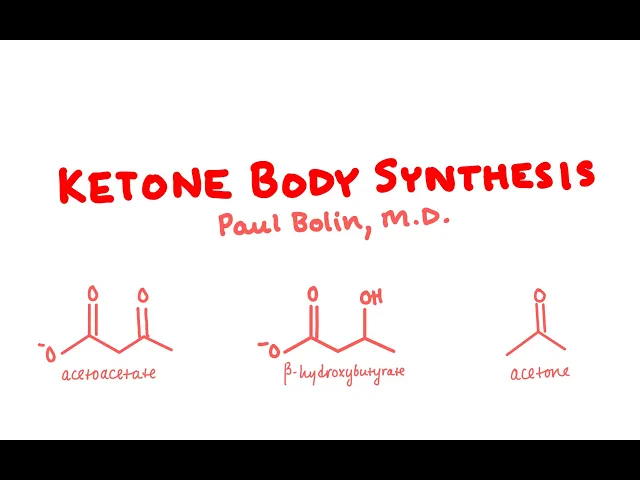
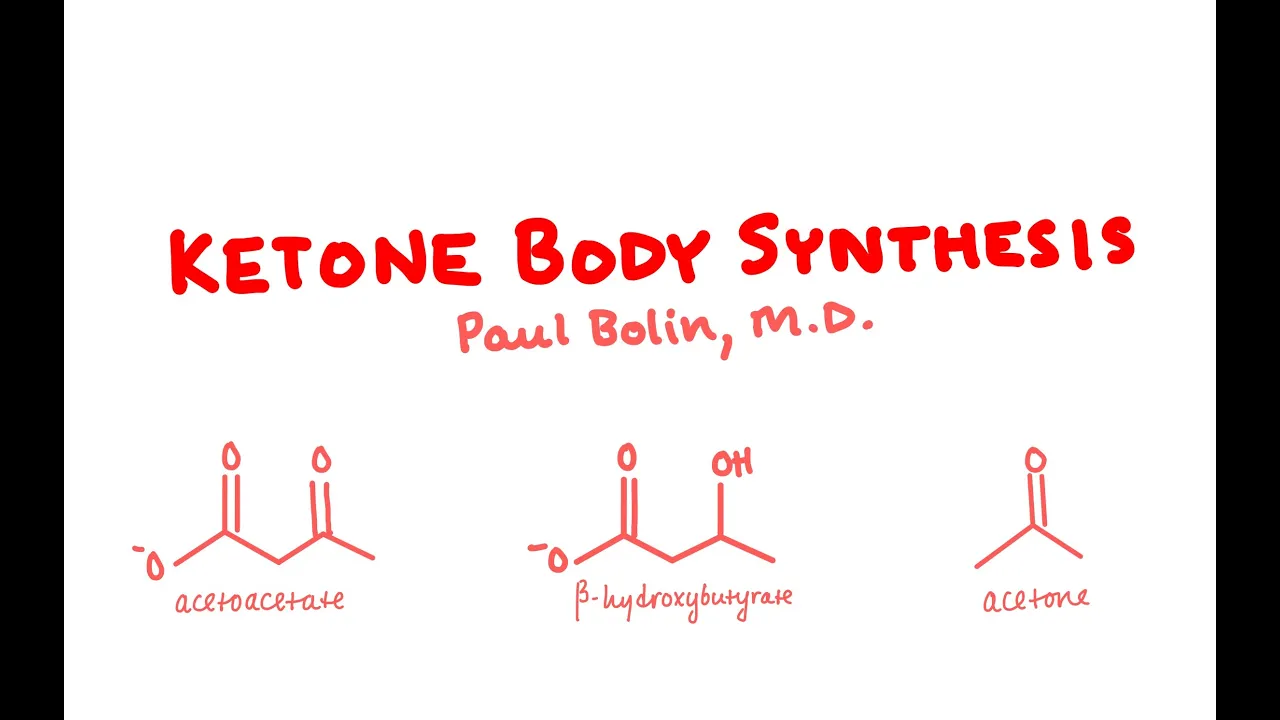
ketone bodies so i don't want you to think of that here what i want you to think of is hmg-coa synthase because that's the most important step in ketone body synthesis okay so instead of hmg-coa making cholesterol hmg-coa is going to make acetoacetate that's the next step in ketone body synthesis and the enzyme that does that is called hmg coa liase and that makes acetoacetate and acetoacetate is the first of our ketone bodies another one another ketone body that can be made from acetoacetate is beta hydroxy butyrate okay so they're both ketone bodies and these
ketone bodies then go into the bloodstream so here we have acetoacetate and beta hydroxybutyrate such long words okay those are our two ketone bodies now acetoacetate can spontaneously get converted into acetone and acetone is volatile and it's not a ketone body that we can use but it's volatile it can go into the lungs and be breathed out and that's what gives that fruity smelling odor uh to the patient's breath when they have a lot of ketones in their blood now it's worth remembering that let me use this color here it's worth remembering that ketones ketone
bodies are mildly acidic and so when they build up they decrease the blood ph and so this is what causes that non anion gap metabolic acidosis that you get with ketoacidosis okay so you've got acetoacetate and beta hydroxybutyrate in the circulation and now they're going to go into peripheral tissue where they can be used now it can be used by any peripheral tissue but the two tissues where it cannot be used you'll want to remember are hepatocytes and red blood cells and that's because they lack some of these enzymes that we're going to talk about
as we convert ketone bodies to things that we can use okay so we've got acetoacetate here and we've got beta hydroxybutyrate here i'm just going to write bhb all right so we've got acetoacetate what do we do with it well we're going to convert it to acetoacetyl coa now how do we do that we actually use an intermediate of the tca cycle that you are probably familiar with and that's succinyl co a and that's going to donate the koa to acetoacetate so we wind up with succinate here and then we've got acetoacetyl coa now the
enzyme that does this is called thiophorase and this is actually what's lacking in hepatocytes and why it's not able hepatocytes are not able to use ketone bodies now we've got acetoacetyl coa and what we do with that is we can make acetyl coa and of course we're making two acetyl coas so we have to have another coa coming in here and then that's really it so acetyl coa then can go into the tca cycle and we make our nadh and nadh goes into the electron transport chain and makes atp and so that's how we get
energy from ketone bodies now the most important tissue that uses ketone bodies is the brain and so this is very very important the brain is going to run on ketone bodies after a prolonged fast now it's also going to be important in diabetes why is it important in diabetes because we're unable to bring glucose into the cells so we're going to rely on mobilization of those fat stores to make ketone bodies in the liver and then supply that to peripheral tissue because we cannot take in glucose so we're reliant on taking in ketone bodies in
order to get energy and atp and keep those cells alive so one way they may ask you a question on ketone body synthesis is that they may tie it in to the tca cycle now this would be definitely a harder end question but it's worth mentioning here because the tca cycle is one of the most important cycles in biochemistry because it's kind of the central uh point in a lot of metabolism so it's worth mentioning here now when you've got ketone body synthesis let's say you've got diabetes and you need to use fat in order
to get energy then you're going to undergo rampant fatty acid oxidation and when you undergo fatty acid oxidation you use up a lot of nad why because nad is an oxidizing reagent it pulls off protons and so it oxidizes fat so your nad stores are going to be very low well what uses nad the tca cycle you use nad here whoops you use nad here you use nad here and you use nad here so what's going to happen is the tca cycle is going to grind to a halt and so acetyl coa is going to
build up what's also going to build up is pyruvate naturally because if you don't have nad you can't convert pyruvate to acetyl coa so what that means is that acetyl coa is going to be diverted into ketones acetyl coa is not going to be diverted into making fat that wouldn't make any sense because we're breaking fat down it's going to be converted into ketones pyruvate is going to be converted to lactic acid and the reason for that is because we have low levels of nad and when pyruvate uh is builds up and there's nowhere else
for it to go then nadh is going to reduce pyruvate into lactic acid and that's going to be favored because we have high nadh relative to nad so those are a couple things that they may try to get at on the usmle and so again if you haven't watched my video on the tca cycle i strongly strongly encourage you to go back and watch that because it's one of the highest yield pathways in biochemistry so let's just go over the high yield points of ketogenesis so when do we undergo ketogenesis we undergo it during conditions
of starvation typically after three days of fasting or if a patient is insulin deficient now this is a gradual process we don't just uh we don't just suddenly shift to ketogenesis after three days after any uh prolonged fasting one two days we gradually ramp up ketogenesis but we're pretty much a hundred percent reliant on it after a few days so if you've ever uh if you ever have a patient that's been fasting for a little while and you get your analysis and it comes back with mildly elevated ketones you can do a magic trick and
tell the patient hey you haven't eaten in a while and they'll say yeah i i haven't how did you know that and it's because they've got ketones in their urine now by the way i just want to point out that the only ketone we can measure in the urine is acetoacetate we can't measure beta-hydroxybutyrate okay so that's when we undergo ketogenesis well where does ketogenesis happen you need to know that it happens in the mitochondria of hepatocytes why do we undergo ketogenesis because it supplies vital energy primarily to the brain heart and skeletal muscle all
very very important parts of the body you need your brain and your heart to stay alive and you need your skeletal muscle to you know be able to function how do we undergo ketogenesis well we convert stored fatty acids to acetyl coa through beta oxidation remember that the rate limiting enzyme of ketogenesis is hmg coast synthase which converts acetyl coa to hmg coa in that that process so remember there's multiple enzymes in that process but ultimately it makes hmg coa and the key regulators are indirectly the regulators of beta oxidation remember that glucagon increases fatty
acid oxidation and so when you have gone a long time fasting glucagon is going to increase and that's going to increase fatty acid oxidation which is thus going to increase ketogenesis by increasing your acetyl coa and also by by slowing down the tca cycle now insulin is naturally going to decrease fatty acid oxidation and that's going to therefore decrease ketogenesis now why is this important because if we have a patient that's insulin deficient then it's going to naturally do the reverse it's going to increase fatty acid oxidation because our our levels of insulin are low
and so that's going to increase ketogenesis if you're insulin deficient and so that's why patients who are are are diabetic that's why they're going to have high levels of ketones [Music] you