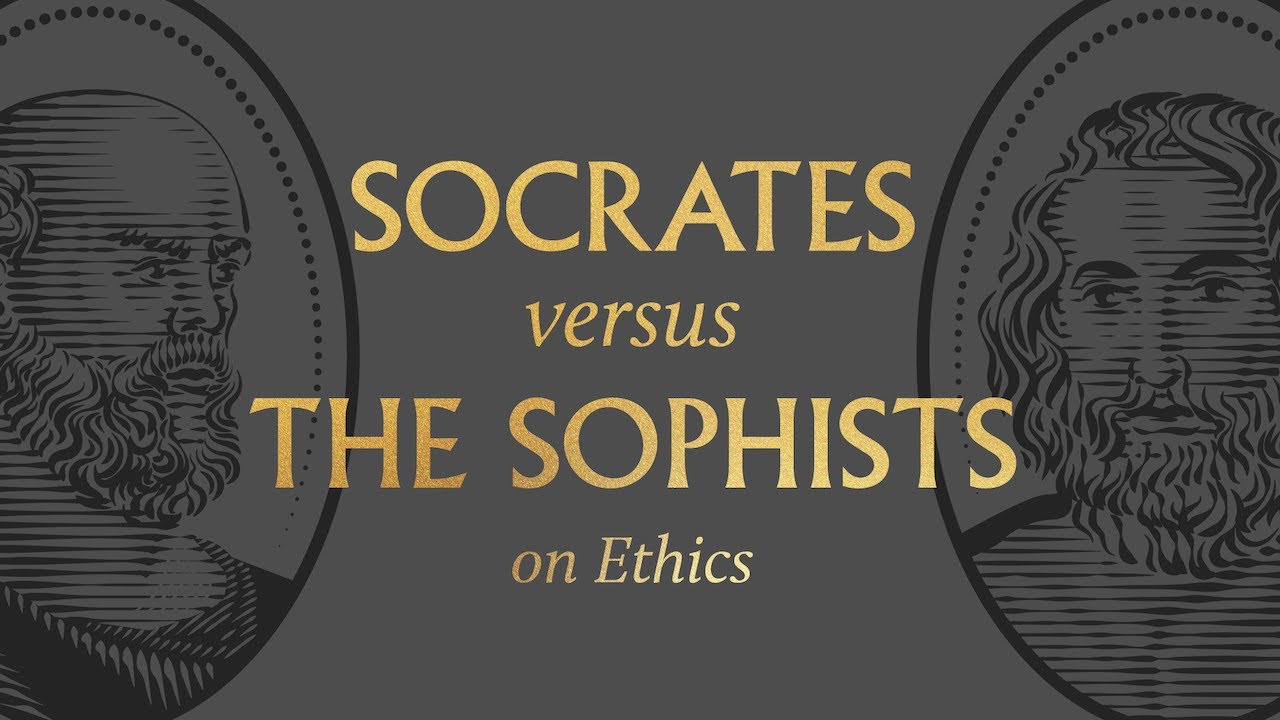
alright now let's leave the atomists and go on to the second school for this evening the Sophists now this office strictly speaking were not so much as school as a professional class in the fifth century BC Sophia as you know means wisdom so Sophists if you go by the etymology as a wise man and Noah however what they knew and what they taught if we put it briefly was how to win friends and flatter the multitude and thereby gain political power in your particular city they appealed above all to unscrupulous office seekers and they taught
them all the debating tricks all the fallacies all the confusing gimmicks that they could think of so that the aspiring politician could bamboozle his opponent they were in effect like debased Dale Carnegie's on the political level the result was that they acquired a bad name and the word softest has come to have its president negative connotations I might say partly the name the negative connotations are undeserved because they were held in opprobrium because they accepted money from teaching philosophy which was regarded as a breach of moral principle and apparently still is by many universities the
main Sophists were Pro Tiger aspire Oh ta geo Ras he's the father of sophism 480 to 410 BC and gorgeous Geor gie a.s who is 483 to 375 BC you may have heard of others such as Thrasymachus and Cal achlys but the big two are pro Tigers and gorgeous now philosophically the Sophists are the first avowed skeptics in history if we ignore cratylus who never would say anything and I've given you the definition of skepticism no objective or certain knowledge as possible to anyone about anything nothing can be known well how you ask do they
know this what arguments do they put forth primarily they based their skepticism on an all-out attack on the senses now when I say all-out I mean all of it they claim to prove that every sense perception by any creature is necessarily invalid now this is a much more sweeping argument than the Reader's Digest type I mean by that then the obviously popular type for instance there is the argument from illusion you know you put a stick in water it appears banded it's really straight and there's a certain mentality that derives from that the conclusion that
therefore the senses are unreliable or there's the argument from hallucinations you know you see a dagger before you or pink rats after having a drink and they aren't really there and there's a certain mentality that concludes from that that the sentencer unreliable now those arguments are very poor arguments they wouldn't stop anybody seriously for five minutes the Sophists were not above using those arguments but that was not the essence of their case their case was a much more important argument it was an all-out attempt to show that every sense perception is wrong not just that
we can be taken in by an occasional illusion or hallucination but that you can never trust anything from the senses why well here is the famous argument whenever we perceive what we perceive depends upon two factors one it depends upon the object being perceived now that much is obvious if I look at a person that's one object and I'm going to have a different experience than if I look at a picture of water and so on if I listen to rock my love I'm going to have a different experience than if I listen to Beethoven
I'm hearing a different object that much is obvious but the crucial point is point to what you perceive they say depends not only on the object but also on the nature of your sensory apparatus the nature and condition of your sensory apparatus I hear there are many famous examples that color blind men and demand with normal vision look at the same rug and one says it's red the other says no it's great they're looking at the same object but their experience is influenced by the type of sensory apparatus they have you taste a piece of
cherry pie but it tastes sweet you then develop a cold or smoke for packages of cigarettes and coat your tongue appropriately and taste it and it tastes bitter same object you look at the Sun from the earth and it seems to be about the size of a 50-cent piece you travel closer and closer to it and it gets you during a huge earth the size that you experience varies with the condition in this case your distance of your perception you take three beakers of water the freezing cold one the medium warm one and the boiling
hot one and you have one person plunges hand in the ice cold one and then in the lukewarm one and he says oh how warm and you have another person plunge his hand in the boiling water and then into the same medium one and he says oh how cold same object different experience this office say because the sensory apparatus is different now you can do this with anyone if you want with any sensory quality if you want an example put your finger gently I stress gently into your eye and press it and you will see
two of me now the Sophists say to elaborate beyond what they said but the idea was we can't go by majority rule in this question what if there was a race of Martians and they had their fingers there's tied into their eyes at birth so they saw two of everything now would you say the way to tell whether there's really one or really two is to take a population count and if there's more marshall's than us there's two if there's more of us than the Martians there's one obviously that would be senseless you can't go
by majority rule in epistemology what conclusion then do we come to who is right well they said there's only one fair conclusion to come to nobody is right because nobody can ever perceive reality except as processed by his particular sensory apparatus nobody ever perceives reality directly you can't just take your consciousness and wrap it around something impulses have to be given off which go through your particular operators and the kind of apparatus you have affects what you at the other end finally experience therefore all we ever can know is the way reality appears to us
because of our senses and if we our sense is different the appearance is different therefore we can never say no one can ever say what is the case objectively in reality all you can ever know about is what appears to you and now because tomorrow your senses may change put it another way you never can say it is you always must begin your sentences with it seems to me it appears to me there's no way of knowing how things really are all we know are our own subjective experiences the private effects on each of us
of the world out there and since these effects vary from individual individual from species to species from time to time each of us lives in his own private subjective world and we simply have to dispense with all talk about reality now some of them went so far as to say we may as well get rid of the whole idea of reality how do you know there even is such a thing since you never perceive it others weren't quite so radical and they said well there is one but what's the differences it's unknowable anyway now this
is the most influential argument ever advanced against the validity of the census it's the only influential argument ever advanced against the validity of the census it was accepted in full by Plato although rejected by Aristotle accepted by Plato and then of course Pike or the whole Christian era by almost all modern philosophers without exception and in a blown up cosmic a gigantic form it's the basis of Kant's whole philosophy so therefore it is urgently important that you know what is wrong with this argument now please observe that two things are true and can't be contested
it is true that perception is impossible without sensory organs and it is true that the type of organs you have in some way affect the type of experience you have that much is true now from those premises Protagoras draws the conclusion you can never perceive reality now I ask you what is wrong with his reason now I suggest you think about it add it to your list all right where did this office go from here having annihilated in their view at least the census well you might say what about reason couldn't reason give us knowledge
of reality even if the senses deceive us well of course the earlier rationalist would have taken exactly that position and Plato subsequently will take that position but the Sophists do not they hold the view that reason depends upon the evidence of the senses which is quite correct you're entirely correct on this point and they say therefore if the senses give each of us only our own private subjective world then our so-called rational conclusions are each of them true only for that private individual only for his private world are true only for him now the arch
mark of a saw fost in today's world is anybody who puts the word for after the word true there's two kinds of people the people who say this is true and people who say this is true for me for you for him for her for it for us for etc as soon as the anybody puts four on that is the tip-off that he has a subjectivist that he does not believe you can make a statement about reality that everybody has his own private little world and in your little world there might be a god and
therefore it's true for you but in my little world there isn't and therefore it's not true for me and so on now that goes back to the Sophos viewpoint now most people that they can't even defend that viewpoint this office at least derived it from an overall epistemology nor was that the only thing they held against reason namely the deficiency of the sensory basis of it they also put forth the argument which we can call the argument from disagreement the argument from disagreement is very simple everybody disagrees about what is rational who is to say
what's really true Bailey says everything is water Heraclitus has no it's fire change Parmenides says oh there is no change at all pythagoras says you're all crazy it's a world of numbers and the atom is they all know it's little particles and the Sophos at this point come in and they say now look this is hopeless if human beings had a way of arriving at the truth they would agree if they don't agree it must just simply go to show that reason is incapable of arriving of the truth that argument by the way is enormous
ly widespread almost as widespread as it is fallacious if you have any questions about it I'll be glad to answer them in the question there but I take for granted the obvious fallacy and there's still a third thing they had against reason namely they were followers of Heraclitus so everything is constantly changing nothing therefore is an absolute so even if by some miracle of good luck you hit on the truth anyone stayed true for two seconds anyway you see nothing is true for two consecutive instants so you can't even say simply it seems you have
to say it seems to me now now a to famous statements expressing this view one is protagonist as famous statement the manifesto of subjectivism man is the measure of all things of things that are that they are and of things that are not that they are not now by man there he means each individual man subjectively in other words if you believe if you feel that something is so it is so for you now and if you don't it isn't for you now and so on that's the famous man is the measure of all things
and therefore of course is complete subjectivism and complete relativism there's no absolutes there's no objective truth and the even more succinct formulation comes from gorgeous who was the perfect example of a 20th century skeptic transplanted into ancient Greece he wrote a book where they were all writing books on nature on reality on the nature of reality as his book in the true Sophos tradition was titled on nature subtitle or the non-existent and it maintained three basic propositions one nothing exists - if anything existed you couldn't know it three if you could know what you couldn't
communicate now that is what you call skepticism now it is useless to ask him does he exist does he know the things that he claims has he communicated there's no use asking him that because he'll say no yes say it's highly probable of nothing exists and if you ask him well do you know that you'll say it's highly probable that it's highly probable that nothing exists and so on and so on that's what they used to call me agent world reduction to babbling the skeptic would finally stand in the corner and simply say it's highly
probable it's highly probable it's a problem so needless to say as is true of all skeptics without exception the Sophists prided themselves on being enlightened on having escaped the superstition and the dogmas of the past they said we proudly know that you can't know anything we don't pretend to have any knowledge now this is a historical cycle you will see and we're therefore at the end of an era you will see that the whole history of philosophy is in cycles like this a constructive era collapsing into total skepticism and in the beginning of a new
one into a still deeper skepticism in comparison to which even gorgeous seems to be a cognitive specialist and so on and so on that this has been repeated over and over again is a fascinating parallel to the history of certain countries which have a mixed economy that is there'll be a constructive period a boom and then a bust a depression and then another constructive period frequently with inflated speculation following upon which there is a more severe depression and that has been the entire pattern of the history of philosophy and whenever you reach complete skeptic you
finish cycle 1 and since people can't live by it that is the time when a new philosopher of great importance always appears because he is the one who tells mankind what to do now now I simply say that in the 20th century skepticism reached and has now reached the most intense level ever which augers well for the future of a new constructive period now let us turn in conclusion to the ethics or morality of this office because they had very definite views on this question well can efex come from reason obviously not reason is deficient
can it come from God obviously not now remember this office says good skeptics are not atheists atheists claim to know something for certain namely that there's a no God the skeptics are agnostics this office are agnostics they don't know one way or the other whether there's ago but in any event they don't know that he does exist so he's no good for ethics well the question is where is ethics come from them can't come from reality it can't come from God and their answer is very simple it doesn't it comes from nowhere there is no
objective ethics there is no basis for it no source of it and man has no cognitive faculty to grasp it therefore they are as you would expect complete ethical subjectivist and complete ethical or relativists man is the measure of all things including of all things that are good you say to them but don't you recognize certain virtues that man should involve answer virtue is an arbitrary social convention their position is if you feel that something is good and by something I mean anything whether it's having an ice-cream cone or massacring a continent if you feel
that it's good or right it is good for you know all desires are ethically equal because there's nothing to go by except arbitrary desires and passions if they were starting out their ethics systematically the first proposition would be I want it whatever it happens to be and if you say to them well what about facts or reality of course the answer will be who knows anything about facts our reality if you say shouldn't your desires be rational the answer would be what's rational for you isn't rational for me man is Domitian and so we have
an ethics of putting it an Objectivist terminology of avowed or whim worshiping and according to the later Sophos particularly the more intense your whims your arbitrary desires the better the ideal life they said is first you should burn with passionate arbitrary desire of any kind at all and then go out and satisfy it by any means at all all desires and all means of satisfying them are equally valid live by your desires they said that's what is the natural element in you that's what's giving you by nature by realities all the talk and argument and
reasoning and philosophy and so on that is simply artificial that is conventional that simply society's arbitrary dictates and so they are profoundly anti intellectual as they would have to be considering the intellect to be completely impotent and they believe that their way to achieve morality as they construe it is simply express your passions and view which has been adopted intact by many schools of contemporary psychotherapy exactly this same view only instead of saying this is the way to be moral they say this is the way to be uninhibited and healthy now the later Sophists added
in another point to this view because the question came up well what happens if your desires conflict with somebody else's desires and you have to deal with other human beings what do you do then and the answer was smash him with a club before he smashes you in other words there's only one method of dealing with other men and that is brute physical force if the useless to try to argue with men or convince them by reason for obvious reasons the reason is helpless the only argument is a club there's a particularly throw Symmachus in
particular is famous for this view it's the first time we've had in philosophy the view that might makes right now they said there's only one trouble with what people call immorality like lying cheating robbing raping murdering ascension the only trouble is you get caught what suppose they said you could put on a veneer of virtue you know you could join some appropriate charitable organizations and some clubs and so on so it looked like you were a good law abiding citizen and you make appropriate sacrifices that religious temples and therefore you bribe the gods suppose you
could put on this outer covering of ice they said and at the same time live a subterranean life out recovering a virtue and at the same time live a subterranean life of roaring vice well they said that would be terrific you would then have the best of both worlds the rewards of virtue the social approval and the pleasures of Vice or if you can't do that they said what about trying to become a dictator get a big police and military on your side and then you don't have to worry about any retaliation and they went
on this is not simply our theory all men are like this this is human nature why then do most men say you shouldn't live this way why does society say you shouldn't cheat and rob and kill and rape and their answer was society is a hypocrite society is a coward the people at makeup society secretly lust after just this kind of life but they're afraid they figure if they do this and then start the law the rule slaughter other people to get what you want somebody's going to do it to them and beat them to
the punch and therefore they get together and they let's compromise I'll give up what would be the ideal life of killing you if you give up what would be the ideal life of killing me and so we'll follow these rules but they said in society does this strictly out of fear cowardice and hypocrisy therefore not out of conviction every man would run riot like a women worshipping Sophists if he thought he could get away with it the famous story illustrating this is told by Plato who of course profoundly opposes the Sophists it's the story of
the Ring of God geez Gy GES a mythical character but simply you said like a parable to illustrate a point guy just was a shepherd who had a discovered a ring and this ring had the magical power that when you turned the stone to the ground you became invisible so it was like an anticipation of HG Wells invisible man and the Sophists say if you had the magic ring of guy geez life would be magnificent you could then run riot you could do anything you wanted satisfy all desires and you would be in a perfect
state and they say everyone is like that that's the way people are and the only question is do you have the courage ineffective approximate this condition or are you gonna be a coward now if I could just read you for a moment from Plato's presentation of this view his dialogues of course represent different views that he tries to answer but this is a famous description by through Symmachus speaking in Plato's dialogue of the myth of God Jesus the Ring of God jeez I'll just read you an excerpt from it suppose there were two such magic
rings and one were given to the just man the other to the unjust no one it is commonly believed would have such iron strength of mind as to stand fast and doing right or keep his hands off other man's Goods when he could go to the marketplace and fearlessly help himself to anything he wanted in her houses and sleep with any woman he chose said prisoners free and kill men at his pleasure and in a word go about among men with the powers of a god the so called just man would behave no better than
the other both would take the same surely this is strong proof that men do right only under compulsion no individual thinks of it as good for him personally since he does wrong whenever he thinks he has the power granted full license to do as he liked people would think a man a miserable fool if he refused to wrong his neighbors or to touch their belongings though in public they keep up a pretence of praising his conduct for fear of being wrong themselves so much for that and then they go on to say that you have
to become a real skilled expert in injustice however so that you can get away with it now this viewpoint is given a philosophic name and it is called egoism it is called egoism because the Sophos certainly do not preach that you should sacrifice for God or for others and they say you should achieve your own advantage and that should be your only goal now you see it is egoism I mean you'd have to classify it as that as against altruism or sacrifice for God or some other type of theory but it is egoism which is
thoroughly relativist skeptical and subjectivist and one of the worst errors one of the worst tragedies of Western philosophy is that egoism at its inception was tied to these other views the result is that ever since egoism has been associated with two cardinal points one way the win worshiping with the idea that the egoist is the man who arbitrarily follows his subjective passions wherever they lead you and to brutality the idea that an ego it to someone who tramples over others and you see arbitrary whim worship and brutality are all that's left when you abandon reason
and since the Sophists were egoist who abandoned reason they gave the first to give egoism the image and the concept that it has to this day in many people's minds now there were exceptions Aristotle is an egoist of a radically different kind but it was to the interest of the centuries of Christianity to ignore the existence of Aristotle and to present sophism as the only concept of egoism and so of course in the mass media today if someone is referred to as selfish that is simply taken as a synonym that he is a brute whim
worshipper but I believe that to this audience knows comment on that is necessary now this is the sort of position that Plato is going to try to answer and tell us what is wrong above all he was concerned to answer the Sophists in the history of philosophy there have been both the empiricist and the rationalist sides to the reason senses dichotomy I didn't use the word empiricist but that's the side that would say we start with the senses and then it turns out that they subsequently say reason is no good and we have just the
senses why did the Greeks take the rationalist side instead of the senses are valid or good and the reason is not side and that's an excellent question and my answer to that would be of course these two views as presented here are false both false the view that reason is right and the senses are wrong or that the senses are right and the reason is useless are both false but it is significant that the Greeks took the rationalist side rather than the empiricist side in the sense that's being used in this question and I would
say the answer is because the Greeks were thinkers in the following way if you're going to be wrong and I don't mean to say that some errors are wrong or less wrong and than others but if you're going to be wrong it is a much superior to be a rationalist in a certain limited respect because if you take the other side and say the senses are valid but you can't trust the mind like David Hume did for instance you are then in the position of an animal or a skeptic you are in the position of
saying nobody can know anything and under that viewpoint knowledge immediately comes to a halt you simply can't know anything because a human being who denies the validity of Reason wipes out the possibility of intellectual development so ideally mankind would have started with the proper relationship of the two faculties but if they had to start wrong it's perfectly understandable that they would start by accepting the validity of thought and then if they were led to primitive conclusions which seem to defy the evidence they clung to their reason as they understood it and wrote off the sensory
evidence that of course is profoundly wrong but if you're going to make a mistake and continue to think you cannot abandon thought in this sense the rationalists have always been philosophically superior to the skeptics although of course objective is and repudiates both and they have always been influential on men the skeptics simply set up the next rationalist that's all the Sophists give time for Plato to come in and the later skeptics give the door open to Augustine and the Renaissance skeptics opened the door to Descartes and David Hume opened the door to Kant etc the
whole pattern has been that the skeptic simply wipe out everything and the next rationalist comes in to institute his own new form of mysticism but in that respect it is the of these two errors it is the rationalists that are the only ones that have even thought and that have influenced mankind for good or evil the skeptics disqualify themselves on the face of it if the Sophists believed that one can't know anything how do they know what a desire is a perfectly good question to which I can only say the Sophists were inconsistent they were
not properly skeptical their modern followers are much more consistent and they say what can't talk about desires because you have the faintest idea what a desire is nor can you ever know what your desires are how can you be sure of anything Kant says for instance your desires as they really are entirely unknowable to you all you can know is your desires as they appear to you so-called phenomenal desires not the luminal desires and he has modern disciples who go one step further and they say how do you even know the way your desires appear
to you how do you know they don't appear to you differently from the way they really appear to you and therefore you can know anything I mean from this point if you gorgeous as I say was a half-hearted Fairweather skeptic compared to the 20th century