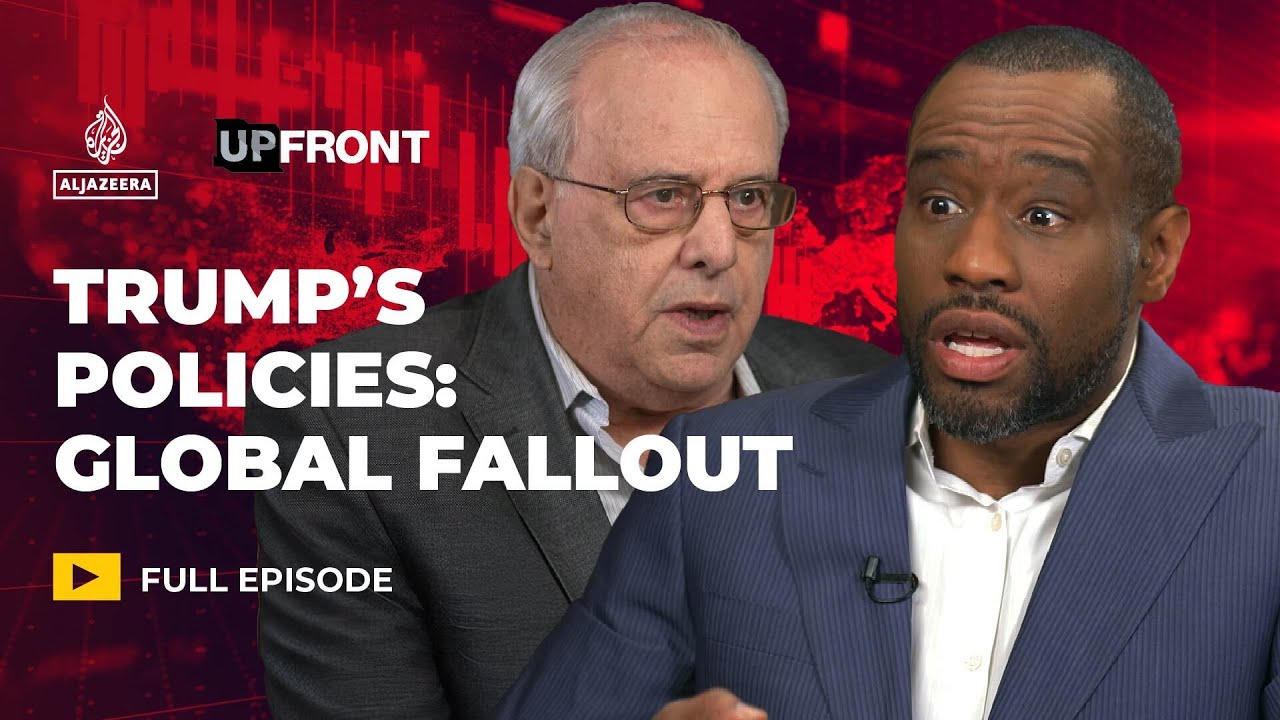
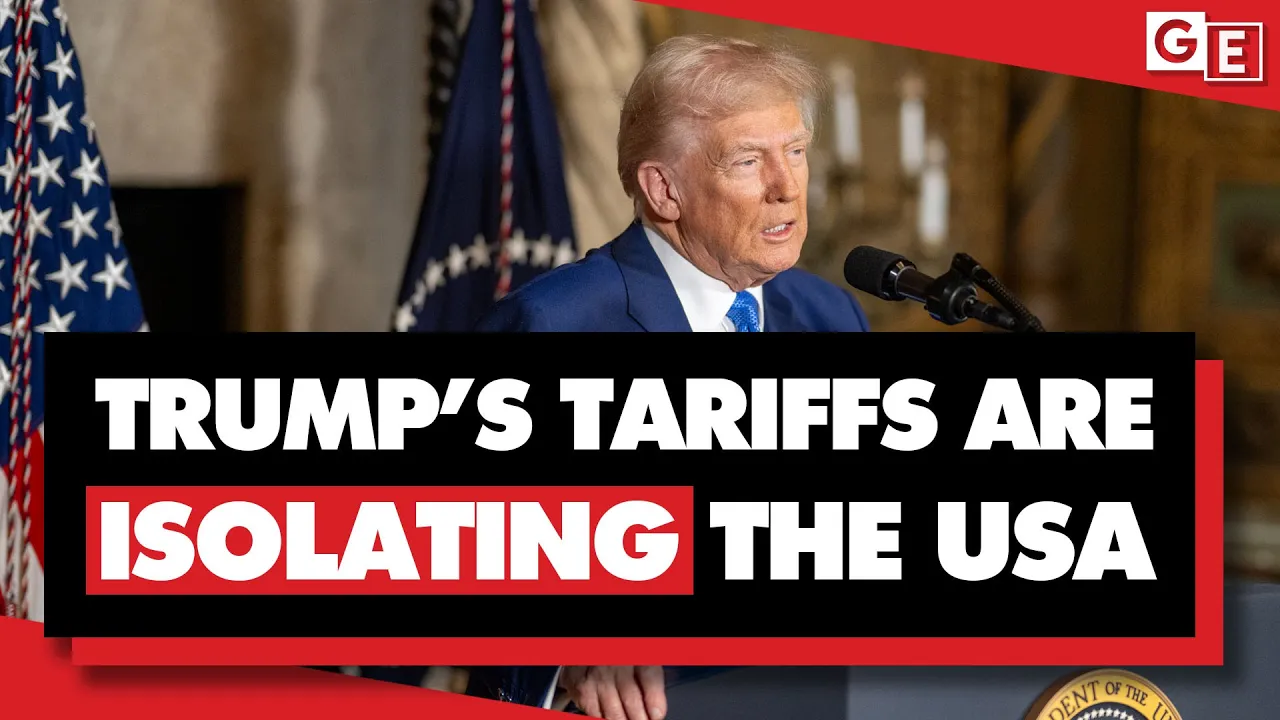
Why has US President Donald Trump imposed tariffs on countries all around the world? And in particular, why is Trump waging a trade war on China? What are his real goals? Well, to try to answer these questions, I spoke with the economist Michael Hudson, who is the author of many books and who just published the new report, Return of the Robber Barons, Trump's distorted view of US tariff history. Michael Hudson outlined the history of the use of tariffs in the United States and in other countries. And he explained how Trump is using tariffs as a weapon
of class war to benefit the rich at the expense of the vast majority of the population and also how Trump is trying to reshape the global financial system in order to benefit the United States at the expense of everyone else. But as Michael Hudson warns, this is already backfiring on the US economy and it's accelerating the transition to a more multi-olar world. So here are a few clips from our discussion and then we'll go straight to the interview. The United States is the only country in the world that has weaponized its foreign trade, weaponized its
foreign currency, the dollar, uh weaponized the international financial system, uh and treated every economic relationship as in an adversarial way to weaponize it. And other countries say how can we uh have a different approach and treat trade as how can we mutually gain? How can we treat investment as something where the investor gains but we also gain. So uh what's happening is that as other countries are putting in place their mutual uh production facilities, transportation facilities, investment pro uh facilities. Uh Trump is isolating the United States from trade and investment relations. has tried to isolate
China, but what it's doing is isolating itself from everyone except its satellites. Michael, thanks for joining me. It's always a pleasure. Let's start by talking about this report that you published and you outlined the history of US use of tariffs and industrial policy and your argument that Trump is using tariffs essentially as a form of class warfare to move the burden off of the rich and corporations and to increase the burden of taxation on the working class through the use of tariffs. So, can you talk about what your argument is in this report and why
you decided to write it? Well, it's much more than uh simply class warfare. Trump has for years been complaining about the fact that the richest people are taxed uh progressively at a higher tax rate than other people. He wants to get rid of the tax rate altogether for the finance, insurance, and real estate sector, the fire sector. And I think he must have had a discussion with some economist or historian and said, "Isn't there some way that we can get by without an income tax?" And uh the person must have told him, "Well, you know,
the United States didn't have an income tax before uh 1913." And Trump said, "No income tax." No. The uh Supreme Court ruled that income tax was unconstitutional. That's what Supreme Courts do. They try to prevent any kind of progressive social legislation. Well, finally in 1913, the Senate passed the 14th amendment and uh and uh enabled an income tax to be levied levied. So Trump said, well, how how did the United States finance itself before that? And the answer was well almost all the uh US uh tax uh fiscal revenues came from the tariff from customs
receipts in addition to land sales for land that they've grabbed from the Indians. So the uh Trump said well that's they they did it through tariffs. Well the advantage of tariffs for Trump is that who who the cost falls on consumers. uh he he doesn't see that they also fall on companies that import goods from their foreign affiliates. But ultimately Trump said, "Well, this is uh on consumers. This is wonderful if uh why couldn't we go back to the way things used to be today? Why can't we get rid of the income tax altogether, at
least on my constituency, the campaign uh campaign donors, and why can't we simply uh uh raise tariffs? Well, uh associates must have said, well, how ever are you going to convince people to go along with this? And so Trump said, well, let's see. uh ter under tariff protection late 19th century that's how the United States rose to be a great industrial power uh so somehow tariffs must have nurtured industry and I want to bring industrialization back to the United States make America great again and I can say tariffs are going to bring back industry and
what he means is untaxing the the wealthy people especially the finance and real estate sector and shifting the tax on to consumers is going to make the country great again. Well, uh what what he's leaving out is the fact that it wasn't tariffs as such that made America into an industrial power. uh what uh there was a whole large program that was necessary to industrialize America and all of this was spelled out in the 1820s by Henry Clay and it was called the American system and the American system was uh protective tariffs with internal improvements
that means public investment in infrastructure and a national banking system to finance industry. Well, Trump has said nothing about these and so it's worth saying something about them. Uh the by the late 19th century, the United States uh said, "How are we going to lower the cost that industry has to pay for its wages uh without uh leading to a huge round of strikes?" Well, what and the solution was, well, we can have uh the public sector pick up many of the costs that uh labor would otherwise have to pay out of its own paychecks
for education. We can have free education. Uh not the $50,000 a year that workers have to pay uh today in order to get a job. Uh we can uh have social programs uh uh health programs and others uh to help them. We can have natural monopolies in the public domain uh such as transportation starting with the Erie Canal and going all the way through uh roads and other transportation communications. Uh all of these natural monopolies uh if they were not held in the public domain would be owned by private people who would get monopoly rents.
And the United States said the way that we can compete with other countries is pretty much the way that the classical economists said you compete. You lower the cost of production uh by uh having uh the government bear as many of these costs as possible through public enterprises through uh public infrastructure. You make them uh you essentially socialize or nationalize the land. uh they use the socialism was not a bad word in the late 19th century. Almost everyone across the political spectrum was describing their policies as socialist. There was Christian socialist and libertarian socialist and
marxian socialist and social democracy. Everybody was one kind of socialist or another. And it meant a rising role of government in providing more and more services or regulating the economy such as the uh antirust uh law of uh 1890 to uh prevent monopoly pricing and Teddy Roosevelt's trust busting. Uh the whole idea was to minimize the cost of production with an active uh government. And uh they said that well if if uh we can have a mixed economy, public and private economy together with uh the government sponsoring uh industrial credit, not the kind of British
credit that was uh just for trade or exploitative or loans uh to farmers uh but actually to finance capital, investment and industry then uh we can take off. And it was this context for product protective tariffs that enabled uh the United States to get rich. Well, what Trump wants to do is the exact opposite of this context. He wants to deregulate the economy, not regulate it. He wants to privatize uh the public uh uh any public uh domain that's left, any public enterprises. The post office, for instance, can be privatized. It's going to cut back
services to uh rural areas. Uh it's going to increase uh prices. It's going to make uh most of the uh US economy look like Temp's Water in London, for instance. They're going to uh Thatcherize the American economy to do to the American economy what Margaret Thatcher and Tony Blair did for uh England uh and or what Regonomics began to do for the United States. So, we're talking about an anti-government policy, not a mixed policy. And under uh Elon Musk, he wants to just carve up the government agencies altogether, privatize everything, and what you're going to
do is dismantle the country's social programs, dismantle its subsidies, dismantle subsidized uh social uh social programs that have enabled companies like uh Amazon uh or other low-wage companies to pay very low wages and having uh the American uh social system pay uh for uh employees that are paid below the poverty line because there they haven't been increasing the minimum wage in the United States. So uh th this is what is uh really in store for the US. Uh cut essentially privatize the government especially get rid of social security uh and other social programs Medicare uh
and uh they call it streamlining the economy or making a free market a market without government that interferes by protecting consumers protecting the population against predatory uh monopolies and predatory finance. Yeah, Michael, you raised so many important points there. I want to hit on this idea of the guilded age that Trump sees the guilded age in the 19th century as essentially his model for what the US should return to. And the guilded age is notorious for the robber barons, these big billionaires like Cornelius Vanderbilt and JP Morgan. And today there are of course similar oligarchs.
Many of them are in the Trump administration, including Elon Musk, who's the richest billionaire oligarch on Earth. You have the Treasury Secretary, another billionaire hedge fund manager, Scott Bessant. Then you have the billionaire who is the commerce secretary, Howard Lutnick. He's also from Wall Street. And of course, at his inauguration in January, Trump invited the world's most powerful billionaires like Mark Zuckerberg, like Jeff Bezos, Tim Cook, and others. So, one of the points that you emphasize is that Trump is really trying to overturn not only the progressive gains of the New Deal, but even the
gains of the progressive era in the late 19th and early 20th centuries. And when Trump looks back at people like McKinley, the US president, he he sees essentially the 19th century in the Guilden Age as as something positive. Of course, the vast majority of the population was exploited and lived in horrible conditions, but for a small handful of oligarchs, the situation was was quite rosy for them. So, what what do why do you think Trump sees it this way? Well, the uh what Trump doesn't realize is that the guild guilded age was a failure of
US protectionism. they uh in the process of protecting u industry industrial investment uh you had financial uh the sector making a lot of money off this and finance has always been the mother of trusts and the finance be uh uh begin to uh lead to a fight over who's going to control the railroads. The crisis of uh 1873 came when Jay Cook's railroad uh defaulted. There were rivals trying to buy rail uh control of railroads from each other. Uh the the the guild the the guilded age emerged uh sort of accidentally as a byproduct of
making industry rich. You also made a lot of opponents of industry rich like monopolists. And that's why in the year of the McKenley tariff uh when he was a congressman in 1890, you had the Sherman antirust law. They said, "Okay, we're going to make sure that uh the protection of industry does not become a protection of monopolies. It uh it will not become a pro protection of unearned wealth, economic rent uh seeking. Uh and uh so Trump gets it all backwards that what was uh an oversight uh that the Americans cured in uh 1890 or
at least started to put in place a public mechanism for avoiding uh the golden age uh as if that was actually a great success. If only it had succeeded, Trump would say, then uh America would have polarized and uh uh done what guilded ages do. Yeah. And one of the points that you emphasize, Michael, is how China's model is completely different. China is following the kind of state-led industrial policy that every industrialized economy has used to industrialize, to develop a manufacturing sector. China has state ownership of telecommunications, infrastructure, education, energy, land, and finance. Most importantly,
the financial system in China is stateowned. And China has five-year plans in which they target certain industries that they want to develop. China creates plans for sectors like electric vehicles. And they say that the government is going to direct resources into these industries through the use of subsidies and infrastructure investment and job training and education and cheap loans from stateowned banks. And they're going to develop semiconductors. They're going to develop local civilian airliners. So can you can you contrast China's industrial policy with the Trump administration's lack of an industrial policy? Well, you could say, could
I compare China's development to the policies of the United States and also Germany when it was uh developing? And uh China has sort of reinvented the wheel. Uh, one of the first books of mine that they translated as a textbook into Chinese was my book on trade development and foreign debt when I described uh, the contrast between free trade and protectionism and how the United States developed a protectionist argument to counter uh, the free trade arguments of England uh, in order to protect the industry. So uh, China has essentially done uh the same logical thing
that any government would have to do. You have to subsidize your own industry and uh uh protect it and insulate it from uh lowerc cost imports underelling you. You have to enable industry uh if not uh really to make a profit uh to at least make enough money to somehow be able to pay its uh labor force and to pay for the raw materials and the machinery that it takes to create uh an industrial production. uh the one thing that China has done that uh other countries did not do although Germany began to do it
in the 19th century was to keep money as a and credit as a public utility and China did this uh because it really didn't have much of a choice uh after Ma's revolution how is the government going to uh finance capital investment uh in industry and what was a very poor uh country of peasants basically as uh the US Secretary of Commerce keeps calling uh China a country of peasants. US Vice President JD Vance referred to the Chinese as a bunch of peasants and that this has really angered people in China. We borrow money from
Chinese peasants to buy the things those Chinese peasants manufacture. That is not a recipe for economic prosperity. And this has really united people in China against the US of course. Well, at any rate, since Ma's revolution had got rid of the wealthy financial classes, there was no way that the government could do what uh the western countries did and borrow from the wealthy classes to pay for the government deficit in financing industry. So, China created its own money. Well, that's exactly what the American colonies did in the 18th and 17th century uh when uh uh
Britain uh was dominating the colonies and forcing the colonies to uh export crops and other materials by uh borrowing hard money from uh British merchants. The colonies begin to create their own paper money. Uh and uh that's how they basically developed. uh when America fought the Revolutionary War, the government issued continentals uh uh fiat currency called continental currency. And in the Civil War uh when America uh the costs of the war were so large that it couldn't possibly borrow from uh domestic uh creditors, the government printed greenbacks. But in peace time uh the financial sector
fought back and insisted in sound money meaning money that you pay interest on to private financeers. Well since China didn't have private finance earers uh it did just same thing that America had done. It printed the money itself and it kept banking in the public domain. And what that mean that meant is that banking uh in China does not make loans for the same kind of things that uh American banks make loans. We know that they went overboard in uh making fairly reckless real estate loans, but they don't make loans for corporate takeovers of company
private investors to borrow the money to take over another industrial corporation and just sort of empty it out and uh uh do what American corporate raiders and kleptocrats do. Uh so China has been able to create money to spend into the economy for purposes uh intended to serve the public interest uh uh to to build up housing to build uh finance highspeed railways to finance all of the public infrastructure that China has put uh kept in the public domain to offer at low subsidized prices to the population at large so that if you have a
private enterprise in China uh creating a factory to produce goods for exports to the United States or other countries they don't have to pay the workers enough to uh high enough to have to pay for privatized transportation. They have wonderful public transportation and uh the subways, the railroads uh they they don't have to take out student loans uh to get an education. they can uh get the education uh from the public uh sector in China. They can get health care. They they don't have to pay for all of the things that the United States uh
employees and employers have to pay for. And that's what enables China to have lowcost labor. It's not that it's impoverished labor. It's not that it's proper labor. It's the uh because the labor in China is better and better uh remunerated. But its remuneration is not only in the form of its paychecks that it gets in salary. It's in the form of all of the public services that it gets that Americans have to pay out of their salary. So when you realize that the standard of living of workers is not only the paycheck but uh the
public services they get or the subsidized uh prices uh that they they have to pay for basic needs then you find that if basic needs are traded as basic needs then everybody should be able to get them and uh as a precondition for being citizens and that's basically know what happens in China and that's what has enabled China to underell western economies that have privatized and thatcherized and reanized uh uh their economies. Uh and of course that's how the United States and uh Germany and other countries that industrialized in the late 19th century uh built
up uh their competitive power internationally. Those are very important points, Michael. And you know, Trump has been expanding his tariffs not only against other countries. You know, he now has blanket 10% tariffs on all countries around the world, but he has specifically targeted China with now tariffs of 245% which after a certain point there's not really any meaning to increasing these tariffs. It's largely symbolic. Why do you think Trump has been so aggressive targeting China specifically? And do you think it has to do with what you were just explaining, the significant differences between China's system
and the US system? And that might explain why the US has de-industrialized and simply can't compete with China's very uh sophisticated manufacturing system. Well, you're right that America can't compete. It realizes that it can't compete. It's treating China as an enemy. Uh but uh regarding the ter the tariff question uh the way in which Trump has arranged his uh this threemonth interim uh before the very high punitive disruptive tariffs are imposed uh is specifically aimed against China and I'll let me explain what the connection is because it's not clear on the surface. uh the tariffs
that he's announced are so disruptive of trade for other countries that they're going to suffer as as will the US economy and US consumers and businesses are going to suffer. Trump says that these maximum demands are only they're all open to negotiation. And he's asking other countries, well, if we don't disrupt your trade by imposing these 40% or even higher tariffs on you, what are you going to give us in return? Uh what's your give back to us for us not making these demands on on you? Uh, and at first I uh thought, well, uh,
he's going to demand that, well, maybe they'll have to sell off some public infrastructure to Americans. Maybe they're going to have to give trade favoritism uh to Americans. There are all sorts of things. But Trump has made it clear uh what uh Trump wants is diplomatic givebacks. Uh, every country is going to be subject to uh one-on-one distinct pressures. Uh 75 countries have uh uh he says have called him and wants to negotiate. I'm telling you these countries are calling us up kissing my ass. They are they are dying to make a deal. Please please
sir make a deal. I'll do anything. I'll do anything sir. With each country uh he's going to treat individually uh that they uh give America something. Um but the common denominator in all of his demands is that they impose uh trade sanctions against uh commerce with China and against mutual investment with China and especially any plans they may have to join its built and road initiative in favor of uh US plans to uh interrupt uh the whole connection system built and road that China wants uh to put in place. So, Chinese officials can see where
all this is lead leading. They've announced their refusal to negotiate with the United States when a gun is pointed to their head. And uh China recognizes that uh uh Trump really doesn't have many cards in his hands. Uh what does he really offer other countries except uh to refrain from disrupting uh their economy? He's what uh back in Mao's time was called a paper t tiger militarily. Well, America has become a paper tiger financially. Today, it doesn't really have anything to offer except the threat of tariffs, the threat of suddenly disrupting all of the trade
patterns that have been put in place uh over the last few decades. So the the most important uh consideration uh for China in all of this and what is it going to do is that it it doesn't need the US market to anywhere near uh the degree that the United States is dependent on China for key metals and key materials and key industrial products. Most in the news are the rare earths uh ores that are refined to make magnets and other alloys that are used in almost every high-tech uh manufacturer today from uh electric cars
to military and uh space uh things but also steel and aluminum are faced with enormous tariffs as well as uh key products that uh uh American industry needs. And of course all of the consumer goods that Walmart uh imports from the United States and that uh Apple uh imports for use in its its iPhones. So uh what's China going to what is really the threat of these tariffs against China? Uh it's already said well uh we don't need to buy soybeans from America. We can buy soybeans from Brazil. uh instead of US farmers and most
US farmers of soybeans live in Republican districts because the Republican party appeals to the western Midwestern uh rural population much more than the educated urban population. Uh I'm told that one of the key US products that uh the United States has sort of cut China off from is soy sauce. And uh all these years, my Chinese friends tell me they've been buying soy sauce from a Singapore company with a Chinese name that they thought was Chinese, probably up just organized uh uh out of uh Singapore, but it turns out that it's an American company and
now they can't get it. So, uh what's going to happen? Well, uh it's not that hard to make soy beans into soy sauce. You can imagine that what is going to happen is that China is uh going to respond to the US sanctions in the way that any country responds to sanctions. Uh once they can't import something that they've been importing from another country uh that they need, they produce it themselves. That's exactly what Russia did uh when the United States and told Europe stop exporting food to Russia. let's starve them out. Uh Russia stopped
its dairy and farm imports from the Baltics and other countries and uh developed its own uh agricultural uh production. That's called import displacement. Uh so the reaction to sanctions is to force other countries to replace US imports with domestic production and that's exactly what uh China has done. Well, why do the United States strategists have this blind spot? And the reason is that I think their their whole mentality of US diplomats is punitive. That's the only thing they have today. They have little to offer the other country. They can't do what President Xi does and
say, "Here's a win-win situation. We'll develop our trade with each other and we'll both uh gain from this from our mutual interdependency. that'll create an efficient uh regional uh trading system. But the United States doesn't have that. Uh all it can do is disrupt uh the trading system. Uh and they can disrupt it for a few months, maybe it'll take a year. It takes time to replace new means of production to uh replace uh uh trade uh imports and exports with the United States. But I you can imagine that uh European countries, Asian, African countries,
uh Latin American countries are all spending these next three months uh thinking ho how are we going to create a world after uh let's say April, May, June, July, after August uh that is going to enable us to keep on producing what we're producing and importing what we're importing but not from the United States. They're all trying to think of realignment. And uh the United States says, "Well, this is going to disrupt your economy, you know, for a year or so." And the other countries will make a calculation and they'll say, "Yes, it's going to
disrupt our economy for a year or so, but then for the next decade or century, we won't have to deal with US threats anymore. The United States is the only country in the world that has weaponized its foreign trade, weaponized its foreign currency, the dollar, uh weaponized the international financial system, uh and treated every economic relationship as in an adversarial way to weaponize it. And other countries say how can we uh have a different approach and treat trade as how can we mutually gain? How can we treat investment as something where the investor gains but
we also gain if China is going to uh build up ports and infrastructure for us and we will uh pay China in the form of raw materials or agricultural production or whatever we're producing then uh we get the capital investment that China's providing and uh they're providing them uh with the uh trade that they've helped develop by putting in place ports and roads and railroads and other means of transportation. So you have two different views of what an alternative world trade system would look like. And of course this alternative is what everybody expected to be
created after World War I. uh that that was the promise of mutual gain that uh mutual trade was going to integrate countries and uh provide gains from trade and uh uh peaceful friendly international relations. uh it hasn't turned out that way. But uh now other countries are saying well we can do we can achieve that kind of uh trade under rules very similar to those that the United Nations created in 1945 but we can't do it uh under the rules that the United States uh imposes for its own one-sided unipolar world order that it's insisting
on. So uh what's happening is that as other countries are putting in place their mutual uh production facilities, transportation facilities, investment pro uh facilities, uh Trump is isolating the United States from trade and investment relations. It's tried to isolate China. But what it's doing is isolating itself from everyone except its satellites uh in uh western Europe, Germany, England and the other European countries and uh from the question is how long can its Asian satellites uh South Korea, Japan, the Philippines, how long can they and even Taiwan how long can they decide well are we going
to look at our long-term future as trade with China which is growing and expand expanding its market or with the United States whose market is shrinking and it goes even further than that. Trump also has said he's going to punish other countries that uh try to find an alternative uh to the dollar. Uh and yet today's Wall Street Journal uh had a whole editorial Trump is now trying to prevent other countries from keeping their international reserves in dollars. He's forcing other countries to sell off their dollars by imposing a tax on other count's holdings of
Treasury uh securities. If you b if you're a foreign central bank and you've done what uh you've done since 1971 uh when Nixon went off gold and you've kept your foreign exchange reserves in the form of uh US dollars uh in the form of US Treasury securities or government agency securities or other US holdings, then all of a sudden you're going to have to pay a tax on them. And this tax is going to mean that you're losing money. Well, the dollar has been going down steadily day after day after day for the last few
weeks. And it looks like uh it's going down because other countries are looking at what Trump is threatening and they think this guy may really mean it. Uh we've been uh the whole essence of super American imperialism is my book superimperialism explained way back in 1972. The whole essence is that America gets a free lunch. It can print its dollars, flood uh the economy with dollars mainly through its foreign military spending which is the uh in most years uh the leading element in the balance of payments deficit. Flood this and other countries haven't had an
alternative uh to to the dollar uh to hold it's they've been cons uh discouraged from buying gold. Well, as you can imagine, China's been buying gold now. Other countries are buying gold. Uh Germany's asked for uh the gold that it had been keeping in the Federal Reserve for safekeeping after World War II that this is uh returned. None of my German uh financial reporters have been able to find out whether it's actually got any of this gold. The politicians are quite mum on that. So uh other countries are are essentially being driven out of the
dollar at the same time that Trump uh uh real he says oh don't join together and create a non-dollar area. Well if they can't hold US dollars or they're told if you recycle your savings and your surplus dollars into US Treasury bills you're going to have to lose money year after year. Well, as the as they sell the treasury securities, the dollar is going down. And as the dollar goes down, that means that if even if other countries uh get a high return in stocks or US bonds, the value in euros in Chinese currency, Japanese
currency, the value in their own currency is going down as a result of Trump's policies. Well, Trump believes that if you lower the exchange rate of the dollar, that will make American exports more competitive. And of course, it would if America had something to export. But how can you make industrial exports more competitive? Uh it a lower price uh with lowers the cost of labor, lowers the cost of America if you don't have factories to produce these exports. That's the crazy thing about all this. uh how can you increase export competitiveness of industry if you
don't have an industry uh and uh since the United States ever since uh uh really Clinton in the 1990s has offshored American industry uh to Asia, China, other countries. Uh how on earth can it uh it it be competitive? It's it's basically neoliberalism has uh undercut the ability of the United States to be competitive in the way that it and European countries and now China have become competitive as a mixed economy. The essence of neoliberalism is to carve up and privatize uh governments basically on on credit uh borrowing the money to buy to buy things.
So uh you're you're having an inherent uh stabil instability and uh this is what other countries are discussing. Now the question is are will other countries agree to give up the Chinese market in order to gain the American market? Well, how long is the American market going to last? Uh and how much trade and and diplomacy with China are they going to give up? Will it be a total uh set of sanctions and isolations? Will it be partial? Uh all of this is by product of bilateral negotiation. And uh I think uh uh other countries
should take a look at what's happening domestically in the way that Trump bargains. Uh you've seen him uh two big fights domestically of Trump against uh American uh economy have occurred in the last few months. The fight against law firms and the fight against universities. Uh Trump declared war on law firms that had worked for the Democratic party uh in the last few decades, especially law firms that uh supplied lawyers who prosecuted him for uh all of the uh Democratic lawfare that the Biden administration began. And he said, "Well, you have to do a give
back." And uh the first give backs that he asked for these firms is well you have to give provide $50 million of uh uh pro bono meaning work without payment for uh for uh Republican backed uh nonbacked organizations. Well the almost all the law firms capitulated. they surrendered and they agreed to give him uh you 50 million or however much free legal advice he wanted uh at their expense. Well, now in the last few days, he's uh asked for what the New York Times and Wall Street Journal say are a billion dollars from the law
firms, saying uh you're going to have to not only uh support Republican uh administration, but you're now going to have to support me and uh support uh uh Republican uh policies as we bring lawsuits against the government to try to carve it up and shrink it for the kind of things that Elon Musk is doing. So, uh, he keeps raising the price. He'll make he he'll make an agreement. They think, "Okay, we gave him 50 million. That's enough." He's, uh, uh, Trump had said, "If you don't do this, I'm going to, uh, cancel your security
clearance for all of your lawyers, and I'm going to ban your lawyers from federal buildings because you're a security risk." Uh, and I can declare a national emergency and a national emergency is anything I find a national emergency and any threat to me is a national emergency because I'm the state. Sounds like Louis the King Louie of France. He asked for more and more and more. It's it's a neverending rise in demand. So again, uh here's the problem uh that they face. Uh are they going to uh uh Once you begin to give in to
Trump, a bully thinks, uh, oh, I've been able to do this. Now I can do even more. Uh, if you begin giving into him, it's a neverending path of decline. Uh, that's the whole problem. And uh uh China uh describes the choices between uh the post-war the whole world's post 1945 commitment to free trade and the same rules for all countries uh or henceforth are they going to be subjected to America's neo mercantalist protectionism is the new context for international trade. Michael, as always, you made so many great points there. It's hard to know where
exactly to respond, but let's pick at this idea which I think is very important which is that China has said that the US is essentially trying to recreate the global system that the US ironically helped to create in the first place after World War II and you described that system very well in your book Superimperialism published in 1972. The US designed the international financial system giving itself the exorbitant privilege of printing the global reserve currency. The US also helped to design the international legal institutions and political institutions through the United Nations. And still at the
UN Security Council, the permanent seats are held yes by China and Russia, but also by the US, France and the UK. And the US has used its veto power to essentially neuter the UN to prevent the UN from actually taking any action the US doesn't approve of. So the US has really benefited from this system. But it seems like Trump is now just throwing a bomb and blowing everything up. What do you think's happening? The world has changed a lot since 1945 uh when the US uh not only uh led creation of the United Nations
but also the international monetary fund and the world bank. Uh it created a system of free trade because u under free trade the dominant economic and industrial power wins over countries that haven't industrialized. That's why countries that haven't industrialized need protective tariffs to develop their industry and especially their agriculture. Uh which is how the United States subsidized all of its agricultural productivity in the uh the 1930s. So uh the United States uh in 1945 could say all countries have to follow the same rules because it knew that the rules that they were to follow uh
with uh uh free trade and no imperial preference for the British pound sterling no uh uh colonialism you decolonialize the US knew that it would gain but uh the US since 1945 this we've now gone uh eight uh uh eight decades since then and the uh since the United States is de-industrialized uh it no longer uh benefits from the rules and the whole philosophy that it supported back in 1945 uh at that under the United Nations at that time it said all countries should be treated politically as equals that's been the whole rule of international
law since 1648 when the 30 30 years war was ended. Uh uh no country should interfere uh with with other countries. Well, the United States no longer uh treats that. Uh it it's able to interfere with other countries, but essentially uh uh will claims that any other country that gets a benefit from the United States is somehow interfering uh with its trade or posing a national security threat. So uh the United States has ended the kind of uh idealistic uh uh rhetoric uh and the underlying world order that it put in place in 1945. So
uh China, Russia uh the speeches of uh foreign minister Lavrov and President Putin, they're all saying the same thing. uh the the ideals of the United Nations as they were set out. The ideals of trade not to weaponize trade but to uh have uh mutual gain. The ideal uh of uh uh the role of government to provide basic needs for the population. Uh all of this was a good idea. But uh the uh spread of neoliberalism by the United States and by Europe uh essentially is now opposing everything that was promised in 1945. Uh we're
in a completely different world. We we cannot achieve uh and restore this world as long as we leave the United States with veto power in the United Nations to stop it and with a military power and willingness to intervene in foreign elections to uh uh support regime change to make sure that its own politicians are uh elected over and above whatever the uh population may want. such as uh Europe. Most of Europe's population wants an end to the war in Ukraine. The politicians want to escalate uh the NATO's war uh against Russia. Uh you could
go right down the line that uh what the politicians that are supported by the United States in many countries advocate uh is the opposite of uh what voters want. Just like in the United States, Trump uh won the election saying he's going to bring peace in NATO's war against Russia. He's going to be a peace candidate, not the war candidate uh that Biden uh and Harris were. Uh and now all of that is just sort of well that's campaign promises. That's just rhetoric. That's the narrative that we've created. So uh you're you're having in a
way two different narratives to shape how people think of this split in the world uh between the 15% of the population US and Europe plus America's satellites in Asia and the 85% global majority and the uh the global south uh that are trying to have uh mutual trade uh and benefit. And in order to have this mutual trade and benefit, you have to have a political system and a tax system that essentially uh uh prevents the emergence of a domestic financial oligarchy uh and monopoly oligarchy and real estate oligarchy from uh stifling economic growth uh
in their countries. uh and the United States want say want wants to create such an oligarchy as long as it's foreign uh is it controlled by US investors themselves. So how do you explain why politicians uh are are so favor this pro- US submission that they're doing? Well, I think there are a number of answers uh for why you're having a a different approach to how the world is being restructured. Uh politicians live in the short run and many are so used to being bullied that they've succumbed to the Stockholm syndrome and identify with with
the bully. They think, well, the Americans are so powerful uh there's really nothing that we can do. we have to join them because uh the bully strong enough to uh fight uh any other policy that we may do. Well, democracy is supposed to prevent the kind of oligarchy from developing that you have in the United States. They're trying they're supposed to prevent a guilded age. They're supposed to prevent the economic polarization between the 1% of the economy, the creditor class, the billionaire class, of creditors, monopolists, real estate owners, uh, and the rest of the economy
of debtors, of renters, uh, of wage earners that have, uh, less and less control over their working conditions. Uh, that's not being prevented. that's being encouraged by by neoliberalism just the opposite uh of uh what was promised. And of course it's it's as if we're having uh a new kind of colonialism, but it's not overtly a military colonialism except in countries that uh refuse to follow US laws. It's sort of uh what free trade imperialism was or the the Treasury Bill standard uh was. It's uh it's what the west calls democracies which is uh control
uh foreign control by uh the neoliberal class the kind of people who go to the world economic foundation in Switzerland and uh think that they're planning uh the kind of world that they would like to see and there we're dealing with two kinds of economic theory the realitybased economic theory recognizes that uh debt tend to grow exponentially and polarize society and create a crisis if they're not cancelled. The uh orthodox uh economic theory that's taught in all the universities throughout the west says if you just uh uh get rid of government, leave government alone. Uh
don't regulate anything, the economy will automatically self-estabilize and produce uh equality among people and among nations. free trade will make nations all more equal instead of polarized. Uh you have a whole different body of economic theory to justify a whole means of social and economic organization uh that occurs in other countries. uh I'm uh you the the fight by uh Asia and the global majority today and by Putin against uh the legacy of kleptocrats that uh the neoliberals subsidized in Russia uh was how do you keep uh this wealthy class using uh you can let
it accumulate wealth but it has to be uh use its wealth in the public interest to develop the overall economy and benefit the economy. Not uh to uh subject the other economy to lower wages to uh to uh take o to use its will to take over government and uh disable the government from the ability to regulate it. Well, this disabling of government to regulate is the political program of Donald Trump. He says he wants to deregulate uh uh all uh any kind of government regulations tax. He wants to uh get rid of uh the
progressive taxation. He wants to stop uh any uh environmental regulation. He's pulled out of all of the global warming agreements uh that America's had. And uh the uh Trump and Vance have gone to Europe and backed the right-wing parties that are following this there. This is uh there's the US is backing this kind of economic and social philosophy and the uh for any country that's trying to do uh regulation it's being attacked politically and this has gone on for 2500 years. uh the uh the the lead for democracy in Greece uh occurred already in the
seventh and 8th century, sixth centuries BC when uh the uh local mafiaike oligarchies were overthrown by uh people uh leaders, populist leaders who were called tyrants. uh the Roman oligarchy uh uh uh call accused uh reformers of uh seeking kingship. The Greek oligarchy called any reformers wanting democracy is uh being tyrants. And the Americans call any reformers as being socialist as if socialist today as the same uh term as seeking kingship to control ambition being tyrants. And yet uh the the the narrative of history has been turned inside out. Uh and they treat all of
these bad words not as the ideal uh that it was during the whole reform movement uh in the uh in the 19th century. Wow. Well, I I don't know if I can add much there. You raise again so many interesting points and you did a great job of drawing these parallels over thousands of years of history and the fight against oligarchy and we see this so clearly today. I mean of course every US president represents the financial oligarchs on Wall Street. But Trump has taken the mask off, lifted the veil and made it as clear
as day. He's regularly inviting these billionaires to the White House. He gave Elon Musk, the world's richest billionaire, an office at the White House. He invited all these oligarchs to his inauguration. So, I think you know your argument is you've been saying this for a long time and you've been proven so correct. Trump is really the epitome of everything you've been saying for so long. So, on that note, I think that's actually a really good place to conclude. Is there anything else you want to add? No. You know when listening to what you've just summarized,
what kind of country would elect a leader who made his money by cheating other people? By uh cheating his suppliers and not paying them, offering only half the money that he'd promised, cheating his suppliers, uh going bankrupt and uh defaulting on his bank loans. uh and being a uh not only being a congenital liar but uh treating that as a social virtue. uh what uh you wonder when somebody like that is elected or someone like uh Obama or Biden when you look at the people who've been uh elected in the United States or uh even
in Britain uh how how could this have ever happened under what was expected 80 years ago? uh it the the world is being turned inside out and how is the rest of the world going to try to uh undo the damage and they can't really undo the damage. All they can do is isolate uh is go along with Trump except uh ex accept the isolation. uh they isolating themselves is the only way that they can create an alternative to just surrender to uh the US neoliberal uh polarized uh economy and society. Well, once again, well
said. I was speaking with the economist Michael Hudson and I will link to his most recent report on Donald Trump's tariffs and the robber barons and the guilded age. That will be in the description below and you can read that. Thanks so much for joining me, Michael. It's always a real pleasure speaking with you. Thanks for having me again, Ben.