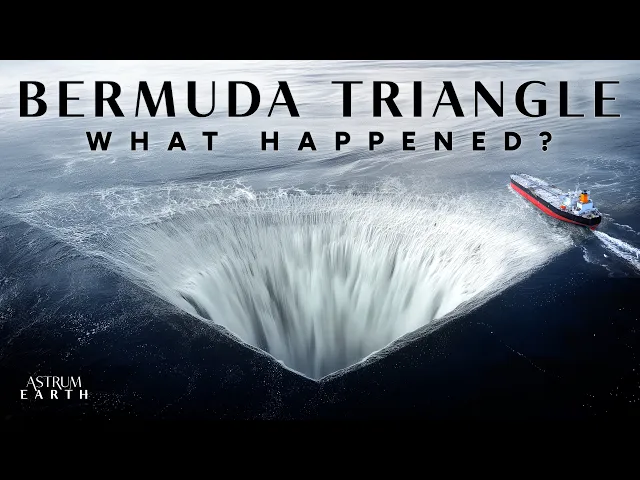
There's a small triangle of water that doesn't exist on any map and whose exact dimensions are not known. And yet, we've all heard the stories that accompany the legendary Bermuda Triangle. Shrouded in mystery and conjuring up some of the wildest conspiracy theories known to man, this geographical anomaly is widely regarded as the most deadly, dangerous, and deceptive place on Earth.
So, how is it that a part of the ocean that isn't even officially recognized as part of the ocean has become so revered? The small body of water that makes up the invisible triangle has slowly filled with wreckage and disappearances over centuries, claiming the lives of those that have not just passed through it, but also over it. Books have been written, documentaries have been produced, and scientists have clamored to try and explain the unexplainable in this perilous patch of ocean.
What's caused this series of unfortunate circumstances to unfold? How can 20 planes, 50 ships, and hundreds of people simply disappear? Is the location merely coincidence?
Or is there something more sinister going on deep below the surface? I'm James Stewart and you're watching Ast from Earth. Join me for this most treacherous of adventures into the notorious Devil's Triangle.
We'll journey back in time to the origins of the mystery to find out where it began and who was responsible for it. We'll visit some of the triangle's most infamous disappearances. Examine each theory surrounding the mystery, all the way from Atlantis to rogue waves to magnetic declination to hidden toxic gases rising from the depths and bring you right to the heart of the matter to uncover the real culprit of the Bermuda Triangle.
Can something inexplicable be explained? After all, whilst that may have sounded like the start of a murder mystery podcast, there is actually a fair amount of science and data to unpack here. But it is generally one of the weirdest and most fascinating videos I've ever made.
As I've mentioned, the Bermuda Triangle doesn't show up on any maps, nor is it officially recognized as a location by the United States, with whom it's closely situated. So then where is it? Unofficially, the Bermuda Triangle is a region of the North Atlantic Ocean roughly bounded by the southeastern coast of the US, Bermuda, and Puerto Rico.
Interestingly, the exact boundaries of the Bermuda Triangle are not universally agreed upon. Approximations of the total area range between 500,000 and 1,500,000 square miles. So there's about well 1 million square miles worth of room for error there.
The region has a vaguely triangular shape, but that triangle could end up being an isosles, a scaline, or could even look more like a rhombus if you move the boundaries. Perhaps Bermuda docahedron wasn't quite as catchy. And so from the outset, you begin to see one glaring hole in much of the discourse that surrounds this subject.
Undoubtedly, there have been incidents in this area and some tragic ones at that. But because the boundaries don't actually exist and they differ from historical account to historical account, it's really difficult to provide actual numbers of fatalities and disappearances for an area whose boundaries are constantly shifting over the course of several hundred years. But it's what's happened inside this triangle throughout history that's most intriguing.
And things begin half a millennium ago with Christopher Columbus. The year is 1492 and Christopher Columbus has set sail with three ships from Spain to find a western route to Asia and the new world. All very exciting.
After sailing across the Atlantic Ocean for 10 weeks, land was cited finally. And he set foot on a small island in the Bahamas, which he named San Salvador. To get there, he would have been the first person to have sailed through the Saraso Sea and therefore the Bermuda Triangle or at least the first person to return and tell everyone back home about it.
Now, you might say this is where the mysteries began because tell everyone about it eventually he did. Extracts from his log which were compiled shortly after his death have since been translated. The first indication that something might be wrong was in September 1492.
Columbus's log reading suggested something was affecting his compass. On this day, at the beginning of night, the compasses northwested, and in the morning, they northeast somewhat. Several days later, he reported the sea rising to great heights, and most curiously described seeing a light on the horizon, which he likened to that of a candle, so small a body that he could not affirm it to be land, a small wax candle that rose and lifted up, which for a few seconds seemed to be an indication of land.
Imagine hearing about those incidents 500 years ago. I mean, America hadn't even been discovered yet. So little about the world was known.
You can see how the stories, fables, mysteries, call them what you will, begin to garner intrigue. Later in the early 1600s, a ship from England named Sea Venture set off to resupply and revive the falling colony at Jamestown. Just off the coast of the uninhabited island chain of Bermuda, the fleet sailed into a hurricane which destroyed the ship and marooned its crew.
Although there wasn't anything particularly mysterious about this occurrence, as those desolate sailors clung to the remains of their once proud ship, it must have felt like a call back to the mysterious events that had already happened in this area. It's believed that this shipwreck actually inspired Shakespeare's play The Tempest, in which he refers to Bermuda or Bamouths as a vexed or cursed place. So Bermuda had found a great place to rise to fame.
One of the spookiest encounters must have been in 1881 when, as legend has it, the Ellen Austin, a cargo ship sailing from Liverpool to New York carrying passengers hoping to immigrate to the United States, cited a ghost ship in the Bermuda Triangle. Their captain took a shortcut through the stormy Saraso Sea, again, where the Bermuda Triangle is located. And it was here that they encountered an eerily silent sailing vessel with no crew on board.
But strangely, plenty of plunder, almost like bait, waiting for someone to find it. And the crew of the Elen Austin took that bait. Wanting to salvage the ship and its goods, they decided to take it to New York with them and sent some of their bravest men over so they could sail both ships back together.
As they carried on their journey across the Saraso Sea, however, they were caught in a huge storm. The howling winds and treacherous waves tore the ships away from one another, and the Ellen Austin lost sight of the now manned ghost ship. When the weather finally cleared, the surviving sailors started searching for their friends and their comrades.
Captain Griffin spotted the vessel and called to his crew, but there was no answer. The eerie silence had returned to the other ship once again. A number of sailors went to investigate, but found no signs of life on board.
Their mates had disappeared without a trace. This didn't stop Captain Griffin from ordering a second team to board the ghostly, unnamed vessel to New York. For several nights, it seemed like they were getting away with it.
The ships were on course for their destination, but their luck ran out when a thick blanket of fog started to settle across the water. The Ellen Austin came to a standstill as everyone waited for the fog to disperse. Once again, they were separated from the unnamed ship, left to wait, practically blind and with no sound but creaking planks and the waves quietly licking at the bow.
After the fog cleared, the ghost ship had disappeared completely, taking with it the entire crew and its treasures, never to be seen again. It makes for a good story, doesn't it? But is there actually something to it?
Well, we know there was a ship called the Ellen Austin that sailed between Liverpool and New York. However, the journey in 1881 was confirmed to have gone without incident in Lloyds of London's Register of Ships. Still, historical accounts keep mentioning mysterious happenings in this region, even up to our modern age, well into the 20th century.
It gained serious attention after an especially infamous tragedy occurred in March 1918. The USS Cyclops, a 542 foot long Navy cargo ship with over 300 men and 10,000 tons of manganese ore which was used in steel making, left Rio de Janeiro bound for Baltimore. After an unplanned stop in Barbados, she headed north and was never seen again.
The ship's disappearance was the largest loss of life in US naval history that wasn't directly related to combat. The Cyclops never sent out an SOS distress call despite being equipped to do so, and an extensive search found no wreckage. US President Woodro Wilson later said, "Only God and the sea know what happened to the great ship.
" In 1941, two of the Cyclops's sister ships similarly vanished without a trace along nearly the same route. One quote from the Santa Fe magazine in 1920 described the incident. She disappeared as though some gigantic monster of the sea had grabbed her, men and all, and sent her into the depths of the ocean.
And the sadness of her destruction is amplified by the absence of any wireless calls for help being picked up by any ship along the route that the Cyclops followed. Sadly, one military tragedy followed another in the same part of the world years later, doing nothing to dispel the growing theories that something strange was a foot, or rather a float. In December 1945, five Navy TBM Avented torpedo bombers carrying 40 men took off from a Fort Lauderdale airfield in order to conduct practice bombing runs over some nearby shores.
But with his compass apparently malfunctioning, the leader of the mission known as Flight 19 got severely lost. Radioing to the control tower, we cannot be sure where we are. 20 minutes later, after turning over command to a new flight leader for reasons unknown, the final words of flight 19 were spoken.
It looks like we are entering white water. We are completely lost. All five planes flew aimlessly until they ran low on fuel and were forced to ditch at sea.
That same day, a rescue plane and its 13-man crew also disappeared. After a massive week-l long search failed to turn up any evidence, the official Navy report declared that it was as if they had flown to Mars. No wreckage or trace of the pilots or their planes has ever been found.
Things were becoming more and more suspicious. No longer was this strange area just claiming ships. It now seemed to extend upwards to include anything that flew over it, too.
In December 1948, just a few years after Flight 19 had gone missing, a British passenger plane carrying around 30 people disappeared on the 30th of January while flying over the Azors to Bermuda. One year later, the BSAA Star Aerial, the same type of plane as the previous one, disappeared while flying from Bermuda to Kingston in Jamaica. Neither plane was ever found.
So many incidents in such a small space that all begin with Columbus noticing something strange about his compass with no real evidence or explanation as to why someone needed to connect the dots and give this space a name. The deadly Bermuda Triangle was the name American author Vincent Gallas went for in the February 1964 edition of Argusy magazine. Drw a line from Florida to Bermuda.
Another one from Bermuda to Puerto Rico and a third line back to Florida through the Bahamas. Within this area known as the Bermuda Triangle, most of the total vanishments have occurred. In the absence of any hard facts, there was frenzy speculation about this idea, and unsurprisingly, it captured the imagination of the world.
Suddenly, like a great detective solving a serial murder, the mysteries had been connected. The article was a masterpiece of conspiratorial fantasy, suggesting that dark forces were at work. For context here, this was the era of the Cold War and the Cuban Missile Crisis, when conspiracy theories and hearsay loomed large.
It was also a time when NASA and science more generally was increasingly filling in the blanks, providing answers to many of life's great unsolved questions. Yet here in the Bermuda Triangle was a phenomenon that tantalizingly defied explanation. Others were quick to cash in on the Bermuda Triangle fever.
Scores of books were published. Many became international bestsellers with the most popular of all being Charles Burlitz's The Bermuda Triangle. Published in 1974, it sold 20 million copies in more than 30 languages.
An extraordinary feat for a work that offered up some mindblowing suggestions as to what was really going on. Nothing was off limits. Burlet's theories were so popular that when Steven Spielberg made close encounters of the third kind, he depicted the Flight 19 air crew as having been abducted by aliens.
Bullets aimed to prove that the Bermuda Triangle was connected to the mythical lost city of Atlantis, pulling ships, planes, and people into its murky depths, explaining why so many vessels and aircraft had disappeared. He also leaned heavily on paranormal or supernatural phenomena to explain what he says cannot be mere coincidences. For example, most interesting to Balitz is that most of the missing aircraft and ships didn't send out distress calls before disappearing.
Something he suggests is evidence of extraterrestrial interference or at least paranormal activity, pricking the ears of Spielberg, evidently. But he doesn't stop there. Oh, no.
He suggests that the triangle may be a portal under the sea transcending time and space to another dimension or some other unearly place. Similarly, he says this might be the spot on earth reserved for aliens to abduct humans. To Bullet, the possibilities were endless.
The wilder the better. Even if critics and us hold serious doubts about his methodology, we know so much these days. Even in the 70s, gaps in knowledge were being filled in.
So to cling on to something that we might not have all the answers to is intoxicating. And it's why the mystery of the Bermuda Triangle has stood the test of time. It's exhilarating to think that despite all these great scientific minds and databased analytics in the world today, something somehow slipped under the net.
It's like a riddle that can't be solved with pretty much the entire rest of the planet mapped out. Bar this small triangle of mystery. Although we haven't heard much about it recently, have we?
But the truth is, we do have the answers. we can finally explain what's going on in the Bermuda Triangle. It's a really strong answer, too.
Not one of those could be this or maybe that. We're an Earth science channel first and foremost. And as much as I'd love to make a video on Atlantis, ghost ships, and alien abductions.
Maybe one day, there are some more plausible science-based theories that exist about the Bermuda Triangle and its disappearances. One of the things that comes up time after time is navigational issues. We touched on a couple with Columbus's compass going arai and flight 19 essentially being unable to identify where they were during their training run.
In almost every account of the mystery surrounding the Bermuda Triangle, you'll see reference to the fact that it's one of only two places on Earth, the other being the Devil Sea just off the coast of Japan, where a compass points to true north rather than magnetic north. Could this cause compasses to malfunction so that ships and planes get terribly offc course? A quick compass refresh.
If like me, you've forgotten how to use one because your phone does it for you. A compass works because its magnetic needle is attracted by the magnetism of Earth, which draws it to point to the constantly shifting magnetic north pole. The geographic north pole, on the other hand, is static and is located 1,200 m north of the magnetic pole.
The variation between these two readings is known as magnetic declination or compass variation which can change as you move across the globe. There's another piece of terminology that's relevant here as well. The agonic line.
It's an imaginary line where true north and magnetic north are in perfect alignment. There is no magnetic declination. In the early 18th century, Edmund Halley noticed that the Aegonic line was slowly moving westwards.
He came up with the idea of showing declination as contour lines on a map. At points west of the Aegonic line, a magnetic needle will point east of true north, positive declination. At points east of the Aegonic line, a magnetic needle will point west of true north, negative declination.
Since then, scientists have noted a westward drift of the Agonic line with an average velocity of about 0. 2° per year. This drift is not equal in all places, however.
It's much stronger in the Atlantic hemisphere than in the Pacific Hemisphere. Navigators must always compensate for magnetic declination when they chart their courses. While the Agonic line once did pass through the Bermuda Triangle, it now falls within the Gulf of Mexico, rendering claims that it contributes to disappearances in the triangle largely inaccurate.
The issue with the compass malfunction theory is that calculation errors anywhere could cause a plane or ship to go off course. It also assumes that experienced pilots and captains passing through the area were unaware of magnetic declination, which is unlikely. Not to mention that the vast majority of Boers and flyers pass through this area without incident.
Another thing you'll have noticed about these instances, particularly at sea, is an absence of wreckage on almost every occasion. One plausible theory of this is quite simply good old-fashioned bad weather. Hurricane season, as we know, passes right through the middle of this exact location.
Just look at 2024's devastation in this area. Some theorists site rogue waves as being a reason so many ships haven't reached their destinations. Huge, abnormally large waves that can reach up to 100 ft in height.
Rogue waves are certainly real and account for roughly one in every 10,000 waves. The first recorded by an instrument was on the 1st of January in 1995 in the North Sea. This particular wave known as the Drpna wave was 84 ft tall.
Let's not forget about the role of the Gulf Stream here too. A theory supported by NOAA, the National Oceanic and Atmospheric Administration, which says environmental considerations can explain away some of the Bermuda Triangle disappearances. The Gulf Stream travels along the western edge of the triangle and is extremely swift and very turbulent.
It can pose extreme navigational challenges, especially for inexperienced sailors. The Gulf Stream has been reported to move faster than four or five knots per hour in some areas. That's 300 times faster than the Amazon River.
This is more than enough to throw sailors hundreds of miles off course if they don't compensate correctly for the current. It can also quickly erase any evidence of disaster. An increasingly popular and in fact the newest scientific theory to come to light is based around methane.
We know it mostly as a particularly potent greenhouse gas that comes from cows, but large amounts of methane are trapped in sediments beneath the ocean. In 2016, researchers at the Arctic University of Norway discovered craters off the coast of the country that were up to half a mile wide and 150 m deep. They suggest the craters appear to have been caused by the explosive release of methane that was trapped in the sediment below, exploding upwards as giant burps of death.
Despite their research making it very clear that they were not claiming any links to the triangle, other academics, including Russian scientist Igor Yeltzoff, took it upon themselves to make the connection anyway. And of course, many media outlets in particular have lapped up the theory. The astrome view, it's certainly possible, but highly, highly unlikely to be the culprit.
With methane gas, geomagnetism, and the Caribbean's stormy weather systems, it becomes apparent that this region can be treacherous for both planes and boats. These are plausible scientific explanations that demystify the Bermuda Triangle. The truth is though, putting said obvious environmental conditions aside, simply mentioning scientific terms like geomagnetism or methane blowouts doesn't equate to presenting irrefutable evidence.
These are hypotheses or speculations. They're not definitive conclusions. So, where's the real evidence?
At the end of it all, a diary that was translated from 1492, a magazine article from the 1940s, and even a best-selling book from the 70s, well, they all tell one story. But when you examine the actual available aviation and marine casualty data over the last few decades, and you compare this to other regions across the globe, the data reveals a very different story. In fact, it's precisely the lack of a story that points us to the truth.
There is nothing out of the ordinary going on in the Bermuda Triangle. It doesn't even make the top 10 most dangerous ocean regions in the world. Utilizing the marine casualty and pollution data for researchers data set, which covers 150,000 plus records from 1982 to 2015, you're left with around 9,000 incidents for analysis.
Of these, 361 were located within the Bermuda Triangle, just 4%. This reveals that the causes of casualties in the Bermuda Triangle closely mirrored the worldwide pattern with a somewhat lower occurrence of capsizing events, likely due to the proximity to major trading ports where conditions are generally calmer. Interestingly, no incidents classified as disappearance were reported within the Bermuda Triangle between 1982 and 2015.
YouTuber Johnny Harris obtained shipping data from 2021 via Lloyd's List, a global shipping publication, which took this a step further. Their data showed that in that entire year, 1. 8% 8% of all vessels everywhere in the world have some sort of casualty during their voyage, which included mysterious disappearances.
Of the 8,634 boats that passed through the Bermuda Triangle, there were only two such casualties, 0. 02%. According to the Lys list data set, the danger of disappearing in the Bermuda Triangle is actually 90 times lower than the global average.
Whilst not committing to quite as low a number as Johnny's video does, Lloyds of London and the US Coast Guard back this up, stating the number of ships that go missing in the Bermuda Triangle to be the same as anywhere else in the world on a percentage basis. Over the past decade, annual shipping losses have actually decreased by 70%. And regions around the Bermuda Triangle don't get a look in when there are incidents.
For the past decade, the South China, Indo-China, Indonesia, and Philippines regions have been by far the worst affected, and the East Mediterranean and Black Sea regions were the second top loss locations. But what about the planes flying over it? Turning our attention to aviation incidents, we can explore the aviation accident database provided by the National Transportation Safety Board.
This covers all investigated accidents from 1962 to the present, including both commercial and military flights. Here we find a very similar story, or lack thereof. While notorious incidents like the Flight 19 bombers disappearance and various passenger aircraft mysteries have fueled Bermuda Triangle legends, a closer examination of the data revealed that most incidents occurred during landing and takeoff, primarily in the Bahamas.
Only a few incidents during flights resulted in fatalities, and the only documented commercial flight accident was attributed to poor weather related decisions by the pilot. Since 1965, there's only been one aviation incident over Bermuda. JetBlue flight number N913 JB experienced severe turbulence resulting in one injury.
In the case of the infamous Flight 19, the transcripts show Lieutenant Taylor, the lead pilot, thought his compass had malfunctioned and that he was above the Florida Keys, a string of islands stretching to the southwest of the US mainland, when in fact, later analysis by ground staff would show he was to the southeast near an island in the Bahamas. Instead of turning back west toward Florida, he kept flying east deeper into the Atlantic Ocean. In other words, he'd gotten lost.
This is something that according to Australian scientist Carl Krishnetski has happened on previous occasions with the same pilot. In all likelihood, this tragedy was sadly as a result of human error. In the triangle, the islands of Bermuda experience on average one damaging tropical cyclone once every six or seven years with smaller, lesser systems affecting the island more frequently.
Approximately 500 tropical and subtropical cyclones have affected the state of Florida. More storms hit Florida than any other US state. And since 1851, only 18 hurricane seasons have passed without a known storm impacting the state.
Puerto Rico is hit by hurricanes on average about four or five times a year. Even in 2025, where we can track, predict, model, observe, and plan against coming storms, they still cause tremendous devastation. So, imagine what it would have been like when we couldn't.
So, there you have it. Maybe slightly underwhelmingly, but if your friends ever bring this up, you can confidently reassure them that there really isn't anything special about the Bermuda Triangle. It's undeniably one of the worst weather affected regions on the planet.
So it tracks that unfortunately and over the course of several centuries there would be incidents along the way. But the truth is statistically speaking you're at no more risk of traveling through the Bermuda Triangle than you are anywhere else in the world. In fact, it's significantly safer than me traveling from Dova to Calala for my boring summer holiday.
Sadly, it seems that some of these tragic events come down to simple human error and one of the worst weather effective regions in the world. No more, no less. Sorry, aliens.
But the good news is the curse has been lifted. The Bermuda Triangle is, well, relatively boring, or as I like to put it, fabulously unremarkable. And let's be honest, we could actually do with things being a little more unremarkable in our lives right now.