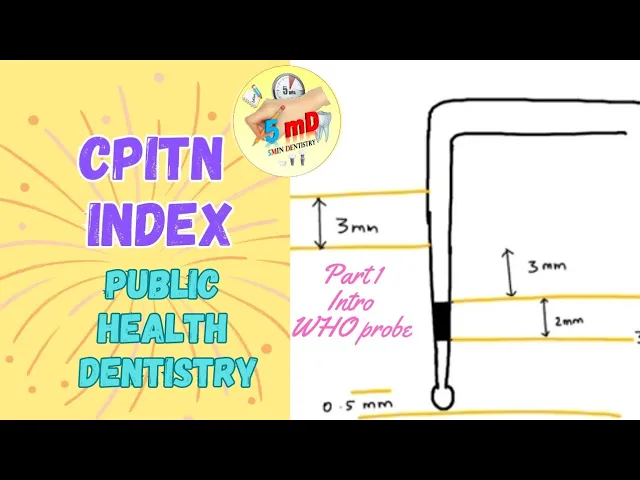
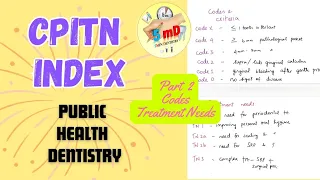
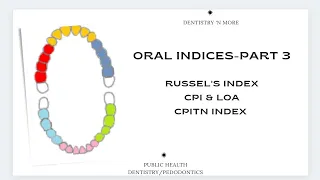
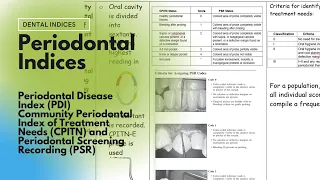
hello all in this video we will see about cpitn index that is community perodontal index of treatment needs this question can be asked as a short note for you and it is good to know this for your practical examination also in public health Dentistry this is an important topic which you need to know about so moving on into the topic cpitn was developed by joint working Committee of World Health Organization and Federation DTI internationally shortly known as who and FDI in the year 1982 The Joint working committee included the following people so the purpose of cpitn is to identify the actual and potential problems that is in perodontal diseases and it is a screening procedure basically it is done at Community level and individual level the advantages of cpitn is that it is simple it is usually quick to calculate and it has an international National uniformity because of the instrument used here we will see about the instrument later the limitation is that it does not regard the position of the ging margin they are concerned about pocket depth and calculus alone but not the position of ging margin that is recession is not calculated here and does not provide assessment of past periodontal breakdown whether they had any surgery or those kind of things are details are not recorded here and it is not a diagnostic tool therefore treatment plan is not accurate and appropriate here it is only to assess the treatment needs and not for specific treatment planning so you have to remember that it is a screening tool and it is for treatment needs alone and it is not a diagnostic tool and it is not for treatment planning accurately the dentition is divided into six seens that is into six teeth the from canine to Canine upper canine to Upper canine lower canine to lower um canine of right and left prolar 2 7 on each side which will divide your dation into six parts six seens each seent is given a score clinically the highest score in each seent that is each individual tooth is examined and the tooth with the high highest score is calculated for this extent but in epidemological survey it is difficult to calculate for each tooth therefore the index teeth are calibrated so what are the index teeth the upper uh right upper Central incer and left lower Central incer along with either six or seven in adults uh that is greater than 20 years of age uh candidates 10 teeth are examined that is six and seven both are examined and the highest score is noted in less than 19 years candidate seven is not examined that is the second molar is not examined in children less than 15 years of age pockets are not recorded and the pro probing is only for bleeding and calculus checking the instruments used here are mouth mirror and cpitn probe also known as who periodontal examination probe this probe was specifically designed for this index so what is this probe cpitn probe or the who perodontal examination probe was designed in 1978 it was designed for two purpose measurement of pocket depth and detection of subj calculus the calibration of these two is important for cpitn index so how does this probe work this probe is has a thin handle first of all the it is of very light weight 5 G which makes it easier to handle the color coding is that there is a black mark from 3. 5 to 5. 5 mm so this marking will help you with the measurement of pocket depth quickly so if the pocket depth is more than 5.
5 mm this black mark will not be visible so the dentist can easily record the probing depth the ball tip has a diameter of5 mm the purpose of the ball tip is that it facilitates the identification of base of the pocket that is it decreases false recording and easy detection of subal calculus is also possible because of this ball tip the light weight along with the ball tip helps in the identification of the base of the pocket as I said already the variation of the basic probe is that there are two additional lines included in certain probes there are lines included here which is used in clinical purposes uh at 8. 5 and uh 11.